Elderberry for Cold and Flu
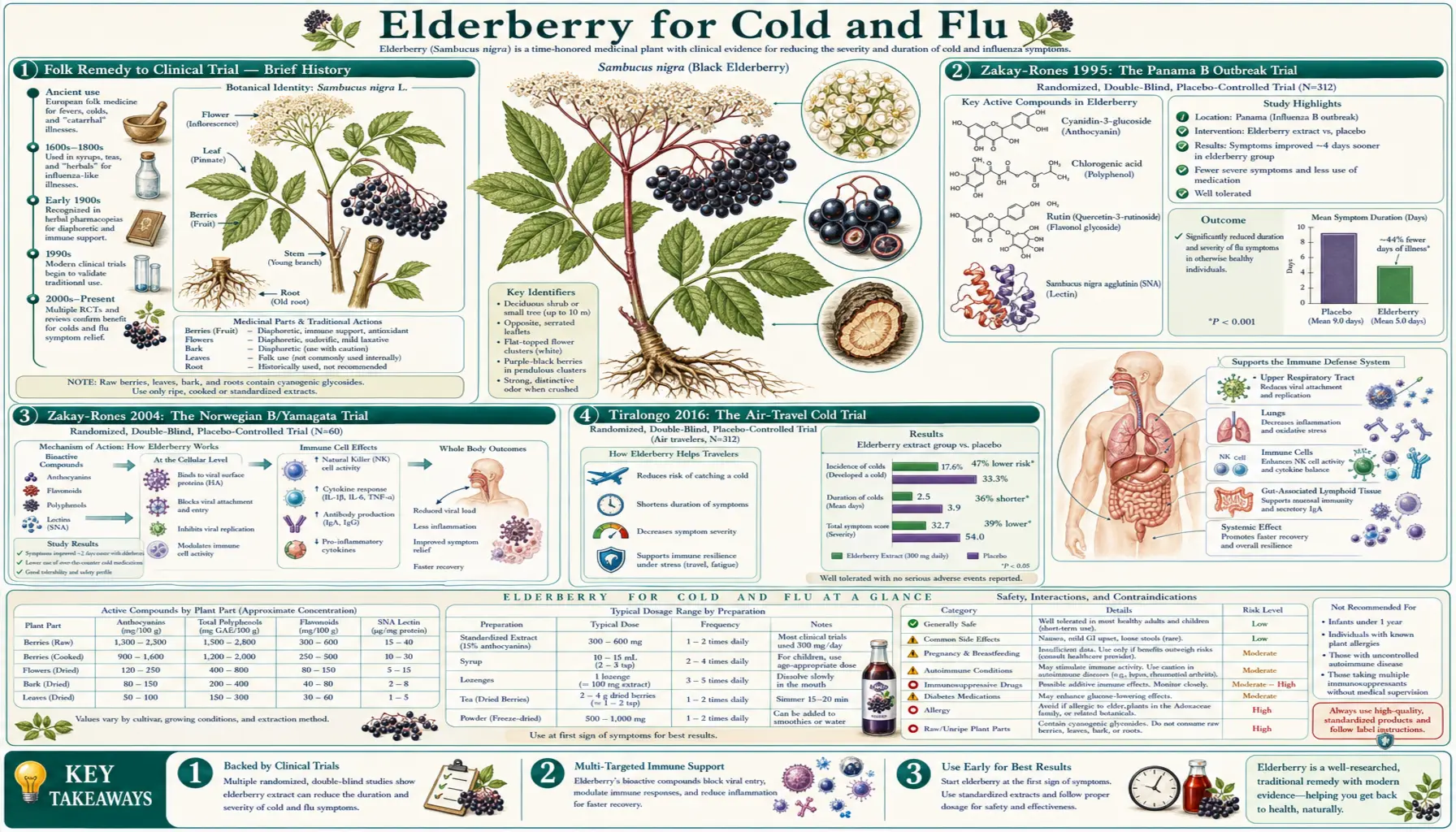
Elderberry has been tested for colds and influenza in a small number of randomized trials, and their results conflict. Two Zakay-Rones influenza trials (an influenza B outbreak on an Israeli kibbutz in 1993, published 1995; Norway, 1999–2000 season, published 2004) reported faster symptom relief with a standardized elderberry syrup than with placebo — on average 4 days earlier in the 2004 trial. The Tiralongo 2016 air-traveller trial found fewer cold-episode days and lower symptom scores, but no significant difference in the number of colds. The Hawkins 2019 meta-analysis of 180 participants reported a large effect. The largest influenza treatment trial, Macknin 2020 in US emergency departments, found no benefit for duration or severity, and a 2021 systematic review rated the evidence as uncertain. Each trial tested one proprietary product, and two of them were funded or sponsored by the product's manufacturer. This page sets out each trial, the laboratory findings, the doses the trials used, and the limits of the evidence.
Table of Contents
- Folk Remedy to Clinical Trial — Brief History
- Zakay-Rones 1995: The Panama B Outbreak Trial
- Zakay-Rones 2004: The Norwegian Influenza Trial
- Tiralongo 2016: The Air-Travel Cold Trial
- Hawkins 2019: The Meta-Analysis
- Macknin 2020: The Emergency-Room Influenza Trial
- Mechanism — What Laboratory Studies Show
- Doses Used in the Trials
- Timing — When Trial Participants Started
- Elderberry vs Oseltamivir (Tamiflu)
- Limitations of the Evidence Base
- Key Research Papers
- Connections
- Featured Videos
Folk Remedy to Clinical Trial — Brief History
Elder preparations have a long history in European folk medicine for colds, influenza and sinus complaints; the 2004 trial report opens by noting that elderberry “has been used in folk medicine for centuries to treat influenza, colds and sinusitis” (Zakay-Rones 2004). Folk practice used the ripe black fruit, cooked into syrups or wines. The fuller history is in the History article.
The modern research began with the 1995 report by Zichria Zakay-Rones and colleagues at the Hebrew University-Hadassah Medical School in Jerusalem, whose co-authors included the virologist Madeleine Mumcuoglu. It described a standardized elderberry extract that inhibited several influenza A and B strains in cell culture, and a placebo-controlled, double-blind study carried out during a 1993 outbreak of influenza B/Panama on a kibbutz (Zakay-Rones 1995).
Since then the trials have not all agreed. The two Zakay-Rones trials and the Tiralongo trial reported benefits on symptoms or duration; the Macknin 2020 emergency-room trial found none. A 2021 systematic review of five randomized trials concluded that elderberry may reduce the duration and severity of colds and the duration of influenza, but that the evidence is uncertain, and that it may not reduce the risk of developing a cold (Wieland 2021).
Zakay-Rones 1995: The Panama B Outbreak Trial
The 1995 trial was a placebo-controlled, double-blind study among people living in an agricultural community (a kibbutz) in Israel during an outbreak of influenza B/Panama in 1993 (Zakay-Rones 1995). It had 27 participants aged 5 to 56, who took 1 tablespoon of syrup twice daily (children) or four times daily (adults) (Wieland 2021).
- Outcomes: fever, feeling of improvement and complete cure, recorded over 6 days
- Result: a significant improvement of symptoms, including fever, was seen in 93.3% of the elderberry group within 2 days, whereas 91.7% of the placebo group improved within 6 days (p < 0.001); a complete cure came within 2 to 3 days in nearly 90% of the elderberry group and within at least 6 days on placebo (p < 0.001)
- Antibodies: convalescent sera showed higher hemagglutination-inhibition titres to influenza B in the elderberry group than in the control group
- Safety: the authors cite the “absence of side-effects”
The trial was small. The sponsor was not reported (Wieland 2021).
Zakay-Rones 2004: The Norwegian Influenza Trial
The 2004 trial, published in the Journal of International Medical Research, was randomized, double-blind and placebo-controlled. It enrolled 60 patients aged 18–54 who had had influenza-like symptoms for 48 hours or less, during the 1999–2000 influenza season in Norway. Patients took 15 ml of elderberry or placebo syrup four times a day for 5 days and recorded their symptoms on a visual analogue scale (Zakay-Rones 2004).
- Result: symptoms were relieved on average 4 days earlier in the elderberry group than on placebo. The abstract gives no day-by-day resolution figures for either group.
- Rescue medication: use was significantly lower in the elderberry group
- Authors' conclusion: the extract “seems to offer an efficient, safe and cost-effective treatment for influenza,” and the findings “need to be confirmed in a larger study”
The trial was sponsored by the manufacturer of the tested syrup (Wieland 2021).
Tiralongo 2016: The Air-Travel Cold Trial
The Tiralongo 2016 trial, published in Nutrients, tested elderberry for colds rather than influenza. It was a randomized, double-blind, placebo-controlled trial of 312 economy-class passengers travelling from Australia to an overseas destination, using a standardized membrane-filtered elderberry extract (Tiralongo 2016). Participants took 300 mg capsules: 600 mg a day from 10 days before travel, then 900 mg a day while travelling and for 4–5 days after arrival.
- Measures: cold episodes, duration and symptoms in a daily diary, scored with the Jackson score; surveys of upper respiratory symptoms (WURSS-21) and quality of life (SF-12) at baseline, just before travel and 4 days after travel
- Cold episodes: 12 on elderberry vs 17 on placebo — not a significant difference (p = 0.4)
- Cold-episode days: 57 on elderberry vs 117 on placebo (p = 0.02)
- Average symptom score over those days: 247 on elderberry vs 583 on placebo (p = 0.05)
- Adverse events: five participants reported adverse events, and a causal relationship with elderberry could not be established; the two with itchy throat were later found to be taking placebo
The authors concluded that more research is warranted to confirm the effect. The trial was funded by the extract's manufacturer, which supplied the elderberry and placebo capsules and was partly involved in the study design. Other approaches to colds are covered in Cold & Flu Treatments.
Hawkins 2019: The Meta-Analysis
The Hawkins meta-analysis was published online in December 2018 and in print in 2019, in Complementary Therapies in Medicine (Hawkins 2019).
- Size: a total of 180 participants from randomized, controlled trials
- Moderators examined: vaccination status and the cause of the upper respiratory symptoms
- Result: elderberry supplementation “was found to substantially reduce upper respiratory symptoms,” and the pooled analysis “yielded a large mean effect size”
- Timing: it was published before the Macknin 2020 trial and so does not include it
The abstract states that there were no large-scale studies of elderberry. The work was funded by the research department of the authors' own wellness institute. The later 2021 systematic review, which did include the Macknin trial, rated the evidence as uncertain (Wieland 2021).
Macknin 2020: The Emergency-Room Influenza Trial
The Macknin trial, run from January 2018 to April 2019 in three US emergency departments, was randomized, double-blind and placebo-controlled. It enrolled 87 patients aged 5 and above with PCR-confirmed influenza, who took 15 ml of elderberry extract twice a day (ages 5–12) or four times a day (over 12) for 5 days (Macknin 2020).
- Days until all symptoms were none or mild: 5.3 on elderberry vs 4.9 on placebo (p = 0.57)
- Days to complete resolution: 8.6 vs 8.7 (p = 0.87)
- Adverse events: no significant difference between the elderberry and placebo groups
- Conclusion: the authors found “no evidence that elderberry benefits the duration or severity of influenza”
Funding came from a family foundation and the hospital system's own research funds; a manufacturer supplied the study product and placebo without financial support and could review the manuscript before publication.
Mechanism — What Laboratory Studies Show
Influenza enters a cell when its surface protein hemagglutinin binds sialic acid on the cell; its neuraminidase then frees new virus particles. Oseltamivir (Tamiflu) and zanamivir (Relenza) inhibit neuraminidase. The elderberry findings below are all from cell culture, which does not show that an oral dose reaches the airway at an active concentration.
- Several influenza strains: the standardized extract tested in the 1995 trial reduced hemagglutination and inhibited replication of influenza A (H3N2 and H1N1) and influenza B strains in cell culture (Zakay-Rones 1995)
- H5N1 and influenza B: a standardized elderberry liquid extract inhibited the propagation of an H5N1-type influenza A virus isolated from a patient and of an influenza B strain, and was also active against several respiratory bacteria (Krawitz 2011)
- Binding to H1N1: flavonoids from an elderberry extract bound to H1N1 virus particles and blocked them from infecting cells (extract IC50 252 µg/mL). The bound compounds were identified as a methylated quercetin and a dihydromyricetin-related flavonoid — not the anthocyanins cyanidin-3-glucoside or cyanidin-3-sambubioside. In the same assay the isolated compounds compared favourably with oseltamivir and amantadine (Roschek 2009). The research was carried out by a company that develops botanical extracts.
- Other cell studies: a 2019 study reported anti-influenza activity of elderberry in cell culture (Torabian 2019)
- Neuraminidase: the sources reviewed for this page do not establish that elderberry inhibits influenza neuraminidase
- Coronaviruses: a stem extract of a different species, Sambucus formosana, inhibited human coronavirus NL63 in cell culture, with caffeic acid its most active constituent (Weng 2019). No study of S. nigra berry against the common-cold coronaviruses 229E or OC43 was found.
How these laboratory findings relate to the mixed trial results is not known.
Doses Used in the Trials
The doses below are what the trials used, reported as findings, not as instructions. Each trial tested one proprietary product, so results may not transfer to other products.
- Zakay-Rones 1995 (syrup): 1 tablespoon twice daily for children and four times daily for adults (Wieland 2021).
- Zakay-Rones 2004 (syrup): 15 ml four times a day for 5 days, in adults with symptoms for 48 hours or less (Zakay-Rones 2004).
- Tiralongo 2016 (capsules): 300 mg capsules; 600 mg a day from 10 days before travel, then 900 mg a day while travelling and for 4–5 days after arrival (Tiralongo 2016).
- Macknin 2020 (extract): 15 ml twice a day (ages 5–12) or four times a day (over 12) for 5 days — the trial that found no benefit (Macknin 2020).
Elderberry syrups are sweetened with sugar or honey; the amount varies by product and is listed on the label. Dietary supplements in the US do not need pre-market approval, and differences are often found between labelled and actual ingredients (LactMed 2025).
Timing — When Trial Participants Started
The 2004 trial enrolled only patients who had had influenza-like symptoms for 48 hours or less (Zakay-Rones 2004). The 1995 trial was run during an outbreak, and the air-traveller trial started elderberry 10 days before travel, before any cold (Zakay-Rones 1995; Tiralongo 2016). The Macknin trial enrolled emergency-room patients with confirmed influenza and found no benefit (Macknin 2020).
No trial reviewed for this page compared early with late starting, so whether timing changes the effect has not been tested.
Elderberry vs Oseltamivir (Tamiflu)
No head-to-head trial of elderberry against oseltamivir was found. What the sources report:
- In the laboratory: isolated elderberry flavonoids compared favourably with oseltamivir and amantadine in a cell-culture assay of H1N1 infection (Roschek 2009). A laboratory comparison does not show clinical equivalence.
- Mechanism: oseltamivir inhibits viral neuraminidase. The elderberry flavonoids in the cell study bound virus particles and blocked infection (Roschek 2009); neuraminidase inhibition by elderberry is not established in the sources reviewed.
- Used together: in the Macknin trial, patients could also take oseltamivir; a post hoc analysis suggested outcomes with elderberry alone were 2 days worse than with placebo alone (Macknin 2020). Post hoc analyses are exploratory. No clinical interaction studies were found.
Influenza treatment, including antiviral drugs, is covered on the Influenza page and in Cold and Flu Treatments.
Limitations of the Evidence Base
The gaps in the elderberry evidence:
- Small numbers. The Hawkins meta-analysis covered 180 participants in total (Hawkins 2019), and the 2004 trial authors wrote that their findings needed to be confirmed in a larger study (Zakay-Rones 2004).
- Conflicting results. The 2020 emergency-room trial found no benefit for the duration or severity of influenza (Macknin 2020), and the 2021 systematic review rated the evidence on both benefits and harms as uncertain (Wieland 2021).
- One product per trial. Each trial tested a single proprietary product. Homemade syrups, tinctures and teas have not been tested in trials, and heating lowers the phenolics as well as the cyanogenic glycosides (Senica 2016), so the trial results may not transfer.
- Funding. The 2004 trial was sponsored by the manufacturer of the tested syrup, the air-traveller trial was funded by the extract's manufacturer, and the meta-analysis was funded by the authors' own institute; the sponsor of the 1995 trial was not reported.
- No complication endpoints. The trials measured symptoms and their duration. None measured pneumonia, hospitalization or death.
- Children. The youngest participants were 5 years old (1995 trial, ages 5–56; Macknin trial, ages 5 and above). No trial studied children younger than 5.
- The cytokine question. In cell culture, elderberry preparations raised inflammatory cytokine production (Barak 2001). The resulting concerns about autoimmune disease and cytokine storm are theoretical: the 2021 review found no evidence that elderberry overstimulates the immune system (Wieland 2021). The Preparation and Safety page covers this in full.
Key Research Papers
- Zakay-Rones Z, Varsano N, Zlotnik M, Manor O, Regev L, Schlesinger M, Mumcuoglu M (1995). Inhibition of several strains of influenza virus in vitro and reduction of symptoms by an elderberry extract (Sambucus nigra L.) during an outbreak of influenza B Panama. Journal of Alternative and Complementary Medicine 1(4):361-9. — PubMed PMID: 9395631
- Zakay-Rones Z, Thom E, Wollan T, Wadstein J (2004). Randomized study of the efficacy and safety of oral elderberry extract in the treatment of influenza A and B virus infections. Journal of International Medical Research 32(2):132-40. — PubMed PMID: 15080016
- Tiralongo E, Wee SS, Lea RA (2016). Elderberry supplementation reduces cold duration and symptoms in air-travellers: a randomized, double-blind placebo-controlled clinical trial. Nutrients 8(4):182. — PubMed PMID: 27023596
- Hawkins J, Baker C, Cherry L, Dunne E (2019). Black elderberry (Sambucus nigra) supplementation effectively treats upper respiratory symptoms: A meta-analysis of randomized, controlled clinical trials. Complementary Therapies in Medicine 42:361-365. — PubMed PMID: 30670267
- Krawitz C, Mraheil MA, Stein M, Imirzalioglu C, Domann E, Pleschka S, Hain T (2011). Inhibitory activity of a standardized elderberry liquid extract against clinically-relevant human respiratory bacterial pathogens and influenza A and B viruses. BMC Complementary and Alternative Medicine 11:16. — PubMed PMID: 21352539
- Roschek B Jr, Fink RC, McMichael MD, Li D, Alberte RS (2009). Elderberry flavonoids bind to and prevent H1N1 infection in vitro. Phytochemistry 70(10):1255-61. — PubMed PMID: 19682714
- Torabian G, Valtchev P, Adil Q, Dehghani F (2019). Anti-influenza activity of elderberry (Sambucus nigra). Journal of Functional Foods 54:353-360. — doi:10.1016/j.jff.2019.01.031
- Kong F (2009). Pilot clinical study on a proprietary elderberry extract: efficacy in addressing influenza symptoms. Online Journal of Pharmacology and Pharmacokinetics 5:32-43. PubMed: Kong elderberry pilot
- Vlachojannis JE, Cameron M, Chrubasik S (2010). A systematic review on the sambuci fructus effect and efficacy profiles. Phytotherapy Research 24(1):1-8. — PubMed PMID: 19548290
- Mumcuoglu M, Safirman D, Ferne M (1995). Antiviral activities of elderberry extract. Acta Horticulturae. PubMed: Mumcuoglu antiviral activity
- Macknin M, Wolski K, Negrey J, Mace S (2020). Elderberry extract outpatient influenza treatment for emergency room patients ages 5 and above: a randomized, double-blind, placebo-controlled trial. Journal of General Internal Medicine 35(11):3271-3277. — PubMed PMID: 32929634
- Tiralongo E, Lea RA, Wee SS, Hanna MM, Griffiths LR (2012). Randomised, double blind, placebo-controlled trial of echinacea supplementation in air travellers. Evidence-Based Complementary and Alternative Medicine 2012:417267. — PubMed PMID: 22229040
- Frank T, Janssen M, Netzel M, Strass G, Kler A, Kriesl E, Bitsch I (2005). Pharmacokinetics of anthocyanidin-3-glycosides following consumption of Hibiscus sabdariffa L. extract. Journal of Clinical Pharmacology 45(2):203-10. — PubMed PMID: 15647413
- Wieland LS, Piechotta V, Feinberg T, Ludeman E, Hutton B, Kanji S, Seely D, Garritty C (2021). Elderberry for prevention and treatment of viral respiratory illnesses: a systematic review. BMC Complementary Medicine and Therapies 21(1):112. — PubMed PMID: 33827515
- Barak V, Halperin T, Kalickman I (2001). The effect of Sambucol, a black elderberry-based, natural product, on the production of human cytokines: I. Inflammatory cytokines. European Cytokine Network 12(2):290-296. — PubMed PMID: 11399518
- Senica M, Stampar F, Veberic R, Mikulic-Petkovsek M (2016). Processed elderberry (Sambucus nigra L.) products: A beneficial or harmful food alternative? LWT — Food Science and Technology 72:182-188. — doi:10.1016/j.lwt.2016.04.056
- Drugs and Lactation Database (LactMed) (2006–). Elderberry. Bethesda (MD): National Institute of Child Health and Human Development; entry revised April 15, 2025. — PubMed PMID: 30000895
- Weng JR, Lin CS, Lai HC, Lin YP, Wang CY, Tsai YC, Wu KC, Huang SH, Lin CW (2019). Antiviral activity of Sambucus FormosanaNakai ethanol extract and related phenolic acid constituents against human coronavirus NL63. Virus Research 273:197767. — PubMed PMID: 31560964