Multiple Sclerosis (MS)
Interactive Visualization Nerve Impulse — fire an action potential Watch it race down the axon: sodium rushing in, potassium out, a live voltage trace spiking, and neurotransmitter crossing the synapse. Launch → Interactive Visualization The Blood-Brain Barrier — get a drug past the bouncer Send molecules at the tightest wall in the body — fat-soluble ones slip through, big ones bounce, a pump ejects the rest — then see why L-DOPA gets in when dopamine can't. Launch → Interactive Visualization Cerebrospinal Fluid — follow the brain's plumbing Make CSF at the choroid plexus and follow it around the brain and spine and back to the blood — block the aqueduct to flood the ventricles, or fall asleep and watch the glymphatic flush. Launch →
Table of Contents
- What is Multiple Sclerosis?
- What Actually Happens to the Nerve
- Types of Multiple Sclerosis
- Common Symptoms of Multiple Sclerosis
- How It Varies Between People
- Causes and Risk Factors
- The Epstein–Barr Virus Finding
- Diagnosis: The Tests and the Criteria
- Treatment Options
- Choosing a Disease-Modifying Therapy
- Managing the Symptoms That Actually Bother People
- What the Evidence Does Not Support
- Prevention and Management Strategies
- Red Flags: When It Is Urgent
- Complications of Multiple Sclerosis
- Key Research Papers
- Connections
- Featured Videos
What is Multiple Sclerosis?
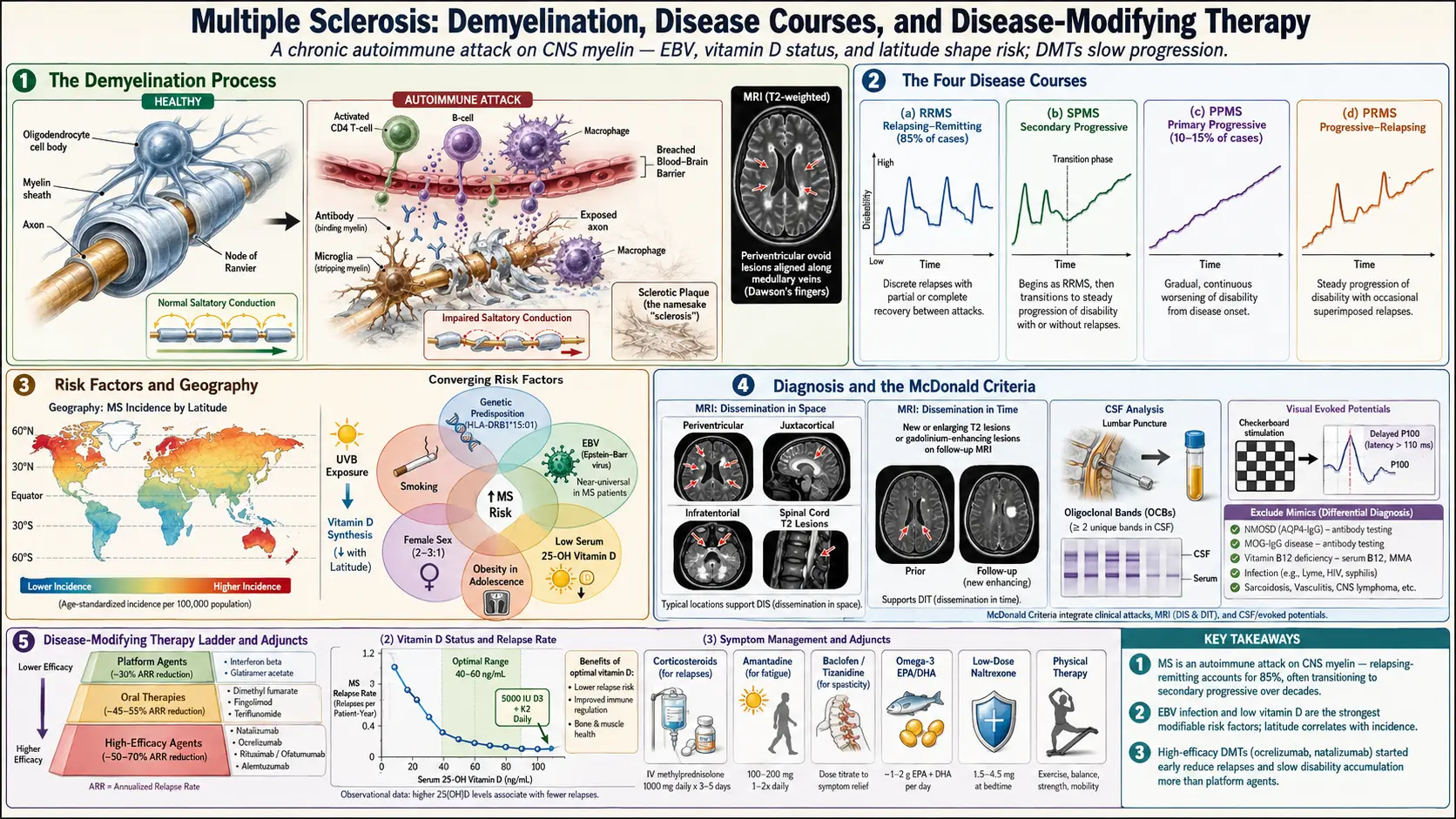
Multiple sclerosis (MS) is a chronic immune-mediated disease of the brain, spinal cord and optic nerves, in which the immune system attacks the insulating sheath around nerve fibres and, over time, the fibres themselves. It is the commonest non-traumatic cause of neurological disability in young adults, usually beginning between the ages of 20 and 40, and it affects women roughly two to three times as often as men.
The name describes what a pathologist sees: multiple areas of sclerosis — scarring — scattered through the central nervous system. The disease is defined by that scattering in two dimensions at once, space (lesions in different parts of the nervous system) and time (lesions arising on different occasions). Those two words are not jargon; they are literally the diagnostic criteria.
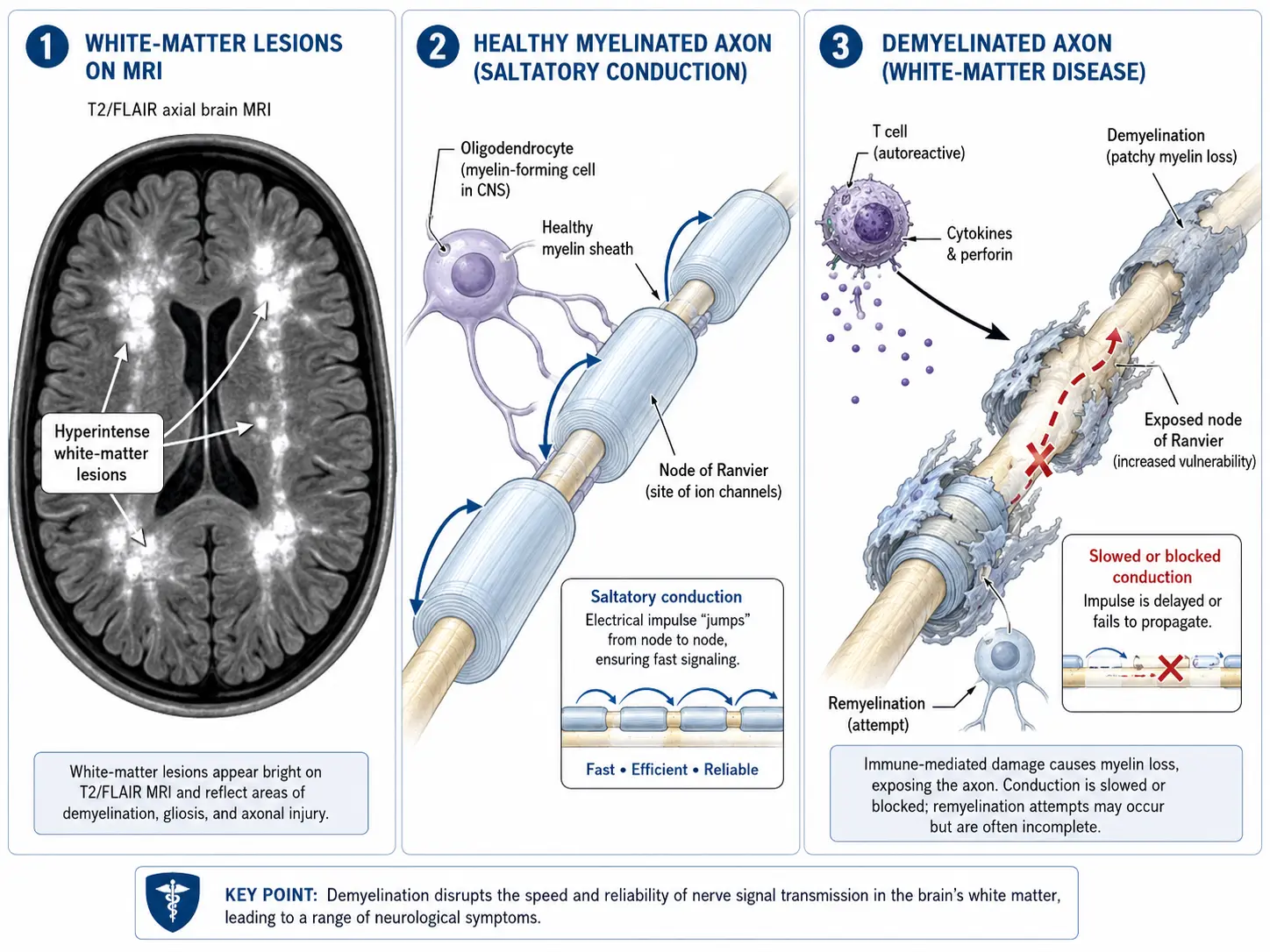
A useful analogy: nerve fibres are electrical cables, and myelin is the plastic insulation around them. Insulation does not merely prevent short circuits — in nerves it lets the signal jump from gap to gap along the fibre, which is why a myelinated nerve conducts up to a hundred times faster than a bare one. Strip the insulation from a patch of cable and the signal slows, distorts, or fails altogether. Which symptom appears depends entirely on which cable is affected: a patch on the optic nerve causes blurred vision, one in the spinal cord causes numb legs, one in the cerebellum causes clumsiness. This is why MS produces such an apparently unrelated collection of symptoms in different people.
What Actually Happens to the Nerve
Three processes run in parallel, and separating them explains a great deal about treatment.
- Inflammatory demyelination. Autoreactive T and B cells cross the blood–brain barrier and attack myelin and the oligodendrocytes that make it. This produces the acute relapse: a new symptom developing over days, plateauing, then partially or fully recovering as inflammation settles and some remyelination occurs. This is the part that current drugs treat well.
- Axonal loss. Once stripped of myelin, the axon is metabolically exposed and vulnerable, and a proportion die. Axons do not regrow in the central nervous system. This is the substrate of permanent disability, and it begins early — brain volume loss is measurable from the first years, long before disability is obvious.
- Compartmentalised chronic inflammation. In progressive disease, inflammation becomes trapped behind a repaired blood–brain barrier, sustained by meningeal immune-cell aggregates and activated microglia, with slowly expanding lesions at their rims. Drugs that act on circulating immune cells reach this poorly, which is precisely why treating progressive MS is so much harder than treating relapses.
Two consequences follow directly. First, relapses and progression are different processes: a drug can abolish relapses and MRI activity while disability creeps on. Second, reserve matters — the brain can compensate for a great deal of damage until compensation runs out, which is why disability can appear to accelerate suddenly after years of apparent stability. Reich, Lucchinetti and Calabresi’s 2018 NEJM review is the standard modern account.
One clinically useful phenomenon: Uhthoff’s phenomenon, in which symptoms worsen temporarily with a rise in body temperature — a hot bath, exercise, fever. Demyelinated fibres conduct marginally, and heat pushes them below the threshold. It is not a relapse, it does not mean new damage, and it resolves on cooling. A “pseudo-relapse” triggered by a urinary infection works the same way and is one of the most common reasons people fear a relapse they are not having.
Types of Multiple Sclerosis
1. Clinically isolated syndrome (CIS)
- A first single episode of neurological symptoms lasting at least 24 hours — optic neuritis, a spinal cord syndrome, or a brainstem syndrome.
- Not everyone converts to MS, but the risk is high if the brain MRI already shows typical lesions, and low if it is clean.
- Under the 2017 McDonald criteria, many people previously labelled CIS can now be diagnosed with MS at the first attack, because oligoclonal bands in the spinal fluid can substitute for demonstrating a second event in time. That earlier certainty allows earlier treatment.
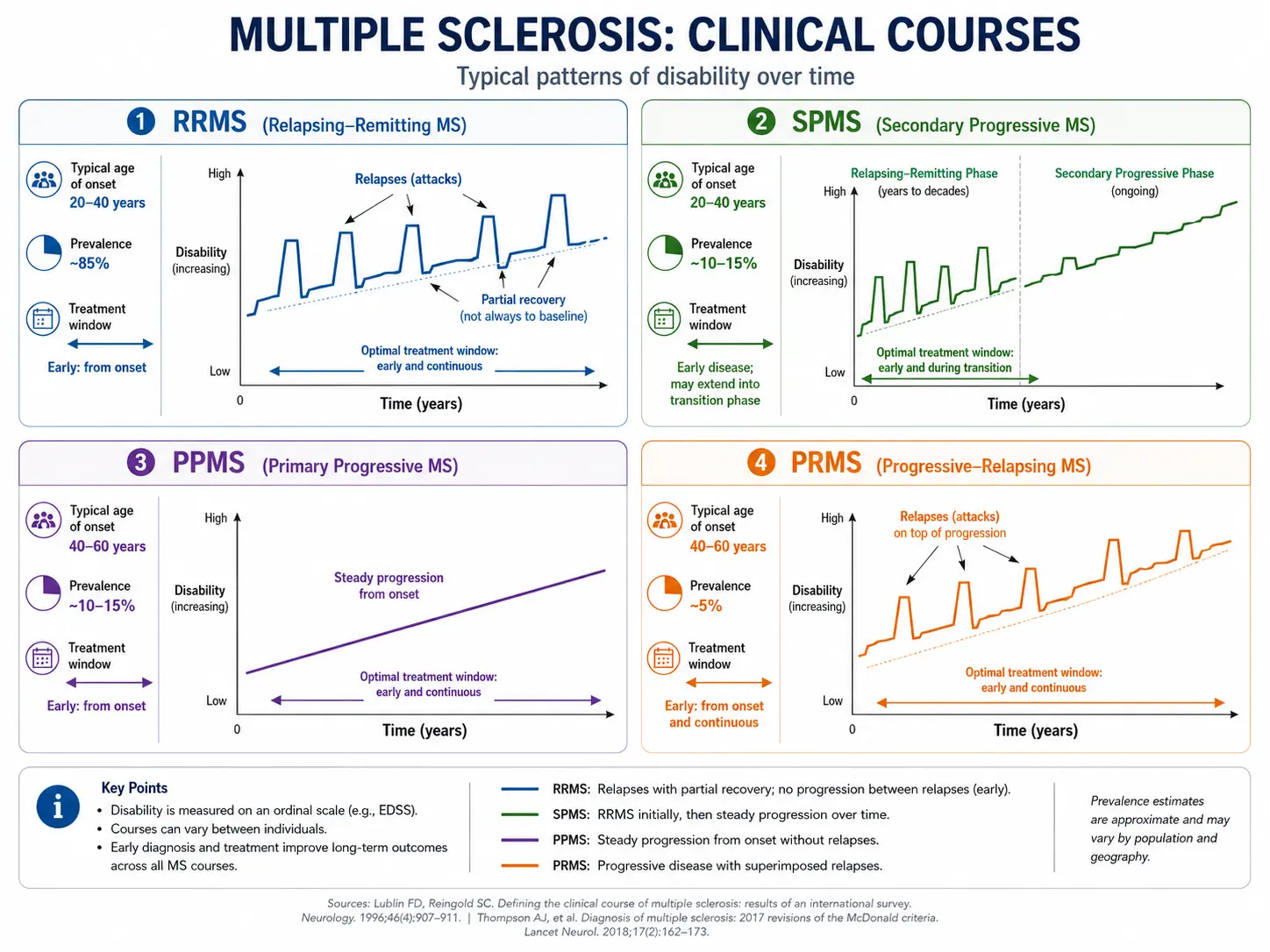
2. Relapsing–remitting MS (RRMS)
- About 85% of people at onset. Discrete relapses developing over days, lasting weeks, with recovery that may be complete or partial, separated by stable periods.
- New MRI lesions frequently appear without symptoms — roughly ten silent lesions for every clinical relapse — which is why routine MRI monitoring changes decisions.
3. Secondary progressive MS (SPMS)
- A gradual accumulation of disability after an initially relapsing course, with or without continuing relapses.
- Historically the eventual fate of most untreated RRMS, though the modern treated picture appears substantially better. Brown and colleagues’ 2019 JAMA analysis of over 1,500 patients found that starting a higher-efficacy therapy early, and within five years of onset, was associated with a lower hazard of conversion to secondary progression.
4. Primary progressive MS (PPMS)
- Around 10–15% of cases. Progressive disability from the outset without distinct relapses, typically presenting later (mid-forties), affecting men and women about equally, and often dominated by a slowly worsening spastic paraparesis — stiff, weak legs.
- Ocrelizumab is the first treatment with proven benefit in this form.
5. Radiologically isolated syndrome (RIS)
- Typical MS lesions found incidentally on a scan done for another reason, with no symptoms. A proportion go on to develop clinical MS, and this group is now the subject of active trials of early treatment.
Common Symptoms of Multiple Sclerosis
- Optic neuritis — blurred or dimmed vision in one eye developing over hours to days, with pain on eye movement and washed-out colour (red looks orange or grey). Often the first symptom, and usually recovers substantially.
- Sensory disturbance — numbness, pins and needles, a band-like tightness around the trunk (the “MS hug”), or altered temperature sensation, typically ascending from the feet.
- Weakness and spasticity — heaviness, stiffness, dragging a leg, painful muscle spasms.
- Fatigue — reported by around 80% and consistently ranked among the most disabling symptoms. It is not ordinary tiredness; it is a disproportionate exhaustion after modest effort, often worse in the afternoon and in heat.
- Balance and coordination problems — unsteadiness, tremor, clumsy hands, slurred speech.
- Bladder dysfunction — urgency, frequency, incomplete emptying, night-time waking. Extremely common, rarely volunteered, and highly treatable.
- Bowel dysfunction — constipation predominantly.
- Cognitive change — slowed information processing, reduced attention and word-finding difficulty in roughly half. Memory storage is usually preserved; processing speed is what suffers.
- Neuropathic pain, and trigeminal neuralgia at a far higher rate than in the general population — trigeminal neuralgia in a young person should prompt consideration of MS.
- Lhermitte’s sign — an electric-shock sensation running down the spine and into the limbs on bending the neck forward, from a cervical cord lesion.
- Diplopia and vertigo from brainstem lesions; internuclear ophthalmoplegia is characteristic.
- Depression and anxiety, both substantially more common than in the general population and not simply a reaction to diagnosis.
- Sexual dysfunction, common in both sexes and under-discussed.
How It Varies Between People
- The course is genuinely unpredictable at diagnosis. Some people have a handful of relapses over decades and minimal disability; others accumulate disability quickly. Features associated with a worse course include male sex, older age at onset, a progressive course from the start, motor or cerebellar rather than sensory onset, poor recovery from the first relapse, a high lesion load at diagnosis, and spinal cord or infratentorial lesions.
- Symptoms are frequently invisible. Fatigue, cognitive slowing, pain, bladder urgency and heat sensitivity are all disabling and none of them shows. This is a substantial source of disbelief from employers, families and sometimes clinicians, and it deserves saying plainly: the symptom is real whether or not it is visible.
- Heat sensitivity varies enormously — for some people a warm room is enough to blur vision or weaken a leg, for others it is irrelevant.
- Pregnancy typically reduces relapse rate, particularly in the third trimester, with a rebound increase in the three to six months postpartum. This is predictable and can be planned for; MS is not a reason to avoid pregnancy, and disease-modifying therapy choice can be adapted around it.
- Ethnicity influences presentation. MS in people of African and Hispanic ancestry tends to present with more aggressive disease and more spinal cord and optic nerve involvement, and has historically been under-studied and under-treated.
- The differential matters. Neuromyelitis optica spectrum disorder (aquaporin-4 antibody) and MOG antibody disease can look like MS but need different treatment — some MS drugs make NMOSD substantially worse. Antibody testing is warranted in severe optic neuritis, longitudinally extensive cord lesions, or an atypical picture.
Causes and Risk Factors
- Epstein–Barr virus infection — now regarded as very likely a necessary condition (see below).
- Genetic susceptibility — over 200 identified variants, dominated by HLA-DRB1*15:01. Risk in the general population is roughly 1 in 300–500; with an affected parent or sibling it is around 1 in 40; in an identical twin, roughly 1 in 4. MS is not inherited in any simple sense.
- Low vitamin D and low sun exposure — prevalence rises with latitude, and Munger and colleagues’ 2006 JAMA study of over seven million US military personnel found that higher serum 25-hydroxyvitamin D was associated with substantially lower MS risk in white participants. This is strong evidence about risk; it is not evidence that supplements treat established disease.
- Smoking — increases both risk of developing MS and rate of progression, and passive smoking counts. Stopping is one of the few lifestyle factors with a real effect on the disease course.
- Adolescent obesity — consistently associated with increased risk, with the exposure window in the teenage years.
- Female sex — and the sex ratio has been rising over decades, which points to environment rather than genes.
- Organic solvent exposure, which interacts with smoking and genotype.
- Shift work in adolescence, in several cohorts.
The Epstein–Barr Virus Finding
This deserves its own section because it is the most important development in MS causation research in decades, and because it is frequently misreported in both directions.
Bjornevik and colleagues (Science, 2022) followed more than 10 million young adults in the US military, with serum samples stored over time. Among those who developed MS, they found that the risk of MS increased 32-fold after infection with Epstein–Barr virus, and that seroconversion to EBV preceded MS in all but one of the 801 cases. Serum neurofilament light chain — a marker of neuronal injury — rose only after EBV infection. Infection with another common virus, cytomegalovirus, showed no such association, which controls for the general tendency to catch things.
What this means: EBV infection appears to be a necessary but far from sufficient cause. Around 95% of adults carry EBV and only a tiny fraction develop MS, so something else — genetics, vitamin D, smoking, timing and severity of infection — must determine who does. What it does not mean is that MS is a treatable infection, or that antiviral drugs are established therapy; trials of EBV-directed treatments and vaccines are underway but nothing has yet changed practice. It is a genuinely major finding whose practical consequences are still ahead of us.
Diagnosis: The Tests and the Criteria
MS is diagnosed by demonstrating lesions disseminated in space and in time, having excluded better explanations. The 2017 revisions of the McDonald criteria (Thompson et al., Lancet Neurology 2018) are the current standard, and they allow earlier diagnosis than previous versions.
MRI
- The central investigation. Brain and spinal cord MRI with gadolinium contrast.
- Dissemination in space requires one or more T2 lesions in at least two of four characteristic locations: periventricular, cortical or juxtacortical, infratentorial, and spinal cord.
- Dissemination in time requires either a new lesion on a later scan, or the simultaneous presence of gadolinium-enhancing (active) and non-enhancing (older) lesions on a single scan — which lets one scan demonstrate two points in time.
- Dawson’s fingers — ovoid lesions oriented perpendicular to the ventricles, following the small veins — are highly characteristic. The central vein sign on higher-field imaging is increasingly used to distinguish MS lesions from those of small-vessel disease or migraine, which is a common source of misdiagnosis.
Lumbar puncture
- Cerebrospinal fluid oligoclonal bands — bands of immunoglobulin present in the CSF but not in matched serum, indicating antibody production inside the nervous system. Found in 85–95% of people with MS.
- Under the 2017 criteria, oligoclonal bands can substitute for dissemination in time in someone with a typical first attack and dissemination in space — permitting diagnosis and treatment months or years earlier.
- The procedure is uncomfortable but brief; post-puncture headache is the common complication and is reduced by an atraumatic needle, which is worth requesting.
Other tests
- Visual evoked potentials — a delayed but preserved response indicates previous optic nerve demyelination, sometimes revealing a clinically silent episode.
- Optical coherence tomography (OCT) — measures thinning of the retinal nerve fibre layer, a quick, non-invasive marker of axonal loss.
- Blood tests to exclude mimics — aquaporin-4 and MOG antibodies, vitamin B12, thyroid function, ANA and extractable nuclear antigens, ACE (sarcoidosis), syphilis and HIV serology, and HTLV-1 where relevant.
- Serum neurofilament light chain — a marker of ongoing axonal injury, increasingly used in research and entering clinical use for monitoring.
What else it might be
Misdiagnosis is common enough to be a recognised problem, and the usual culprits are migraine with white-matter changes, small-vessel ischaemic disease, fibromyalgia, functional neurological disorder, B12 deficiency, neurosarcoidosis, Sjögren’s syndrome, lupus, Susac syndrome, and hereditary spastic paraparesis. Non-specific white spots on an MRI in someone with headache are not MS, and the diagnosis should never rest on imaging alone.
Treatment Options
Treating a relapse
- High-dose corticosteroids — typically methylprednisolone 500–1,000 mg daily for three to five days, oral or intravenous (oral is equally effective and far more convenient). Steroids speed recovery but do not change the eventual level of recovery, and do not affect long-term disability. That is worth knowing, because it means a mild relapse can reasonably be left alone.
- Plasma exchange for severe steroid-refractory relapses.
- Exclude infection first. A urinary or other infection can unmask old deficits (a pseudo-relapse) and steroids will not help; treating the infection will.
Disease-modifying therapies (DMTs)
These reduce relapse rate and new MRI lesions, and delay disability. They do not repair existing damage. Broadly, by efficacy:
- Moderate efficacy, injectable or oral — interferon beta, glatiramer acetate, teriflunomide, dimethyl fumarate. Long safety records; relapse reduction on the order of 30–50%.
- Higher efficacy — sphingosine-1-phosphate modulators (fingolimod, siponimod, ozanimod), cladribine, natalizumab, and the anti-CD20 antibodies (ocrelizumab, ofatumumab, rituximab off-label). Relapse reduction typically 50–70% or more.
The evidence for the anti-CD20 drugs was decisive. In OPERA I and II (Hauser et al., NEJM 2017), ocrelizumab reduced the annualised relapse rate by roughly 46–47% compared with interferon beta-1a. In ORATORIO (Montalban et al., same issue), it reduced 12-week confirmed disability progression in primary progressive MS from 39.3% to 32.9% — the first positive trial in that population, and a modest but real effect that should be described as such. ASCLEPIOS (Hauser et al., NEJM 2020) showed subcutaneous ofatumumab, self-injected monthly at home, outperformed teriflunomide.
For secondary progressive disease, EXPAND (Kappos et al., Lancet 2018) found siponimod reduced 3-month confirmed disability progression from 32% to 26%, with benefit concentrated in those still showing inflammatory activity.
- Natalizumab is highly effective but carries a risk of progressive multifocal leukoencephalopathy (PML), a serious brain infection caused by JC virus. Risk is stratified by JC virus antibody status and index, duration of treatment beyond two years, and prior immunosuppressant use; JCV-negative patients are at very low risk. Regular antibody testing is part of using it safely.
- Anti-CD20 drugs reduce vaccine responses and cause hypogammaglobulinaemia over years, with increased infection risk; vaccinate before starting, and time seasonal vaccines relative to infusions.
- Autologous haematopoietic stem cell transplantation (AHSCT) — for highly active relapsing disease failing standard treatment, with impressive results in selected younger patients with inflammatory activity, and real treatment-related mortality. It is not a treatment for progressive disease without inflammation, despite how it is marketed by some overseas clinics.
Choosing a Disease-Modifying Therapy
There are two philosophies, and it is worth knowing which one you are being offered.
- Escalation — start with a safer, moderately effective drug and step up if disease activity continues. Minimises early risk.
- Early intensive treatment — start with a high-efficacy drug immediately. Accepts more early risk to prevent damage that cannot be undone.
Evidence has shifted towards early intensive treatment. Observational data, including the Brown 2019 JAMA analysis, associate earlier high-efficacy therapy with lower conversion to secondary progression, and the underlying logic is that axons lost in the first years are lost permanently. The trade-off is genuine — infection risk, PML, malignancy signals, monitoring burden — and it is a decision to make deliberately rather than by default.
Practical questions worth asking: How often is it given, and how? What monitoring does it need and how often? What are the specific risks for me given my JC virus status and vaccination history? What happens if I want to become pregnant? What is the washout period if I need to switch? And what will trigger a change — how many new MRI lesions, how many relapses?
On cost: DMTs are among the most expensive drugs in routine use, with US list prices frequently exceeding $80,000 a year, though almost nobody pays list. Manufacturer patient-assistance programmes, copay foundations and, in the UK and most of Europe, national provision cover the great majority. Generic and biosimilar versions of glatiramer, dimethyl fumarate, fingolimod and rituximab have brought prices down substantially, and rituximab is used off-label very widely and very cheaply in some health systems with good outcomes.
Managing the Symptoms That Actually Bother People
DMTs do not treat symptoms, and symptom management is where most day-to-day quality of life is won or lost.
- Fatigue — the single most reported problem. Energy pacing and planned rest, treating sleep disorders and depression, correcting anaemia and thyroid disease, exercise (which improves fatigue rather than worsening it), and cooling strategies. Amantadine and modafinil are commonly tried; a well-conducted randomised trial found neither outperformed placebo, so expectations should be set accordingly.
- Spasticity — stretching and physiotherapy first; then baclofen, tizanidine or gabapentin; botulinum toxin for focal spasticity; intrathecal baclofen for severe cases. Nabiximols oromucosal spray is licensed for spasticity in several countries.
- Bladder — a post-void residual measurement is the key first step, because urgency with incomplete emptying is treated very differently from urgency with complete emptying. Antimuscarinics or mirabegron, intermittent self-catheterisation, and botulinum toxin into the bladder wall are all effective. Recurrent urinary infections cause pseudo-relapses, so this is not a minor issue.
- Walking — fampridine (dalfampridine) improves walking speed in roughly a third of people; it is worth a defined trial with a walking test before and after, and stopping if there is no benefit.
- Neuropathic pain — gabapentin, pregabalin, duloxetine, amitriptyline; carbamazepine for trigeminal neuralgia.
- Cognition — cognitive rehabilitation has modest evidence; treating fatigue, depression and sleep usually helps more than anything aimed at cognition directly.
- Mood — depression is common, treatable, and independently worsens fatigue and cognition. Ask and treat.
- Rehabilitation — physiotherapy, occupational therapy and speech therapy are consistently under-referred and have good evidence for function and quality of life.
What the Evidence Does Not Support
- Vitamin D supplements as a treatment for established MS. The association between low vitamin D and MS risk is strong; the treatment trials are not. SOLAR (Hupperts et al., Neurology 2019) randomised patients on interferon beta-1a to 14,000 IU/day of vitamin D3 or placebo and did not meet its primary endpoint of no evidence of disease activity, though some MRI measures improved. Maintaining adequate vitamin D is sensible; presenting it as disease-modifying therapy is not supported.
- “Chronic cerebrospinal venous insufficiency” and venous angioplasty (“liberation therapy”). The hypothesis that MS is caused by narrowed neck veins was tested and refuted: blinded studies found no consistent venous abnormality, and randomised sham-controlled trials of venoplasty showed no benefit. People were harmed and some died pursuing it privately. It should be described as disproven, not merely unproven.
- Steroids to improve long-term outcome. They speed recovery from a relapse; they do not change the eventual degree of recovery or long-term disability.
- Specific MS diets as disease-modifying treatment. The Swank, Wahls, paleo and various elimination diets have devoted followings and no adequate randomised evidence of effect on relapse rate or disability. Diet quality is associated with lower symptom burden in cross-sectional data (Fitzgerald et al., Neurology 2018) — which is worth knowing and is not the same as proof of benefit. Eat well; do not spend heavily on a restrictive protocol expecting it to change the disease.
- Amantadine and modafinil for MS fatigue — a randomised placebo-controlled crossover trial found neither superior to placebo, with more side effects. Some individuals still benefit, but a trial with a clear stopping rule is the right approach.
- Stem cell tourism. Unregulated clinics offering intravenous “stem cells” for progressive MS are selling something quite different from the AHSCT protocols studied in trials, at high cost and real risk.
Prevention and Management Strategies
- Stop smoking. The clearest modifiable factor affecting progression, and it also reduces the chance of developing neutralising antibodies to interferon therapy.
- Exercise regularly. Aerobic and resistance training improve fatigue, mood, walking, balance and quality of life, and there is no evidence they worsen the disease. Warm up gradually and cool down; use cooling if heat sensitivity is an issue.
- Maintain adequate vitamin D, particularly at high latitude — sensible for bone health and reasonable given the risk association, with the treatment caveat above.
- Eat a good general diet — vegetables, fruit, oily fish, olive oil, nuts, legumes, eggs and whole grains such as brown rice, oats and barley. Fitzgerald and colleagues found higher diet quality associated with lower disability and symptom severity in a large MS cohort.
- Keep vaccinations up to date, and ideally complete them before starting an anti-CD20 or S1P drug, since responses are blunted afterwards. Live vaccines are contraindicated on most DMTs.
- Treat urinary infections promptly and investigate recurrent ones.
- Manage heat — cooling vests, cool showers before exercise, air conditioning. Practical and effective.
- Plan pregnancy with your neurologist rather than after the fact; some DMTs need a washout, others can be continued, and the postpartum rebound can be pre-empted.
- Get MRI monitoring, usually annually early on. Silent lesions change treatment decisions.
- Ask about the MS nurse specialist service where one exists — it is usually the fastest route to advice about a possible relapse.
Red Flags: When It Is Urgent
- New severe vision loss, particularly if in both eyes or with a poor response to steroids — consider neuromyelitis optica, which needs different and urgent treatment.
- Rapidly progressive weakness, especially with a sensory level, bladder retention or bowel incontinence — needs urgent imaging to exclude cord compression as well as a relapse.
- New confusion, personality change, seizures or rapidly worsening deficits on natalizumab — consider PML urgently. Symptoms of PML tend to progress steadily over weeks rather than plateauing like a relapse.
- Fever with a possible relapse — treat the infection and reassess; steroids into an untreated infection are harmful.
- Suicidal thoughts — suicide risk is raised in MS and this warrants immediate help.
- Unable to pass urine — acute retention needs same-day catheterisation.
- Severe infection while on any DMT — seek advice and name the drug.
Complications of Multiple Sclerosis
- Progressive disability — mobility loss, and eventually the need for aids or a wheelchair in a proportion of people. Modern treatment has meaningfully improved these trajectories.
- Urinary tract infections and urosepsis, from incomplete bladder emptying.
- Pressure sores with reduced mobility and sensation.
- Aspiration pneumonia where swallowing is affected.
- Osteoporosis and fractures, from reduced weight-bearing, low vitamin D and repeated steroid courses.
- Depression, anxiety and increased suicide risk.
- Cognitive impairment, which is a leading reason for leaving work — often before physical disability would require it.
- Unemployment and financial strain; workplace adjustments made early keep people in work longer.
- Treatment complications — PML with natalizumab, infections and hypogammaglobulinaemia with anti-CD20 drugs, macular oedema and bradycardia with S1P modulators, liver injury with several agents, and transplant-related mortality with AHSCT.
- Sexual dysfunction and reduced fertility treatment access, both under-addressed.
Key Research Papers
Historical background
Jean-Martin Charcot described sclérose en plaques at the Salpêtrière in Paris in 1868, linking the clinical picture to the scattered hardened plaques seen after death and defining a triad of nystagmus, intention tremor and scanning speech. Earlier accounts exist — the diaries of Augustus d’Esté from 1822 are among the most complete first-person records of any disease of that era. Treatment remained purely supportive until interferon beta in 1993, the first drug shown to reduce relapses. The three decades since have produced more than a dozen disease-modifying therapies, the 2017 McDonald criteria enabling far earlier diagnosis, and the 2022 Epstein–Barr virus finding.
Key research papers
Each citation below was checked against its PubMed record; the linked DOI resolves to the paper named.
- Reich DS, Lucchinetti CF, Calabresi PA. Multiple sclerosis. N Engl J Med. 2018;378(2):169–180. — doi:10.1056/NEJMra1401483 ( PubMed PMID: 29320652)
- Thompson AJ, Banwell BL, Barkhof F, et al. Diagnosis of multiple sclerosis: 2017 revisions of the McDonald criteria. Lancet Neurol. 2018;17(2):162–173. — doi:10.1016/S1474-4422(17)30470-2 ( PubMed PMID: 29275977)
- Bjornevik K, Cortese M, Healy BC, et al. Longitudinal analysis reveals high prevalence of Epstein–Barr virus associated with multiple sclerosis. Science. 2022;375(6578):296–301. — doi:10.1126/science.abj8222 ( PubMed PMID: 35025605)
- Munger KL, Levin LI, Hollis BW, Howard NS, Ascherio A. Serum 25-hydroxyvitamin D levels and risk of multiple sclerosis. JAMA. 2006;296(23):2832–2838. — doi:10.1001/jama.296.23.2832 ( PubMed PMID: 17179460)
- Hupperts R, Smolders J, Vieth R, et al. Randomized trial of daily high-dose vitamin D3 in patients with RRMS receiving subcutaneous interferon beta-1a (SOLAR). Neurology. 2019;93(20):e1906–e1916. — doi:10.1212/WNL.0000000000008445 · PubMed PMID: 31594857 — the primary endpoint was not met.
- Polman CH, O’Connor PW, Havrdova E, et al. A randomized, placebo-controlled trial of natalizumab for relapsing multiple sclerosis (AFFIRM). N Engl J Med. 2006;354(9):899–910. — doi:10.1056/NEJMoa044397 ( PubMed PMID: 16510744)
- Hauser SL, Bar-Or A, Comi G, et al. Ocrelizumab versus interferon beta-1a in relapsing multiple sclerosis (OPERA I and II). N Engl J Med. 2017;376(3):221–234. — doi:10.1056/NEJMoa1601277 ( PubMed PMID: 28002679)
- Montalban X, Hauser SL, Kappos L, et al. Ocrelizumab versus placebo in primary progressive multiple sclerosis (ORATORIO). N Engl J Med. 2017;376(3):209–220. — doi:10.1056/NEJMoa1606468 ( PubMed PMID: 28002688)
- Kappos L, Bar-Or A, Cree BAC, et al. Siponimod versus placebo in secondary progressive multiple sclerosis (EXPAND). Lancet. 2018;391(10127):1263–1273. — doi:10.1016/S0140-6736(18)30475-6 ( PubMed PMID: 29576505)
- Hauser SL, Bar-Or A, Cohen JA, et al. Ofatumumab versus teriflunomide in multiple sclerosis (ASCLEPIOS I and II). N Engl J Med. 2020;383(6):546–557. — doi:10.1056/NEJMoa1917246 ( PubMed PMID: 32757523)
- Brown JWL, Coles A, Horakova D, et al. Association of initial disease-modifying therapy with later conversion to secondary progressive multiple sclerosis. JAMA. 2019;321(2):175–187. — doi:10.1001/jama.2018.20588 ( PubMed PMID: 30644981)
- Fitzgerald KC, Tyry T, Salter A, et al. Diet quality is associated with disability and symptom severity in multiple sclerosis. Neurology. 2018;90(1):e1–e11. — doi:10.1212/WNL.0000000000004768 · PubMed PMID: 29212827 — an association in cross-sectional data, not a trial.
PubMed Topic Searches
The following PubMed topic searches surface the current peer-reviewed literature on multiple sclerosis. Each link opens a live query; results update as new papers are indexed.
- PubMed: Topic search: Multiple sclerosis review
- PubMed: Topic search: McDonald criteria MS diagnosis
- PubMed: Topic search: Relapsing remitting multiple sclerosis
- PubMed: Topic search: Primary progressive MS
- PubMed: Topic search: Ocrelizumab MS trial
- PubMed: Topic search: Natalizumab and PML risk
- PubMed: Topic search: Early intensive versus escalation therapy
- PubMed: Topic search: AHSCT for multiple sclerosis
- PubMed: Topic search: Vitamin D multiple sclerosis
- PubMed: Topic search: Epstein-Barr virus multiple sclerosis
- PubMed: Topic search: MRI central vein sign in MS
- PubMed: Topic search: MS fatigue management
- PubMed: Topic search: Multiple sclerosis misdiagnosis
- PubMed: Topic search: Neuromyelitis optica and aquaporin-4
Connections
- Neurology
- Cerebrospinal Fluid: The Brain’s Cushion & Plumbing — interactive animation
- The Blood-Brain Barrier: The Brain’s Bouncer — interactive animation
- Nerve Impulse — interactive animation
- ALS
- Myasthenia Gravis
- Peripheral Neuropathy
- Alzheimer's Disease
- Chronic Fatigue Syndrome (ME/CFS)
- Vitamin B12
- Vitamin D3
- Magnesium
- Lysine & Epstein-Barr Virus
- Low-Dose Naltrexone
- Fatigue
- Brain Fog
- Numbness & Tingling
- Chronic Pain
- Depression
- Parkinsons Disease
- Dizziness
- Lions Mane Mushroom
- Mononucleosis
- Essential Tremor
- Trigeminal Neuralgia
- Urinary Incontinence
- Dr. Bryan Ardis: Snus and Multiple Sclerosis
- Omega-3