Milk Thistle — Benefits Deep Dive
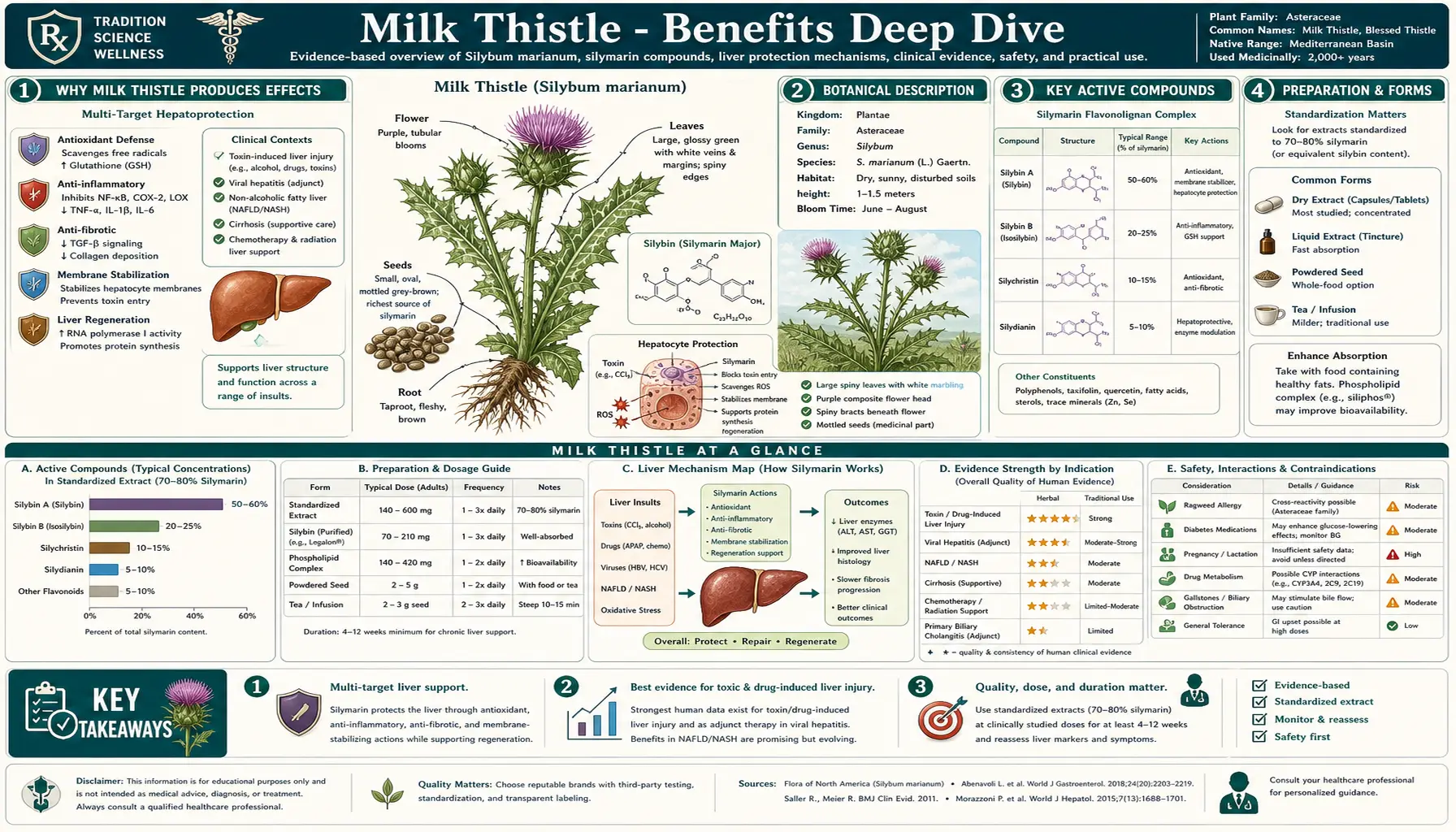
Milk Thistle (Silybum marianum) is one of the most-studied herbal liver remedies in modern phytomedicine, with a documented therapeutic record stretching back more than 2,000 years to Dioscorides and Pliny the Elder. The active constituent is silymarin, a flavonolignan complex extracted from the seed (technically the achene), composed principally of silybin A and silybin B (collectively "silibinin") along with isosilybin, silychristin, and silydianin. Silybin alone accounts for 60-70% of standardized silymarin and is the principal active compound. The most dramatic clinical demonstration of milk thistle's liver-protective effect is the use of intravenous silibinin (silibinin dihydrogen succinate) as the standard-of-care antidote for Amanita phalloides (death cap mushroom) poisoning across Europe — a setting in which placebo-controlled trials are impossible; a 2012 review reports overall mortality under 10% in nearly 1,500 documented cases treated with intravenous silibinin, compared with more than 20% with penicillin or penicillin plus silibinin. Four benefit pages below explore the uses most studied for milk thistle — alcoholic and toxic liver disease, oxidative stress and glutathione replenishment, chronic viral hepatitis (hepatitis B virus (HBV) and hepatitis C virus (HCV)) adjunctive therapy, and topical and oral dermatologic applications.
Deep-Dive Articles
Liver Protection & Detox
The silymarin flavonolignan complex (silybin A/B, isosilybin, silychristin, silydianin), the German Commission E and EMA HMPC monographs, Cochrane meta-analyses of alcoholic liver disease and cirrhosis trials, the Amanita phalloides mushroom poisoning antidote story (intravenous silibinin, as silibinin dihydrogen succinate), the hepatocyte membrane-stabilization and hepatic-regeneration mechanism (RNA polymerase I stimulation), and the 420 mg/day standardized silymarin dose most often described.
Read the deep dive →Antioxidant & Glutathione
Silymarin's replenishment of hepatic and intestinal glutathione (reduced glutathione, GSH) by 35-50%, Nrf2/ARE pathway activation upregulating phase II detoxification enzymes (NQO1, HO-1, GST, glutamate-cysteine ligase), direct free-radical scavenging chemistry, side-by-side comparison with N-acetylcysteine (NAC) as a reduced glutathione-precursor alternative, and the documented synergy with alpha-lipoic acid (ALA) and selenium in liver-support protocols.
Read the deep dive →Hepatitis Adjunctive
The mixed-evidence picture for chronic hepatitis C (hepatitis C virus) — positive serum-aminotransferase signals in older trials, the disappointing HALT-C and Fried/SyNCH oral silymarin studies, and the modern reframing of milk thistle as a hepatitis C virus symptom-and-quality-of-life adjunct now that direct-acting antivirals cure most hepatitis C virus. Hepatitis B (hepatitis B virus) trials showing modest aminotransferase reduction and HBV DNA effects. The silybin-phosphatidylcholine complex (IdB 1016) developed to improve milk thistle's notoriously poor oral bioavailability.
Read the deep dive →Skin Health
Topical silymarin as an ultraviolet B-photoprotective agent (preventing sunburn cell formation, pyrimidine dimer reduction, and apoptosis in keratinocytes), randomized trials in melasma and chloasma showing pigmentation reduction comparable to hydroquinone with fewer reported side effects, post-inflammatory hyperpigmentation use, rosacea anti-inflammatory effects, and the dual antioxidant + NF-kappa-B-inhibition + matrix metalloproteinase suppression mechanism behind topical formulations. In a 2022 split-face trial of 25 people with melasma, 1.4% silymarin cream and 2% hydroquinone cream lightened the skin by a similar amount on a colour meter (14.56% vs 12.82%), with more side effects on the hydroquinone side, although only the hydroquinone side showed a significant fall in the melasma severity score; in a 2019 study of 42 women, 0.7% and 1.4% silymarin creams and 4% hydroquinone cream all reduced melasma scores over 3 months, with no significant difference between them and no side effects recorded with silymarin.
Read the deep dive →Table of Contents
Why Milk Thistle Produces Effects
Most herbal products have either a single dominant mechanism or such poorly characterized chemistry that the mechanism remains speculative. Milk thistle is unusual in having both well-characterized active constituents (the silymarin flavonolignan complex, with silybin A and B identified and synthesized) and multiple complementary mechanisms that converge on the same target organ — the hepatocyte. Five mechanisms are proposed to explain the effects described for it:
- Hepatocyte membrane stabilization — silybin physically intercalates into the phospholipid bilayer of the hepatocyte plasma membrane, altering membrane fluidity in a way that blocks toxin entry. This is the demonstrated mechanism behind the Amanita phalloides antidote use: alpha-amanitin and phalloidin (the two principal death-cap toxins) enter hepatocytes via the OATP1B3 sodium-independent organic-anion transporter, and silybin competes for that same transporter, preventing toxin uptake. This same membrane-protective effect underlies milk thistle's protection against carbon tetrachloride, acetaminophen, halothane, and ethanol in animal models.
- Hepatic protein synthesis and regeneration (RNA polymerase I stimulation) — silybin stimulates nucleolar RNA polymerase I, increasing ribosomal RNA transcription, ribosome assembly, and protein synthesis in hepatocytes. The cells most damaged by toxin or alcohol exposure are also the cells most actively regenerating, and silymarin accelerates that regenerative protein synthesis. This is the rare mechanism that drives active healing, not just damage prevention.
- Glutathione (reduced glutathione) replenishment — silymarin raises hepatic and intestinal glutathione concentrations by 35-50% in deficient animals and patients, restoring the body's principal water-soluble intracellular antioxidant. Because reduced glutathione is required for phase II conjugation of both endogenous oxidized molecules and exogenous toxins, this single mechanism produces broad downstream protection. See the Antioxidant & Glutathione page for the full mechanism.
- Nrf2 / antioxidant response element (ARE) pathway activation — silymarin disrupts the Keap1-Nrf2 complex, freeing Nrf2 to translocate to the nucleus and bind ARE elements in the promoter regions of phase II detoxification genes. The downstream effects include induction of NAD(P)H quinone oxidoreductase 1 (NQO1), heme oxygenase-1 (HO-1), glutathione S-transferase (GST), glutamate-cysteine ligase (the rate-limiting enzyme in reduced glutathione synthesis), and several other cytoprotective enzymes. This is now recognized as one of the master regulatory mechanisms of cellular antioxidant defense.
- Antifibrotic (hepatic stellate cell inhibition) — silymarin suppresses transforming growth factor-beta (TGF-β) signaling in hepatic stellate cells, the cell type responsible for laying down collagen during cirrhosis. By blocking stellate cell activation from quiescent vitamin-A-storing cells to activated myofibroblast-like cells, silymarin reduces collagen deposition and slows the progression of fibrosis. This is the proposed mechanism behind the modest cirrhosis-survival benefit seen in some (but not all) older European trials. A 2007 Cochrane review of 18 randomised trials (1,088 people with alcoholic or hepatitis B or C liver disease, mostly of low methodological quality) found no significant effect of milk thistle on overall deaths (relative risk 0.78), complications of liver disease or liver biopsy findings; liver-related deaths were fewer across all trials (relative risk 0.50) but not in the high-quality trials, and the authors concluded that their results question the benefits. In a 48-week randomised trial of 99 people with nonalcoholic steatohepatitis (fatty liver with inflammation), silymarin 700 mg three times a day did not improve the main liver-activity score more than placebo (32.7% vs 26.0% reached the goal), but more people on silymarin had less scarring (fibrosis) on repeat liver biopsy (22.4% vs 6.0%) and on liver-stiffness scans (24.2% vs 2.3%); the authors wrote that this fibrosis finding remains to be confirmed in a larger trial, and no side effects were attributed to silymarin.
In chronic hepatitis C, the 2012 SyNCH trial gave 154 people whose interferon treatment had failed oral silymarin (420 mg or 700 mg) or a matching placebo three times a day for 24 weeks. Only 2 people in each group (3.8–4.0%) reached the liver-enzyme (alanine aminotransferase, ALT) goal, and ALT, virus levels and quality of life did not differ between the groups; side effects were similar to placebo.
The therapeutic complication that limits all of these mechanisms is poor oral bioavailability. Free silybin has an oral bioavailability of approximately 20-50%, with extensive first-pass conjugation to glucuronide and sulfate forms in the liver, and relatively short serum half-life (~6 hours). Two pharmaceutical solutions address this: (1) the silybin-phosphatidylcholine complex (IdB 1016), which increases bioavailability roughly 4.6-fold via improved lipid-membrane partitioning, and (2) the standardized 80%-silymarin extract used in the European hepatology literature, alongside intravenous silibinin (silibinin dihydrogen succinate) used in the mushroom-poisoning antidote protocol. Store-bought milk thistle capsules vary widely in silymarin content and are not pharmaceutically equivalent to the studied preparations.
What Recent Reviews Found for Fatty Liver
A 2025 Cochrane review gathered 17 randomised trials with 2,069 adults who had metabolic dysfunction-associated steatotic liver disease (MASLD, the newer name for fatty liver disease not caused by alcohol). Compared with placebo or no treatment, silymarin taken alone may lower the liver enzyme ALT by about 7 U/L (6 trials, 409 people), but the certainty of that evidence was very low. Silymarin complexes (silymarin combined with other substances such as vitamin E or phosphatidylcholine) did not clearly lower liver enzymes, and neither form lowered liver enzymes compared with other treatments. None of the trials reported deaths or quality of life, no serious side effects were judged to be caused by silymarin, and the authors concluded that the benefits and harms of silymarin in adults with fatty liver disease are unclear.
Key Research Papers
- Saller R, Meier R, Brignoli R (2001). The use of silymarin in the treatment of liver diseases. Drugs 61(14):2035-63. — PubMed PMID: 11735632
- Rambaldi A, Jacobs BP, Gluud C (2007). Milk thistle for alcoholic and/or hepatitis B or C virus liver diseases. Cochrane Database Syst Rev. — PubMed PMID: 17943794
- Mengs U, Pohl RT, Mitchell T (2012). Legalon SIL: the antidote of choice in patients with acute hepatotoxicity from amatoxin poisoning. Curr Pharm Biotechnol 13(10):1964-70. — PubMed PMID: 22352731
- Fried MW, Navarro VJ, Afdhal N, Belle SH, Wahed AS, Hawke RL, Doo E, Meyers CM, Reddy KR; Silymarin in NASH and C Hepatitis (SyNCH) Study Group (2012). Effect of silymarin (milk thistle) on liver disease in patients with chronic hepatitis C unsuccessfully treated with interferon therapy: a randomized controlled trial. JAMA 308(3):274-82. — PubMed PMID: 22797645
- Loguercio C, Festi D (2011). Silybin and the liver: from basic research to clinical practice. World J Gastroenterol 17(18):2288-301. — PubMed PMID: 21633595
- Wah Kheong C, Nik Mustapha NR, Mahadeva S (2017). A randomized trial of silymarin for the treatment of nonalcoholic steatohepatitis. Clin Gastroenterol Hepatol 15(12):1940-1949.e8. — PubMed PMID: 28419855
- Wang C, Shang Y, Kanaan G, Chai L, Li H, Qi X (2025). Silymarin for adults with metabolic dysfunction-associated steatotic liver disease. Cochrane Database Syst Rev 6:CD015524. — PubMed PMID: 40552569
- Wattanakrai P, Nimmannitya K (2022). A randomized, double-blind, split-face study of topical silymarin vs 2% hydroquinone cream in melasmas. J Drugs Dermatol 21(12):1304-1310. — PubMed PMID: 36468967
- Nofal A, Ibrahim AM, Nofal E, Gamal N, Osman S (2019). Topical silymarin versus hydroquinone in the treatment of melasma: a comparative study. J Cosmet Dermatol 18(1):263-270. — PubMed PMID: 30146802
External Authoritative Resources
- U.S. National Center for Complementary and Integrative Health (NCCIH), National Institutes of Health (NIH) — Milk Thistle — U.S. government summary of evidence base, safety, drug interactions
- European Medicines Agency (EMA) HMPC monograph — Silybi mariani extractum siccum raffinatum et normatum — the formal European pharmacopoeial monograph for standardized milk thistle extract
- WHO Monographs on Selected Medicinal Plants Volume 2 — Fructus Silybi Mariae — the WHO traditional-medicine reference monograph
- LiverTox (U.S. National Institutes of Health) — Milk Thistle — clinical and research database on drug-induced liver injury
- Memorial Sloan Kettering — Milk Thistle About Herbs — oncology-focused review of drug-herb interactions
- PubMed — All silymarin / silybin / silibinin / milk thistle research (~5,000+ papers)
Connections
- All Herbs
- Milk Thistle (Main Page)
- Liver Protection & Detox
- Antioxidant & Glutathione
- Hepatitis Adjunctive
- Skin Health
- Turmeric (Curcumin)
- Dandelion
- Chanca Piedra
- Andrographis
- N-Acetylcysteine
- Glutathione
- Liver Disease
- Cirrhosis
- Non-Alcoholic Fatty Liver Disease
- Hepatitis
- Hepatitis C
- Liver Cleansing
- Detox Protocols
- Oxidative Stress
- Comprehensive Metabolic Panel
- Gamma-Glutamyl Transferase (Liver Enzyme)
- History