Hawthorn: History and Traditional Use
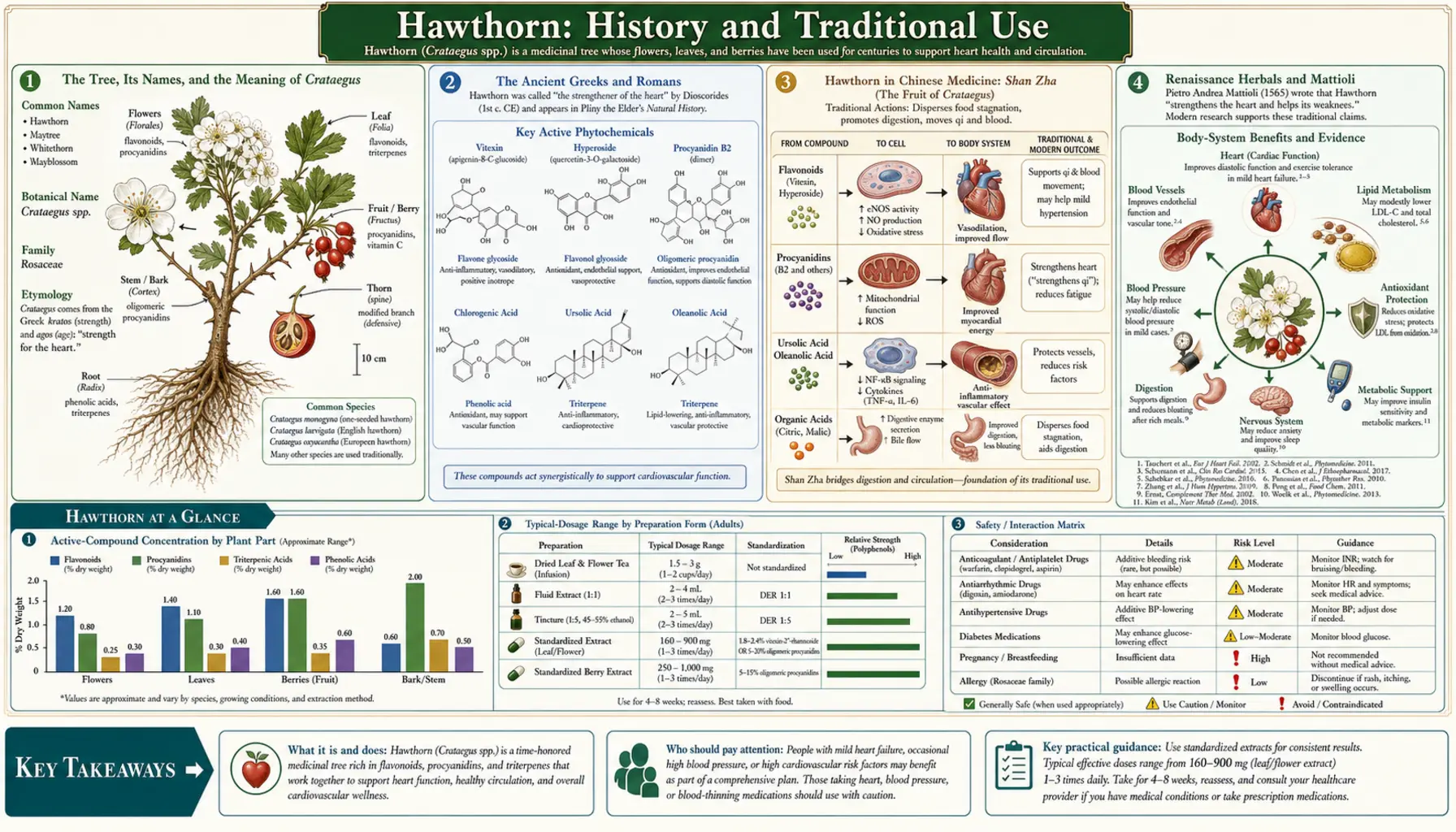
Hawthorn is a thorny tree of the rose family whose white spring blossom and red autumn berries have been woven into European and Asian life for thousands of years — as a sacred hedgerow tree, a digestive food-medicine in China, and, more recently, as one of the West's best-known heart herbs. This is the longer story of how a common thornbush gathered so many meanings, where its medicinal reputation genuinely comes from, and which famous "facts" about it are firm history and which are folklore. Throughout, traditional uses are described as tradition, not as proven medical treatment.
Table of Contents
- The Tree, Its Names, and the Meaning of Crataegus
- The Ancient Greeks and Romans
- Hawthorn in Chinese Medicine: Shan Zha
- Renaissance Herbals and Mattioli
- Becoming a "Heart Herb": A Modern Story
- The German Standardized-Extract Era
- Folklore: The May Tree, the Fairy Thorn, and Glastonbury
- From Tradition to Modern Research
- Research Papers and References
- Connections
- Featured Videos
The Tree, Its Names, and the Meaning of Crataegus
Hawthorn is the common English name for several closely related thorny shrubs and small trees in the genus Crataegus, of the rose family (Rosaceae). The two species best known in European herbal medicine are Crataegus monogyna (common or one-seeded hawthorn) and Crataegus laevigata, long called Crataegus oxyacantha — a name that still appears throughout the older medical literature and on many product labels. They are hedgerow plants of Europe, North Africa, and western Asia, easily recognised by their sharp thorns, deeply lobed leaves, masses of white (sometimes pink) five-petalled flowers in late spring, and clusters of small red fruits, the "haws," in autumn.
The genus name itself records the tree's most obvious feature. Crataegus derives from the Greek root kratai-, meaning strength, might, or hardness — a reference usually understood as pointing to the toughness of the wood and the formidable thorns. The old species epithet oxyacantha comes straight from Dioscorides' Greek and means literally "sharp thorn." The English word hawthorn is just as plain-spoken: haw is an old word for a hedge or enclosure (the same root as in hawthorn hedge), so the name means roughly "the thorn of the hedge" — a fitting description for the plant that has fenced European fields for centuries.
Other folk names cluster around the season and the blossom. In Britain and Ireland the tree was so closely tied to the start of May that it was simply called the May, or May-tree, and its blossom may; it was also widely known as whitethorn (from the pale flowers and bark) and quickthorn or quickset (from its use as living, "quick" hedging). This thicket of names is itself historical evidence: a plant gets re-christened by every community that lives alongside it only when it is genuinely useful and genuinely everywhere.
The Ancient Greeks and Romans
Hawthorn appears in the very oldest surviving works of European botany and pharmacy, though — importantly — not at first as a remedy for the heart. The Greek philosopher and botanist Theophrastus (fourth to third century BCE), often called the father of botany, gave one of the earliest detailed descriptions of the plant in his Historia Plantarum (Enquiry into Plants), comparing its leaf to that of the medlar and noting its strong, yellowish wood. His interest was botanical rather than medicinal, and his text is named here as a historical primary source.
The plant's first clearly documented medicinal uses come from the Greek physician and pharmacologist Pedanius Dioscorides, whose De Materia Medica (about 50–70 CE) was the standard reference work of Western pharmacy for the next fifteen centuries. In the entry usually numbered 1.93, Dioscorides recommends the fruit, eaten or drunk, to check diarrhoea and excessive vaginal discharge, and the finely ground root as a poultice to draw out splinters and thorns; he also records a folk belief that the root could induce miscarriage. It is worth being honest about what this means for the popular story: Dioscorides did not describe hawthorn as a heart medicine. Its famous cardiac reputation is a much later development, and claims that ancient Greek physicians used it "for the heart" should be treated with caution. The Roman naturalist Pliny the Elder (first century CE) likewise mentions crataegus in his vast Naturalis Historia, but chiefly as a name and a botanical curiosity rather than as a celebrated drug.
So the classical inheritance is real but modest: hawthorn was known, named, and used — for the gut, for drawing out thorns, and as folklore — but the heart was not yet part of its story. Keeping that distinction straight is part of telling the herb's history accurately.
Hawthorn in Chinese Medicine: Shan Zha
Half a world away, a different hawthorn grew into a completely different role. In China the fruit of Crataegus pinnatifida (and, regionally, Crataegus cuneata) is the herb shan zha (山楣), and its traditional reputation is not cardiac at all but digestive. Chinese medicine classes shan zha as the great remedy for "food stagnation," and within that, specifically for the heavy, over-full feeling after eating rich, greasy, or meat-laden meals — a reputation so well established that candied hawthorn skewers and hawthorn flakes are still eaten as an everyday after-dinner treat. It is also traditionally used to move "blood stasis," for example in cramping abdominal pain.
Shan zha has a long documented pedigree in the Chinese materia medica. It is generally traced to the Tang-dynasty pharmacopoeia tradition (the Xin Xiu Ben Cao, or Newly Revised Materia Medica, of the seventh century CE), with its uses elaborated over later centuries. The Yuan-dynasty physician Zhu Danxi (c. 1281–1358; his birth year is given variously as 1281 or 1282) is traditionally credited with championing the herb and with the classic digestive formula Bao He Wan ("Preserve Harmony Pill"), in which hawthorn is the chief ingredient for breaking down food accumulation. Later, the celebrated Ming naturalist Li Shizhen (1518–1593) gave shan zha a detailed entry in his monumental Bencao Gangmu (Compendium of Materia Medica, completed 1578), describing how it "transforms food and drink" and disperses meat accumulation and stagnant blood.
The contrast is one of the most striking facts in this whole history: the very same kind of plant became, in Europe, a symbol of the heart, and in China, a symbol of good digestion. Both traditions are genuinely old and genuinely documented — they simply emphasised different parts of the plant and different problems. Modern interest in hawthorn for cholesterol and blood lipids sits intriguingly at the crossroads of the two, but that is a recent research direction, not part of the classical Chinese indication.
Renaissance Herbals and Mattioli
For much of the medieval and early-modern period, European knowledge of hawthorn was carried forward by re-readings of Dioscorides. The most influential of these was the work of the Italian physician and botanist Pietro Andrea Mattioli (1501–1578), whose hugely popular illustrated commentary on De Materia Medica — issued in many expanded editions from the 1540s onward — became one of the standard herbals of Renaissance Europe. Mattioli's commentaries broadened the classical entry with additional reported uses gathered from contemporary practice.
It is in this later herbal tradition that we first start to see hawthorn associated with chest and circulatory complaints, rather than only with the gut and with thorns. Such mentions are scattered and should not be over-read: they are a long way from a clearly defined "heart medicine" and are bound up with the very different disease-categories of the period (for example "cardiac pain" could mean pain at the heart of the body, the stomach). The honest summary is that, through the Renaissance, hawthorn remained a respected but secondary herb — valued for the fruit's astringency and as a hedgerow staple — and that its modern fame as the heart herb had still not arrived.
Becoming a "Heart Herb": A Modern Story
Hawthorn's identity as the European heart remedy is, perhaps surprisingly, largely a story of the late nineteenth and early twentieth centuries rather than of antiquity. Several botanical historians note that hawthorn's cardiac use was effectively rediscovered or popularised in this period, earning it its modern reputation as a plant for the heart.
One often-repeated origin story belongs to Dr. Green of Ennis, in County Clare, Ireland. As the tale is told across the herbal literature, this nineteenth-century physician had a closely guarded secret remedy that brought striking relief to patients with heart trouble and "dropsy" (the old word for the fluid retention of heart failure); only after his death — commonly given as 1894 — did his daughter reveal that the secret was a tincture of ripe hawthorn berries, after which the remedy was written up (by one account in the New York Medical Journal around 1896) and the herb's cardiac use spread quickly through Britain and the United States. This is a genuinely popular and frequently recounted story, and it captures how hawthorn entered modern Western practice — but readers should know that it survives mainly as a often-retold anecdote in herbal writing rather than as a well-documented episode in the peer-reviewed medical-history record, so it is best treated as tradition.
On firmer documentary ground stands the French physician Henri Leclerc, a major figure in early modern herbal medicine who is credited with coining the term phytotherapy (he first used the word in the early twentieth century, commonly dated to 1913) and whose handbook Précis de phytothérapie first appeared in 1922. Leclerc was a notable advocate of hawthorn as a gentle cardiac tonic and sedative and helped establish its place in twentieth-century European phytotherapy. From there, hawthorn passed into the homeopathic and herbal pharmacopoeias as Crataegus oxyacantha, the form in which a great deal of the older clinical writing on the herb is recorded.
The German Standardized-Extract Era
The final chapter in hawthorn's journey from hedgerow to clinic was written largely in twentieth-century Germany, where herbal medicine (Phytotherapie) developed an unusually rigorous, regulated, evidence-seeking culture. Out of this came the manufacture of standardized hawthorn leaf-and-flower extracts — preparations made to a defined, reproducible content of active polyphenols rather than left to the variability of homemade teas and tinctures.
The best-known of these is the extract designated WS 1442, which became one of the most thoroughly studied botanical preparations in all of cardiology. It was the subject of the large SPICE trial (Survival and Prognosis: Investigation of Crataegus Extract WS 1442 in Congestive Heart Failure), an international, randomised, placebo-controlled study in patients with heart failure reported in 2008 — notable as one of the first mortality-and-morbidity trials ever conducted on a herbal drug. Other reviews, including a Cochrane systematic review the same year, pooled the smaller trials of hawthorn extract as an add-on treatment in chronic heart failure. This modern, trial-based phase is what the dedicated Benefits articles examine in detail; here it matters as history, because it represents the moment a folk and traditional remedy was put, formally and at scale, to the test of the randomised controlled trial.
Folklore: The May Tree, the Fairy Thorn, and Glastonbury
Few plants in the British Isles carry as dense a load of folklore as the hawthorn, and that lore is part of its history even where it is plainly legend rather than medicine. As the May tree, hawthorn was the emblem of May Day and the festival of Beltane: people gathered its flowering boughs to decorate doorways, and young women were said to wash their faces in the dew gathered from its blossom on May morning to keep their beauty through the year. Folklore holds that an old taboo nonetheless warned against bringing the cut blossom indoors, where it was thought to bring misfortune — a superstition still surprisingly widespread in twentieth-century folklore surveys.
In Ireland and parts of Scotland the hawthorn was the fairy tree above all others. A solitary thorn standing in a field, at a crossroads, or on an ancient mound was widely believed to belong to the "good people," and tradition warned that to cut, burn, or even damage such a tree would bring sickness, ruin, or worse upon the offender. This belief proved remarkably durable: lone hawthorns have repeatedly been spared or carefully relocated rather than felled during modern road and building works, a real and well-attested reflection of how seriously the old respect was taken.
Perhaps the most famous single hawthorn is the Glastonbury Thorn in south-west England. Legend holds that Joseph of Arimathea, arriving from the Holy Land, thrust his staff into the ground at Glastonbury, whereupon it took root and flowered — and the Glastonbury thorn is indeed an unusual hawthorn that blossoms twice a year, once in spring and again around midwinter, a sprig of which has by custom been sent to the British monarch at Christmas. The miraculous origin is, of course, religious legend; the twice-flowering tree is real. Holding those two facts side by side — the genuine botanical oddity and the devotional story grown up around it — is a good model for reading hawthorn's whole history.
From Tradition to Modern Research
What makes hawthorn's history unusual is that its modern scientific reputation does not simply confirm an ancient one — it largely created a new one. The deepest classical roots of the plant are digestive (in China) and astringent (in Dioscorides); the heart reputation is mostly a story of the last century and a half. That is a more honest and more interesting arc than the tidy "the ancients knew it all along" version, and it is worth telling straight.
Modern phytochemistry has identified the compounds behind hawthorn's cardiovascular interest — chiefly oligomeric proanthocyanidins (OPCs) and flavonoids such as vitexin, hyperoside, rutin, and quercetin, concentrated in the leaves and flowers — and these are explored, with the clinical evidence, on the companion pages. The traditional digestive use of the Chinese fruit and the traditional "palpitations of nervous origin" use of the European leaf and flower have likewise become subjects of laboratory and clinical study. The detailed mechanisms, dosing, and trial evidence are taken up in the Hawthorn Benefits hub and its sub-articles on heart failure, blood pressure, cardioprotection and angina, and anxiety and mood.
The thread that runs from Theophrastus' description of the leaf, through a Tang-dynasty pharmacopoeia and a candied hawthorn skewer, past a guarded Irish berry tincture and Henri Leclerc's consulting room, to a standardized extract in a modern heart-failure trial, is not a single unbroken tradition but several overlapping ones. Tradition raised the questions in many different ways; research is now testing the answers — and that, rather than any one origin myth, is why hawthorn's history is worth knowing. As always, traditional and historical uses are not medical advice, and anyone with heart symptoms, palpitations, breathlessness, or swelling should see a clinician rather than self-treat.
Research Papers and References
The list below combines key peer-reviewed reviews and trials of hawthorn (Crataegus spp.) with curated PubMed topic-search links into the historical, ethnobotanical, and clinical literature. Historical primary texts (Theophrastus' Historia Plantarum, Dioscorides' De Materia Medica, Pliny's Naturalis Historia, Mattioli's commentaries, and Li Shizhen's Bencao Gangmu) are named in the article as historical sources rather than as modern citations. Author names, titles, and journals are given as plain text; only stable identifiers (DOI, PMID, PubMed) are linked, each opening in a new tab.
- Tassell MC, Kingston R, Gilroy D, Lehane M, Furey A. Hawthorn (Crataegus spp.) in the treatment of cardiovascular disease. Pharmacognosy Reviews. 2010;4(7):32–41. — doi:10.4103/0973-7847.65324 · PMID 22228939
- Pittler MH, Guo R, Ernst E. Hawthorn extract for treating chronic heart failure. Cochrane Database of Systematic Reviews. 2008;(1):CD005312. — doi:10.1002/14651858.CD005312.pub2 · PMID 18254076
- Holubarsch CJF, Colucci WS, Meinertz T, Gaus W, Tendera M. The efficacy and safety of Crataegus extract WS 1442 in patients with heart failure: the SPICE trial. European Journal of Heart Failure. 2008;10(12):1255–1263. — doi:10.1016/j.ejheart.2008.10.004 · PMID 19019730
- Hawthorn (Crataegus) history and traditional medicinal use — PubMed: Crataegus history and traditional use
- Crataegus pinnatifida (shan zha) traditional Chinese medicine and digestion — PubMed: Crataegus pinnatifida Chinese medicine
- Crataegus oligomeric proanthocyanidins and flavonoids — phytochemistry — PubMed: Crataegus proanthocyanidins and flavonoids