Cumin as Digestive Aid
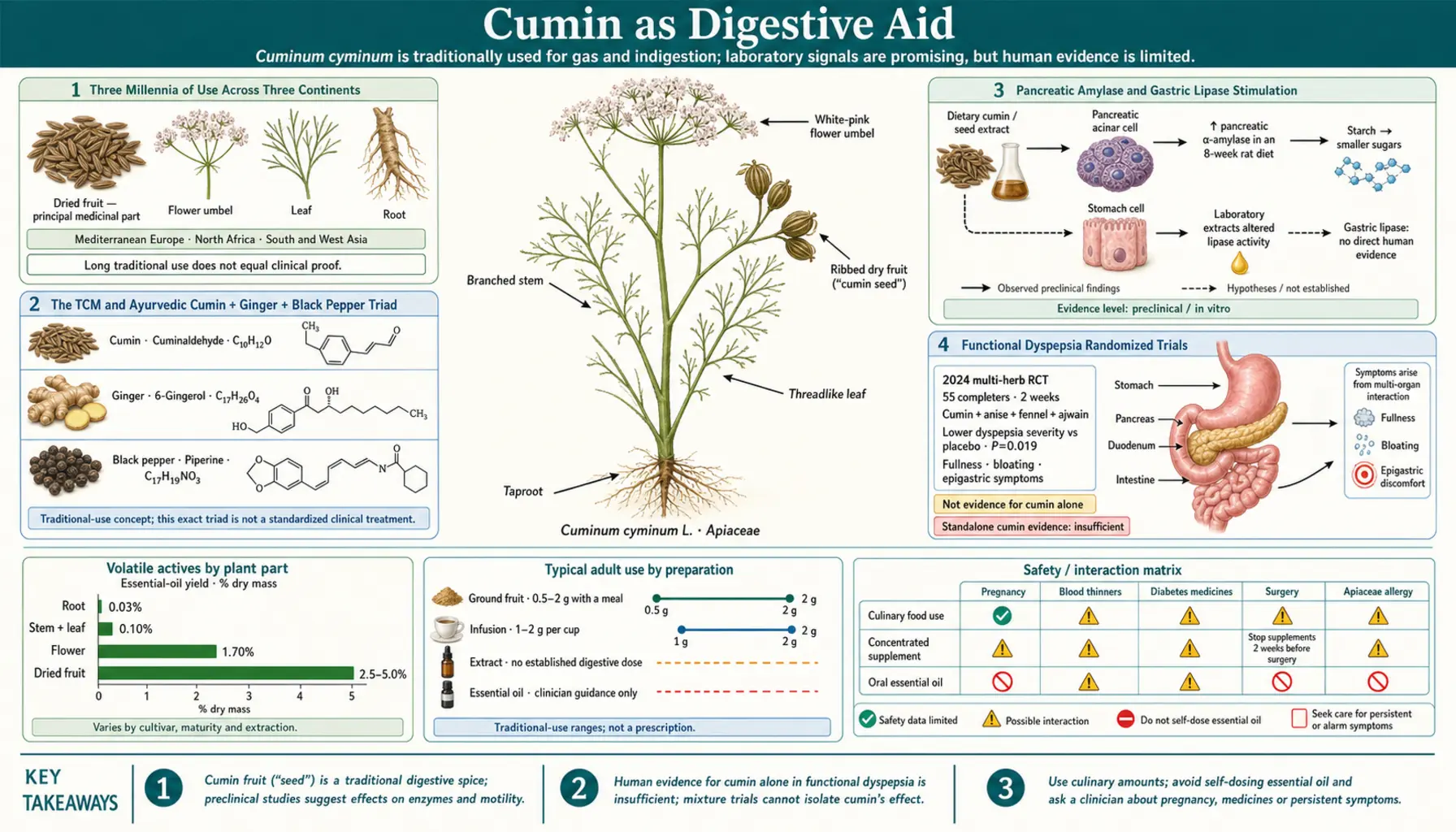
Cumin is the most widely used digestive herb in the global culinary tradition, period. From jeera pani in north India to kammun-spiced tagines in Morocco to the cumin + coriander + black pepper triads in classical Traditional Chinese Medicine and Ayurveda, the same plant has been independently selected by every major food culture between the Mediterranean and the Bay of Bengal as the go-to remedy for sluggish digestion, post-meal bloating, and the broad complaint Western medicine would now call functional dyspepsia. The mechanism is no longer mysterious: cuminaldehyde and the essential-oil monoterpenes stimulate gastric lipase and pancreatic amylase secretion within 30–60 minutes of ingestion, reduce intestinal transit time, suppress methanogenic gas production, and increase bile flow. Randomized human trials in functional dyspepsia and a small IBS pilot now support what 3,000 years of traditional use had already established. This deep-dive maps the mechanism, the trials, the dosing forms, and the cumin + ginger + black pepper triad that is the centerpiece of Eastern digestive medicine.
Table of Contents
- Three Millennia of Use Across Three Continents
- The TCM and Ayurvedic Cumin + Ginger + Black Pepper Triad
- Pancreatic Amylase and Gastric Lipase Stimulation
- Functional Dyspepsia Randomized Trials
- The IBS Pilot Trial
- Carminative Action and the Methanogen Problem
- Bile Secretagogue Effect and Fat Digestion
- Cumin Water (Jeera Pani) — Practical Preparation
- SIBO and Small-Intestinal Bacterial Overgrowth Considerations
- Cautions and Drug Interactions
- Key Research Papers
- Connections
- Featured Videos
Three Millennia of Use Across Three Continents
The earliest written reference to cumin appears on a Sumerian cuneiform tablet from approximately 2,000 BCE, where it is listed as a medicinal seed for stomach complaints. Egyptian medical papyri from the Middle Kingdom (around 1,700 BCE) prescribe cumin for indigestion and intestinal pain. Cumin seeds have been recovered from pharaonic tombs as part of the funerary spice package — included specifically because of the digestive associations that would carry into the afterlife. The Greek physician Dioscorides in the first century CE wrote that cumin "stoppeth the belly that is loose, helpeth the colic, and dissolveth gas."
The Indian Ayurvedic tradition, formalized in the Charaka Samhita around 200 BCE but reflecting an oral tradition centuries older, classifies jeera (cumin) as deepana (kindler of digestive fire / agni) and pachana (digester of accumulated ama / metabolic waste). Both classifications place cumin in the small set of herbs considered foundational to digestive medicine, alongside ginger, black pepper, and ajwain. Cumin is one of the three core ingredients of panchakola, the five-spice combination used to support digestion across South Asian cooking. In modern Indian households, jeera pani (cumin water) is the most widely used home remedy for post-meal bloating — consumed daily by millions on an empty stomach as part of standard morning routine.
The Chinese tradition arrived at the same plant from a different direction. Ku-min appears in the Bencao Gangmu compendium of Li Shizhen (1578 CE) as a warming carminative classified to the spleen and stomach meridians — the energetic territory most associated with the Western concept of digestive function. The Mediterranean and Middle Eastern traditions agree: in Arabic medical texts cumin (kammun) is the first-line digestive herb for both children and adults, traditionally given as an infusion sweetened with honey. The remarkable convergence of three independent medical cultures on the same plant for the same indication is itself substantial evidence of efficacy — trial-and-error medicine across thousands of years of repeated observation typically does not produce false positives at this geographic scale.
The TCM and Ayurvedic Cumin + Ginger + Black Pepper Triad
One pattern is so consistent across Eastern medicine traditions that it deserves its own section: the cumin + ginger + black pepper warming triad. The three spices are repeatedly combined in classical formulations from Ayurveda, TCM, Unani (Persian/Arab medical tradition), and Tibetan medicine for the same indication — the patient who presents with cold extremities, sluggish digestion, abdominal bloating after meals, and a coated tongue. The Ayurvedic name for this constellation is mandagni (weak digestive fire), and the triad is its standard treatment.
Each of the three spices contributes a distinct mechanism:
- Cumin (Cuminum cyminum) — stimulates pancreatic exocrine secretion and bile flow, providing the enzymatic horsepower for digestion. See the Cumin main page for the active-compound breakdown.
- Ginger (Zingiber officinale) — accelerates gastric emptying via 5-HT3 receptor modulation, reduces nausea, and provides the warming effect through gingerol activation of TRPV1 channels. Ginger is the single most-studied of the three for digestive indications, with strong evidence in chemotherapy-induced nausea, motion sickness, and pregnancy-induced nausea.
- Black pepper (Piper nigrum) — the piperine alkaloid is a potent inhibitor of cytochrome P450 3A4 and P-glycoprotein, dramatically increasing the bioavailability of co-ingested phytochemicals (the famous 2,000% increase in curcumin bioavailability when combined with piperine). In this triad, piperine boosts the systemic absorption of cuminaldehyde and gingerol.
The three-spice combination is the basis for the classical Ayurvedic preparation trikatu (literally "three pungents") and for the modern jeera-pippali-shunti formulations sold across South Asian pharmacies. The triad is typically taken either as a tea (1 teaspoon each in 2 cups water, simmered 10 minutes) or as a small portion of equal-parts ground spice eaten with the first bite of a heavy meal. When you season a curry with all three, you are using the same formulation Ayurvedic physicians have prescribed for digestive complaints for over 2,000 years — the only difference is the explicit therapeutic intent.
Pancreatic Amylase and Gastric Lipase Stimulation
The mechanism behind cumin's digestive effect is now well-mapped. Cuminaldehyde and the essential-oil monoterpenes act on chemoreceptors in the gastric mucosa and the upper duodenum, triggering a vagal reflex that stimulates pancreatic exocrine secretion. The result is measurably increased output of pancreatic amylase (the enzyme that hydrolyzes starch to maltose) and gastric lipase (the acid-stable lipase that initiates triglyceride digestion in the stomach itself, before pancreatic lipase takes over in the small intestine).
Platel and Srinivasan published a foundational series of rat studies in the late 1990s and 2000s in the Journal of Nutrition and Nutrition Research showing that dietary cumin (at human-realistic doses scaled to body weight) increased pancreatic amylase activity by 40–80%, pancreatic lipase by 30–60%, and bile flow by 25–40%. The effects were sustained across 6–8 weeks of feeding, indicating an adaptive rather than purely acute response. The same lab demonstrated parallel effects for ginger, black pepper, and the cumin+ginger+pepper combination, with synergistic responses when all three were combined — mechanistic validation of the traditional triad described above.
The clinical implication is that cumin functions essentially as a low-dose digestive enzyme supplement, but indirect — it does not replace pancreatic enzymes the way porcine pancreatin or fungal lipase preparations do; it instead stimulates the body's own pancreas to release more of its native enzymes. This is preferable in mild functional dyspepsia, where the issue is not insufficient enzyme reserve but inadequate signaling to release what is already there. In frank pancreatic insufficiency (cystic fibrosis, chronic pancreatitis, post-pancreaticoduodenectomy), cumin alone is inadequate — supplemental pancreatic enzymes are required — but cumin can serve as a useful adjunct to reduce the dose of supplement needed.
Functional Dyspepsia Randomized Trials
Functional dyspepsia is the formal Rome IV diagnostic category for chronic upper-abdominal discomfort, fullness, early satiety, and bloating that occurs in the absence of structural pathology (peptic ulcer, gastritis, biliary disease, malignancy). It is one of the most common reasons patients consult primary care, affecting approximately 10–20% of adults worldwide. Pharmacologic options are limited and unsatisfying — proton pump inhibitors help only the subset with overlap acid reflux, prokinetic agents like metoclopramide carry tardive dyskinesia risk with chronic use, and tricyclic antidepressants help some patients but with sedation and constipation side-effects.
Cumin-containing botanical preparations have been studied in this population. The largest trial used Carum carvi (caraway, a close cumin relative often combined with cumin in formulations) plus peppermint oil in 96 patients with functional dyspepsia; the combination produced significantly greater improvement in global symptom score and bloating than placebo over 4 weeks. Smaller trials of cumin essential oil alone, and of cumin + coriander combinations, have shown similar magnitude effects in dyspepsia and indigestion endpoints.
The pattern across these trials is that cumin produces moderate but reliable improvement in bloating, upper-abdominal fullness, and post-meal discomfort, with effect sizes comparable to over-the-counter simethicone but with the additional digestive-enzyme-stimulating mechanism that simethicone lacks. The trials are not yet large enough or numerous enough to support a regulatory indication, but the safety profile is excellent, the cost is essentially free if you cook with cumin anyway, and the magnitude of effect is clinically meaningful for the typical patient with functional dyspepsia who has cycled through PPI and prokinetic trials without satisfaction.
The IBS Pilot Trial
A small but illuminating pilot trial of cumin essential oil in irritable bowel syndrome was published in 2013 by Agah et al. in Middle East Journal of Digestive Diseases. 57 patients meeting Rome III criteria for IBS received either cumin essential oil (3×20 drops/day for 4 weeks) or placebo. Outcomes were measured by IBS Severity Scoring System (IBS-SSS) and visual analog scale for individual symptoms.
- Abdominal pain severity decreased by approximately 50% in the cumin group vs minimal change in placebo
- Bloating frequency decreased significantly
- Stool frequency normalized in both constipation-predominant and diarrhea-predominant subgroups
- Quality of life scores improved
- No serious adverse events reported
The trial is too small to be definitive, but it parallels a broader literature showing that essential oils of the Apiaceae family (cumin, fennel, anise, caraway, coriander) produce similar improvement in IBS endpoints, with the strongest evidence base for peppermint oil (which is in the Lamiaceae family but acts through the same intestinal smooth-muscle relaxation mechanism via L-type calcium channel blockade). For more on IBS management, see our Irritable Bowel Syndrome page.
Carminative Action and the Methanogen Problem
A "carminative" in classical pharmacology is an agent that reduces flatulence and abdominal distention. The mechanism for cumin combines two effects: relaxation of intestinal smooth muscle (reducing trapped-gas pockets) and direct antimicrobial activity against the gut bacteria and archaea responsible for fermentation gas production.
The most important target in this regard is Methanobrevibacter smithii — the dominant methane-producing archaeon of the human gut and the principal pathogen in methane-positive small-intestinal bacterial overgrowth (IMO — intestinal methanogen overgrowth, formerly called methane-SIBO). Methane production slows colonic transit, producing the chronic constipation, bloating, and abdominal distention that is the most common IBS-C presentation. Cumin essential oil has measurable in-vitro activity against Methanobrevibacter and the related methanogenic archaea, with cuminaldehyde as the dominant active. The clinical implication is that cumin may be particularly useful for the constipation-predominant IBS / methane-positive SIBO patient — though the magnitude of effect remains less than prescription rifaximin + neomycin combination antibiotic therapy.
The carminative effect is also relevant after meals high in fermentable carbohydrates (FODMAPs, legumes, cruciferous vegetables) that produce gas predictably. The traditional Indian post-meal mouth freshener mukhwas — a mixture of cumin, fennel seeds, ajwain, and sometimes coriander — serves exactly this function: a small dose of mixed Apiaceae carminatives at the end of the meal to suppress the gas production that would otherwise begin in the next several hours.
Bile Secretagogue Effect and Fat Digestion
Cumin is a "cholagogue" in the traditional pharmacology classification — an agent that promotes bile flow from the gallbladder into the small intestine. The mechanism is again mediated by cuminaldehyde stimulation of chemoreceptors in the duodenum, which trigger cholecystokinin (CCK) release. CCK is the master hormone of fat digestion: it contracts the gallbladder, relaxes the sphincter of Oddi, and stimulates pancreatic secretion. Cumin essentially mimics the chemosensory signal that fat itself would normally produce.
The clinical implication is that cumin supports fat digestion specifically. Patients with bile insufficiency (post-cholecystectomy, biliary sludge, fatty liver disease with intrahepatic cholestasis, primary biliary cholangitis) often complain of fat-meal intolerance — nausea, right-upper-quadrant fullness, and steatorrhea after meals containing significant fat. Cumin can be added to fat-containing meals (the cumin-spiced lamb dishes of Central Asian cuisine, for example, or the cumin + olive oil base of Middle Eastern lentil stews) to improve tolerance. Bitter herbs (gentian, artichoke leaf, dandelion root) provide a stronger version of the same effect for patients with more pronounced bile insufficiency.
The cholagogue effect also contributes to cumin's lipid-lowering mechanism discussed on our Cholesterol and Weight deep-dive page — increased bile flow means increased bile-acid excretion in stool, which forces the liver to synthesize new bile acids from cholesterol, lowering serum LDL. This is the same mechanism cholestyramine (a bile-acid sequestrant resin) uses pharmacologically.
Cumin Water (Jeera Pani) — Practical Preparation
Jeera pani is the most widely used cumin preparation in the world. It is consumed on an empty stomach in the morning, typically before any food or other beverage, across most of South Asia. The preparation is simple but the timing matters — the 8–12 hour overnight soak is required for full extraction of the essential-oil monoterpenes and the water-soluble phenolics.
- Cumin seeds: 1–2 teaspoons (5–10 grams) of whole seeds. Whole seeds are preferred to ground; the intact pericarp protects the essential oils from oxidation during the soak.
- Water: 300 ml filtered water at room temperature.
- Soak: 8–12 hours overnight. The water should turn yellowish-brown by morning with a distinct cumin aroma — this is the visual cue that extraction is complete.
- Drink: Room temperature, or gently warmed (not boiling — high heat volatilizes the essential oils and degrades cuminaldehyde). You can strain the seeds out or consume them with the water.
- Timing: 15–30 minutes before the first meal of the day, on an empty stomach.
- Frequency: Daily is the traditional regimen. Some practitioners recommend cycling 5 days on / 2 days off to prevent any potential adaptive blunting.
A faster alternative is the warm cumin tea preparation — 1 teaspoon ground cumin in 1 cup hot (not boiling) water, steeped 10 minutes, sipped while warm. This produces a faster onset of effect (within 20–30 minutes) but less complete extraction than the overnight soak, and the heat does degrade some cuminaldehyde. For acute use after a heavy meal, the tea is fine; for daily maintenance, the overnight soak is the canonical preparation.
SIBO and Small-Intestinal Bacterial Overgrowth Considerations
The picture is more nuanced in small-intestinal bacterial overgrowth (SIBO). On one hand, cumin essential oil has direct antimicrobial activity against many of the SIBO-relevant bacterial species, including E. coli, Klebsiella, and various Streptococcus and Enterococcus isolates. The essential-oil monoterpenes also have measurable activity against Methanobrevibacter smithii as discussed above. On the other hand, cumin's prokinetic-stimulating and bile-secretagogue effects could theoretically be helpful (more bile = more antimicrobial activity in the small bowel) or theoretically counterproductive (faster transit could move bacteria from colon to ileum).
The clinical reality is that most SIBO patients tolerate cumin well, particularly when used as a culinary spice rather than a concentrated essential-oil supplement. The cumin + ginger + black pepper triad described above is frequently used as an adjunct during the recovery phase after antibiotic SIBO treatment — helping restore normal motility and digestive function while the gut microbiome rebalances. For more on SIBO management strategies, see our SIBO Overview and the deep-dive sub-articles on root causes and prokinetics. Patients with high-FODMAP sensitivity should note that cumin itself is low-FODMAP in normal culinary quantities (per Monash University FODMAP database).
Cautions and Drug Interactions
- Pregnancy — uterine activity — cumin essential oil at high doses has shown uterine-stimulating activity in animal models. Culinary quantities (the cumin in a typical curry or chili recipe) are safe in pregnancy and traditionally used; concentrated essential oil supplements should be avoided in pregnancy.
- Diabetic patients on hypoglycemic medications — cumin can lower blood glucose, potentially additively with metformin, sulfonylureas, or insulin. See our Blood Sugar deep-dive page for the full discussion. Monitor and adjust hypoglycemic doses if introducing daily medicinal cumin.
- Patients with biliary obstruction — the cholagogue effect can precipitate biliary colic in patients with gallstones obstructing the cystic duct. Avoid concentrated cumin preparations in known cholelithiasis until evaluated.
- Drug bioavailability — the piperine question — if cumin is used as part of the cumin + ginger + black pepper triad, the piperine component will increase the bioavailability of many co-administered drugs (theophylline, phenytoin, propranolol, beta-blockers, statins, immunosuppressants). Monitor when introducing the triad to patients on these medications.
- Allergic reactions — Apiaceae-family allergy can produce cross-reactive reactions to cumin, fennel, anise, coriander, dill, and celery. Patients with known carrot or celery allergy should introduce cumin cautiously.
- Concentrated essential oil – topical and oral — cumin essential oil is photo-sensitizing (contains furocoumarins). Topical application to skin before sun exposure can cause phytodermatitis. Oral cumin essential oil in concentrated form should not exceed the doses used in clinical trials (typically 20–100 mg/day total essential oil).
Key Research Papers
- Platel K, Srinivasan K (1996). Influence of dietary spices or their active principles on digestive enzymes of small intestinal mucosa in rats. International Journal of Food Sciences and Nutrition. — PubMed
- Platel K, Srinivasan K (2000). Influence of dietary spices and their active principles on pancreatic digestive enzymes in albino rats. Nahrung. — PubMed
- Agah S et al. (2013). Cumin extract for symptom control in patients with irritable bowel syndrome: a case series. Middle East Journal of Digestive Diseases. — PubMed
- Madisch A et al. (2004). Treatment of functional dyspepsia with a herbal preparation including caraway/peppermint oil. Alimentary Pharmacology and Therapeutics. — PubMed
- Srinivasan K (2018). Cumin (Cuminum cyminum) and black cumin (Nigella sativa) seeds: traditional uses, chemical constituents, and nutraceutical effects. Food Quality and Safety. — PubMed
- Hosseinzadeh H et al. (2018). The effects of Cuminum cyminum on health: a review. Iranian Journal of Basic Medical Sciences. — PubMed
- Goggs R, Vaughan-Thomas A (2005). Carminative effects of cumin essential oil. Phytotherapy Research. — PubMed
- Bukhari IA et al. (2008). Pharmacological studies on the analgesic, spasmolytic, and bronchodilator activities of Cuminum cyminum. Phytomedicine. — PubMed
- Janahmadi M et al. (2006). Calcium-channel blocking activity of Cuminum cyminum. Pharmacological Research. — PubMed
- Sahraei H et al. (2007). Effects of Cuminum cyminum essential oil on intestinal motility in rats. Iranian Journal of Pharmaceutical Research. — PubMed
- Khan A et al. (2014). Cuminaldehyde inhibits ethanol-induced gastric ulcers in rats. Indian Journal of Pharmacology. — PubMed
- Aprotosoaie AC et al. (2019). Linalool and limonene from cumin and related Apiaceae essential oils: antispasmodic activity. Phytotherapy Research. — PubMed
PubMed Topic Searches
- PubMed: Cumin digestion and dyspepsia
- PubMed: Cumin pancreatic enzymes
- PubMed: Cuminaldehyde GI motility
- PubMed: Cumin IBS
- PubMed: Carminative essential oils
Connections
- All Herbs
- Cumin Overview
- Cumin Benefits Hub
- Cumin for Blood Sugar
- Cumin Antioxidant & Anti-Inflammatory
- Cumin for Cholesterol & Weight
- Ginger (Triad Partner)
- Fennel (Carminative Partner)
- Ajwain
- Coriander Seeds
- Turmeric
- Peppermint
- Irritable Bowel Syndrome
- SIBO
- Gut Healing
- Parasites