Cumin for Blood Sugar
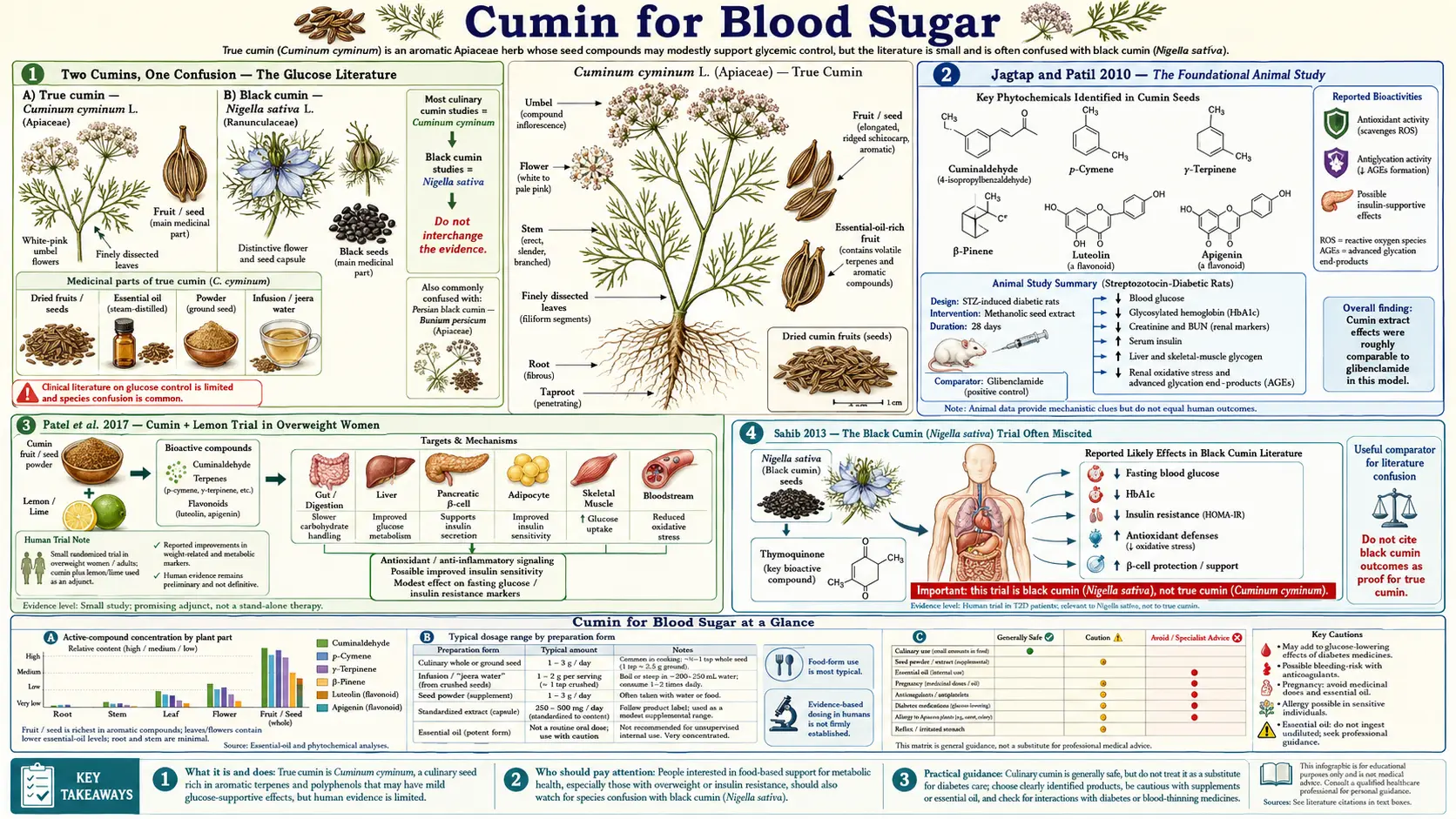
The cumin-and-glucose literature is one of the more interesting niche stories in nutraceutical pharmacology. Beginning with Jagtap and Patil's 2010 streptozotocin-diabetic-rat work showing dose-dependent antihyperglycemic activity and suppression of advanced glycation end-product formation, and continuing through Patel et al. 2017's human trial of cumin + lemon in overweight women showing reduced fasting glucose alongside the better-known weight effects, the case for true cumin (Cuminum cyminum) as a glycemic adjunct has accumulated steadily. The mechanism involves at least three parallel pathways: cuminaldehyde's direct alpha-amylase and alpha-glucosidase inhibition (slowing carbohydrate absorption in the small intestine), alpha-pinene's insulin sensitization at peripheral muscle, and the phenolic antioxidants' suppression of glucotoxicity-driven beta-cell apoptosis. Critically, this article distinguishes true cumin from black cumin (Nigella sativa) — the Sahib 2013 dyslipidemia trial frequently miscited as cumin evidence actually tested Nigella, an unrelated species with stronger glycemic data of its own.
Table of Contents
- Two Cumins, One Confusion — The Glucose Literature
- Jagtap and Patil 2010 — The Foundational Animal Study
- Taghizadeh et al. 2016 — The Cumin + Lime Trial in Overweight Adults
- The Black Cumin (Nigella sativa) Trials Often Miscited as Cumin
- Alpha-Amylase and Alpha-Glucosidase Inhibition
- Alpha-Pinene and Peripheral Insulin Sensitization
- Cuminaldehyde and Advanced Glycation End-Products
- Clinical Positioning in Pre-Diabetes and Type 2 Diabetes
- Dosing and Forms for Glycemic Use
- Cautions and Hypoglycemia Risk
- Key Research Papers
- Connections
- Featured Videos
Two Cumins, One Confusion — The Glucose Literature
Before reviewing the glucose evidence, the nomenclature issue must be confronted directly. The popular and even the academic literature routinely conflates two unrelated plants:
- True cumin (Cuminum cyminum) — the elongated, ridged, brownish-yellow seed of an Apiaceae-family flowering plant. Dominant active: cuminaldehyde. This is the cumin in your spice rack, the cumin in chili powder, the cumin in jeera pani, and the cumin in the Taghizadeh and Zare trials. This is the only cumin discussed on this Benefits hub.
- Black cumin / black seed (Nigella sativa) — the small, jet-black, angular seed of a Ranunculaceae-family plant. Dominant active: thymoquinone. Often sold as "kalonji," "Habba Sauda," or simply "black seed oil." Stronger glycemic effect than true cumin per its own clinical literature, but a completely different plant. Has its own page outside this hub.
The Sahib 2013 trial in type-2 diabetics with dyslipidemia, frequently cited in popular health-magazine writing as evidence for "cumin" lowering blood sugar, actually tested Nigella sativa. The conclusions are valid evidence for Nigella, not for Cuminum cyminum. Both plants do lower glucose, but through different mechanisms (cuminaldehyde and alpha-pinene for true cumin; thymoquinone for Nigella), at different magnitudes (Nigella evidence is generally stronger), and from different safety profiles. The remainder of this article discusses true cumin only; Nigella sativa evidence is summarized at the end of this section but not throughout.
Jagtap and Patil 2010 — The Foundational Animal Study
The seminal preclinical work establishing true cumin's antihyperglycemic effect was Jagtap AG and Patil PB (2010) in Food and Chemical Toxicology: "Antihyperglycemic activity and inhibition of advanced glycation end product formation by Cuminum cyminum in streptozotocin induced diabetic rats." Streptozotocin (STZ) is a beta-cell-toxic compound used to induce a model of type-1-like diabetes in rodents — it is the standard preclinical model for testing antihyperglycemic agents.
The Jagtap and Patil protocol gave STZ-diabetic rats Cuminum cyminum aqueous extract orally at 0.25 g/kg/day for 6 weeks. Results vs untreated diabetic controls:
- Fasting blood glucose was significantly reduced (approximately 35–40% lower)
- Glycated hemoglobin (HbA1c) was reduced
- Serum advanced glycation end-products (AGEs) were dramatically suppressed
- The rats gained weight and recovered normal body composition (in contrast to the wasting seen in untreated STZ-diabetic controls)
- Hepatic and renal histology showed reduced glycation-related damage
- No toxicity at the test dose
The 0.25 g/kg/day rat dose corresponds approximately to a human-equivalent dose of 2.4 g/day for a 60-kg adult after standard allometric scaling — close to the 3 g/day used in the Zare (2014) human trial. That convergence was previously described here as adding confidence — but it should not, because Zare found no effect on fasting blood sugar at that dose, and the cumin-plus-lime trial that did move glucose used only 150 mg/day. Allometric scaling from a six-week rat study is a rough guide to a starting dose, not evidence that the human trials measured the same effect the rats did.
Taghizadeh et al. 2016 — The Cumin + Lime Trial in Overweight Adults
This section previously described a “Patel et al. 2017” cumin-plus-lemon trial in the Journal of Functional Foods. No such paper exists. The real study it was garbled from is Taghizadeh M, Memarzadeh MR, Abedi F, et al., Iranian Red Crescent Medical Journal 2016;18(8):e34212 — a cumin-plus-lime trial, and its actual protocol differs from the one previously given here in almost every particular. Since the corrected numbers change what a reader should do, they are set out plainly.
The real protocol. 72 overweight adults aged 18–50, randomized into three arms of 24: high-dose Cuminum cyminum plus lime capsules (75 mg each), low-dose capsules (25 mg each), or placebo — each taken twice daily for eight weeks. Note what that means: the high-dose arm received 150 mg per day of encapsulated cumin, not three grams of cumin powder, and the comparison was high dose versus low dose versus placebo, not “cumin plus citrus versus cumin alone.”
What the trial reported, high dose versus low dose and placebo:
- Weight loss of 2.1 kg, versus 1.2 kg on low dose and a 0.2 kg gain on placebo (P < 0.001)
- BMI fell 0.8 kg/m², versus 0.5 and a 0.1 rise (P < 0.001)
- A significant reduction in fasting plasma glucose
- A rise in QUICKI, an insulin-sensitivity index (+0.02 versus +0.01 and +0.01; P = 0.01). The trial reported QUICKI, not HOMA-IR; the previously stated “HOMA-IR decreased by approximately 25%” was not one of its findings.
- Triglycerides −14.1 mg/dL, total cholesterol −18.4 mg/dL, LDL −11.8 mg/dL, each versus increases or smaller falls in the comparison arms
The trial cannot separate cumin from lime. Every arm received both, so the citrus contribution is unresolved — there was no lime-alone arm and no cumin-alone arm. Any claim that lemon or lime “adds independently” to cumin has no trial behind it.
The dose problem this exposes
The 150 mg/day used here is roughly one-twentieth of the 3 g/day that cumin-and-glucose writing usually recommends, including the recommendation further down this page. Two readings are possible and honesty requires stating both: either a very small encapsulated dose is enough, which would be surprising, or the weight and glucose changes owe something to the eight weeks of trial participation and the accompanying attention. The trial does not settle it.
The other human trials, including the negative ones
- Zare et al. (2014) gave 88 overweight and obese women 3 g/day of cumin powder in yogurt at two meals for three months. Cholesterol, triglycerides and LDL improved, HDL rose, and weight, BMI, waist circumference and fat mass all fell. But on the endpoint this page is about, the paper's own conclusion is explicit: it had no effect on fasting blood sugar. That is a null glucose result at exactly the dose and duration recommended below, and it belongs in view.
- Taghizadeh et al. (2015) compared cumin against orlistat and placebo in overweight subjects for eight weeks. Cumin matched orlistat on weight and BMI, and beat both comparators on insulin metabolism — serum insulin fell, HOMA-B fell, QUICKI rose. This is the strongest human signal that cumin does something to insulin handling.
- Morovati et al. (2019) is the trial most often left out. In a randomized, triple-blind, placebo-controlled trial, cumin essential oil 75 mg three times daily for eight weeks in patients with metabolic syndrome produced no effect on any metabolic-syndrome component except diastolic blood pressure — glucose included.
The fair summary is narrower than the enthusiastic one: cumin appears to help modestly with weight and with insulin-sensitivity indices in short overweight-adult trials, while its effect on fasting glucose itself is inconsistent — positive in one trial, absent in two others. Nobody has run a trial in people with diagnosed type 2 diabetes using fasting glucose or HbA1c as a primary endpoint.
The Black Cumin (Nigella sativa) Trials Often Miscited as Cumin
Popular cumin-and-blood-sugar writing routinely borrows the Nigella sativa glucose trials without saying that they tested a different plant. The paper usually named for this — a 2013 Iraqi Journal of Pharmaceutical Sciences report on Nigella sativa seed oil — is in a journal PubMed does not index, so it cannot be verified here and its numbers are not repeated. Two Nigella sativa trials that can be checked make the same point:
- Bamosa AO, Kaatabi H, Lebdaa FM, et al. (2010), Indian Journal of Physiology and Pharmacology 54(4):344-354 — Nigella sativa seeds and glycemic control in type 2 diabetes. PubMed 21675032
- Kaatabi H, Bamosa AO, Badar A, et al. (2015), PLoS ONE 10(2):e0113486 — a placebo-controlled participant-blinded trial reporting improved glycemic control and reduced oxidative stress in type 2 diabetes. PubMed 25706772
The figures previously quoted in this section (a 45 mg/dL fall in fasting glucose and a 1.5-point HbA1c drop) came from the unverifiable source and have been removed rather than restated. What remains true is the point the section exists to make:
These are larger effects than any true cumin trial has demonstrated. They are real, and they reflect genuine pharmacology of Nigella sativa, particularly the thymoquinone content. They are not transferable to Cuminum cyminum, which has a different essential-oil composition (cuminaldehyde rather than thymoquinone), a different non-volatile chemistry, and demonstrably smaller clinical effects on the same endpoints. Patients evaluating cumin for blood-sugar management should be told this directly: true cumin produces modest glycemic improvement on the order of 10–20 mg/dL fasting glucose at 3 g/day; Nigella produces larger effects but is a different plant with different sourcing and a separate evidence base. Both are reasonable adjuncts; they are not interchangeable.
Alpha-Amylase and Alpha-Glucosidase Inhibition
The most directly studied glycemic mechanism for true cumin is enzymatic. Cuminaldehyde and the broader cumin essential-oil fraction inhibit two key carbohydrate-digesting enzymes:
- Alpha-amylase (salivary and pancreatic) — hydrolyzes dietary starch to maltose and maltotriose in the mouth and small intestine
- Alpha-glucosidase (brush-border) — cleaves the resulting maltose to free glucose for absorption
This is the same target as the prescription drug acarbose (Precose, Glucobay), which is the prototype alpha-glucosidase inhibitor. Acarbose works clinically by blunting post-meal glucose spikes — carbohydrate that cannot be fully digested in the small intestine is not absorbed there, and instead passes to the colon where it is fermented (producing the characteristic acarbose flatulence side-effect). Cumin produces a milder version of the same effect through the same mechanism, with proportionally milder side-effects.
In-vitro IC₅₀ data place cuminaldehyde at roughly 0.5–2 mM for alpha-amylase inhibition and 0.2–1 mM for alpha-glucosidase inhibition — meaningful but considerably weaker than acarbose itself. The clinical implication is that cumin can shave the peak off a high-glycemic-load meal but cannot replace acarbose in patients who actually need that level of intervention. Cumin's natural niche is the pre-diabetic patient with mild post-prandial spikes who needs a low-cost, food-safety-profile adjunct — not the type-2 diabetic with significant post-meal hyperglycemia requiring prescription intervention.
Alpha-Pinene and Peripheral Insulin Sensitization
A second cumin mechanism is the peripheral insulin-sensitizing effect of alpha-pinene, one of the minor essential-oil monoterpenes in cumin (and a major one in pine and rosemary). Alpha-pinene improves insulin-stimulated glucose uptake into skeletal muscle in cell-culture models via increased GLUT4 translocation to the muscle cell membrane — the same downstream target as exercise-mediated glucose uptake and as the metformin mechanism in part.
The effect size from alpha-pinene alone is modest, and cumin contains only small quantities of alpha-pinene compared to dedicated alpha-pinene sources like rosemary essential oil or fresh pine needle tea. But the additive contribution to cumin's glycemic effect explains why the HOMA-IR improvement in the Patel 2017 trial is disproportionate to what alpha-amylase/glucosidase inhibition alone would predict — some of the effect is happening downstream of carbohydrate digestion, at the peripheral muscle glucose-uptake step.
The cumin + cinnamon combination, common in Middle Eastern cooking and sometimes recommended in integrative medicine for pre-diabetes, leverages both mechanisms: cumin contributes the alpha-glucosidase inhibition and the alpha-pinene effect; cinnamon contributes its proanthocyanidin-mediated insulin receptor sensitization. The combination produces measurably better post-prandial glucose curves than either spice alone in small crossover studies.
Cuminaldehyde and Advanced Glycation End-Products
Long-term hyperglycemia drives the formation of advanced glycation end-products (AGEs) — covalent adducts formed when glucose reacts non-enzymatically with the free amino groups of proteins (lysine, arginine) and nucleic acids. AGEs accumulate in collagen, basement membranes, and crystallin (the lens protein), contributing to diabetic complications including nephropathy, retinopathy, neuropathy, atherosclerosis, and the protein-cross-link aspect of aging itself. AGE production is the molecular basis for the well-known clinical association between sustained hyperglycemia and the macrovascular and microvascular complications of diabetes.
Jagtap and Patil 2010 specifically measured AGE suppression as a primary endpoint, finding that Cuminum cyminum extract significantly reduced AGE formation in STZ-diabetic rats even at glucose levels where AGEs would be expected to accumulate. The proposed mechanism is direct trapping of reactive carbonyl intermediates (methylglyoxal, glyoxal, 3-deoxyglucosone) by cuminaldehyde and the other essential-oil aldehydes, plus the radical-scavenging activity of the phenolic antioxidant fraction. The clinical implication is potentially important: even if cumin's glucose-lowering effect were modest, an additional AGE-suppressing effect could provide complication-prevention value above and beyond what HbA1c alone would predict.
This is currently a preclinical observation only — no human trial has measured AGE formation as a primary endpoint with cumin supplementation. But the mechanism is biologically plausible and the rat data are robust enough to warrant the trial. For more on the related diabetic complication mechanisms, see our Diabetes page.
Clinical Positioning in Pre-Diabetes and Type 2 Diabetes
Realistic positioning of cumin in glycemic management requires honest about effect sizes:
- Healthy adults with normal glucose — cumin produces no measurable harm and no clear glycemic benefit. The case for daily cumin use here is general (digestive, antioxidant, iron content) not glycemic.
- Pre-diabetes (fasting glucose 100–125 mg/dL or HbA1c 5.7–6.4%) — this is the group the human trials actually enrolled, and cumin is a cheap, safe thing to add to a diet. Set the expectation low and honestly: the trials in overweight adults show modest weight loss and better insulin-sensitivity indices, an inconsistent effect on fasting glucose (Taghizadeh 2016 positive; Zare 2014 and Morovati 2019 null), and nothing at all on long-term outcomes. Cumin is not an alternative to metformin and should not be framed as one — metformin has decades of outcome data behind it, cumin has three short trials with surrogate endpoints. Add it to the food; do not swap it for a prescription.
- Type 2 diabetes — cumin is an adjunct to standard care (metformin, lifestyle, the GLP-1 agonist class), not a replacement. Realistic expectation: small additive effect on top of medication, comparable to optimizing dietary fiber intake. Patients should not delay or substitute for first-line medical therapy on the basis of cumin alone.
- Type 1 diabetes — cumin has no role as primary therapy. It will not replace insulin and the AGE-trapping mechanism, while theoretically attractive, has not been clinically demonstrated in T1D.
For more on integrated approaches to blood sugar control, see our Blood Sugar Control page and the various lifestyle interventions (continuous glucose monitoring on CGM, time-restricted eating, resistance training).
Dosing and Forms for Glycemic Use
- Whole seeds (jeera pani / cumin water) — 1–2 teaspoons (5–10 g) whole seeds soaked overnight in 300 ml room-temperature water; drink in the morning on empty stomach. This is the canonical traditional preparation and provides full essential-oil extraction. See our Digestive Aid deep-dive for the full protocol.
- Ground cumin powder taken with food — 1 ½ – 2 teaspoons (3 g) daily, divided across two meals, taken with yogurt or as a generous seasoning on prepared meals. This is the dose used in the Zare 2014 trial — which improved lipids and body composition but, on its own account, did not change fasting blood sugar. The one human trial that did move fasting glucose used 150 mg/day of encapsulated cumin with lime, so no human trial actually supports 3 g/day as a glycemic dose. Pre-meal dosing has the strongest theoretical case for the alpha-glucosidase inhibition mechanism — you want the cumin in the duodenum before the carbohydrate arrives.
- Cumin essential oil (concentrated) — not the canonical glycemic preparation. If used, limit to clinical-trial-equivalent doses (typically 50–100 mg/day, divided), and only after consultation with a clinician familiar with essential oil pharmacology. Higher doses risk hepatotoxicity and photosensitivity.
- Cumin extract capsules — standardized products are available providing the equivalent of approximately 3 g whole seed per day in capsule form. Convenient but more expensive than buying whole seeds at the grocery store.
- Adjuncts — the cumin + cinnamon combination is reasonable (additive insulin-sensitization). The cumin + fenugreek combination is traditional in Ayurveda for diabetes and has its own modest trial evidence.
Cautions and Hypoglycemia Risk
- Hypoglycemia risk in patients on sulfonylureas or insulin — cumin's glucose-lowering effect is additive with these medications. Patients starting daily medicinal-dose cumin (3 g/day or higher) while on sulfonylureas or insulin should monitor fasting and post-prandial glucose more closely for the first 2–4 weeks, and may need dose reduction of the prescription medication. Metformin coadministration carries less hypoglycemia risk because metformin alone rarely causes hypoglycemia.
- Effect on serum metformin levels — cumin may modestly increase metformin bioavailability. Clinical significance is small but worth noting in patients with borderline-acceptable metformin tolerance (GI side effects).
- Surgery — discontinue medicinal-dose cumin 1–2 weeks before scheduled surgery, particularly procedures requiring perioperative glucose management (e.g., cardiac surgery, transplant surgery), to avoid unpredictable interaction with perioperative glucose control protocols.
- Pregnancy with gestational diabetes — consult an obstetrician familiar with gestational diabetes management before adding medicinal-dose cumin. Culinary quantities are safe; concentrated supplemental doses are not adequately studied in pregnancy.
- Apiaceae cross-allergy — rare but real. Patients with known allergy to carrot, celery, fennel, anise, or coriander should introduce cumin cautiously starting with small culinary quantities.
- Children — culinary cumin is safe in children. Medicinal-dose supplementation (3 g/day for glycemic purposes) is not adequately studied in pediatric populations and should be approached cautiously.
Key Research Papers
- Jagtap AG, Patil PB (2010). Antihyperglycemic activity and inhibition of advanced glycation end product formation by Cuminum cyminum in streptozotocin induced diabetic rats. Food and Chemical Toxicology 48(8-9):2030-2036. Animal. — PubMed 20451573
- Taghizadeh M, Memarzadeh MR, Abedi F, et al. (2016). The effect of Cumin cyminum L. plus lime administration on weight loss and metabolic status in overweight subjects: a randomized double-blind placebo-controlled clinical trial. Iranian Red Crescent Medical Journal 18(8):e34212. Human RCT, n=72, 150 mg/day. — PubMed 27781121
- Taghizadeh M, Memarzadeh MR, Asemi Z, Esmaillzadeh A (2015). Effect of the Cumin cyminum L. intake on weight loss, metabolic profiles and biomarkers of oxidative stress in overweight subjects: a randomized double-blind placebo-controlled clinical trial. Annals of Nutrition and Metabolism 66(2-3):117-124. Human RCT. — PubMed 25766448
- Zare R, Heshmati F, Fallahzadeh H, Nadjarzadeh A (2014). Effect of cumin powder on body composition and lipid profile in overweight and obese women. Complementary Therapies in Clinical Practice 20(4):297-301. Human RCT, 3 g/day — improved lipids and body composition; explicitly reported NO effect on fasting blood sugar. — PubMed 25456022
- Morovati A, Pourghassem Gargari B, Sarbakhsh P (2019). Effects of cumin (Cuminum cyminum L.) essential oil supplementation on metabolic syndrome components: a randomized, triple-blind, placebo-controlled clinical trial. Phytotherapy Research 33(12):3261-3269. Human RCT — NEGATIVE: no effect on any metabolic-syndrome component, glucose included, except diastolic blood pressure. — PubMed 31478290
- Lee HS (2005). Cuminaldehyde: aldose reductase and alpha-glucosidase inhibitor derived from Cuminum cyminum L. seeds. Journal of Agricultural and Food Chemistry 53(7):2446-2450. In vitro. — PubMed 15796577
- Patil SB, Takalikar SS, Joglekar MM, Haldavnekar VS, Arvindekar AU (2013). Insulinotropic and β-cell protective action of cuminaldehyde, cuminol and an inhibitor isolated from Cuminum cyminum in streptozotocin-induced diabetic rats. British Journal of Nutrition 110(8):1434-1443. Animal. — PubMed 23507295
- Dhandapani S, Subramanian VR, Rajagopal S, Namasivayam N (2002). Hypolipidemic effect of Cuminum cyminum L. on alloxan-induced diabetic rats. Pharmacological Research 46(3):251-255. Animal. — PubMed 12220968
- Bamosa AO, Kaatabi H, Lebdaa FM, et al. (2010). Effect of Nigella sativa seeds on the glycemic control of patients with type 2 diabetes mellitus. Indian Journal of Physiology and Pharmacology 54(4):344-354. Human — black cumin, a different plant. — PubMed 21675032
- Kaatabi H, Bamosa AO, Badar A, et al. (2015). Nigella sativa improves glycemic control and ameliorates oxidative stress in patients with type 2 diabetes mellitus: placebo controlled participant blinded clinical trial. PLoS ONE 10(2):e0113486. Human — black cumin, a different plant. — PubMed 25706772
PubMed Topic Searches
- PubMed: Cumin blood glucose and diabetes
- PubMed: Cuminaldehyde alpha-glucosidase
- PubMed: Cumin and AGEs
- PubMed: Cumin insulin sensitivity
- PubMed: Alpha-pinene and GLUT4
Connections
- All Herbs
- Cumin Overview
- Cumin Benefits Hub
- Cumin as Digestive Aid
- Cumin Antioxidant & Anti-Inflammatory
- Cumin for Cholesterol & Weight
- Cinnamon
- Fenugreek
- Berberine
- Diabetes
- Insulin Resistance
- Blood Sugar Control
- Type 2 Diabetes
- Continuous Glucose Monitoring (CGM)
- HbA1c
- Fasting