Fennel (Foeniculum vulgare)
Names in Buddhist tradition: "The Herb That Harmonizes Everything" / "The Herb That Balances the Three Bodily Humors"
Description
- Elongated seeds with slightly sweet flavor and licorice aroma
- Buddhist tradition holds that fennel has been revered in its medicine for over 2,500 years
- Traditionally described as the "conductor" that makes all other herbs work together in harmony
- The tradition holds that it suits every body constitution, age and physical condition; the safety record is more specific (see Safety Facts About Fennel below)
- In the tradition, monks are said to have chewed fennel seeds ritually after every meal
- Fennel is generally well tolerated in adults, according to the U.S. National Library of Medicine's breastfeeding-drug database (LactMed); in young children, long-term use of fennel preparations has been linked to early breast development (premature thelarche), and a toxicology study found estragole safety margins for children drinking fennel tea long-term small, but wide when use was limited to 1–2 weeks (see Safety Facts About Fennel below)
Key Active Compounds
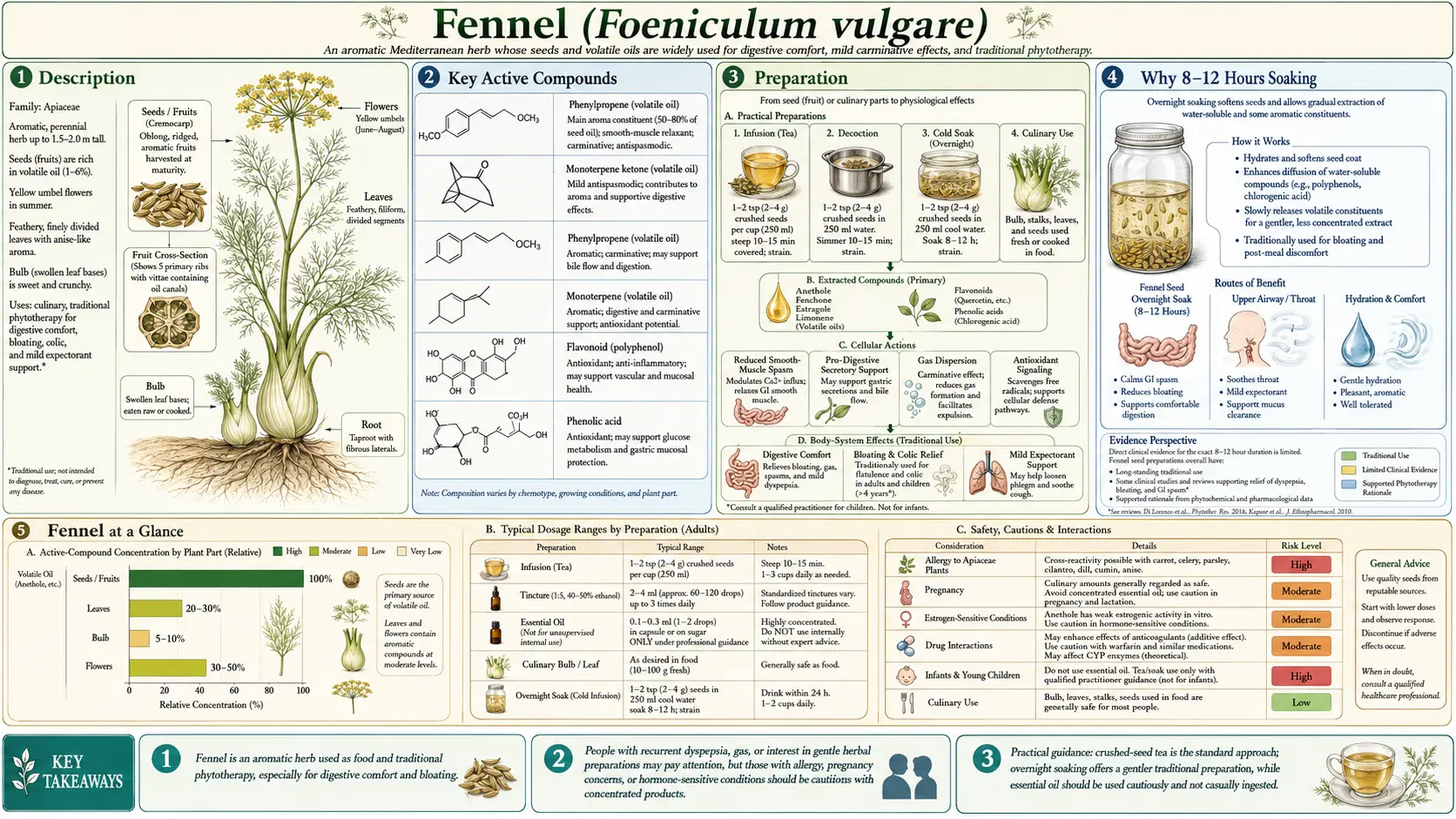
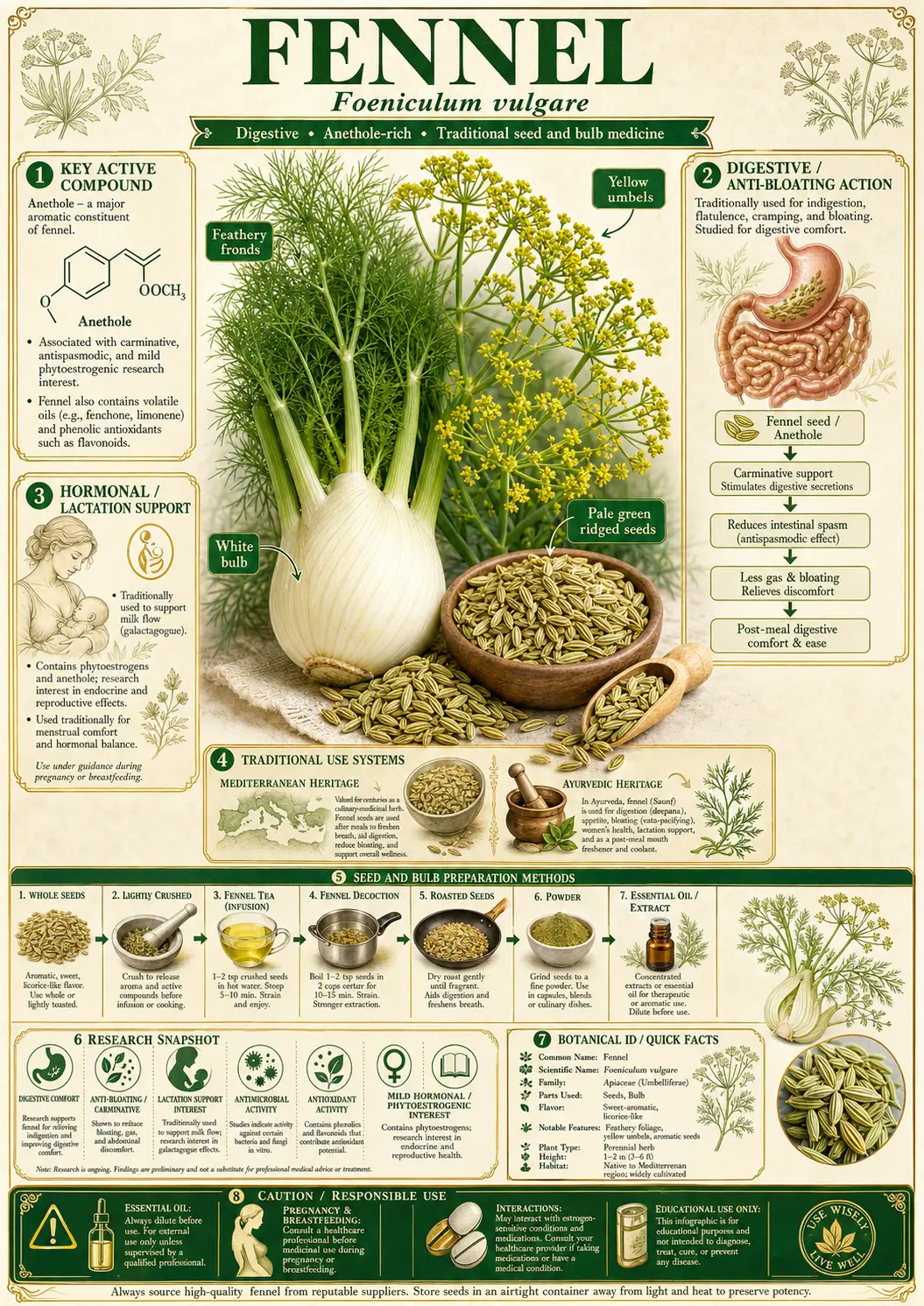
- Anethole: Main active compound (gives sweet flavor); responsible for most therapeutic effects
- Fenchone, Estragole, Limonene: Volatile oils with antimicrobial activities
- Quercetin and Kaempferol: Flavonoids with antioxidant and anti-inflammatory properties
- Natural phytoestrogens: Plant compounds that gently mimic estrogen; anethole, the main component of the seed oil, is itself a phytoestrogen (LactMed)
- Antispasmodic compounds
- Rich in dietary fiber, vitamin C, potassium, manganese, iron, folic acid, calcium
Health Benefits
Complete Digestive Health & Gas Relief
- Traditionally used as a carminative (a remedy said to prevent gas formation and help expel existing gas)
- Relieves abdominal bloating, painful cramps, and trapped air
- Anethole relaxes gastrointestinal tract muscles
- Stimulates secretion of digestive juices and enzymes
- Improves breakdown of complex proteins, heavy fats, and carbohydrates
- Irritable Bowel Syndrome (IBS): in a 2018 open pilot study with no placebo group, 211 people with IBS took capsules combining turmeric extract and fennel essential oil for two months; symptom-severity scores fell and quality of life improved in every IBS subtype. Fennel was not tested on its own (Di Ciaula 2018)
- Relieves acid reflux and gastritis
Infant Colic
- In a randomized, placebo-controlled trial in two clinics, 125 colicky infants aged 2 to 12 weeks were given a fennel-seed-oil emulsion or placebo; colic (by the Wessel crying criteria) ended in 65% (40 of 62) of the fennel group against 23.7% (14 of 59) on placebo, and no side effects were reported in either group during the trial (Alexandrovich 2003)
Natural Hormonal Balance for Women
- Anethole, fennel's main oil compound, is a phytoestrogen (LactMed), and traditional use credits fennel with balancing hormones. The estrogen-like effect is not risk-free: long-term use of fennel preparations in young children has been linked to early breast development (Türkyilmaz 2008)
- Helps restore menstrual regularity (irregular periods, polycystic ovary syndrome (PCOS), absent cycles)
- Relieves intense menstrual cramps by relaxing uterine muscles and reducing pelvic inflammation
- Many women report cramps become manageable or disappear completely after several cycles
- Menstrual cramps trial: in a 2026 triple-blind crossover trial, 384 women aged 18–26 in India took fennel (480 mg), ginger (500 mg) or placebo capsules every 8 hours for the first three days of menstruation; on a 10-point pain scale, pain fell to 4.61 with fennel and from 6.14 to 3.28 with ginger, while placebo showed little change (6.24) — ginger did better than fennel (Negi 2026)
- Menopause: traditionally used for hot flashes, mood swings and insomnia. In a 2017 randomized, triple-blind trial, 90 postmenopausal women aged 45–60 in Tehran took 100 mg fennel soft capsules twice a day or placebo for 8 weeks; Menopause Rating Scale scores fell significantly more with fennel at 4, 8 and 10 weeks, with no serious side effects; the authors call for larger trials (Rahimikian 2017)
Eye Health & Visual Clarity
- Traditionally used for millennia to improve vision
- Traditionally used to protect against age-related eye degeneration (cataracts, macular degeneration)
- Antioxidants protect delicate eye cells against free radical damage
- Anethole's anti-inflammatory properties reduce swollen, red, irritated eyes
- A story told in Buddhist tradition says monks reading by candlelight used fennel water to keep sharp vision even at ages 90-100
Preparation
The traditional cold-soak preparation is described below.
- Amount: 1 generous tablespoon (10-12 grams) of seeds (what is known about long-term use and use in children is under Safety Facts About Fennel below)
- The seeds are lightly crushed with a mortar and pestle or the back of a spoon, which breaks the outer shell so the aromatic oils come out faster
- Water: 300-400 ml filtered water at room temperature
- Soak: 8-12 hours overnight, covered with a breathable cloth
- Sign of readiness: the water turns slightly yellowish or light green, with a sweet, pleasant aroma
- Drinking: traditionally drunk on an empty stomach or 20 minutes before meals
- The softened seeds are either strained out or chewed (they become soft and sweet-flavored)
Why 8-12 Hours Soaking
These are the practitioners' explanations for the long soak; they are not measured results.
- First hours: Only superficial sweet flavor dissolves; deep compounds locked
- 4-6 hours: Water penetrates deeper but hasn't reached essential oil pockets where anethole and fenchone are concentrated
- 8+ hours: Practitioners describe this as the full release of phytoestrogens, antioxidants, anti-inflammatory compounds, and volatile oils
- 12 hours: Practitioners describe this as the point of maximum benefit — a drink they say balances hormones, calms digestion, reduces inflammation, and harmonizes the entire system
Safety Facts About Fennel
- Adults: fennel is generally well tolerated in adults, and the U.S. Food and Drug Administration lists fennel oil as "generally recognized as safe" (GRAS) for use in food (LactMed).
- Early breast development in young children: Turkish pediatric surgeons reported that long-term use of fennel preparations, which are given to children for gas and to regulate the bowels, may cause premature thelarche — breast development, usually before age 2, with no other signs of puberty — and wrote that such use should be limited (Türkyilmaz 2008).
- Breastfed newborns: LactMed reports that heavy use by a mother of an herbal tea containing fennel, anise and other herbs appeared to cause toxicity in 2 breastfed newborns, consistent with anethole toxicity; it notes that some sources limit treatment to 2 weeks.
- Allergy and sunlight: fennel can cause allergic reactions of the airways or skin after eating it or putting it on the skin, including photosensitivity (a skin reaction to sunlight); LactMed lists possible cross-allergy in people allergic to carrots, celery or other plants of the carrot family (Apiaceae).
- Liver reports: LactMed lists diarrhea and an enlarged liver in a woman taking fennel, fenugreek and goat's rue to increase milk supply, and raised liver enzymes in another woman drinking a fennel-containing nursing tea.
- Estragole: a 2014 analysis found 0.15 to 13.3 mg of estragole per gram of dry fennel product, much less in the tea itself, and about 3 times less in tea made from whole seeds than from finely cut fennel. Comparing the intake from 1–3 cups a day with animal tumour data, the authors found a low priority for risk management in adults, especially at one cup a day; for children drinking fennel tea the margins of exposure were generally below 10,000, which they class as a priority for risk management, but with use limited to 1–2 weeks the margins were about 1,000 times higher and there was no priority (van den Berg 2014).
Key Research Papers
The numbered list gives the studies and reference works this page draws on, each closing with its fixed PubMed record. The PubMed topic searches below it open live searches into the wider fennel (Foeniculum vulgare) literature at the National Library of Medicine.
- Alexandrovich I, Rakovitskaya O, Kolmo E, Sidorova T, Shushunov S. The effect of fennel (Foeniculum vulgare) seed oil emulsion in infantile colic: a randomized, placebo-controlled study. Alternative Therapies in Health and Medicine. 2003;9(4):58-61. — PubMed PMID: 12868253
- Negi R, Sharma SK, Madar IH, Bahadur A, Chinannai KS. Efficacy of ginger and fennel in relieving primary dysmenorrhea: a triple-blind crossover controlled trial. Journal of Education and Health Promotion. 2026;15:360. — PubMed PMID: 42829743
- Rahimikian F, Rahimi R, Golzareh P, Bekhradi R, Mehran A. Effect of Foeniculum vulgare Mill. (fennel) on menopausal symptoms in postmenopausal women: a randomized, triple-blind, placebo-controlled trial. Menopause. 2017;24(9):1017-1021. — PubMed PMID: 28509813
- Di Ciaula A, Portincasa P, Maes N, Albert A. Efficacy of bio-optimized extracts of turmeric and essential fennel oil on the quality of life in patients with irritable bowel syndrome. Annals of Gastroenterology. 2018;31(6):685-691. (Open pilot study of a turmeric and fennel-oil combination, no placebo group.) — PubMed PMID: 30386118
- Drugs and Lactation Database (LactMed). Fennel. Bethesda (MD): National Institute of Child Health and Human Development; 2006–. (Fennel as a galactagogue in lactating women; safety in breastfeeding.) — PubMed PMID: 30000852
- Türkyilmaz Z, Karabulut R, Sönmez K, Can Başaklar A. A striking and frequent cause of premature thelarche in children: Foeniculum vulgare. Journal of Pediatric Surgery. 2008;43(11):2109-11. — PubMed PMID: 18970951
- van den Berg SJ, Alhusainy W, Restani P, Rietjens IM. Chemical analysis of estragole in fennel based teas and associated safety assessment using the Margin of Exposure (MOE) approach. Food and Chemical Toxicology. 2014;65:147-54. — PubMed PMID: 24384409
PubMed Topic Searches
- Fennel for menopausal symptoms. — PubMed: fennel menopause hot flashes
- Anethole: pharmacology and estrogenic activity. — PubMed: anethole pharmacology
- Antispasmodic activity of fennel extracts. — PubMed: Foeniculum vulgare antispasmodic
- Antioxidant pharmacology of Foeniculum vulgare. — PubMed: fennel antioxidant
- Antimicrobial activity of fennel essential oil. — PubMed: fennel antimicrobial
- Fennel in polycystic ovary syndrome. — PubMed: fennel PCOS polycystic
- Fennel and metabolic markers: clinical evidence. — PubMed: fennel glucose lipid metabolic
External Authoritative Resources
Connections
- All Herbs
- Fennel Benefits Deep Dive
- Irritable Bowel Syndrome
- Gut Healing
- Coriander Seeds
- Fenugreek
- Ginger
- Cumin
- Ajwain
- Polycystic Ovary Syndrome
- Bloating
- Reflux
- Chamomile
- Lemon Balm
- Turmeric
- Potassium
- Vitamin C
- Peppermint
- Peppermint Probiotics and Herbals
- Chen Pi (Aged Tangerine Peel) — aged citrus peel used to keep tonic formulas from causing bloating
- Caraway