Codonopsis (Dang Shen) and Immune Modulation
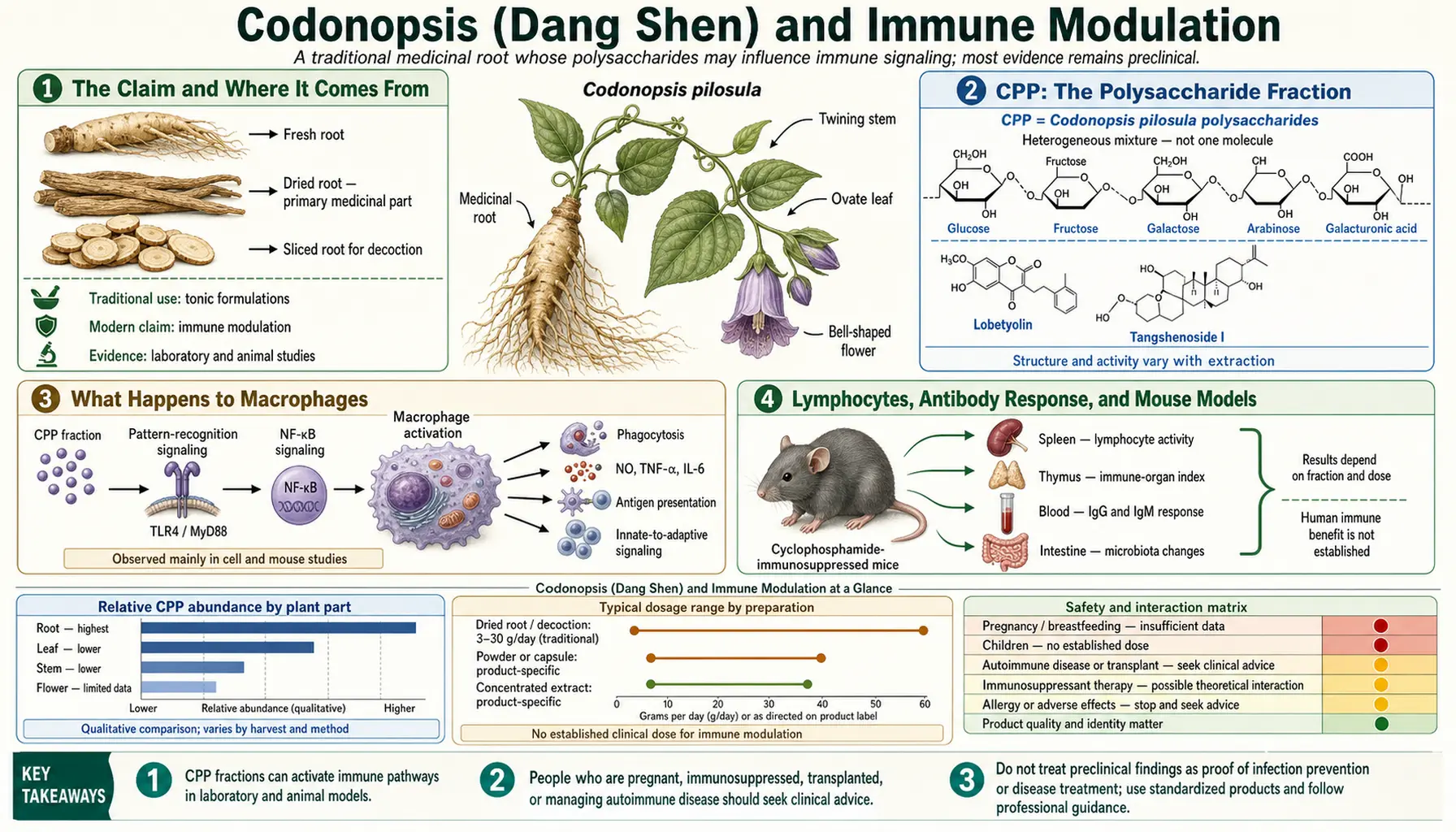
If you search for Codonopsis in English, the first thing you will read is that it "boosts immunity." That phrase is doing a lot of work, and most of it is wrong. What the laboratory literature actually shows is that a water-soluble polysaccharide fraction from Codonopsis pilosula root changes how certain immune cells behave in a dish and in mice. That is a genuine and reproducible finding. It is also several very large steps away from "this herb will stop you catching a cold," and no published human trial has closed that gap for Codonopsis on its own.
This page walks through what the polysaccharides do, why "modulation" is a better word than "boosting," what the traditional Lung-qi framing was actually describing, and — importantly — who should not take this herb at all.
Table of Contents
- The Claim and Where It Comes From
- CPP: The Polysaccharide Fraction
- What Happens to Macrophages
- Lymphocytes, Antibody Response, and Mouse Models
- The Gut Route: Why Fibre Talks to the Immune System
- Why "Immune Boosting" Is the Wrong Frame
- What Human Evidence Exists
- Autoimmune Disease and Immunosuppressants
- Practical Use and Realistic Expectations
- Key Research Papers
- Connections
- Featured Videos
The Claim and Where It Comes From
In Chinese medicine Codonopsis is a Lung and Spleen qi tonic. The Lung-qi part of that description is the origin of every modern immune claim about the herb, but the traditional syndrome it addresses is not "weak immunity" in the immunological sense. It describes a specific patient picture: weak voice, shortness of breath on mild exertion, spontaneous daytime sweating, pallor, and a pattern of catching respiratory infections repeatedly and recovering from them slowly. Codonopsis appears in formulas aimed at that picture — most famously Bu Zhong Yi Qi Tang, the "tonify the middle and augment qi" formula, and Yu Ping Feng San-style combinations where Astragalus does the heavy lifting.
When Chinese pharmacology laboratories began screening traditional tonics in the second half of the twentieth century, that Lung-qi indication is what pointed them at immune assays. They found something — but what they found is narrower than the folk claim that inspired the search.
CPP: The Polysaccharide Fraction
Almost all of the immune research on this herb is research on Codonopsis pilosula polysaccharides, usually abbreviated CPP in the literature. These are long chains of sugar units — glucose, galactose, arabinose, fructose, and uronic acids in varying proportions — extracted with hot water and precipitated with alcohol. A large part of the fraction is inulin-type fructan, the same class of storage carbohydrate found in chicory and Jerusalem artichoke.
Three things follow from that, and they matter for anyone reading a supplement label:
- Water extraction is essential. Polysaccharides are large and polar. They come out into hot water; they largely do not come out into strong alcohol. A high-proof tincture is not delivering the fraction the immune papers studied. Traditional decoction is, as it happens, the correct extraction method for this particular chemistry.
- "CPP" is not one molecule. Every research group extracts and purifies slightly differently and names its fraction differently — CPP-1, CPPS, LCP, and so on. Two papers reporting "immunomodulatory activity of CPP" may be studying materially different mixtures. This is a well-known limitation of the whole plant-polysaccharide field, not a Codonopsis-specific flaw.
- Endotoxin is the field's oldest trap. Bacterial lipopolysaccharide activates macrophages powerfully at vanishingly small concentrations, and plant polysaccharide preparations can carry it. Careful modern papers run endotoxin controls, such as polymyxin B blockade; older papers frequently did not. When a paper reports dramatic macrophage activation without that control, treat the result cautiously.
What Happens to Macrophages
The most repeated experiment in this literature uses RAW 264.7 cells, an immortalised mouse macrophage line that has served as the workhorse of natural-product immunology for decades. Cells are grown in culture, a Codonopsis polysaccharide fraction is added, and the researchers measure what the cells do next.
The typical reported result: increased phagocytic uptake, increased nitric oxide output, and increased secretion of signalling proteins such as tumour necrosis factor alpha and interleukin-6. Mechanistically, several groups have implicated pattern-recognition receptors — the sensors macrophages use to detect microbial carbohydrates — with downstream signalling through NF-κB and MAPK pathways. In plain language: the macrophage's own microbe-detection machinery reads a large plant sugar as "something worth reacting to" and switches into a more alert, more inflammatory state.
That is a real observation. Here is what it is not. A macrophage in a plastic dish, bathed directly in milligrams of purified polysaccharide, is not a macrophage in your spleen after you drank a bowl of soup. Large polysaccharides are poorly absorbed intact from the human gut. The concentrations used in vitro are usually far above anything achievable in blood. And "more TNF-α and more nitric oxide" is not automatically desirable — those are the same molecules that drive the misery of an inflammatory illness. In vitro macrophage activation is a hypothesis-generating result, not a health benefit.
Lymphocytes, Antibody Response, and Mouse Models
Beyond macrophages, Codonopsis polysaccharides have been tested on lymphocyte proliferation — the ability of T and B cells to multiply when stimulated — and in whole-animal models. Reported findings across various rodent studies include higher spleen and thymus weight relative to body weight, higher lymphocyte proliferation indices, higher antibody titres after immunisation, and partial restoration of immune parameters in mice deliberately immunosuppressed with cyclophosphamide.
The cyclophosphamide model deserves comment because it recurs constantly in Chinese herbal pharmacology. A chemotherapy drug is used to knock down the animal's bone marrow and immune cell counts, then the herb is given to see whether the numbers recover faster. The model is useful for detecting a real biological signal, and it is the model behind many "Codonopsis restores immunity" headlines. But restoring a drug-flattened immune system in a mouse is a different question from improving a normal immune system in a healthy person, and it does not establish that the herb is safe or useful alongside chemotherapy in humans — a question that would need clinical trials nobody has run.
The Gut Route: Why Fibre Talks to the Immune System
There is a more physiologically plausible route by which an orally consumed polysaccharide could influence immunity, and it does not require the molecule to be absorbed at all.
Roughly seventy percent of the body's immune cells sit in or around the gut wall, in the mucosa-associated lymphoid tissue. The intestine is where the immune system does most of its daily work: deciding, continuously, which of the trillions of microbes and thousands of food proteins passing through are threats and which are not. Two things happen to a fermentable fructan in that environment. First, resident bacteria ferment it into short-chain fatty acids — butyrate, propionate, acetate — and butyrate in particular is a signalling molecule that supports regulatory T-cell development and feeds colonocytes directly. Second, specialised sampling structures in the intestinal lining (Peyer's patches, and the M cells above them) take up particulate carbohydrate and present it to immune cells locally.
This is a far more credible mechanism for a food-grade root than "the polysaccharide enters the bloodstream and activates macrophages." It also predicts a slow, indirect, whole-system effect rather than a sharp stimulation — which is closer to what traditional practice actually describes, and closer to what people report. It remains, however, a mechanism supported mostly by general microbiome science plus rodent Codonopsis studies, not by human Codonopsis trials.
Why "Immune Boosting" Is the Wrong Frame
The immune system is not a dial that runs from low to high, with more being better. It is a network of opposing controls, and the diseases of immune excess are as serious as the diseases of immune deficiency. Rheumatoid arthritis, lupus, coeliac disease, psoriasis, multiple sclerosis, and severe allergy are all conditions where the immune system is doing too much, aimed at the wrong target. A genuine, powerful "immune booster" — if such a consumer product existed — would be dangerous to a large fraction of the people who buy it.
What the tonic herbs are more plausibly doing, if they are doing anything measurable in humans, is modulation: nudging a dysregulated system back toward its normal operating range rather than pushing one direction. That framing is not a marketing softener; it is what the laboratory data actually look like, because studies of Codonopsis polysaccharides variously report increased activity in suppressed animals and, in some inflammatory models, decreased inflammatory signalling. A substance that raises a low signal and lowers a high one is a modulator, not a booster.
Be equally sceptical in the other direction. "Modulates the immune system" is also a phrase that can be stretched to mean almost nothing. The honest statement for Codonopsis is: this root contains polysaccharides that measurably alter immune-cell behaviour in laboratory systems, the effect direction depends on the model, and no one has shown a clinically meaningful immune outcome in humans taking Codonopsis alone.
What Human Evidence Exists
Very little, and almost none of it isolates the herb. The realistic inventory:
- No registered, placebo-controlled trial of Codonopsis alone for infection frequency, immune parameters, or any immune-related clinical endpoint has been published in the international literature.
- Multi-herb formula trials exist — Bu Zhong Yi Qi Tang and Shen Ling Bai Zhu San have been studied for fatigue, chemotherapy side effects, and gastrointestinal complaints, mostly in Chinese-language journals. Codonopsis is one ingredient among six to ten. Even when such a trial is positive, it cannot tell you what Codonopsis contributed, and many are small, unblinded, and not pre-registered.
- Traditional use is real evidence of tolerability — centuries of daily culinary use across a large population is meaningful safety information. It is not evidence of efficacy.
If you see a website claiming Codonopsis is "clinically proven" to strengthen immunity, that claim is not supported by anything currently in the published record.
Autoimmune Disease and Immunosuppressants
This is the section that matters most for safety, and it follows directly from everything above. If a herb reliably activates immune cells in laboratory systems, then the people most likely to be harmed are the people whose immune systems are already overactive or are being deliberately suppressed for medical reasons.
- Transplant recipients on tacrolimus, ciclosporin, mycophenolate, or sirolimus should not take Codonopsis without their transplant team's agreement. The entire point of that medication is to hold immune activity down.
- People on biologics or DMARDs for rheumatoid arthritis, inflammatory bowel disease, psoriasis, or lupus — TNF inhibitors, methotrexate, JAK inhibitors — are in the same category. A herb reported to raise TNF-α output in culture is a poor companion to a drug prescribed to block TNF-α.
- Anyone with an active autoimmune diagnosis should treat immune-active tonics, including Codonopsis, Astragalus, and medicinal mushrooms, as a conversation to have with their specialist rather than a self-directed experiment.
To be precise about the strength of this warning: it is theoretical and precautionary. There is no published series of autoimmune flares caused by Codonopsis. But the mechanism points one way, the consequences of a transplant rejection or a serious flare are severe, and the potential benefit is unproven — which makes caution the obviously correct trade.
Practical Use and Realistic Expectations
For a healthy adult with no autoimmune condition and no immunosuppressant prescription, Codonopsis is a food-grade root with a long safety record, and using it is a low-risk choice. Practical notes:
- Use water, not alcohol. Decoct 9–30 g of dried sliced root for 30–45 minutes, or use a hot-water extract powder. The researched fraction is water-soluble.
- Think in weeks. Traditional use is daily and long-term, in soup or formula. Nothing in the pharmacology suggests an acute effect, and taking a single dose at the first sign of a cold is not a use the traditional literature or the modern literature supports.
- Pair as tradition does. Codonopsis is rarely used alone. Its classical partners are Astragalus (the more researched immune herb), Atractylodes, Poria, and Licorice. If your interest is specifically immune support, Astragalus has the deeper research base.
- Expect a background effect, not an event. The realistic honest expectation is that you may feel steadier and better nourished over weeks, in the same way a good diet works. Do not expect to notice an immune effect directly — you cannot feel lymphocyte counts.
- Stop and reassess if you get gut symptoms. The fructan content can cause bloating; see Digestive and Gut Health for who that affects.
One recurring point of confusion worth closing on: the alkaloids in this plant are pyrrolidine alkaloids (codonopsine, codonopsinine), not the hepatotoxic pyrrolizidine alkaloids found in comfrey, borage, and coltsfoot. The names differ by three letters and the chemistry differs entirely. Codonopsis does not carry the comfrey liver-toxicity problem.
Key Research Papers
This site does not print PubMed ID numbers it cannot confirm. Where the record has been checked against PubMed and its title, first author, journal and year all match, the year and page numbers link straight to that record. Where no single paper could be confirmed, the link opens a PubMed topic query instead, so you can verify the literature yourself.
- He JY, Ma N, Zhu S, Komatsu K, Li ZY, Fu WM. The genus Codonopsis (Campanulaceae): a review of phytochemistry, bioactivity and quality control. Journal of Natural Medicines. 2015;69(1):1–21.
- Gao SM, Liu JS, Wang M, et al. Traditional uses, phytochemistry, pharmacology and toxicology of Codonopsis: a review. Journal of Ethnopharmacology. 2018;219:50–70.
- Luan F, Ji Y, Peng L, Liu Q, Cao H, Yang Y, He X, Zeng N. Extraction, purification, structural characteristics and biological properties of the polysaccharides from Codonopsis pilosula: a review. Carbohydrate Polymers. 2021;261:117863.
- Sun QL, Li YX, Cui YS, Jiang SL, Dong CX, Du J. Structural characterization of three polysaccharides from the roots of Codonopsis pilosula and their immunomodulatory effects on RAW264.7 macrophages. International Journal of Biological Macromolecules. 2019;130:556–563. Note that the reported readout here is nitric-oxide output from two pectin-type fractions; for the receptor and NF-κB/MAPK signalling work described above, browse the current record set.
- Fu YP, Feng B, Zhu ZK, et al. The polysaccharides from Codonopsis pilosula modulates the immunity and intestinal microbiota of cyclophosphamide-treated immunosuppressed mice. Molecules. 2018;23(7).
- Bai RB, Zhang YJ, Fan JM, Jia XS, Li D, Wang YP, Zhou J, Yan Q, Hu FD. Immune-enhancement effects of oligosaccharides from Codonopsis pilosula on cyclophosphamide induced immunosuppression in mice. Food & Function. 2020;11(4):3306–3315.
- Xie X, Gu Y, Liu Y, Shen M, Ji J, Gao J, Li J. An inulin-type fructan from Codonopsis pilosula ameliorates cyclophosphamide-induced immunosuppression and intestinal barrier injury in mice. International Journal of Biological Macromolecules. 2025;310(Pt 1):143312.
- Lymphocyte proliferation and antibody response following Codonopsis polysaccharide administration in rodents. Current record set. This endpoint is reported across many small studies with no single standard reference, so it stays a topic search.
- Plant polysaccharide immunology and the endotoxin-contamination problem — essential methodological background for reading any of the papers above. Current record set.
- Short-chain fatty acids, dietary fibre fermentation, and regulatory T-cell induction in the gut — the mechanism underpinning the fibre-to-immunity route. Current record set.
Live PubMed Searches
- codonopsis pilosula immunomodulatory
- codonopsis polysaccharide macrophage
- codonopsis lymphocyte
- codonopsis cyclophosphamide
- bu zhong yi qi tang immune
- inulin type fructan immune modulation
- herbal immunostimulant autoimmune caution
- astragalus polysaccharide immune
Connections
- All Herbs
- Codonopsis (Dang Shen) — the main research article.
- Codonopsis: History and Traditional Use — where the Lung-qi indication comes from.
- Codonopsis Benefits — hub for all four deep dives.
- Astragalus — the better-researched immune tonic and Codonopsis's usual partner.
- Ginseng — unrelated botanically; contains ginsenosides, which Codonopsis does not.
- Licorice — harmonising herb in the same classical formulas.
- Atractylodes — shares atractylenolide chemistry with Codonopsis.
- Poria Mushroom — another polysaccharide-rich formula partner.