Codonopsis (Dang Shen) for Energy and Fatigue
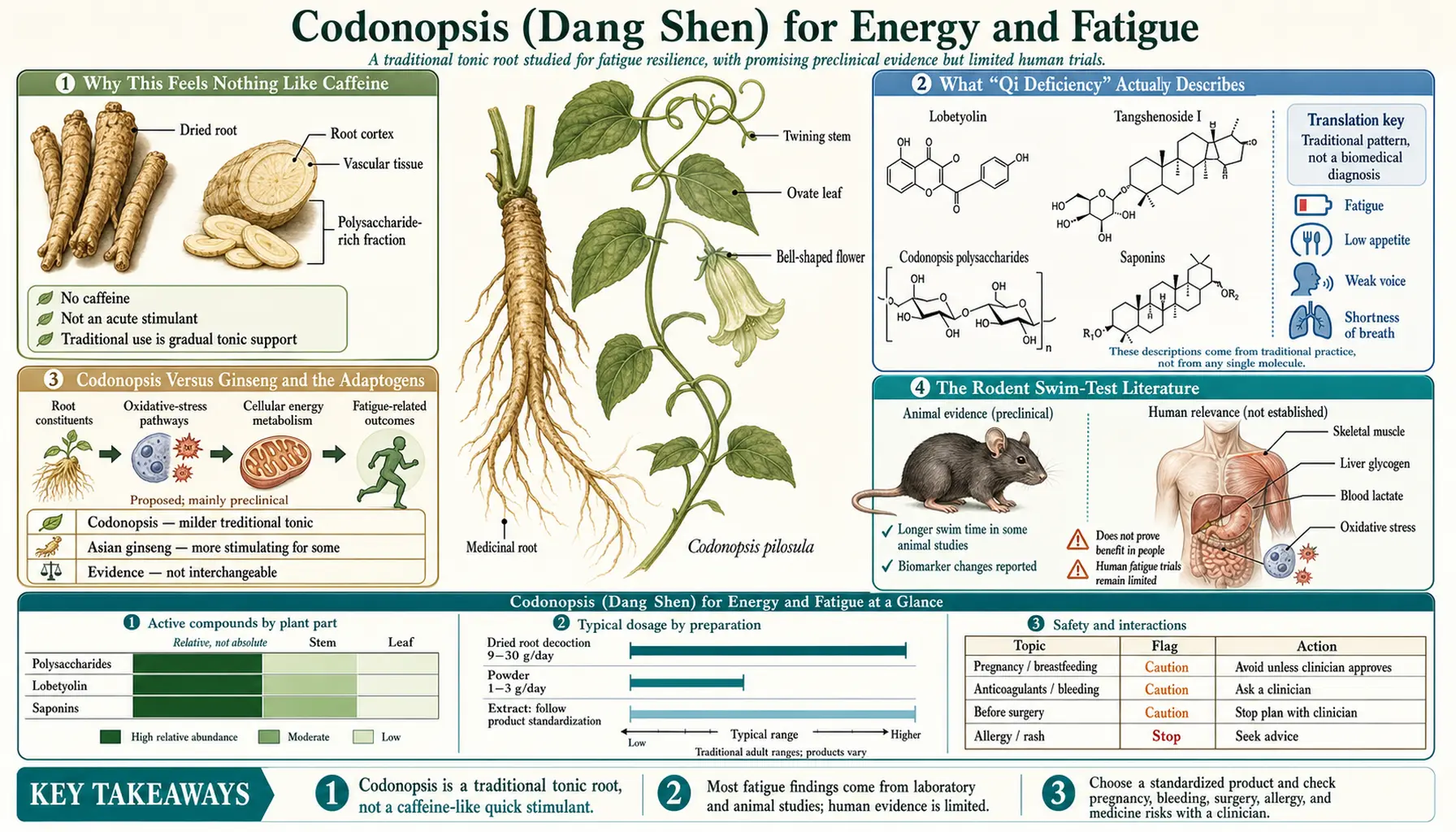
"Qi tonic" is usually translated as "energy tonic," and that translation causes most of the disappointment people report with Codonopsis. If you take a dose expecting the lift of coffee, or even the sharper edge of Panax ginseng, you will conclude within an hour that the herb does nothing. That conclusion is understandable and, in a narrow sense, correct: Codonopsis contains no stimulant. It has no caffeine, no ephedrine-type amines, and no compound known to act on adrenergic receptors. Nothing in it is designed to make you feel anything quickly.
What the traditional literature actually claims is different, slower, and harder to test — and what the modern research offers is a body of rodent endurance experiments that is interesting but does not amount to human evidence. This page separates those three things carefully.
Table of Contents
- Why This Feels Nothing Like Caffeine
- What "Qi Deficiency" Actually Describes
- Codonopsis Versus Ginseng and the Adaptogens
- The Rodent Swim-Test Literature
- Proposed Mechanisms and How Much to Believe
- What Human Evidence Exists
- Rule Out the Treatable Causes First
- Realistic Expectations and Time Course
- How It Is Actually Used
- Key Research Papers
- Connections
- Featured Videos
Why This Feels Nothing Like Caffeine
Caffeine works by blocking adenosine receptors. Adenosine accumulates through the waking day and is one of the signals that makes you feel sleepy; caffeine occupies the receptor so the signal is not received. The energy you feel is not new energy — it is a suppressed fatigue signal, borrowed against a debt that is still accruing and still has to be paid. That is why the effect is fast, obvious, dose-dependent, tolerance-forming, and followed by a crash.
Codonopsis has no equivalent mechanism. Nothing in its known chemistry — polyacetylene glycosides, pyrrolidine alkaloids, phenylpropanoid glycosides, fructans, polysaccharides — blocks adenosine receptors or triggers catecholamine release. Whatever it does, it does not do by masking a fatigue signal.
The traditional framing is worth taking seriously as a description even if you reject the theory behind it. A tonic in this system is supposed to build the substrate — improve digestion and nutrient uptake so the body has more to work with — rather than spend what is already there. The prediction that framing makes is a slow, cumulative, unremarkable change: not a lift you notice at 10 a.m., but a floor that gradually rises over weeks. That prediction happens to be much harder to confirm than a caffeine effect, and much easier to confuse with regression to the mean, seasonal change, or simply eating better.
What "Qi Deficiency" Actually Describes
Codonopsis is indicated for a specific fatigue pattern, not fatigue in general. Translated out of the classical vocabulary, the picture is:
- Tiredness that is worse after eating rather than relieved by it.
- Tiredness that is worse with exertion and better with rest — a deficiency pattern, not a restless or agitated one.
- Weak voice, reluctance to speak, shortness of breath on mild effort.
- Poor appetite, loose stools, bloating — the digestive picture is treated as the cause, not a separate complaint.
- Spontaneous daytime sweating, pallor, and easy susceptibility to colds.
Notice what is absent: this is not the picture of someone who is wired and exhausted, anxious, sleeping badly, or fatigued with agitation. In classical terms those are different patterns entirely, and Codonopsis is not the herb for them. A practitioner would consider a calming or yin-nourishing approach instead. The pairing of fatigue with weak digestion is the specific signature that points to this herb — which is why the digestive page and this one are really describing the same claim.
Codonopsis Versus Ginseng and the Adaptogens
Codonopsis is routinely called "poor man's ginseng," and that nickname has caused a great deal of confusion. The facts:
- Panax ginseng is in the family Araliaceae. Codonopsis pilosula is in Campanulaceae, the bellflowers. They are not close relatives.
- Codonopsis contains no ginsenosides. Ginsenosides are the triterpene saponins responsible for most of ginseng's studied pharmacology. Codonopsis does not make them. A supplement label claiming a ginsenoside content for a Codonopsis product is mislabelled or adulterated.
- The substitution is economic and clinical, not chemical. When ginseng was expensive, Codonopsis went into the formula at a larger dose in its place, because practitioners judged that it filled a similar role more gently.
- "Gentler" is the operative word. Ginseng is described as warm and is well known for causing insomnia, agitation, and headache in people who are not deficient. Codonopsis is described as neutral, and is used at larger doses in food.
Codonopsis is also frequently grouped with the "adaptogens" in Western herbal writing. That term comes from mid-twentieth-century Soviet pharmacology and was defined around Eleutherococcus and Schisandra, with criteria involving non-specific resistance to stressors and a normalising influence. It is a useful loose category and a poor scientific one — the definition has never been operationalised in a way that allows a substance to fail it. Codonopsis is sometimes placed inside the category and sometimes outside it, depending on the author. Treat the label as marketing shorthand rather than a claim about evidence.
The Rodent Swim-Test Literature
Nearly every "anti-fatigue" claim for Codonopsis traces back to one experimental design: the weight-loaded forced swim test in mice. A small weight is attached to the animal's tail, the animal is placed in a water tank, and the time to exhaustion is recorded. Mice given a herbal extract for one to four weeks beforehand are compared with controls.
Reported results for Codonopsis extracts and polysaccharide fractions typically include longer swim time to exhaustion, higher liver and muscle glycogen after exercise, lower blood lactate and lower serum urea nitrogen after a standard exercise load, and higher antioxidant enzyme activity with lower malondialdehyde in muscle tissue. Similar findings are reported in rotarod and treadmill variants.
These are consistent enough to be worth mentioning. They are also weak evidence for human fatigue, for reasons worth spelling out:
- Forced swimming is a stress and escape paradigm, not a fitness test. Time to exhaustion in a water tank is influenced by anxiety, buoyancy, temperature, body composition, thermoregulation, and whether the animal adopts a passive floating strategy. It is not a clean readout of energy metabolism.
- Human fatigue is mostly not a muscle-endurance problem. The complaint that brings people to a doctor is subjective: low drive, poor concentration, needing to lie down, feeling wiped out after minor activity. Mouse swim time does not model that.
- Doses are frequently very high in human-equivalent terms, and extracts are rarely characterised well enough for another laboratory to reproduce them exactly.
- Publication bias is severe in this corner of the literature. A very large number of plant extracts have been reported to extend mouse swim time; almost none have been reported not to. When nearly every tested substance "works," the test is telling you little about any individual substance.
So the fair summary is: Codonopsis extracts behave like other tonic plant extracts in rodent endurance models, with a consistent pattern of glycogen sparing and reduced exercise-induced oxidative markers. This is a hypothesis about human fatigue, not a demonstration of it.
Proposed Mechanisms and How Much to Believe
Four mechanisms get proposed, in descending order of plausibility:
- Nutritional and digestive. If Codonopsis improves appetite and nutrient uptake in someone eating poorly, better energy follows for entirely ordinary reasons. This requires no exotic pharmacology and is the most credible route — and it is also, essentially, what the traditional theory says.
- Antioxidant support during exertion. The rodent data consistently show lower lipid-peroxidation markers and higher endogenous antioxidant enzyme activity after exercise. Plausible, measurable in animals, of unknown relevance to how a person feels.
- Glycogen handling and lactate clearance. Reported repeatedly in rodents. Whether anything comparable happens in humans at realistic doses is unstudied.
- Stress-axis or "adaptogenic" modulation. Sometimes claimed, rarely measured for Codonopsis specifically. Treat this as speculation until someone measures cortisol dynamics in humans, which nobody has.
An honest fifth possibility deserves listing alongside them: expectation. Fatigue is a subjective symptom, it fluctuates, and it is one of the most placebo-responsive endpoints in all of medicine — placebo response rates of 30–40 percent are ordinary in fatigue trials. Any uncontrolled personal trial of a tonic is competing against that. This is not a reason to dismiss the herb; it is a reason to be sceptical of testimonials, including your own.
What Human Evidence Exists
For Codonopsis alone: essentially none. There is no registered, placebo-controlled human trial of Codonopsis pilosula as a single agent for fatigue, exercise performance, or chronic fatigue syndrome in the international literature.
What exists instead is formula-level work. Bu Zhong Yi Qi Tang — in which Codonopsis or ginseng is one of eight herbs — has been studied for fatigue, post-viral debility, and cancer-related fatigue, mostly in Chinese and Japanese literature (where the Japanese Kampo equivalent is hochuekkito). Some of that work is positive. None of it isolates Codonopsis, most of it is small, blinding is often absent or inadequate, and reporting standards vary widely. A positive result for an eight-herb decoction tells you about the decoction.
If you want the honest bottom line: Codonopsis is a traditional remedy for fatigue with a plausible mechanism and no human efficacy evidence. Anyone telling you otherwise is overselling.
Rule Out the Treatable Causes First
This is the most useful section on the page. Persistent fatigue has a list of common, testable, treatable causes, and reaching for a tonic before checking them is how people lose a year:
- Iron deficiency — with or without anaemia. Ferritin, not just haemoglobin; low ferritin with a normal blood count causes real fatigue. Especially common in menstruating women, blood donors, and vegetarians.
- Thyroid disease — TSH is a cheap test and hypothyroidism is common and eminently treatable.
- Vitamin B12 and vitamin D deficiency — both common, both cheap to check, both fixable.
- Sleep apnoea — massively under-diagnosed, and the single most common cause of "I sleep eight hours and wake up exhausted."
- Depression and anxiety — fatigue is a core symptom, not a side issue.
- Diabetes, coeliac disease, chronic kidney disease, heart failure, and medication side effects — particularly beta-blockers, antihistamines, and statins in some people.
Codonopsis will not fix any of these, and a tonic that produces a small subjective improvement can delay a diagnosis by making a real problem tolerable. Get the basic bloods first. If they are clear and you still feel flat, then a food-grade tonic is a reasonable low-risk thing to try.
Realistic Expectations and Time Course
What people who use Codonopsis consistently describe — and what the traditional literature predicts — is a background change rather than an event:
- Days 1–7: nothing, or possibly some bloating from the fructan content. Do not increase the dose in response to feeling nothing; that misunderstands the herb.
- Weeks 2–3: if anything happens, this is usually where people notice it — typically as better appetite and less of an after-lunch collapse, rather than as more energy directly.
- Weeks 4–8: the realistic ceiling of what a tonic offers: a modestly higher baseline, better tolerance of ordinary exertion, fewer days flattened by minor illness.
- Never: a stimulant lift, a replacement for sleep, an acute performance aid, or a fix for an untreated medical cause of fatigue.
If eight weeks of consistent use at a reasonable dose changes nothing, the correct conclusion is that it does not work for you. Escalating the dose or adding more herbs to a failed trial is how people end up spending money on cabinets full of supplements.
How It Is Actually Used
- Dose: 9–30 g of dried sliced root per day as a decoction, simmered 30–45 minutes. Higher end for the traditional therapeutic range, lower end for daily food use.
- Form: water extraction. Hot-water extract powder is fine; strong alcohol tinctures miss the polysaccharide fraction entirely.
- Culinary use is the most authentic route: a few slices simmered into chicken soup with jujube, goji berry, and ginger is the everyday form across northern China, and it is genuinely nourishing food for someone who is not eating well.
- Timing: with or before meals, daily. Because it is not a stimulant, evening dosing is not a problem — unlike ginseng, it is not associated with insomnia.
- Combinations: traditionally with Astragalus for fatigue with frequent infections, and with Atractylodes, Poria, and Licorice for fatigue rooted in weak digestion.
- Cautions: avoid with immunosuppressant drugs and in active autoimmune disease (see Immune Modulation); may worsen bloating in IBS or SIBO; mild theoretical additive effect with blood-pressure medication. And to settle the recurring confusion — the alkaloids in Codonopsis are pyrrolidine alkaloids, not the liver-toxic pyrrolizidine alkaloids of comfrey.
Key Research Papers
This site does not print PubMed ID numbers it cannot confirm. Where a record has been checked against PubMed and its title, first author, journal and year all match, the year and page numbers link straight to that record. Where no single paper could be confirmed, the link opens a PubMed topic query instead, so every claim can still be verified directly.
- Gao SM, Liu JS, Wang M, et al. Traditional uses, phytochemistry, pharmacology and toxicology of Codonopsis: a review. Journal of Ethnopharmacology. 2018;219:50–70.
- He JY, Ma N, Zhu S, Komatsu K, Li ZY, Fu WM. The genus Codonopsis (Campanulaceae): a review of phytochemistry, bioactivity and quality control. Journal of Natural Medicines. 2015;69(1):1–21.
- Xie Q, Sun Y, Cao L, Chen L, Chen J, Cheng X, Wang C. Antifatigue and antihypoxia activities of oligosaccharides and polysaccharides from Codonopsis pilosula in mice. Food & Function. 2020;11(7):6352–6362. Swimming and hypoxia-tolerance endpoints in mice.
- He P, Chen L, Qin X, Du G, Li Z. Astragali Radix–Codonopsis Radix–Jujubae Fructus water extracts ameliorate exercise-induced fatigue in mice via modulating gut microbiota and its metabolites. Journal of the Science of Food and Agriculture. 2022;102(12):5141–5152. A three-herb combination, so it cannot isolate the contribution of Codonopsis alone.
- Glycogen sparing, blood lactate, and serum urea nitrogen as anti-fatigue endpoints in rodent herbal studies. Current record set. A methodological convention rather than a single paper, so this stays a topic search.
- Methodological critique of the forced swim test as a model of fatigue and of antidepressant-like behaviour. Current record set. No single critique could be verified as the standard reference, so this stays a topic search.
- Jeong JS, Ryu BH, Kim JS, Park JW, Choi WC, Yoon SW. Bojungikki-tang for cancer-related fatigue: a pilot randomized clinical trial. Integrative Cancer Therapies. 2010;9(4):331–338. Bojungikki-tang is the Korean name for Bu Zhong Yi Qi Tang. Note the control arm was a waiting list, not a placebo, and n was 40 — the authors themselves call for more rigorous trials.
- Satoh N, Sakai S, Kogure T, Tahara E, Origasa H, Shimada Y, Kohoda K, Okubo T, Terasawa K. A randomized double blind placebo-controlled clinical trial of Hochuekkito, a traditional herbal medicine, in the treatment of elderly patients with weakness. Phytomedicine. 2005;12(8):549–554. Hochuekkito is the Japanese name for the same formula.
- Placebo response magnitude in fatigue and chronic fatigue syndrome trials. Current record set. No single estimate could be verified as authoritative, so this stays a topic search.
- Verdon F, Burnand B, Stubi CL, et al. Iron supplementation for unexplained fatigue in non-anaemic women: double blind randomised placebo controlled trial. BMJ. 2003;326(7399):1124. The trial behind the "check your ferritin before you buy a tonic" advice.
- The adaptogen concept: definition, history, and methodological criticism. Current record set.
Live PubMed Searches
- codonopsis fatigue
- codonopsis pilosula exercise endurance
- codonopsis antioxidant muscle
- qi deficiency fatigue traditional chinese medicine
- panax ginseng fatigue randomized
- hochuekkito randomized
- obstructive sleep apnea daytime fatigue
- hypothyroidism fatigue prevalence
Connections
- All Herbs
- Codonopsis (Dang Shen) — the main research article.
- Codonopsis: History and Traditional Use — how it became the standard ginseng substitute.
- Codonopsis Benefits — hub for all four deep dives.
- Ginseng — the stimulating, unrelated herb Codonopsis replaces in formulas.
- Astragalus — paired with Codonopsis in Bu Zhong Yi Qi Tang.
- Atractylodes — Spleen-strengthening partner herb.
- Poria Mushroom — the fourth member of the classical quartet.
- Licorice — harmonises and sweetens the decoction.