Codonopsis (Dang Shen), Blood and Circulation
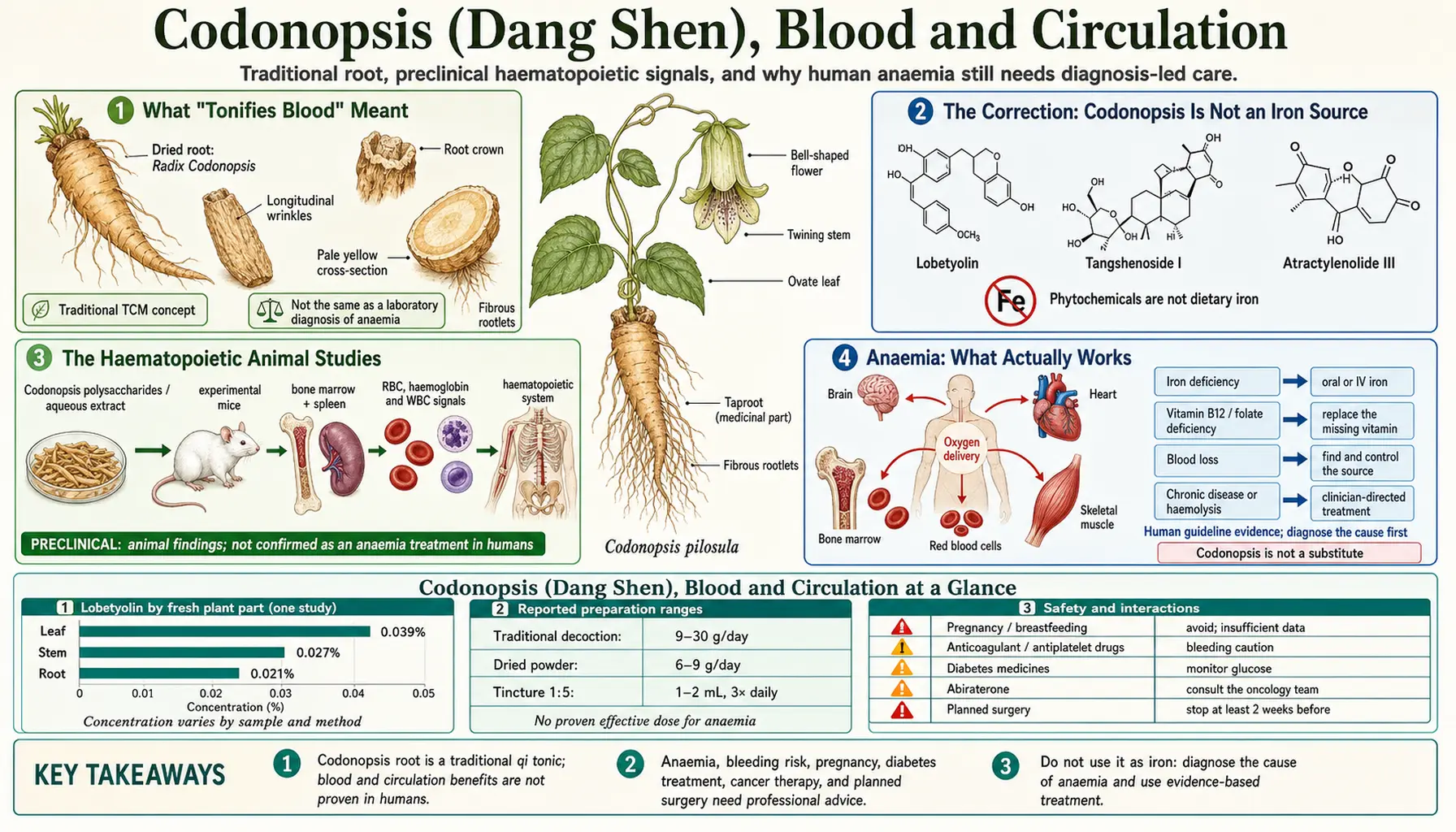
Alongside its Spleen and Lung qi indication, Codonopsis carries a secondary classical claim: it tonifies blood. English-language herb sites routinely translate that into "builds red blood cells," "treats anaemia," or even "increases haemoglobin," and those translations are not supported. The correction is the most important content on this page, so it goes first: Codonopsis is not an iron source, and there is no human evidence that it raises haemoglobin or treats anaemia.
What does exist is a genuinely interesting set of animal experiments on bone-marrow recovery, an older and largely forgotten pharmacology of the plant's minor alkaloids that reported blood-pressure lowering, and a classical rationale that turns out to be more defensible than the mistranslation suggests. This page covers all three, and the safety issues that follow from them.
Table of Contents
- What "Tonifies Blood" Meant
- The Correction: Codonopsis Is Not an Iron Source
- The Haematopoietic Animal Studies
- Anaemia: What Actually Works
- Blood Pressure and the Pyrrolidine Alkaloids
- Microcirculation, Blood Viscosity, and Platelets
- Lipids, Glucose, and Other Cardiovascular Claims
- Interactions and Who Should Avoid It
- Practical Use and Sensible Expectations
- Key Research Papers
- Connections
- Featured Videos
What "Tonifies Blood" Meant
In classical Chinese medicine, "blood" (xuè) is not identical to the red fluid a haematologist measures. It is a broader functional category covering nourishment, moisture, and the substrate that supports mental settledness and, in women, the menstrual cycle. Blood deficiency in that system is a symptom picture: pallor of the face and lips, dizziness on standing, blurred vision or floaters, dry skin and brittle nails, thin scanty periods, poor sleep with vivid dreaming, and palpitations.
Codonopsis is not classed primarily as a blood tonic — that role belongs to herbs like Dang Gui and prepared Rehmannia. Its role is upstream. The classical doctrine holds that the Spleen is the source of qi and blood: food is transformed into the raw material from which blood is made, so an herb that strengthens digestion indirectly supports blood production. Codonopsis appears in blood-building formulas as the qi component that "generates blood" by improving the manufacturing process, not by supplying the material.
Read that way, the traditional claim is more coherent than the English translation suggests. Nutrient absorption genuinely is upstream of erythropoiesis — you cannot build red cells without iron, folate, B12, protein, and copper, and all of them come through the gut. The classical model gets the topology right even where its physiology is pre-modern.
The Correction: Codonopsis Is Not an Iron Source
Be blunt about this, because it is where the most harm can occur.
- Codonopsis root is not a meaningful dietary source of iron. It is a starchy root high in fructans and polysaccharides. Any iron present is at ordinary plant-food levels, in the poorly absorbed non-haem form, and is further hampered by the polyphenol content of a decoction. Nothing in a normal dose approaches a therapeutic iron intake.
- It contains no vitamin B12. B12 is produced by bacteria and is absent from plants. Any plant product claiming to correct B12 deficiency is wrong.
- No human trial has shown Codonopsis raising haemoglobin, haematocrit, or red cell count. Not one. Claims to the contrary on retail sites trace back either to the classical phrase or to rodent studies.
- Treating iron-deficiency anaemia with a tonic instead of iron is dangerous — not because the tonic harms you, but because iron-deficiency anaemia in an adult, particularly a man or a post-menopausal woman, is a symptom that requires a cause to be found. Gastrointestinal blood loss from an ulcer or a colon cancer presents exactly this way. Masking the fatigue while the cause continues is the worst possible outcome.
The Haematopoietic Animal Studies
Having said all that, the animal literature is not empty and is worth describing accurately.
The standard design is the myelosuppression model: mice are given cyclophosphamide, or irradiated, to knock down bone marrow function, then treated with a Codonopsis extract or polysaccharide fraction while blood counts are tracked. Reported outcomes across these studies include faster recovery of white cell and red cell counts, increased numbers of bone-marrow colony-forming units, higher spleen and thymus indices, and in some studies changes in haematopoietic growth-factor expression such as erythropoietin, GM-CSF, or stem cell factor. Some work reports effects on proliferation of haematopoietic progenitors in culture.
Three cautions on how much this means:
- Recovery from chemical marrow suppression is not the same as treating anaemia. A drug-flattened mouse marrow rebounding faster tells you the extract has some biological effect on a stressed system. It says nothing about a person whose problem is that they lack iron.
- These are almost entirely rodent and cell studies, many published in Chinese-language journals, with the reproducibility and reporting limitations that implies. Extract characterisation is often minimal.
- It does not license using Codonopsis during chemotherapy. The obvious inference — "then it should help chemotherapy patients" — is exactly the inference that requires clinical trials, which have not been done. Herb-drug interactions during cancer treatment are a real risk, and an immune-active herb is not something to add to an oncology regimen on the strength of mouse data. Codonopsis does not treat cancer, and nothing in this literature suggests otherwise.
Anaemia: What Actually Works
If pallor, fatigue, breathlessness, and dizziness sent you to this page, the useful information is not herbal:
- Get tested. A full blood count plus ferritin, and usually B12 and folate. Ferritin matters because iron stores fall long before haemoglobin does — low ferritin with a normal blood count causes real fatigue and is frequently missed.
- Anaemia is a finding, not a diagnosis. The essential question is always why. Menstrual loss, pregnancy, poor intake, coeliac disease, gastrointestinal bleeding, kidney disease, thalassaemia trait, and haemolysis all produce anaemia and have entirely different treatments.
- Iron repletion works and is cheap. Current evidence supports lower, less frequent dosing than the old three-times-daily regimens — alternate-day dosing improves absorption by limiting the hepcidin response and causes fewer gut side effects. Vitamin C with the dose helps; tea, coffee, and calcium with the dose hinder.
- Where a tonic might genuinely contribute is at the margins: if poor appetite and poor digestion are part of why intake is inadequate, improving that is real support. That is a supporting role alongside treatment, not a replacement for it — and it is precisely the role the classical theory assigns.
Blood Pressure and the Pyrrolidine Alkaloids
The circulation half of this page rests largely on the plant's minor alkaloids. Codonopsine and codonopsinine are pyrrolidine alkaloids first isolated from Central Asian Codonopsis species in the late 1960s by Soviet natural-products chemists. Older pharmacological reports describe hypotensive and mild sedative or peripheral vasodilatory activity in animals, and extract-level studies have also reported blood-pressure reductions in anaesthetised animals.
Important qualifications:
- The alkaloids are minor constituents. Whether a normal decoction delivers a pharmacologically active amount of them is unclear.
- Much of this pharmacology is old, sparse, and not replicated to modern standards, and some of it was performed on Codonopsis clematidea rather than C. pilosula.
- There is no human blood-pressure trial of Codonopsis. It is not an antihypertensive treatment and should not be used as one.
The practical consequence is an interaction caution rather than a benefit claim: if you take blood-pressure medication, a mild additive lowering effect is theoretically possible. Monitor at home for the first couple of weeks rather than assuming nothing will happen, and mention it to your prescriber.
The name confusion, once more, because it is the single most common error about this plant: codonopsine and codonopsinine are pyrrolidine alkaloids. They are not pyrrolizidine alkaloids — the liver-toxic, veno-occlusive-disease-causing compounds found in comfrey, borage, coltsfoot, and butterbur. The words differ by three letters and describe different ring systems. Codonopsis does not carry the comfrey hepatotoxicity risk, and a search result telling you it does has almost certainly confused the two names.
Microcirculation, Blood Viscosity, and Platelets
A scattered set of studies, mostly older Chinese work, reports that Codonopsis preparations reduce whole-blood viscosity, improve microcirculatory flow in animal models, and in some experiments affect platelet aggregation. These findings underpin occasional claims that the herb "improves circulation."
Treat them as preliminary. The methods vary widely, the extracts are inconsistently characterised, replication in independent laboratories is thin, and no human data exist. But there is one practical implication worth taking seriously even from weak data: if a herb might affect platelet function, combining it with anticoagulants or antiplatelet drugs deserves caution. Anyone on warfarin, a direct oral anticoagulant, clopidogrel, or regular aspirin — or anyone facing surgery — should mention Codonopsis to their prescriber and, for surgery, follow the standard advice to stop herbal supplements one to two weeks beforehand.
Lipids, Glucose, and Other Cardiovascular Claims
You will find claims that Codonopsis lowers cholesterol, lowers blood glucose, or protects the heart. The underlying data are rodent studies — reduced serum lipids in high-fat-fed animals, modest glucose lowering in diabetic rodent models, reduced infarct size or oxidative damage in cardiac injury models. None of it has been tested in humans.
Two consequences. First, do not substitute Codonopsis for a statin, an antihypertensive, metformin, or any prescribed cardiovascular therapy; those drugs have large outcome trials behind them and this herb has none. Second, if you take Codonopsis while on diabetes medication, be aware of the theoretical additive risk of hypoglycaemia and check your glucose more often than usual for the first few weeks — a small precaution that costs nothing.
Interactions and Who Should Avoid It
- Antihypertensives — theoretical additive blood-pressure lowering. Monitor.
- Anticoagulants and antiplatelet drugs — theoretical additive effect from the platelet and viscosity data. Discuss with your prescriber; stop before surgery.
- Diabetes medication — theoretical additive glucose lowering. Monitor.
- Immunosuppressants and biologics; active autoimmune disease — avoid, on the immune-activation reasoning set out on the Immune Modulation page.
- Active cancer treatment — do not add without your oncology team's knowledge.
- Pregnancy and breastfeeding — traditionally used in some postpartum soups, but modern safety data are absent. Avoid concentrated extracts.
- IBS and SIBO — the fructan content can worsen bloating; see Digestive and Gut Health.
None of these is a documented case-report interaction. They are mechanism-based precautions, which is the honest category for a herb with this much animal data and this little human data.
Practical Use and Sensible Expectations
If, after the corrections above, you still want to use Codonopsis in the traditional blood-supporting role — as part of a nourishing approach rather than as a treatment — the traditional pattern is straightforward:
- Dose: 9–30 g dried root per day, decocted 30–45 minutes. Water extraction, not alcohol.
- Classical pairing: in blood-building contexts Codonopsis is combined with true blood tonics and with Astragalus; the "generate blood by strengthening qi" logic means it is always a supporting ingredient rather than the lead herb.
- Everyday form: simmered into soup with chicken, jujube, and goji berries. Eaten this way it is food that happens to be nourishing — a defensible use that requires no pharmacological claim at all.
- What to expect: nothing measurable on a blood count. If your numbers improve while taking it, look at what else changed — diet, iron supplementation, a resolved source of bleeding — before crediting the herb.
- What to do instead if you are anaemic: get tested, find the cause, and take iron if you need iron. That is the whole answer, and it is a better one than any herb.
Key Research Papers
This site does not print PubMed ID numbers it cannot confirm. Where a record has been checked against PubMed and its title, first author, journal and year all match, the year and page numbers link straight to that record. Where no single paper could be confirmed, the link opens a PubMed topic query instead, so every claim can still be verified directly.
- Gao SM, Liu JS, Wang M, et al. Traditional uses, phytochemistry, pharmacology and toxicology of Codonopsis: a review. Journal of Ethnopharmacology. 2018;219:50–70.
- He JY, Ma N, Zhu S, Komatsu K, Li ZY, Fu WM. The genus Codonopsis (Campanulaceae): a review of phytochemistry, bioactivity and quality control. Journal of Natural Medicines. 2015;69(1):1–21.
- Liu M, Tan H, Zhang X, Liu Z, Cheng Y, Wang D, Wang F. Hematopoietic effects and mechanisms of Fufang E'jiao Jiang on radiotherapy and chemotherapy-induced myelosuppressed mice. Journal of Ethnopharmacology. 2014;152(3):575–584. Important caveat: this tests a five-herb formula — donkey-hide gelatin, Codonopsis, red ginseng, hawthorn and prepared rehmannia — so the blood-count recovery it reports cannot be attributed to Codonopsis on its own.
- Codonopsine and codonopsinine: isolation and reported hypotensive pharmacology of the Codonopsis pyrrolidine alkaloids. Current record set. The hypotensive reports trace to mid-twentieth-century Soviet pharmacology that is not indexed in PubMed and could not be verified, so this stays a topic search.
- Pyrrolizidine alkaloid hepatotoxicity and hepatic veno-occlusive disease — the distinct compound class Codonopsis alkaloids are confused with. Current record set. A large literature with no single standard reference, so this stays a topic search.
- Tsai KH, Lee NH, Chen GY, et al. Dung-shen (Codonopsis pilosula) attenuated the cardiac-impaired insulin-like growth factor II receptor pathway on myocardial cells. Food Chemistry. 2013;138(2–3):1856–1867. Note this is cardiomyocyte work on a hypertrophy signalling pathway, not haemorheology; for the blood-viscosity and microcirculation claims, browse the current record set, which remains unverified.
- Stoffel NU, Cercamondi CI, Brittenham G, Zeder C, Geurts-Moespot AJ, Swinkels DW, Moretti D, Zimmermann MB. Iron absorption from oral iron supplements given on consecutive versus alternate days and as single morning doses versus twice-daily split dosing in iron-depleted women: two open-label, randomised controlled trials. The Lancet Haematology. 2017;4(11):e524–e533. The hepcidin-response and fractional-absorption evidence behind alternate-day dosing.
- Investigation of iron-deficiency anaemia in adults and the search for a gastrointestinal source. Current record set.
- Herb-drug interactions with warfarin and antiplatelet therapy: a review of the evidence base. Current record set.
Live PubMed Searches
- codonopsis hematopoietic
- codonopsis pilosula blood pressure
- codonopsine
- codonopsis platelet aggregation
- codonopsis lipid glucose rodent
- blood deficiency traditional chinese medicine anemia
- ferritin threshold iron deficiency fatigue
- non-heme iron absorption polyphenols inhibition
Connections
- All Herbs
- Codonopsis (Dang Shen) — the main research article.
- Codonopsis: History and Traditional Use — the classical sources for the blood-tonifying claim.
- Codonopsis Benefits — hub for all four deep dives.
- Astragalus — the qi tonic paired with blood tonics in classical blood-building formulas.
- Ginseng — unrelated botanically; the herb Codonopsis substitutes for.
- Atractylodes — Spleen-strengthening partner, upstream of blood production in classical theory.
- Poria Mushroom — fourth herb of the classical quartet.
- Licorice — harmonising herb; note its own blood-pressure caution.