Codonopsis (Dang Shen): History and Traditional Use
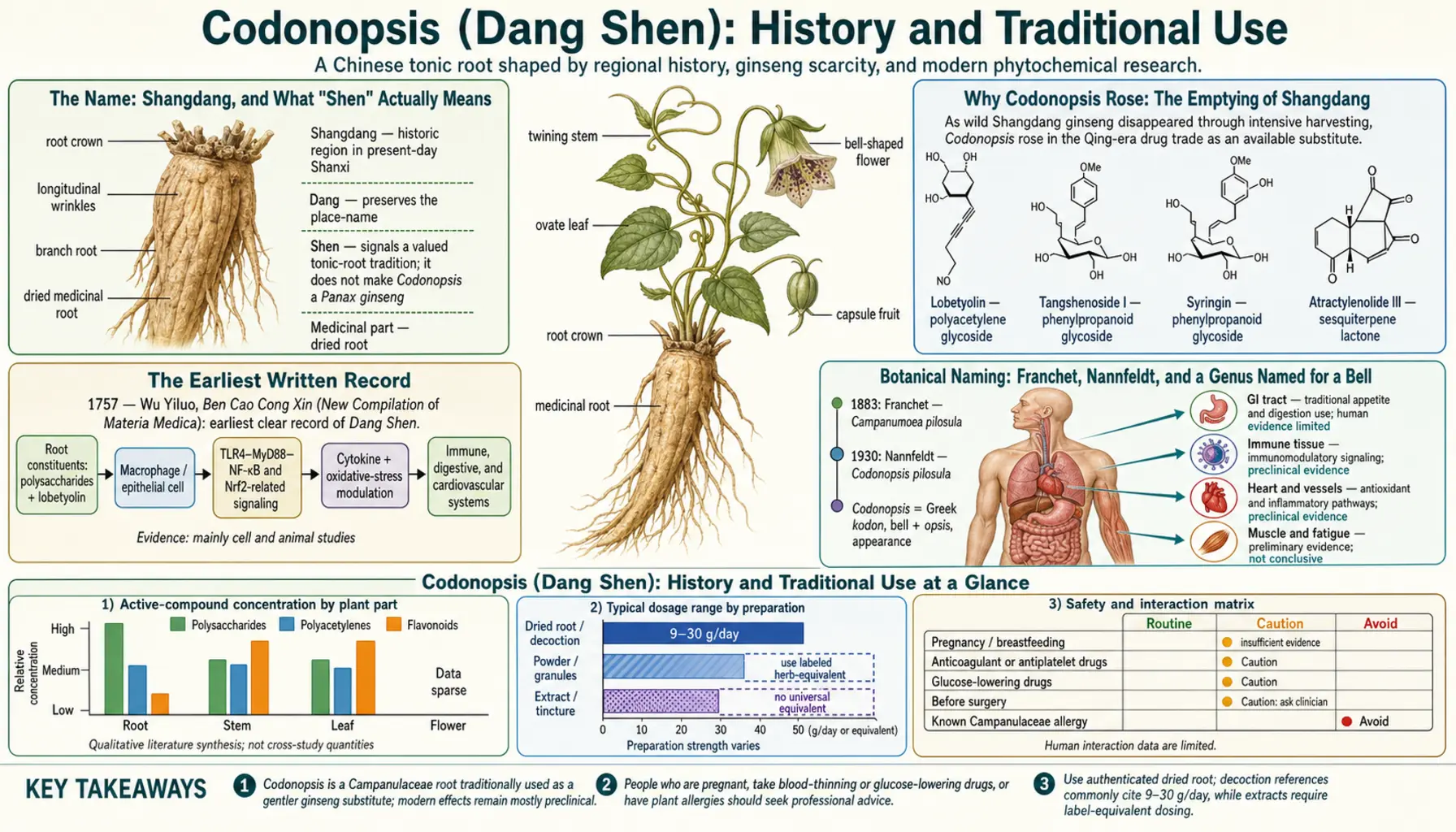
Codonopsis has one of the most unusual origin stories in Chinese herbal medicine. It is not an ancient herb. It does not appear in the foundational classics. It entered the materia medica only in the eighteenth century — and it did so largely because a different plant had been harvested to local extinction, leaving a famous place-name attached to a root that had grown quietly alongside it all along.
What follows is the documented history: where the name came from, which text first described it, who gave it a botanical name in Europe, how it was grown and processed, how it spread, and what modern research has and has not confirmed. Where a date or attribution is uncertain, this page says so rather than inventing precision.
Table of Contents
- The Name: Shangdang, and What "Shen" Actually Means
- Why Codonopsis Rose: The Emptying of Shangdang
- The Earliest Written Record
- Botanical Naming: Franchet, Nannfeldt, and a Genus Named for a Bell
- How the Root Was Grown, Harvested, and Processed
- Entry into the Classical Formulas
- Regional Spread: Korea, Japan, Vietnam and the Himalaya
- How Codonopsis Entered Modern Research
- What Modern Science Confirmed — and What It Did Not
- Research Papers
- Connections
- Featured Videos
The Name: Shangdang, and What "Shen" Actually Means
The Chinese name 党参 dǎng shēn is a contraction. The first character is short for Shangdang (上党), an old prefecture in the mountains of what is now southeastern Shanxi province, centred on the city known today as Changzhi and historically as Lu'an. The second character, 参 shēn, is the generic term for a fleshy tonic root. So the name means, quite literally, "the shen from Shangdang."
That second character carries most of the confusion that surrounds this herb in English. 参 is not a botanical term. It is a functional and culinary one — a word for a plump, sweetish, restorative root, applied across completely unrelated plant families. Chinese materia medica contains a whole shelf of them:
| Chinese name | Plant | Family |
|---|---|---|
| Ren shen 人参 | Panax ginseng | Araliaceae |
| Dang shen 党参 | Codonopsis pilosula | Campanulaceae |
| Dan shen 丹参 | Salvia miltiorrhiza | Lamiaceae (mints) |
| Xuan shen 玄参 | Scrophularia ningpoensis | Scrophulariaceae (figworts) |
| Ku shen 苦参 | Sophora flavescens | Fabaceae (legumes) |
| Sha shen 沙参 | Adenophora / Glehnia species | Campanulaceae / Apiaceae |
| Tai zi shen 太子参 | Pseudostellaria heterophylla | Caryophyllaceae (chickweeds) |
Only the first is ginseng. The habit of translating every one of these as some flavour of "ginseng" — "red ginseng," "prince ginseng," "poor man's ginseng" — is an artefact of English-language herb catalogues, not a statement about botany. Codonopsis picked up the epithets "poor man's ginseng" and "bastard ginseng" in Western trade during the twentieth century, both of which describe its market position rather than its identity.
Why Codonopsis Rose: The Emptying of Shangdang
To understand why an eighteenth-century root took a name from a place, you have to know what that place used to produce.
Shangdang was, for well over a thousand years, the most celebrated source of Panax ginseng in China. Ginseng from the Shangdang mountains — Shangdang renshen — was the benchmark grade, referenced in materia medica going back to the earliest Chinese pharmacological writing, and it commanded prices that made it a tribute item and a currency of court gift-giving.
Then it ran out. Centuries of demand, in a region with no cultivation practice and no harvest restraint, exhausted the wild population. By the late imperial period Shangdang ginseng had effectively ceased to exist as a commercial article; supply had shifted decisively northeast to Manchuria (Liao shen) and to Korea (Gao li shen), where it remains today. The exact century in which local extinction became complete is debated in the historical literature, but the direction of the story is not: a famous name outlived the plant that earned it.
What was left behind in those same mountains was a climbing bellflower with a sweet, fleshy taproot that local people had long dug for food and for household tonic soups. Whether the substitution began as honest local practice, as commercial opportunism, or as some mixture of both is impossible to settle at this distance. What is documented is the result: by the eighteenth century the root of Codonopsis was circulating under the Shangdang name, and by the nineteenth it had been formally accepted into the pharmacopoeial tradition as a medicine in its own right.
This is worth sitting with, because it complicates the usual "5,000 years of Chinese medicine" marketing line. Codonopsis's traditional record is roughly 250 years as a named medicine, not five millennia. That is still a long and serious clinical tradition — but it is not the tradition its packaging usually implies.
The Earliest Written Record
Dang shen is generally credited with its first clear, distinct description in the Ben Cao Cong Xin (本草从新, New Compilation of Materia Medica) by Wu Yiluo (吴仪洛), published in 1757 during the Qing dynasty. Wu's work was a revision and correction of earlier materia medica, and one of its notable contributions was separating dang shen from ren shen as a different drug with its own properties, rather than treating it as a low grade of ginseng.
Shortly afterwards, Zhao Xuemin (赵学敏) discussed Codonopsis in the Ben Cao Gang Mu Shi Yi (本草纲目拾遗, Supplement to the Compendium of Materia Medica), a work compiled in the second half of the eighteenth century — the manuscript is conventionally dated to the 1760s, though it was not printed until the following century. Zhao's project was precisely to catalogue drugs that Li Shizhen's great sixteenth-century Ben Cao Gang Mu had missed, and Codonopsis is a textbook example of why such a supplement was needed: it simply had not been in circulation as a distinct medicine when Li Shizhen was writing in the 1500s.
A note on honesty here. You will encounter claims that Codonopsis appears in the Shen Nong Ben Cao Jing (the Han-era classic) or in Li Shizhen's Ben Cao Gang Mu of 1578. Those claims arise from the ambiguity of the character 参 — early texts discussing "shen" from Shangdang are discussing Panax, not Codonopsis. The absence of Codonopsis from the pre-Qing classics is not a gap in the record; it is the record.
The properties Wu Yiluo and his successors assigned to the herb are the ones still taught today: sweet in flavour, neutral in temperature, entering the Spleen and Lung channels, tonifying the qi of the middle burner, generating fluids, and nourishing blood. Critically, the classical texts also noted what it was not: it lacked ginseng's forceful, rescuing, "restore the collapsing qi" action. Ginseng was reserved for the acutely collapsing patient; dang shen was for the chronically depleted one. That distinction was made explicitly by traditional authors and is still the correct way to think about the two herbs.
Botanical Naming: Franchet, Nannfeldt, and a Genus Named for a Bell
The plant's European scientific history runs on a completely separate track from its Chinese medical history, and the two only met in the twentieth century.
The genus Codonopsis was established by the Danish-born botanist Nathaniel Wallich, superintendent of the Calcutta Botanic Garden, in 1824, based on Himalayan material. The name is straightforward Greek: kodon (κώδων), a bell, plus opsis (ὄψις), appearance — "bell-like," for the drooping, campanulate flowers that mark the whole family.
The Chinese species itself was first described by the French botanist Adrien René Franchet, who worked through the enormous plant collections that French missionaries — Armand David, Jean Marie Delavay, Paul Guillaume Farges and others — shipped back to the Muséum national d'Histoire naturelle in Paris during the nineteenth century. Franchet published the plant in the 1880s under the name Campanumoea pilosula, placing it in a neighbouring bellflower genus. The epithet pilosula is Latin for "somewhat hairy," describing the fine pubescence on the young stems and leaf undersides.
The transfer to Codonopsis was made by the Swedish botanist Jöran Fredrik Nannfeldt in the 1930s, in the course of his revision of the genus. That is why the full authority reads Codonopsis pilosula (Franch.) Nannf. — the parenthetical author is the one who first described the species, the following author is the one who moved it to its current genus. The related official variety C. pilosula var. modesta also carries Nannfeldt's hand, and Codonopsis tangshen was described by the English botanist Daniel Oliver, its epithet taken directly from the Chinese trade name.
The important consequence of this naming history is the one covered on the main Codonopsis page: the family assignment. Campanulaceae — bellflowers, harebells, balloon flower. Ginseng is Araliaceae, the ivy and aralia family. European botany settled the question of whether these plants were related long before Western herb catalogues started calling one of them a ginseng.
How the Root Was Grown, Harvested, and Processed
Traditional Codonopsis production is a slow, hands-on business, and much of it survives essentially unchanged.
Growing. Codonopsis is a twining vine and needs support — traditionally brushwood or bamboo staked along terraced mountain plots between roughly 1,500 and 3,000 metres. Plants are grown from seed, usually transplanted as seedlings, and left in the ground for three to four years or more before lifting. Roots dug at two years are thin and lack the sweetness that defines a good grade; the extra years are the whole economic and quality argument for the crop.
Harvest. Digging is an autumn job, after the vines have died back and the root has drawn in its reserves. The roots are lifted carefully — a snapped taproot loses most of its value — then washed and sorted by thickness.
Drying and rubbing. This is the step that gives dang shen its character. The roots are sun-dried in stages, and between drying sessions they are repeatedly rolled and rubbed (揉搓 róu cuō) — by hand, or by working them between wooden boards. The purpose is practical: rubbing breaks down the internal structure just enough to drive moisture out evenly, prevents the outside case-hardening while the core stays damp, and compacts the root. The finished article is pliable rather than brittle, faintly sticky, and marked with the close transverse wrinkles that a graded root is judged on.
What graders look for. Three traditional marks, all still used in the trade:
- The "lion's head" (狮子头) — the dense knobby crown of old stem scars at the top of the root. More rings means an older, better plant.
- The "chrysanthemum heart" (菊花心) — the radiating pattern visible in a clean cross-section.
- Pliability and sweetness — a good root bends without snapping and tastes distinctly sweet, not sour or acrid.
Regional grades. The trade names are geographic: Lu dang shen (潞党参) from the historic Lu'an/Shangdang district in Shanxi, the most prestigious; Xi dang shen (西党参), "western," from Gansu and Shaanxi, which supplies the bulk of the market; and Chuan dang shen (川党参) from Sichuan and western Hubei, which is the separate species C. tangshen.
Processing (pao zhi). Beyond plain drying, two classical preparations are standard. Honey-fried dang shen (蜜炙党参) is stir-processed with honey until darkened and sticky, which traditional pharmacy holds to strengthen its Spleen- and Lung-tonifying and moistening action. Bran-fried dang shen (麸炒党参) is stir-fried with wheat bran, said to direct it more firmly toward the digestive system. Both remain in use in Chinese dispensaries today.
And as food. None of this was confined to the pharmacy. In northern China, dang shen sticks go into the everyday convalescent pot: simmered for two hours or more with chicken, astragalus slices, jujube dates and goji berries. This is how most Chinese families have actually encountered the herb — as a kitchen ingredient with a reputation, closer in social role to bone broth than to a prescription.
Entry into the Classical Formulas
Codonopsis today sits inside some of the most famous formulas in Chinese medicine. It is important to be precise about how it got there, because this is where most popular accounts go wrong.
The three formulas Codonopsis is most associated with are all older than Codonopsis itself:
- Si Jun Zi Tang (四君子汤, Four Gentlemen Decoction) — ginseng, Atractylodes, Poria and Licorice. It comes from the Tai Ping Hui Min He Ji Ju Fang, the imperially sponsored formulary of the Song dynasty, compiled around the turn of the twelfth century.
- Shen Ling Bai Zhu San (参苓白术散) — from the same Song formulary; the standard prescription for chronic loose stools with poor appetite and fatigue.
- Bu Zhong Yi Qi Tang (补中益气汤) — composed by Li Dongyuan (李东垣) and published in his Pi Wei Lun (Treatise on the Spleen and Stomach) in 1249, adding astragalus, dong quai, bupleurum and cimicifuga.
Every one of those was written with ren shen — real Panax ginseng — in the ingredient list. Codonopsis was not described as a medicine until roughly five hundred years after Li Dongyuan and six hundred and fifty after the Song formulary. It entered these prescriptions later, as a substitution, driven by the price and scarcity of ginseng once the Shangdang supply was gone and Manchurian and Korean root had become a luxury commodity.
Classical authors were open about this and about its consequences. The standard adjustment is a dose increase: where a formula called for a modest amount of ren shen, practitioners substituting dang shen use two to three times the weight, on the explicit understanding that the replacement is weaker. And the substitution was never considered universal — in acute collapse, shock, or profound qi exhaustion, traditional practice holds that ginseng cannot be replaced. Dang shen was for the long haul, not the emergency.
Modern Chinese practice has largely completed the switch. Most Four Gentlemen Decoction dispensed in China today contains Codonopsis, and the herb is one of the highest-volume items in the entire Chinese materia medica by weight. What began as a compromise became the default.
Regional Spread: Korea, Japan, Vietnam and the Himalaya
Codonopsis is a genus of the eastern Himalaya, central and northern China, and the Korean peninsula, and different regions adopted different members of it.
Korea. C. pilosula is known as 만삼 (mansam) and used in traditional Korean medicine along broadly Chinese lines. But Korea's more culturally prominent Codonopsis is a different species entirely: Codonopsis lanceolata, known as 더덕 (deodeok), which is primarily a food — the fleshy root is pounded flat, marinated in gochujang and sesame oil, and grilled as a well-loved side dish. Deodeok is not dang shen, and the two should not be conflated on a label.
Japan. Codonopsis (tōjin) is used in kampo medicine, though less centrally than in China; Japanese kampo has historically been more conservative about substituting away from ginseng in classical formulas.
Vietnam. The Vietnamese name is đảng sâm, a direct borrowing of the Chinese. Vietnamese material, however, is frequently Codonopsis javanica rather than C. pilosula — a related Southeast Asian species harvested in the central highlands, where it is also known as sâm dây. It occupies the same cultural niche as an affordable tonic root, but it is a different plant, and it should not be assumed equivalent.
The Himalaya and Central Asia. Several Codonopsis species grow through Nepal, northern India, Tibet and Central Asia, and appear in Tibetan, Mongolian and Central Asian folk practice. Codonopsis clematidea, distributed across Central Asia and the western Himalaya, matters for a specific technical reason covered below: it is the species from which the herb's characteristic alkaloids were first isolated.
The West. Codonopsis reached Western herbalism late — essentially in the second half of the twentieth century, alongside the general Western uptake of Chinese herbal medicine. It arrived with the "poor man's ginseng" label already attached, which shaped how it has been marketed and misunderstood ever since. Some Codonopsis species also entered Western horticulture as ornamental climbers for their pretty, purple-veined bells, entirely independent of any medicinal interest.
How Codonopsis Entered Modern Research
Serious chemical investigation of the genus began not in China but in Soviet Central Asia. Working on Codonopsis clematidea in the 1960s, Uzbek chemists — the alkaloid research group associated with the Institute of the Chemistry of Plant Substances in Tashkent — isolated and characterised two new alkaloids and named them codonopsine and codonopsinine after the genus. These are pyrrolidine alkaloids, a structural class that has since attracted independent interest from synthetic chemists as targets for total synthesis.
Chinese pharmacological research on C. pilosula expanded from the 1970s and 1980s onward, following the general institutional push to place traditional medicines on a modern experimental footing. Three threads emerged:
- The polysaccharides. From the 1980s, water-extracted polysaccharide fractions (now generically labelled CPP) became the focus of immunological work, in parallel with similar programmes on astragalus polysaccharides and mushroom beta-glucans.
- The polyacetylenes. Lobetyolin and its relatives were identified as the herb's distinctive small-molecule markers. The name is a fossil of its own discovery history — lobetyolin was first characterised from Lobelia, and only later recognised as a principal constituent of Codonopsis. It has since become the analyte of choice for HPLC assay of Radix Codonopsis, including in modern pharmacopoeial quality standards.
- Authentication. A large and rather unglamorous body of analytical work addresses a practical trade problem: distinguishing genuine C. pilosula from substituted Campanulaceae roots, distinguishing geographic grades, and — a persistent issue in the Chinese root trade — detecting sulfur fumigation, the bleaching and pest-control practice that leaves sulfur dioxide residues and degrades the herb's constituents.
Two comprehensive reviews consolidated this literature in the 2010s and remain the standard entry points: a 2015 review of the genus in the Journal of Natural Medicines covering phytochemistry, bioactivity and quality control, and a 2018 review in the Journal of Ethnopharmacology covering traditional uses, pharmacology and toxicology. Both are linked below.
What Modern Science Confirmed — and What It Did Not
This is the section that matters most, and it needs to be blunt.
Confirmed.
- The botany. Codonopsis is definitively Campanulaceae, definitively unrelated to Panax, and definitively contains no ginsenosides. Every part of the folk claim that it is a kind of ginseng is settled and false.
- The chemistry. The constituent profile is well characterised: polyacetylene glycosides, pyrrolidine alkaloids, phenylpropanoid glycosides, polysaccharides and inulin-type fructans. Lobetyolin works as a reliable authentication marker.
- That it is not a stimulant. The traditional description of dang shen as gentler and less activating than ginseng is consistent with its chemistry. There is nothing in it that acts like a stimulant, and the classical decision to reserve ginseng for acute collapse looks, in hindsight, entirely sensible.
- Biological activity in the laboratory. Codonopsis polysaccharides genuinely do things in cell culture and in rodents — macrophage activation via TLR4-linked signalling, protection in induced gastric-ulcer models, measurable shifts in gut microbial composition and short-chain fatty acid output. These are real, replicated laboratory findings.
- A benign safety record. Centuries of food-level use with no signal of serious toxicity, and no association with the liver injury caused by pyrrolizidine-containing herbs — a class Codonopsis does not belong to.
Not confirmed.
- Any human clinical outcome. There is no adequately powered, placebo-controlled trial of Codonopsis as a single herb for fatigue, immunity, digestion, anemia, or anything else. The clinical literature that exists tests multi-herb formulas in which the herb's individual contribution cannot be separated out.
- "Immune boosting." Macrophage activation in a dish is a mechanism, not an outcome. Nobody has shown that taking Codonopsis reduces how often a person gets sick.
- Treating anemia. Rodent hematopoiesis data do not translate into a treatment. Anemia in a person needs a diagnosis, not a tonic.
- Cancer treatment. Cell-culture work on isolated compounds — including lobetyolin's effect on glutamine transport in tumour cell lines — is early-stage laboratory research. It is not evidence of clinical benefit, and Codonopsis is not a cancer therapy.
- Dosing. The familiar 9–30 g range comes from traditional practice and pharmacopoeial convention. No human dose-finding study has established it.
The fair conclusion is that Codonopsis is a well-characterised, food-like, unusually well-tolerated tonic root with a genuine 250-year clinical tradition, an active and legitimate preclinical research programme, and — as of today — essentially no controlled human efficacy evidence of its own. That is a more modest claim than the marketing makes, and it is the true one. The current evidence for each traditional use is examined in detail on the Benefits pages.
Research Papers
Entries whose source paper has been verified against the PubMed record — title, first author, journal and year all confirmed — link their year and page numbers directly to that record. The rest link to a PubMed topic search, which stays valid and cannot point at the wrong paper. Nothing here is a guess. Authors, journals and titles are given as plain text for independent verification.
- He JY, Ma N, Zhu S, Komatsu K, Li ZY, Fu WM. The genus Codonopsis (Campanulaceae): a review of phytochemistry, bioactivity and quality control. Journal of Natural Medicines. 2015;69(1):1–21.
- Gao SM, Liu JS, Wang M, Cao TT, Qi YD, Zhang BG, Sun XB, Liu HT, Xiao PG. Traditional uses, phytochemistry, pharmacology and toxicology of Codonopsis: a review. Journal of Ethnopharmacology. 2018;219:50–70.
- El-Nezhawy AOH, Alrobaian M, Khames A, El-Badawy MF, Abdelwahab SF. Design and total synthesis of (−)-codonopsinine, (−)-codonopsine and codonopsinine analogues. Bioorganic & Medicinal Chemistry. 2019;27(7):1263–1273. For the original isolation from Codonopsis clematidea and its structural determination — mid-twentieth-century work largely predating PubMed indexing — browse the literature on PubMed.
- Lobetyolin in Radix Codonopsis: identification, HPLC quantification and use as a quality marker. View the literature on PubMed. No single paper could be verified as the standard reference for lobetyolin as a marker compound, so this remains a topic search.
- Li Y, Yang P, Qing H, Xie Z, Zhou K, Sun L, Chen M, Wang M, Ren X. A multimodal strategy for quality control and botanical origin traceability of Codonopsis Radix based on HPLC fingerprints with chemometric analysis. Biomedical Chromatography. 2025;39(10):e70185. Authentication and geographic-origin discrimination in the traded root.
- Ma XQ, Leung AK, Chan CL, Su T, Li WD, Li SM, Fong DW, Yu ZL. UHPLC UHD Q-TOF MS/MS analysis of the impact of sulfur fumigation on the chemical profile of Codonopsis Radix (Dangshen). The Analyst. 2014;139(2):505–516. How fumigation changes the constituent profile, and how it is detected.
- Comparative studies of Codonopsis pilosula and Panax ginseng as substitutes in classical Chinese formulas. View the literature on PubMed. No verifiable head-to-head study exists, so this remains a topic search.
- Sanjay, Sood R, Lee HJ. Pharmacological insights into Codonopsis lanceolata: a review of its potential in disease prevention and therapy. Molecules. 2026;31(13). Composition and pharmacology of the Korean food species (deodeok).
Live PubMed Searches
- Codonopsis pilosula — all literature
- Dang shen in traditional Chinese medicine
- Codonopsis ethnopharmacology
- Codonopsis tangshen (chuan dang shen)
- Codonopsis javanica (Vietnamese đảng sâm)
- Tangshenoside chemistry
- Si Jun Zi Tang (Four Gentlemen Decoction)
- Bu Zhong Yi Qi Tang
- Panax ginseng — history and cultivation in China
- Pyrrolizidine alkaloids and herbal hepatotoxicity (for contrast)
Connections
- All Herbs
- Codonopsis (Dang Shen) — the main research article
- Codonopsis Benefits — the four deep-dive articles
- Immune Modulation
- Digestive and Gut Health
- Energy and Fatigue
- Blood and Circulation
- Ginseng — the herb whose name and place Codonopsis inherited
- Astragalus — its constant partner in qi-tonic formulas and soups
- Atractylodes — Four Gentlemen Decoction, second ingredient
- Poria Mushroom — Four Gentlemen Decoction, third ingredient
- Licorice — Four Gentlemen Decoction, fourth ingredient
- White Peony — blood-nourishing partner herb
- Dong Quai — the classic blood tonic of Bu Zhong Yi Qi Tang