Motherwort — Benefits Deep Dive
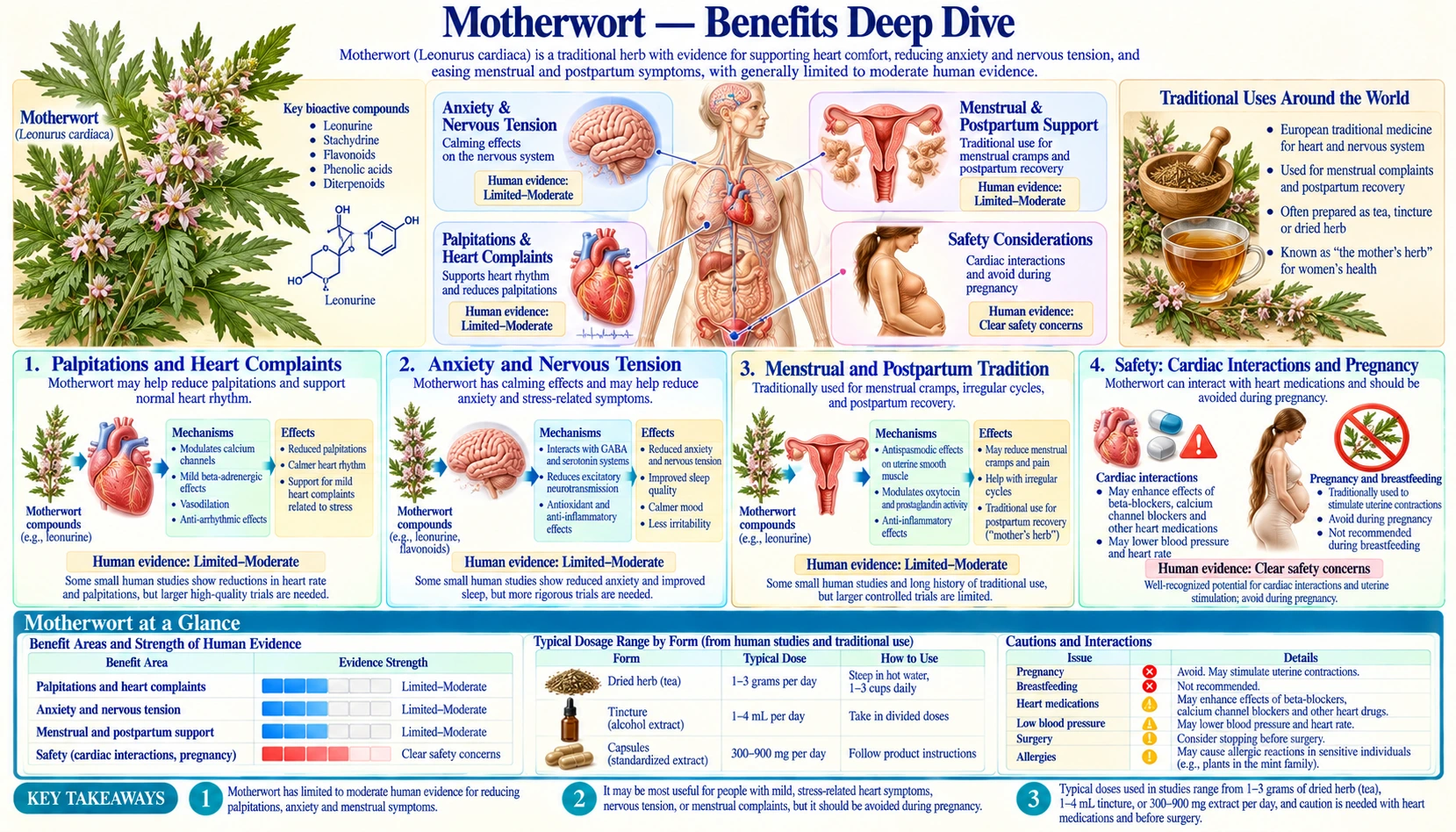
Motherwort (Leonurus cardiaca) is a bitter, weedy member of the mint family with an unusually legible history. Its species epithet cardiaca, the German name Herzgespann, and the English folk names throw-wort and lion's tail together record two traditions that ran side by side for centuries: a cardiac one, for the racing, gripped, "nervous" heart, and an obstetric one, for menstruation, labour and the weeks after a birth. These four deep-dive articles cover both, plus the interaction and pregnancy questions that most readers actually need.
Two points belong at the top rather than buried in a safety section, because they are the two ways this herb most commonly goes wrong.
Palpitations are a symptom with many possible causes, and motherwort is not an established treatment for any of them. Motherwort's cardiac reputation is genuine and old, and there is some small human and preclinical work on L. cardiaca extract and heart rate, blood pressure and anxiety measures. But there is no adequate controlled trial establishing it as a treatment for any arrhythmia. The cause of a racing, irregular, skipping or pounding heartbeat is found by recording the heart's rhythm (an electrocardiogram, ECG). Palpitations with chest pain, breathlessness, fainting or near-fainting are signs hospitals treat as urgent. Palpitations that are sustained or very fast, palpitations in anyone with a known heart condition or cardiac risk factors, and new palpitations in later life are the kinds usually checked with a rhythm recording. Atrial fibrillation and other arrhythmias carry stroke and heart-failure risks that a herb does not address — and the danger does not track how bad the symptom feels.
Pregnancy is a firm contraindication, and the name misleads about it. "Motherwort" and the postpartum tradition lead people to assume the plant is pregnancy-friendly. It is not. Motherwort is a traditional uterine stimulant and emmenagogue, and the European Medicines Agency (EMA) states that motherwort medicines must not be taken during pregnancy. Herbal references also list it as unsuitable while trying to conceive and while breastfeeding, for which safety data are lacking. This is one of the clearest cases on this site of a common name implying a safety profile the plant does not have.
A note on species that runs through all four pages: Leonurus cardiaca is the European plant behind every English-language product and the EU traditional-use monograph, while Leonurus japonicus (yi mu cao) is the heavily used Chinese species that carries most of the genus's pharmacological literature — including nearly all the work on the alkaloid leonurine. The marker constituent of European cardiaca is stachydrine, alongside iridoids, a substantial flavonoid fraction, and the labdane diterpene bitters that make the tea so hard to drink. Every study cited on these pages names its species.
Deep-Dive Articles
Motherwort for Palpitations and Heart Complaints
The use that brings most readers here, with the safety frame it needs. A full red-flag list, why palpitations are a symptom rather than a diagnosis, what the isolated-tissue and animal cardiac work actually shows, the one small uncontrolled human study, and why atrial fibrillation's stroke risk is not something a herb covers.
Read the deep dive →Motherwort for Anxiety and Nervous Tension
The herb's most defensible claim. What "nervous tension" and Herzgespann described, the animal sedative and psychotropic findings, why the single human study's missing placebo arm is decisive, the anxiety-palpitation loop that cuts both ways, and an honest comparison with passionflower, lemon balm and valerian.
Read the deep dive →Motherwort in Menstrual and Postpartum Tradition
The tradition the name commemorates, covered respectfully at traditional-use tier: emmenagogue use, cramps, premenstrual and menopausal complaints, uterine involution and afterpains, and the parallel yi mu cao tradition — with the pregnancy contraindication made unmissable.
Read the deep dive →Motherwort Safety: Cardiac Interactions and Pregnancy
The practically important page. Beta-blockers and rate-slowing drugs, digoxin and antiarrhythmics, blood-pressure medication, sedative additivity, antiplatelet and anticoagulant caution — each labelled theoretical, preclinical or documented — plus pregnancy, breastfeeding, side effects and species substitution.
Read the deep dive →Table of Contents
- Deep-Dive Articles
- What Motherwort Is
- The Evidence, Stated Honestly
- Key Research: Cardiac and Electrophysiological
- Key Research: Sedative and Psychotropic
- Key Research: The Human Evidence
- Key Research: Chemistry and Species Identity
- Key Research: Safety, Interactions and Pregnancy
- External Resources
- Connections
- Featured Videos
What Motherwort Is
A hardy perennial in the Lamiaceae — the mint family, alongside lemon balm, sage and peppermint — with the family's square stem and opposite leaf pairs, plus its own distinguishing features: ragged, deeply lobed lower leaves and small pale pink to purple flowers in whorls, held in spiny green cups that are genuinely prickly to handle. Native to Central Asia and southeastern Europe, it has naturalised widely across Europe and North America as a roadside and waste-ground weed. The part used is the aerial part: leafy flowering tops harvested as the plant blooms.
Its defining sensory feature is bitterness — motherwort is one of the most punishingly bitter herbs in common use, and that bitterness is the single commonest reason people abandon the tea in favour of a tincture. The taste comes largely from labdane-type diterpenes such as leocardin.
The topic page, Motherwort, covers identification, the origins of the name, forms and dosing, and the general safety picture. These Benefits pages go deeper into four specific questions rather than repeating that ground.
The Evidence, Stated Honestly
Every claim on these pages carries an evidence tier. Here is the whole picture in one place, so nothing on the individual pages comes as a surprise.
- Randomized clinical trial evidence: none. Not for palpitations, not for any arrhythmia, not for blood pressure, not for anxiety, not for any menstrual, menopausal or postpartum indication with Leonurus cardiaca. This is the most important line on the page.
- Randomized trials of a different product: Chinese motherwort injection (made from Leonurus japonicus and given in hospital, not a tea) has been tested in Chinese trials after vaginal birth. A 2019 meta-analysis pooled 37 randomized trials with 7,887 women, all at moderate to high risk of bias. Across 29 trials, motherwort injection added to oxytocin (the standard drug given to make the womb contract after birth), compared with oxytocin alone, was linked to less blood loss (85.6 mL less on average within 24 hours) and fewer cases of heavy bleeding after birth (postpartum haemorrhage; risk ratio 0.29). In 8 trials comparing motherwort injection with oxytocin, there was no clear difference. The authors rated the evidence low to very low quality and called for better-designed, larger trials.
- Preliminary human, uncontrolled: one small open-label study of a Leonurus cardiaca oil extract in hypertension accompanied by anxiety and sleep disturbance, reporting improved anxiety scores and modest blood-pressure reduction. Fifty patients took 1,200 mg of the extract a day for 28 days. No placebo arm, not replicated.
- Preclinical (isolated tissue): L. cardiaca extracts slowed rate and altered cardiac electrophysiology in isolated preparations: in isolated rabbit hearts a refined extract lengthened the time between beats, and in single heart cells it blocked calcium and potassium channels.
- Preclinical (animal): the isolated glycoside lavandulifolioside reduced heart rate and blood pressure but, unlike the butanol extract it came from, did not reduce the animals' spontaneous movement (it was not sedative); whole modified dry extracts showed psychotropic activity in behavioural testing; analgesic testing in mice was consistent with central depressant activity. Most leonurine work — cardioprotection, neuroprotection, uterine smooth muscle — concerns L. japonicus.
- Traditional use only: the nervous heart and palpitations; nervous tension, restlessness and irritability; delayed or scanty periods; menstrual cramps; premenstrual and menopausal complaints; postpartum uterine involution, afterpains and mood.
- Regulatory status: the European Medicines Agency's herbal committee has published an EU herbal monograph accepting traditional use of motherwort preparations to relieve symptoms of nervous tension and nervous conditions of the heart such as palpitations, after serious conditions have been excluded by a doctor, and only in adults. EMA explains that "although there is insufficient evidence from clinical trials, the effectiveness of these herbal medicines is plausible and there is evidence that they have been used safely in this way for at least 30 years (including at least 15 years within the EU)". That status rests on documented long-standing use and acceptable safety, not on demonstrated efficacy — a distinction routinely blurred in marketing. There is no single EU-wide registration: applications to license a motherwort medicine go to each country's national medicines authority. The monograph is under periodic review, with an EMA call for new scientific data (consultation 15 March to 15 June 2026). EMA: Leonuri cardiacae herba
- Safety: pregnancy contraindicated (EMA: motherwort medicines must not be taken during pregnancy); breastfeeding not studied, so herbal references list it as unsuitable; cardiac, sedative and anticoagulant interactions mostly theoretical or preclinical rather than documented in case reports, so the lack of reports does not show that these combinations have been tested and found safe.
Key Research: Cardiac and Electrophysiological
Named papers below link to their PubMed records; general entries link to PubMed topic searches, so they return the live literature.
- Ritter M, Melichar K, Strahler S, et al. Cardiac and electrophysiological effects of primary and refined extracts from Leonurus cardiaca L. (Ph.Eur.). Planta Medica, 2010;76(6):572-82. The central preclinical cardiac paper: extracts prepared to European Pharmacopoeia standards slowed rate and produced electrophysiological changes of the general kind seen with mild antiarrhythmic activity, in isolated preparations. In isolated rabbit hearts, a refined extract lowered the pressure generated by the left ventricle (the main pumping chamber), raised blood flow through the coronary arteries, and lengthened the PQ interval (the time the electrical signal takes to pass from the upper to the lower chambers) and the time between beats. In single heart cells it blocked the L-type calcium current, reduced the I(Kr) potassium current that resets the heart after each beat, and lengthened the action potential, while the sodium current was unaffected. These are laboratory results in animal tissue and cells, not in people; they are the reason motherwort's effects could add to those of drugs that slow heart rate or rhythm. Preclinical (isolated tissue). PubMed PMID: 19918711
- Miłkowska-Leyck K, Filipek B, Strzelecka H. Pharmacological effects of lavandulifolioside from Leonurus cardiaca. Journal of Ethnopharmacology, 2002;80(1):85-90. An isolated phenylethanoid glycoside slowed heart rate, lengthened the P-Q, Q-T and QRS intervals of the heart tracing and lowered blood pressure in animal testing. Unlike the butanol extract it was isolated from, it did not reduce the animals' spontaneous movement, and the authors concluded that this one compound does not explain the plant's effects on its own. The closest thing to an intact-organism cardiovascular result for a cardiaca constituent. Preclinical (animal). PubMed PMID: 11891090
- Bernatoniene J, Kopustinskiene DM, Jakstas V, et al. The effect of Leonurus cardiaca herb extract and some of its flavonoids on mitochondrial oxidative phosphorylation in the heart. Planta Medica, 2014;80(7):525-32. How the herb's flavonoid fraction affects energy handling in cardiac mitochondria. Preclinical. PubMed PMID: 24841965
- Loh KP, Qi J, Tan BKH, et al. Leonurine protects middle cerebral artery occluded rats through antioxidant effect and regulation of mitochondrial function. Stroke, 2010;41(11):2661-8. Frequently cited as evidence for "motherwort" — but it concerns a purified alkaloid chiefly associated with L. japonicus, in an animal stroke model. Preclinical (animal), different species. PubMed PMID: 20947850
- Sadowska B, Laskowski D, Bernat P, et al. Molecular mechanisms of Leonurus cardiaca L. extract activity in prevention of staphylococcal endocarditis. Molecules, 2019;24(18). Laboratory antibacterial and anti-biofilm work relevant to heart-valve infection — an entirely separate line from the rhythm question. Preclinical (in vitro). PubMed PMID: 31547303
Key Research: Sedative and Psychotropic
- Koshovyi O, Raal A, Kireyev I, et al. Phytochemical and psychotropic research of motherwort (Leonurus cardiaca L.) modified dry extracts. Plants, 2021;10(2). Chemical characterisation of whole dry extracts paired with animal behavioural testing for sedative and anxiolytic-type activity — closer to a real product than an isolate. Preclinical (animal). PubMed PMID: 33503956
- Miłkowska-Leyck K, Filipek B, Strzelecka H. Pharmacological effects of lavandulifolioside from Leonurus cardiaca. Journal of Ethnopharmacology, 2002;80(1):85-90. Cited again here because it is often quoted as support for the calming tradition, but its sedative finding belongs to the whole butanol extract: the extract reduced the animals' spontaneous movement, while the isolated glycoside lavandulifolioside did not. Preclinical (animal). PubMed PMID: 11891090
- Rezaee-Asl M, Sabour M, Nikoui V, et al. The study of analgesic effects of Leonurus cardiaca L. in mice by formalin, tail flick and hot plate tests. International Scholarly Research Notices, 2014;2014:687697. Pain-behaviour testing is sensitive to sedation, so this belongs in the same picture of central depressant activity. Preclinical (animal). PubMed PMID: 27433501
- Comparative trial literature on herbal anxiolytics — passionflower, lemon balm, valerian and chamomile in controlled human studies. The fair benchmark: several of these have human randomized data, and motherwort has none. PubMed: herbal anxiolytics randomized trials
Key Research: The Human Evidence
- Shikov AN, Pozharitskaya ON, Makarov VG, et al. Effect of Leonurus cardiaca oil extract in patients with arterial hypertension accompanied by anxiety and sleep disorders. Phytotherapy Research, 2011;25(4):540-3. The entire human evidence base for Leonurus cardiaca. Fifty patients with stage 1 or 2 high blood pressure plus anxiety and sleep problems took 1,200 mg of the oil extract a day for 28 days, open label, no placebo group, reporting improved anxiety and depression scores and modest blood-pressure reduction — all outcomes highly susceptible to expectation effects. On the Clinical Global Impression scale, anxiety and depression symptoms improved significantly in 32% of patients, moderately in 48% and weakly in 8%; 12% did not respond. Side effects were minimal. Not replicated in the years since. Preliminary human, uncontrolled. PubMed PMID: 20839214
- Wojtyniak K, Szymański M, Matławska I. Leonurus cardiaca L. (motherwort): a review of its phytochemistry and pharmacology. Phytotherapy Research, 2013;27(8):1115-20. The standard modern survey; catalogues the traditional indications and the absence of trials supporting them. PubMed PMID: 23042598
- Fierascu RC, Fierascu I, Ortan A, et al. Leonurus cardiaca L. as a source of bioactive compounds: an update of the European Medicines Agency assessment report (2010). BioMed Research International, 2019;2019:4303215. Ties the chemistry and pharmacology to Europe's formal regulatory assessment — and explains why the herb's EU status is traditional use rather than established efficacy. PubMed PMID: 31119169
- Yu J, Cai Y, Su G, Li Y. Motherwort injection for preventing postpartum hemorrhage in women with vaginal delivery: a systematic review and meta-analysis of randomized evidence. Evidence-Based Complementary and Alternative Medicine, 2019;2019:1803876. The one body of randomized trials in the genus: 37 Chinese trials (7,887 women) of an injected Leonurus japonicus hospital product, not the European herb or tea. Added to oxytocin it was linked to less bleeding after birth (risk ratio 0.29 for postpartum haemorrhage), but every trial was at moderate to high risk of bias and the evidence was rated low to very low quality. Randomized trials, low-quality evidence, different species and form. PubMed PMID: 31354850
- Searches for anything newer — a properly controlled trial would change these pages substantially, so they are worth re-running: PubMed: Leonurus cardiaca randomized trial and PubMed: motherwort clinical trial.
Key Research: Chemistry and Species Identity
- Kuchta K, Ortwein J, Hennig L, Rauwald HW. ¹H-qNMR for direct quantification of stachydrine in Leonurus japonicus and L. cardiaca. Fitoterapia, 2014;96:8-17. The reference for the marker alkaloid and for how the two species differ — the analytical basis of the species warning that runs through these pages. PubMed PMID: 24704554
- Agnihotri VK, ElSohly HN, Smillie TJ, et al. New labdane diterpenes from Leonurus cardiaca. Planta Medica, 2008;74(10):1288-90. Isolation of the bitter diterpene constituents that define the plant sensorially and chemically. PubMed PMID: 18666048
- Reviews of Leonurus japonicus (yi mu cao) traditional uses, phytochemistry and pharmacology. The larger literature of the genus sits here, and most leonurine research with it — which is why species attribution matters when reading any claim about "motherwort." PubMed: Leonurus japonicus review
- Research on leonurine and uterine smooth muscle, largely in L. japonicus preparations and tissue or animal models — the mechanistic root of the genus's uterine-stimulant reputation. PubMed: leonurine uterine smooth muscle
- Literature on adulteration, misidentification and species authentication in botanical products — the reason a label that names the species lets a reader tell L. cardiaca from L. japonicus. PubMed: botanical authentication and adulteration
Key Research: Safety, Interactions and Pregnancy
- Tachjian A, Maria V, Jahangir A. Use of herbal products and potential interactions in patients with cardiovascular diseases. Journal of the American College of Cardiology, 2010;55(6):515-25. The standard cardiology reference on herb use and potential interactions in people with heart disease, who often take several prescription drugs at once. PubMed PMID: 20152556
- Izzo AA, Ernst E. Interactions between herbal medicines and prescribed drugs: an updated systematic review. Drugs, 2009;69(13):1777-98. The broad systematic picture, including how thin the evidence base is for most botanicals. PubMed PMID: 19719333
- Literature on herbal medicine use in pregnancy and its safety, including reviews of emmenagogue and uterine-stimulant botanicals — the general framework behind motherwort's pregnancy contraindication. PubMed: herbal medicines in pregnancy
- Literature on herbal medicine use during lactation and the absence of data for most botanicals. PubMed: herbal medicines and breastfeeding
- Literature on herbal supplements and perioperative risk — bleeding and sedation — the basis of the usual pre-surgery instruction to stop botanicals before an operation. PubMed: herbal supplements and surgery
- Current safety searches specific to the herb: PubMed: Leonurus cardiaca safety and PubMed: motherwort drug interaction.
External Resources
- European Medicines Agency — publishes the herbal monograph and assessment report for motherwort herb, including its traditional-use indication and contraindications.
- U.S. National Center for Complementary and Integrative Health (NCCIH) — US National Center for Complementary and Integrative Health; herb-by-herb evidence and safety summaries.
- MedlinePlus — consumer health, drug and supplement information from the US National Library of Medicine.
- NCBI Bookshelf — hosts LactMed, the standard reference for breastfeeding safety.
- American Heart Association — patient information on palpitations, arrhythmias and atrial fibrillation.
- NHS (United Kingdom) — plain-language guidance on heart palpitations, anxiety, and when to seek urgent care.
- American College of Obstetricians and Gynecologists — guidance on pregnancy and postpartum care.
- PubMed: Leonurus cardiaca — the complete live literature on the European species.
Connections
- All Herbs
- Motherwort for Palpitations
- Motherwort for Anxiety
- Menstrual and Postpartum Tradition
- Motherwort Safety
- Motherwort
- Palpitations
- Heart Palpitations
- Arrhythmia
- Atrial Fibrillation
- Supraventricular Tachycardia
- Hypertension
- Anxiety
- Panic Disorder
- Insomnia
- Postpartum Depression
- Dysmenorrhea
- Perimenopause
- Hyperthyroidism
- Magnesium and Palpitations
- Potassium and Arrhythmia
- Hawthorn Benefits
- Valerian Benefits
- Lemon Balm Benefits
- Passionflower Benefits
- Chamomile
- Skullcap
- L-Theanine
- Cardiology
Safety Note and Disclaimer
These pages are health education, not medical advice. Motherwort has no randomized controlled trial evidence for any indication; its reputation rests on centuries of European tradition, a small preclinical literature, and one small uncontrolled human study. It is not an established treatment for any arrhythmia. Palpitations are a symptom with many possible causes — palpitations with chest pain, breathlessness, fainting or near-fainting are signs hospitals treat as urgent, and palpitations that are sustained, very fast, irregular, or new in anyone with a heart condition or cardiac risk factors are the kinds usually checked with a heart-rhythm recording. The European Medicines Agency states that motherwort medicines must not be taken during pregnancy, and herbal references also list it as unsuitable while trying to conceive and while breastfeeding: it is a traditional uterine stimulant and emmenagogue, and its common name misleadingly suggests otherwise. In isolated rabbit hearts and heart cells, a refined motherwort extract slowed the heartbeat's electrical conduction and blocked calcium and potassium channels (Ritter 2010, above), so its effects could add to those of beta-blockers, other rate-slowing drugs, blood-pressure medication, digoxin, antiarrhythmics and sedatives; antiplatelet and anticoagulant interactions are also listed as possible. These interactions are theoretical or preclinical rather than documented in case reports. Stopping prescribed heart medication removes the protection it gives, such as the stroke prevention that anticoagulants provide in atrial fibrillation.