Perimenopause: The Under-Recognized Transition
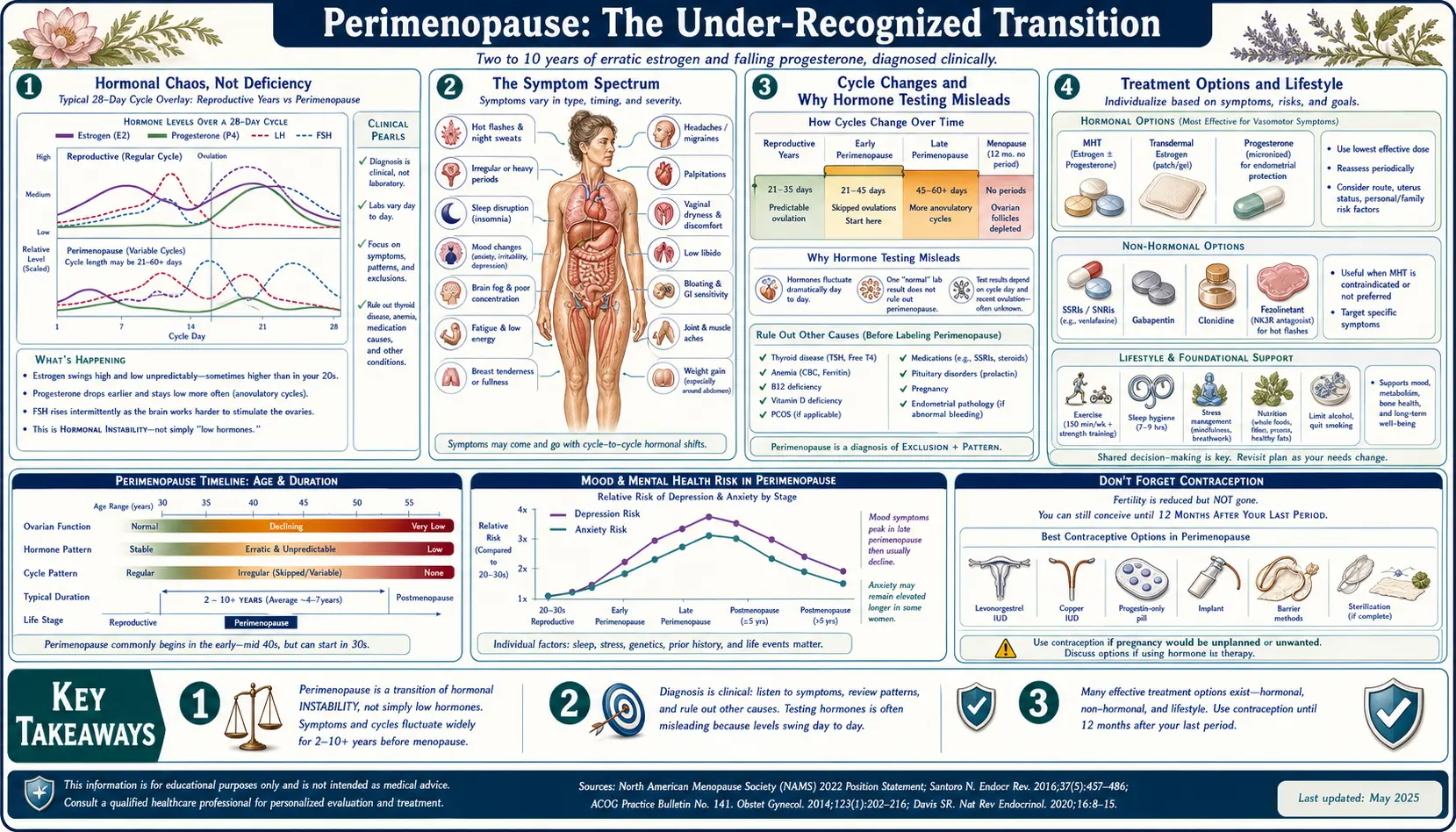
Perimenopause is the transitional phase leading to menopause — typically beginning in the mid-40s but sometimes starting as early as the late 30s — during which ovarian function becomes erratic, hormone levels fluctuate dramatically, and many of the symptoms classically attributed to “menopause” actually begin. Perimenopause can last anywhere from 2 to 10 years before menopause itself (defined as 12 consecutive months without a period). Because it occurs while women are still menstruating — often with regular-appearing cycles at first — perimenopausal symptoms are frequently misattributed to anxiety, thyroid dysfunction, depression, or generic “stress,” and women often go years without an accurate framework for what their body is doing.
Interactive Visualization Menopause — run the hormones down and set off a hot flash Empty the ovarian follicle pool and watch estradiol swing, then flatten, while follicle-stimulating hormone (FSH) climbs — then trigger a hot flash and see the narrowed thermoneutral zone behind it. Launch →Table of Contents
What Perimenopause Is
In reproductive years, ovaries produce a relatively predictable monthly rhythm of estrogen and progesterone. In perimenopause, the follicular pool diminishes and remaining follicles become less responsive to pituitary stimulation. Follicle-stimulating hormone rises to compensate, sometimes overshooting and producing estrogen spikes higher than normal premenopausal peaks, alternating with dips. Progesterone typically falls earlier and more consistently than estrogen, producing a state of unopposed estrogen that drives heavy periods, breast tenderness, mood volatility, and sleep disruption. This hormonal chaos — not simple deficiency — is what makes perimenopause distinctively turbulent.
The Symptom Spectrum
- Irregular, heavier, or longer periods; skipped cycles.
- Hot flashes and night sweats (often earlier than commonly taught).
- Sleep fragmentation, early-morning awakening.
- Anxiety (often new-onset), irritability, mood swings.
- New or worsened migraines tied to cycle.
- Brain fog, word-finding difficulty.
- Breast tenderness, bloating, weight gain.
- Decreased libido or arousal changes.
- Vaginal dryness beginning.
- Hair thinning, skin changes, joint aches.
- Palpitations, especially at night.
- Worsening PMS in the cycles that still occur.
Why Hormone Testing Is Unreliable
A single blood draw of follicle-stimulating hormone, estradiol, and progesterone in a woman with fluctuating perimenopausal hormones may show normal, high, or low values depending on what day and what cycle phase is caught. Normal results do not rule out perimenopause; elevated follicle-stimulating hormone can happen transiently in regular cyclers. The diagnosis is clinical — based on age, symptom pattern, and menstrual history — rather than laboratory. Testing has a role in excluding thyroid disease (thyroid-stimulating hormone (TSH), free T4) and anemia (complete blood count (CBC), ferritin) and in pregnancy testing when indicated.
Cycle Changes
Early perimenopause is often marked by shorter cycles (21–24 days) as the follicular phase contracts. As the transition progresses, cycles become irregular, heavy bleeding episodes can occur, and skipped months appear. A cycle longer than 60 days is a strong signal of late perimenopause. Evaluation of any post-menopausal bleeding (after 12 period-free months) is mandatory to exclude endometrial pathology.
Mood and Cognitive Effects
Women with a history of premenstrual mood sensitivity or postpartum depression are at higher risk of perimenopausal mood disorder. The hormonal fluctuations directly affect serotonin, gamma-aminobutyric acid (GABA), and dopamine signaling; the sleep fragmentation compounds the effect. Studies show a clear peak incidence of new-onset depression during perimenopause. Transdermal estradiol has antidepressant effect in some studies and is a reasonable consideration alongside or instead of selective serotonin reuptake inhibitors (SSRIs) in the perimenopausal context.
Treatment Options
- Hormonal birth control. Low-dose combined pills or vaginal/patch options regulate cycles and reduce symptoms in early perimenopause for non-smokers under 55.
- Cyclic or continuous progesterone. Micronized oral progesterone at bedtime stabilizes sleep and mood and protects the endometrium from unopposed estrogen.
- Transdermal estradiol — helps hot flashes, sleep, and mood. Safe with progesterone for endometrial protection.
- Levonorgestrel IUD. Reduces heavy menstrual bleeding and provides endometrial protection.
- Non-hormonal options. Selective serotonin reuptake inhibitors, serotonin-norepinephrine reuptake inhibitors (SNRIs), gabapentin, fezolinetant, cognitive behavioral therapy (CBT) — similar to menopause.
- Vaginal estrogen. For GSM symptoms that begin in perimenopause.
Lifestyle Foundations
- Resistance training two to three times weekly. Preserves muscle and bone as hormones decline.
- Adequate protein (1.2 g/kg goal weight).
- Reduce alcohol — a major VMS and mood amplifier, and breast-cancer risk modifier.
- Aerobic exercise for mood and cardiovascular health.
- Sleep hygiene.
- Caffeine moderation, especially after noon.
- Mind-body practices — cognitive behavioral therapy, mindfulness, and hypnosis all have trial evidence.
Fertility and Contraception
Fertility declines sharply in the 40s but does not reach zero until 12 months past the last period. Contraception remains necessary until then, or until age 55 if natural cessation has not occurred. Hormonal contraception both prevents pregnancy and may relieve symptoms, combining two functions into one choice.
Connections
- Reproductive Medicine
- Menopause: Why the Hormones Fall and What Changes — interactive animation
- Depression
- Perimenopause Symptom Tracker and Hormonal Testing
- Anxiety
- Uterine Fibroids
- Endometriosis
- Menopause and Hormone Replacement Therapy
- Estradiol Formulations: Patch, Gel, Oral Routes
- Vasomotor Symptoms: Hot Flashes and Night Sweats
- Non-Hormonal Options: Selective Serotonin Reuptake Inhibitors, Gabapentin, Fezolinetant
- Insomnia
- Hormone Panel
- Thyroid Panel
- Micronized Progesterone vs Synthetic Progestins
- Hormone Replacement Therapy Risks: Breast Cancer, Clots and Stroke
- Bone Loss Prevention and Hormone Replacement Therapy
- Infertility
- Ovarian Cysts
- Ashwagandha
- Breast Cancer
- Endometrial Cancer
- PMS and PMDD
- Herbs covered on this site that discuss this condition: Black Cohosh (Actaea racemosa) · Motherwort · Tribulus terrestris
Key Research Papers
- Harlow SD, Gass M, Hall JE, et al. (2012). Executive summary of the Stages of Reproductive Aging Workshop + 10: addressing the unfinished agenda of staging reproductive aging. The Journal of Clinical Endocrinology and Metabolism — PubMed PMID: 22344196
- Prior JC (1998). Perimenopause: the complex endocrinology of the menopausal transition. Endocrine Reviews — PubMed PMID: 9715373
- Santoro N (2016). Perimenopause: From Research to Practice. Journal of Women's Health (2002) — PubMed PMID: 26653408
- Cohen LS, Soares CN, Vitonis AF, et al. (2006). Risk for new onset of depression during the menopausal transition: the Harvard study of moods and cycles. Archives of General Psychiatry — PubMed PMID: 16585467
- Freeman EW, Sammel MD, Lin H, et al. (2006). Associations of hormones and menopausal status with depressed mood in women with no history of depression. Archives of General Psychiatry — PubMed PMID: 16585466
- Soares CN, Almeida OP, Joffe H, et al. (2001). Efficacy of estradiol for the treatment of depressive disorders in perimenopausal women: a double-blind, randomized, placebo-controlled trial. Archives of General Psychiatry — PubMed PMID: 11386980
- Maki PM, Kornstein SG, Joffe H, et al. (2018). Guidelines for the evaluation and treatment of perimenopausal depression: summary and recommendations. Menopause (New York, N.Y.) — PubMed PMID: 30179986
- Avis NE, Crawford SL, Greendale G, et al. (2015). Duration of menopausal vasomotor symptoms over the menopause transition. JAMA Internal Medicine — PubMed PMID: 25686030
PubMed Topic Searches
The following PubMed topic searches aggregate the current peer-reviewed literature. Each link opens a live PubMed query — results update as new studies are indexed.
- PubMed: Perimenopause
- PubMed: Menopausal transition
- PubMed: STRAW staging reproductive aging
- PubMed: Perimenopause symptoms
- PubMed: Perimenopause hormone therapy
- PubMed: Hot flashes vasomotor symptoms
- PubMed: Irregular menses perimenopause
- PubMed: Perimenopause depression
- PubMed: Perimenopause bone loss
- PubMed: Perimenopause sleep
- PubMed: Perimenopause contraception
- PubMed: FSH perimenopause