⚠ Evidence warning: Clinical trials or other evidence do not support the claim that olive leaf extract has a practical role in preventing repeat urinary tract infections, reducing herpes simplex flares and treating early colds; the only study cited for these uses is a laboratory (test-tube) study. This page keeps it as a report of what people, websites or other media say.
Olive Leaf — Benefits Deep Dive
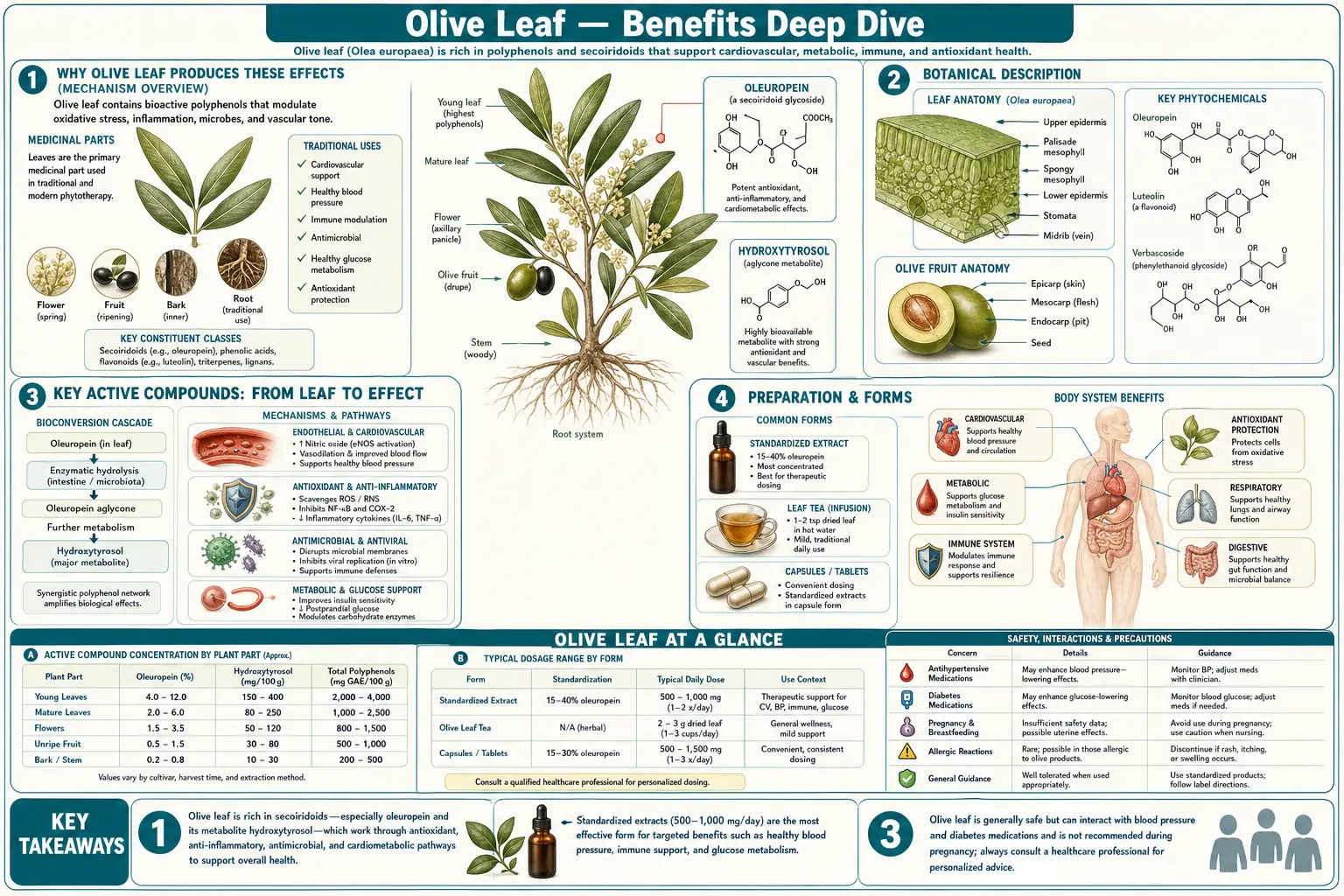
Olive leaf (Olea europaea leaf) is the higher-polyphenol cousin of the celebrated olive fruit. Fresh olive leaves contain 6-9% oleuropein by dry weight — orders of magnitude more than the fruit oil itself — making standardized olive leaf extract (OLE) the most concentrated dietary delivery vehicle for oleuropein and its bioactive hydrolysis product hydroxytyrosol. These two phenolics, central to the Mediterranean cardiometabolic story, drive four mechanistically distinct but overlapping clinical effects: angiotensin-converting enzyme (ACE) inhibition and endothelial nitric oxide upregulation for blood pressure, broad-spectrum antimicrobial activity via elenolic acid for traditional fever and antiviral indications, two-electron radical scavenging plus nuclear factor erythroid 2-related factor 2 (Nrf2) activation for cellular antioxidant defense, and AMP-activated protein kinase (AMPK) activation plus beta-cell preservation for insulin sensitivity. Pharmaceutical-comparable clinical evidence exists in the cardiovascular domain (Susalit 2011 matched OLE 500 mg twice daily to captopril), and a placebo-controlled trial exists in type 2 diabetes (Wainstein 2012 found significantly lower hemoglobin A1c (HbA1c) and fasting insulin with OLE 500 mg once daily). The trials used different doses — 500 mg twice daily against captopril, 500 mg once daily in the Wainstein diabetes trial, and a daily extract giving 136 mg oleuropein and 6 mg hydroxytyrosol in the Lockyer 2017 blood-pressure trial — and the antimicrobial and antioxidant effects below rest on laboratory and mechanism studies rather than human trials.
Deep-Dive Articles
Cardiovascular & Blood Pressure
The pivotal Susalit 2011 trial showed OLE 500 mg twice daily matched captopril 12.5-25 mg twice daily on systolic and diastolic blood pressure (BP) reduction in stage-1 hypertension, while additionally lowering triglycerides. Lockyer 2017 confirmed the blood pressure and lipid effects in 60 men with high-normal blood pressure (prehypertension): in a 6-week crossover trial, 24-hour systolic pressure fell 3.33 mmHg and diastolic 2.42 mmHg, total cholesterol 0.32 mmol/L and triglycerides 0.18 mmol/L, compared with a polyphenol-free control. Mechanism: oleuropein and hydroxytyrosol upregulate endothelial nitric oxide, inhibit angiotensin-converting enzyme, reduce low-density lipoprotein (LDL) oxidation, and contribute the polyphenol portion of the Mediterranean diet's well-documented cardiovascular benefit.
Read the deep dive →Antimicrobial & Antiviral
The Markin 2003 Mycoses laboratory (test-tube) study found that a 0.6% olive-leaf water extract killed almost all bacteria tested within 3 hours, including E. coli, inhibited skin fungi (dermatophytes) at 1.25%, and killed Candida albicans at 15% after 24 hours. Activity against methicillin-resistant Staphylococcus aureus (MRSA), H. pylori, herpes simplex viruses, influenza, and several protozoa is also reported for olive leaf, outside that study. Traditional Mediterranean use for fevers, wound infections, and urinary tract complaints maps onto the mechanism of elenolic acid (released from oleuropein hydrolysis) directly disrupting microbial membranes and inhibiting viral envelope-receptor docking. Herbal practice describes a role in preventing repeat urinary tract infections (UTI), reducing herpes simplex virus (HSV) flares, and early acute upper respiratory illness.
Read the deep dive →Antioxidant & Anti-Aging
Oleuropein and hydroxytyrosol rank among the most potent dietary antioxidants, with hydroxytyrosol's catechol structure providing three to four times the per-mole radical-quenching capacity of Vitamin E. Mitochondrial-membrane-targeted protection (reduced cytochrome c release, preserved cardiolipin), Nrf2 pathway activation upregulating endogenous phase II antioxidant enzymes, and direct comparison to the lower polyphenol content of extra-virgin olive oil itself. Mechanistic alignment with established aging pathways (mitochondrial function, telomere biology, skin photoaging).
Read the deep dive →Blood Sugar & Insulin Sensitivity
Wainstein 2012 randomized 79 adults with type 2 diabetes to OLE 500 mg once daily or placebo for 14 weeks; the OLE group had significantly lower HbA1c and fasting insulin. In a separate 12-week crossover trial in 46 overweight middle-aged men (de Bock 2013), olive leaf polyphenols improved insulin sensitivity by 15% and beta-cell responsiveness by 28% compared with placebo. Oleuropein acts as a glucose-dependent insulin secretagogue (gentler than sulfonylureas) plus a peripheral insulin sensitizer via AMP-activated protein kinase activation in skeletal muscle and hepatocytes. Also covers use alongside metformin, the glucagon-like peptide-1 (GLP-1) contribution, the gut-microbiome mechanism, and its described use in prediabetes and metabolic syndrome.
Read the deep dive →Table of Contents
Why Olive Leaf Produces These Effects (Mechanism Overview)
Most herbal therapeutics owe their activity to a single principal mechanism or to a small group of related actions. Olive leaf is unusual because two phenolic constituents — oleuropein and its hydrolysis product hydroxytyrosol — produce four mechanistically distinct effects that together cover the four deep-dive topics above. The unifying chemistry is that olive leaf is the most concentrated dietary delivery vehicle for these two polyphenols, and each phenolic carries multiple bioactivities.
- ACE inhibition and endothelial nitric oxide upregulation (blood pressure) — oleuropein has measurable in vitro inhibition of angiotensin-converting enzyme, the same target as prescription ACE inhibitors. Independently, both oleuropein and hydroxytyrosol upregulate endothelial nitric oxide (NO) synthase (eNOS) and increase NO bioavailability, producing direct vasodilation. The combination of weak ACE inhibition plus NO-mediated vasodilation produces blood pressure reductions comparable to a starting-dose prescription ACE inhibitor in stage-1 hypertension — in the Susalit 2011 head-to-head trial, systolic pressure fell 11.5 mmHg on olive leaf extract and 13.7 mmHg on captopril, and diastolic pressure 4.8 and 6.4 mmHg, a difference between the groups that was not statistically significant; the results are detailed in the Cardiovascular deep-dive.
- Direct antimicrobial activity via elenolic acid (antimicrobial and antiviral) — when ingested, oleuropein is partially hydrolyzed by gastric and intestinal enzymes, releasing elenolic acid (an antimicrobial monoterpene secoiridoid) in addition to hydroxytyrosol. Elenolic acid disrupts bacterial and viral membrane integrity, inhibits microbial protein synthesis, and blocks viral envelope-receptor docking. This is the proposed basis for the broad-spectrum in vitro activity reported for olive leaf against gram-positive and gram-negative bacteria, herpes viruses, influenza, candida species, and several protozoa; the Markin 2003 laboratory study itself tested bacteria and fungi, killing almost all bacteria tested within 3 hours with a 0.6% water extract and Candida albicans with a 15% extract after 24 hours — see the Antimicrobial deep-dive.
- Two-electron radical scavenging plus Nrf2 activation (antioxidant) — hydroxytyrosol's ortho-dihydroxyphenyl (catechol) structure allows it to donate two hydrogens to neutralize free radicals while forming a stable, non-reactive ortho-quinone product. This is structurally why hydroxytyrosol outperforms Vitamin E and Vitamin C in standard oxygen radical absorbance capacity (ORAC), ferric reducing antioxidant power (FRAP), and 2,2-diphenyl-1-picrylhydrazyl (DPPH) radical-quenching assays. Beyond direct quenching, hydroxytyrosol activates the Nrf2/Keap1 pathway, inducing transcription of the phase II endogenous antioxidant battery (NAD(P)H quinone oxidoreductase 1 (NQO1), heme oxygenase-1 (HO-1), glutathione peroxidase, thioredoxin). The combined direct-plus-hormetic mechanism produces durable cellular antioxidant capacity and is the foundation for the mitochondrial protection and aging-marker benefits described in the Antioxidant deep-dive.
- AMP-activated protein kinase activation and beta-cell preservation (insulin sensitization) — oleuropein and hydroxytyrosol activate AMP-activated protein kinase (AMPK) in skeletal muscle and hepatocytes, increasing glucose uptake and inhibiting hepatic gluconeogenesis — the same mechanism as metformin. Additionally, oleuropein potentiates glucose-stimulated insulin secretion from pancreatic beta cells in a glucose-dependent manner (unlike sulfonylureas, which override the glucose dependency and produce hypoglycemia risk). The dual effect on insulin sensitivity and insulin secretion is the proposed explanation for the 15% better insulin sensitivity and 28% better beta-cell responsiveness seen in the de Bock 2013 trial in overweight men, and for the lower HbA1c and fasting insulin in the Wainstein 2012 trial in type 2 diabetes, detailed in the Blood Sugar deep-dive.
OLE draws interest because all four mechanisms come from one supplement, which is why it is discussed for people who have several components of metabolic syndrome at once — mild hypertension plus prediabetes plus borderline lipids, often alongside a Mediterranean-style diet in which OLE adds to the polyphenols of dietary olive oil.
The same multi-mechanism profile creates several potential drug interactions. In the Susalit 2011 trial OLE lowered blood pressure about as much as captopril, so its effect can add to that of blood-pressure medicines; its glucose-lowering effects can add to those of insulin and sulfonylureas, raising the risk of low blood sugar; and interactions with anticoagulants are also raised. The dosing and cautions sections within each deep-dive page give specifics.
Pooled Trials Find Blood-Pressure and Blood-Fat Effects but No Blood-Sugar Effect
Two 2026 meta-analyses pooled the randomized trials of olive leaf in people:
- Mansouri 2026 — 30 randomized controlled trials with 1,726 people. Olive leaf supplements lowered total cholesterol, triglycerides and low-density lipoprotein (LDL) cholesterol, and reduced systolic and diastolic blood pressure, body weight and body mass index (BMI). No significant effects were seen on blood-sugar (glycemic) markers. The certainty of the evidence ranged from very low to high.
- Câmara Rocha Menezes 2026 — 11 randomized trials of olive leaf extract or oleuropein. Short-term crossover studies gave mixed results on blood sugar and insulin after meals. In the longer, continuous-intake parallel trials, the pooled results showed no statistically or clinically significant effect on blood sugar or blood fats, and the authors concluded that the current evidence does not support clinical recommendations for OLE supplementation.
Key Research Papers
- Susalit E et al. (2011). Olive (Olea europaea) leaf extract effective in patients with stage-1 hypertension: comparison with Captopril. Phytomedicine 18(4):251-258. The pivotal head-to-head trial demonstrating OLE blood-pressure equivalence to a first-line pharmaceutical ACE inhibitor. — PubMed PMID: 21036583
- Wainstein J et al. (2012). Olive leaf extract as a hypoglycemic agent in both human diabetic subjects and in rats. Journal of Medicinal Food 15(7):605-610. A 14-week controlled trial in 79 adults with type 2 diabetes: 500 mg once daily lowered HbA1c and fasting insulin; rat intestine tests showed reduced starch digestion and absorption. — PubMed PMID: 22512698
- Markin D, Duek L, Berdicevsky I (2003). In vitro antimicrobial activity of olive leaves. Mycoses 46(3-4):132-136. A laboratory (test-tube) study of olive leaf water extract against bacteria and fungi. — PubMed PMID: 12870202
- Lockyer S et al. (2017). Impact of phenolic-rich olive leaf extract on blood pressure, plasma lipids and inflammatory markers: a randomised controlled trial. European Journal of Nutrition 56(4):1421-1432. Confirms OLE blood pressure and lipid effects in a double-blind, controlled crossover trial in 60 prehypertensive men. — PubMed PMID: 26951205
- Bulotta S et al. (2014). Beneficial effects of the olive oil phenolic components oleuropein and hydroxytyrosol: focus on protection against cardiovascular and metabolic diseases. Journal of Translational Medicine. A comprehensive review of the oleuropein and hydroxytyrosol mechanistic literature across cardiovascular and metabolic indications. — PubMed PMID: 25086598
- de Bock M, Derraik JG, Brennan CM, Biggs JB, Morgan PE, Hodgkinson SC, Hofman PL, Cutfield WS (2013). Olive (Olea europaea L.) leaf polyphenols improve insulin sensitivity in middle-aged overweight men: a randomized, placebo-controlled, crossover trial. PLoS One 8(3):e57622. — PubMed PMID: 23516412
- Mansouri F, Mardani M, Rucci C, Bordoni L, Gabbianelli R (2026). A GRADE-assessed systematic review and meta-analysis of randomized controlled trials evaluating the effects of olive leaf or olive pomace supplementation on cardiometabolic and anthropometric health markers. Nutrition, Metabolism and Cardiovascular Diseases 36(10):104821. — PubMed PMID: 42303499
- Câmara Rocha Menezes R, Peres KK, da Mata IR, Morelo Dal Bosco S, Garavaglia J, Dallegrave E (2026). Metabolic and inflammatory effects of oleuropein and olive leaf extract: a systematic review and meta-analysis. Food & Function 17(7):3077-3090. — PubMed PMID: 41848522
External Authoritative Resources
- LiverTox — U.S. National Institutes of Health (NIH) database of drug and herbal liver injury (NIH-NIDDK)
- European Food Safety Authority (EFSA) Scientific Opinion — Olive Polyphenols and low-density lipoprotein Oxidation Health Claim (2011)
- MedlinePlus — Olive Leaf
- PubMed — All research on olive leaf extract and oleuropein (~3,000+ papers)
- WHO — Cardiovascular Diseases Fact Sheet (context for OLE's hypertension indication)
Connections
- All Herbs
- Olive Leaf (Main Page)
- OLE for Cardiovascular & Blood Pressure
- OLE for Antimicrobial & Antiviral
- OLE for Antioxidant & Anti-Aging
- OLE for Blood Sugar
- Olive Oil
- Hypertension
- Cardiology
- Type 2 Diabetes
- Endocrinology
- Continuous Glucose Monitor
- Urinary Tract Infections
- Staphylococcus Aureus
- Escherichia Coli
- Influenza
- Garlic
- Oregano
- Rosemary
- Lysine (HSV Synergy)
- Resveratrol
- Curcumin
- Vitamin C
- Vitamin E
- Celery Juice for Blood Pressure
- Immune Boosting
- History