Swiss Chard
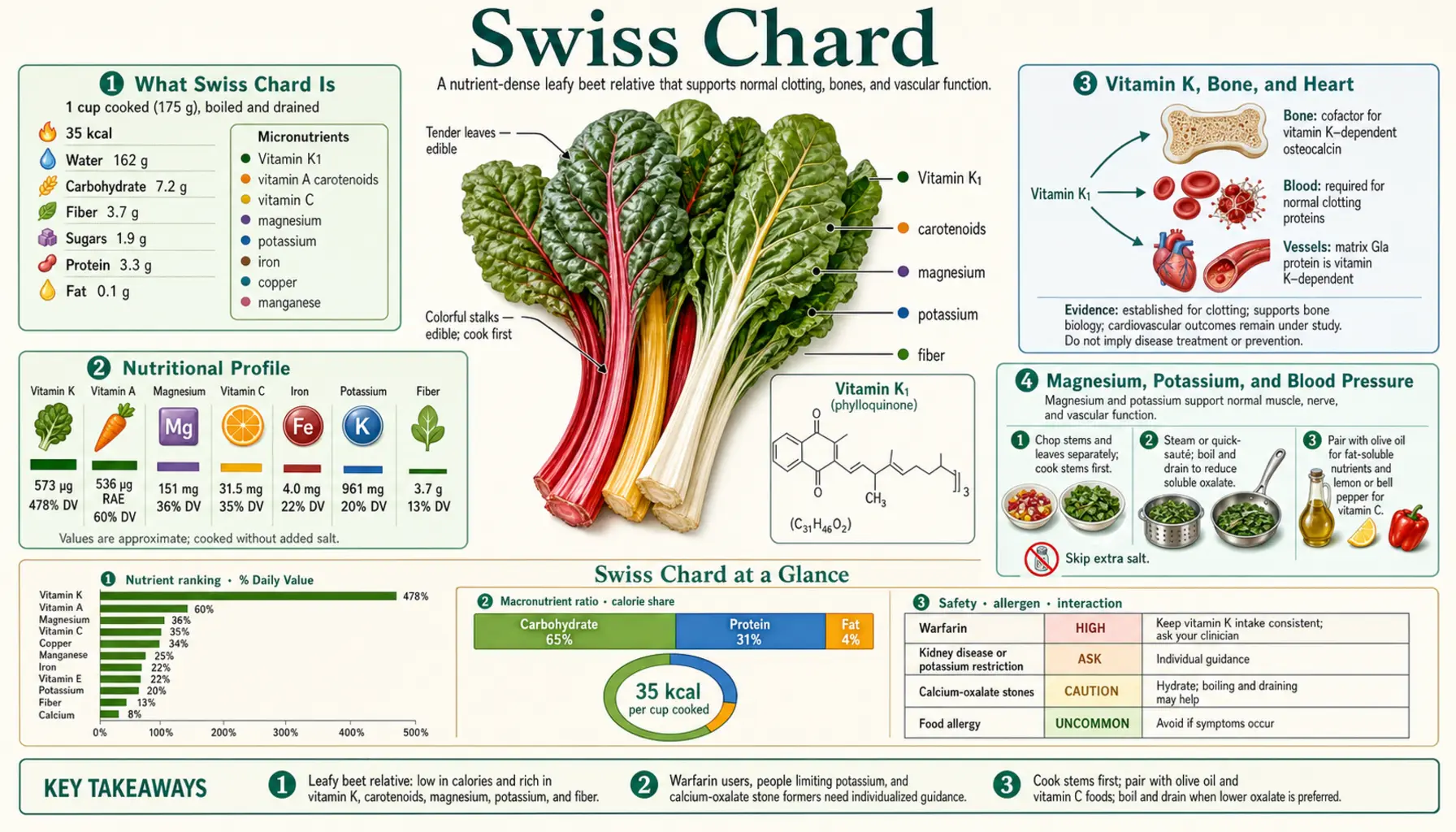
Swiss chard (Beta vulgaris, subspecies cicla) is a leafy green with big, glossy, deeply crinkled leaves and thick, crunchy stalks that can be white, gold, pink, or a vivid crimson. Despite the name, it is not especially Swiss — it is a Mediterranean vegetable, grown and eaten around the Mediterranean basin for thousands of years, and the "Swiss" label was likely attached by seed catalogs to distinguish it from French spinach beets. The most important thing to know about chard is its family tree: it is the very same species as the garden beet, just bred for its leaves and stems instead of a swollen root. That makes it a relative of beets and spinach in the amaranth family (Amaranthaceae) — not a cabbage-family crucifer like kale or broccoli. Nutritionally, chard is a standout for vitamin K, vitamin A, vitamin C, magnesium, and potassium for very few calories, and its rainbow stems carry the same betalain pigments that color beets. But it shares one honest drawback with its cousins spinach and beet greens: it is high in oxalates, which matters for people prone to kidney stones. This page walks through what chard actually offers, where the evidence is strong and where it is modest, the real oxalate trade-off, and the practical side of buying, prepping, cooking, and storing it.
Table of Contents
- What Swiss Chard Is
- Nutritional Profile
- Vitamin K, Bone, and Heart
- Magnesium, Potassium, and Blood Pressure
- Betalains, Lutein, and Zeaxanthin
- The Oxalate Question
- How to Select, Prep, and Cook
- How to Store Chard
- Safety and Who Should Be Cautious
- Research Papers
- Connections
- Featured Videos
What Swiss Chard Is
Swiss chard is a leaf vegetable in the goosefoot or amaranth family (Amaranthaceae, which absorbed the old Chenopodiaceae). Botanically it is Beta vulgaris — the same species as the ordinary red beet, the sugar beet, and the mangel-wurzel — but selected over centuries for lush, edible leaves and fleshy stems rather than a starchy root. In other words, if you grow chard and let it go, it is essentially a beet that never bothered to make a big bulb. This kinship explains a lot about chard: its earthy flavor, its beet-red pigments, and its oxalate content all echo the beet and its greens.
A crucial point for anyone sorting vegetables by health category: chard is not a cruciferous vegetable. Kale, collards, broccoli, cabbage, and bok choy belong to the mustard family (Brassicaceae) and carry sulfur compounds called glucosinolates; chard and spinach do not. They look similar on a plate and cook similarly, but they are different plant families with different chemistry. If a recipe or a diet plan lumps chard in with "cruciferous greens," that is a common but real mistake.
What you see in the store is often "rainbow chard," a mix of varieties whose stalks and veins range from snow white through yellow and orange to deep pink and ruby red. The colors are not just decorative — the red and yellow pigments are betalains, the same pigment class that makes beetroot red. Both the broad leaves and the crunchy stalks are edible, though they cook at different rates. Chard has been a humble Mediterranean staple for a very long time; it turns up in Italian, Provencal, Greek, Turkish, and North African cooking in tarts, gratins, braises, and savory pies, valued because it is hardy, productive, and grows in cooler weather when other greens fade.
Nutritional Profile
Swiss chard is a classic example of a nutrient-dense food: it delivers a lot of vitamins and minerals for almost no calories. A cup of raw chard is only about 7 calories, and even a generous cooked serving (chard wilts down dramatically, so a big pile of raw leaves becomes a modest cooked portion) stays very low in calories while concentrating minerals. Most of chard's tiny calorie load is water and a little fiber and carbohydrate; it has minimal fat and only a small amount of protein. The reason to eat it is not energy — it is the density of micronutrients and plant compounds. Here is what chard supplies in genuinely useful amounts:
- Vitamin K — the headline nutrient. Chard is extremely high in vitamin K1 (phylloquinone); a single cooked cup provides several times a full day's requirement. This is a real strength for bone and vascular health, and it is also the reason for the warfarin note in the safety section.
- Vitamin A — chard is rich in beta-carotene and other carotenoids that the body converts toward vitamin A, supporting vision, skin, and immune function. The deep green leaves are the carotenoid store.
- Vitamin C — a solid contribution toward the daily target, useful for immunity, collagen, and helping the body absorb the plant (non-heme) iron in the same leaves. Some vitamin C is lost with long cooking.
- Magnesium — one of chard's most valuable and under-appreciated features. Leafy greens are among the better food sources of magnesium, a mineral many people fall short on, and chard is near the top of that list.
- Potassium — a meaningful amount, part of what makes chard fit a blood-pressure-friendly, DASH-style pattern of eating.
- Iron — some plant-based iron, alongside a little manganese and copper. Because it is non-heme iron, absorption is partial and is helped by the vitamin C in the same leaf but hindered by chard's own oxalates (see below).
- Antioxidant plant compounds — betalain pigments in the colored stems and veins, plus lutein and zeaxanthin in the green leaves. These get their own section.
Two honest footnotes belong with these numbers. First, exact amounts shift with variety, maturity, growing conditions, and especially cooking — water-soluble vitamins like C and folate drop with boiling, while minerals largely stay. Second, some of the calcium and iron chard contains is partly bound up by its oxalates and therefore not fully absorbed, so chard is a better source of magnesium, potassium, and the fat-soluble vitamins A and K than it is of calcium.
Vitamin K, Bone, and Heart
If chard has a signature nutrient, it is vitamin K. The form in leafy greens is vitamin K1 (phylloquinone), and chard is one of the richest common dietary sources, rivaling kale and spinach. Vitamin K is best known for its role in blood clotting — the name comes from the German Koagulation — but its jobs reach well beyond that. Vitamin K is required to activate a family of proteins that regulate where calcium goes in the body, and that function ties it to both the skeleton and the arteries.
In bone, vitamin K activates osteocalcin, a protein that helps bind calcium into the bone matrix. In blood vessels, it activates matrix Gla protein, which helps keep calcium out of arterial walls where it does not belong. These mechanisms are why researchers describe roles for vitamin K "beyond coagulation," and they make a strong biological case that adequate vitamin K supports healthy bones and flexible arteries. It is worth being precise, though: much of the clinical trial evidence for bone and heart benefits comes from vitamin K2 (menaquinone) supplements, not from eating leafy K1 greens, and observational studies linking higher menaquinone intake to lower heart-disease risk (such as the Rotterdam Study) show association, not proof. The fair summary is that chard is an excellent, food-first way to meet and exceed your vitamin K needs, that meeting those needs is genuinely important for bones and vessels, and that eating chard is a sensible part of that picture — not a substitute for the other pillars of bone and heart health.
Magnesium, Potassium, and Blood Pressure
Beyond vitamins, chard's mineral profile is where it quietly earns its keep — especially for blood pressure. Chard is a good source of both magnesium and potassium, two minerals that work in the body's favor when it comes to cardiovascular health, and many people do not get enough of either.
Potassium helps counterbalance sodium and relaxes blood-vessel walls, and the evidence that raising potassium intake lowers blood pressure is among the more solid findings in nutrition. A large systematic review and meta-analysis in the BMJ found that increased potassium intake reduced blood pressure in adults with hypertension and was associated with a lower risk of stroke. Magnesium tells a similar, if more modest, story: pooled analyses of controlled trials show that magnesium supplementation produces small but real reductions in blood pressure. Chard delivers both minerals through food rather than pills, and it does so as part of the kind of vegetable-and-fruit-rich, low-processed pattern that the landmark DASH trial showed can lower blood pressure substantially on its own.
The honest framing matters here. No single serving of chard is a blood-pressure medication, and you should not stop prescribed treatment in favor of a salad. What chard offers is a low-calorie, high-mineral, high-potassium building block for exactly the dietary pattern that decades of research link to healthier blood pressure. Its magnesium is also involved in hundreds of other bodily processes — energy production, nerve and muscle function, blood-sugar handling — so the benefit of chard's minerals extends well past the cardiovascular system.
Betalains, Lutein, and Zeaxanthin
Chard carries two distinct families of protective plant pigments, and they explain both its beauty and part of its health interest.
Betalains — the beet pigments
The red, pink, and yellow of chard's stems and veins come from betalains, the same nitrogen-containing pigments that make beetroot crimson. This is a direct consequence of chard being the same species as the beet. Betalains split into red-violet betacyanins and yellow betaxanthins, and in laboratory and animal studies they show antioxidant and anti-inflammatory activity. Research on red beetroot, chard's close relative, has explored betalains for their effects on oxidative stress and inflammation, and reviews of Beta vulgaris greens specifically (both the green-and-white cicla chard and red rubra beet leaves) highlight their content of these bioactive pigments and flavonoids. The reasonable takeaway is that the colored parts of chard are not just pretty — they contribute genuine antioxidant compounds — while remembering that most of this evidence is mechanistic or from concentrated beetroot preparations rather than trials of people eating chard.
Lutein and zeaxanthin — for the eyes
The green leaves of chard are a good source of lutein and zeaxanthin, two carotenoids that the body funnels into the retina, where they concentrate in the macula and act as a natural blue-light filter and antioxidant. Diets higher in lutein and zeaxanthin are associated with a lower risk of age-related macular degeneration, and in the large AREDS2 clinical trial, lutein and zeaxanthin were part of the supplement formula studied for slowing advanced macular degeneration. Dark leafy greens like chard, spinach, and kale are the classic food sources of these eye-protective pigments, which is a concrete, evidence-backed reason to keep them on the plate. As with the other benefits, food-level intake supports eye health as part of an overall diet rather than acting as a treatment for existing eye disease.
The Oxalate Question
Here is the honest caveat that every fair account of chard has to include: chard is high in oxalates. This is not a reason for most people to avoid it, but it is a real consideration for some, and it deserves a clear explanation rather than either alarm or silence.
Oxalate (oxalic acid) is a natural compound found in many plants, and chard sits in the high-oxalate tier right alongside its cousins spinach and beet greens — all three are among the highest-oxalate vegetables commonly eaten. Oxalate causes two distinct issues:
- Kidney stones. The most common type of kidney stone is made of calcium oxalate. In people who are prone to forming these stones, a high dietary oxalate load can contribute to stone risk; observational research has linked higher oxalate intake to a modestly increased risk of stone formation, particularly in those already susceptible. If you have a history of calcium-oxalate kidney stones, the standard advice is to moderate very-high-oxalate foods like chard, spinach, and beet greens — not necessarily to eliminate them, but not to eat large amounts daily — and to keep calcium intake adequate and fluids high, since dietary calcium eaten with oxalate binds it in the gut and can actually reduce absorption.
- Reduced mineral absorption. Oxalate binds tightly to certain minerals, notably calcium and iron, forming compounds the body cannot readily absorb. This means chard binds a good portion of its own calcium and some of its iron, so despite containing these minerals, chard is not a well-absorbed source of them the way low-oxalate greens (like kale or bok choy) are for calcium. It is a fine source of magnesium, potassium, and vitamins A and K, but you should look elsewhere for readily absorbed calcium.
The good news is that cooking reduces oxalate. Boiling in particular leaches a meaningful fraction of the soluble oxalate out of leafy greens into the cooking water, which you then discard; controlled kitchen studies have measured substantial oxalate reductions from boiling compared with steaming or eating raw. So if oxalate is a concern for you, boiling chard and pouring off the water — rather than sauteing it in its own juices or eating it raw — is a simple, evidence-based way to lower the load. For the general population with healthy kidneys, oxalate from chard is not a problem, and the vegetable's benefits comfortably outweigh it; the caution is specifically for stone-formers and, to a lesser degree, for anyone relying on chard as a calcium source.
How to Select, Prep, and Cook
Chard is forgiving and quick to cook, and both the leaves and the stems are edible — a nice advantage over some greens where the stalks are thrown away.
Selecting
- Choose bunches with crisp, vividly colored stalks and fresh, glossy leaves. The leaves should look lively, not wilted, yellowed, slimy, or torn.
- Smaller, younger leaves are more tender and milder; very large mature leaves are still good but earthier and may need a bit more cooking.
- Rainbow bunches are a mix of colors and cook the same as white-stemmed chard; the choice is mostly aesthetic.
Prepping
Because the stems are thicker and denser than the leaves, they take longer to cook, so it helps to separate them. Slice or fold each leaf along the central rib and cut the stalk away from the leafy part. Chop the stems into short pieces and start them cooking a few minutes before you add the leaves, so both finish tender at the same time. Wash chard well — the crinkled leaves can trap grit — and there is no need to peel the stalks.
Cooking
- Saute: The everyday method. Cook the chopped stems first in a little olive oil (with garlic, if you like) until they soften, then add the leaves and cook just until wilted and tender, a few minutes. A squeeze of lemon at the end brightens the earthy flavor.
- Steam: Steaming keeps more of the water-soluble vitamins than boiling and gives a clean, tender result — a good choice when oxalate is not your concern.
- Boil / blanch: Best if you specifically want to lower oxalate (discard the water) or need pre-cooked chard for a tart, gratin, or savory pie. Blanch, drain well, and squeeze out excess water before using.
- Braise, bake, or fold into dishes: Chard shines stirred into soups, beans, frittatas, pasta, and Mediterranean tarts and pies. Its sturdiness lets it stand up to longer cooking better than delicate spinach.
Young, tender chard leaves can also be used raw in small amounts in salads, though most people prefer chard cooked, which mellows its earthiness and shrinks the volume dramatically.
How to Store Chard
Chard is a leafy green, so it is perishable and happiest cold and slightly humid. A few simple habits keep it fresh:
- Refrigerate unwashed. Wash chard only right before you cook it; washing before storage leaves moisture on the leaves that speeds spoilage. Keep it loosely wrapped in a plastic bag or wrapped in a slightly damp paper towel in the crisper drawer.
- Use it within a few days. Fresh chard typically keeps well for about three to five days, sometimes up to a week if very fresh. It does not last as long as sturdy roots — the leaves will wilt and yellow as they age.
- Revive if limp. Slightly wilted chard can perk up with a short soak of the stem ends in cold water.
- Freeze for the long term. Chard freezes well if blanched first: briefly boil, cool in ice water, drain and squeeze dry, then freeze in portions. Frozen chard is best used in cooked dishes, since freezing softens the texture.
Safety and Who Should Be Cautious
For the great majority of people, Swiss chard is a wholesome, safe, low-calorie vegetable that is worth eating often. A few specific, honest cautions apply to particular groups:
- Kidney-stone formers (oxalate): This is the main one. Because chard is high in oxalate and the commonest kidney stones are calcium oxalate, people with a history of calcium-oxalate stones should moderate chard, spinach, and beet greens rather than eating large amounts daily. Staying well hydrated and eating adequate calcium with meals (which binds oxalate in the gut) are part of standard stone-prevention advice. This is a caution to be sensible, not a blanket ban — discuss specifics with your clinician or dietitian if you form stones.
- Warfarin and vitamin K: Chard is very high in vitamin K, which counteracts the anticoagulant warfarin (Coumadin). The issue is consistency, not danger: people on warfarin should keep their vitamin-K intake steady week to week rather than swinging from little to a large plate of greens, so their dose stays balanced. You do not have to avoid chard — just be consistent and follow your clinician's guidance. Newer anticoagulants such as apixaban and rivaroxaban are not affected by dietary vitamin K.
- Not a well-absorbed calcium source: Because oxalate binds much of chard's calcium and some of its iron, do not rely on chard to meet calcium needs. Choose low-oxalate greens (kale, bok choy, collards), dairy, or fortified foods for calcium, and pair chard with a vitamin-C source to help absorb its iron.
- Nitrates and infants: Like spinach and beets, chard can accumulate nitrates from the soil. This is not a concern for older children and adults, but very young infants are more sensitive, so leafy greens like chard are generally not recommended as a first food in the earliest months and, once introduced, are best served freshly cooked rather than stored a long time.
- Wash it well: As with all raw leafy greens, rinse chard thoroughly to remove grit and reduce any surface contamination before eating raw or lightly cooking.
None of these caveats change the basic picture for a typical, healthy household: Swiss chard is a nutrient-dense, versatile green that most people can enjoy freely and often.
Research Papers
- Ninfali P, Angelino D. Nutritional and functional potential of Beta vulgaris cicla and rubra. Fitoterapia. 2013;89:188–199. doi:10.1016/j.fitote.2013.06.004 — a chard-specific review of the vitamins, minerals, betalains, and flavonoids in Swiss chard and red-beet greens.
- Booth SL. Roles for Vitamin K Beyond Coagulation. Annu Rev Nutr. 2009;29:89–110. doi:10.1146/annurev-nutr-080508-141217 — explains vitamin K's role in bone (osteocalcin) and vascular (matrix Gla protein) health beyond clotting.
- Geleijnse JM, Vermeer C, Grobbee DE, et al. Dietary Intake of Menaquinone Is Associated with a Reduced Risk of Coronary Heart Disease: The Rotterdam Study. J Nutr. 2004;134(11):3100–3105. doi:10.1093/jn/134.11.3100 — observational link between higher vitamin K2 intake and lower heart-disease risk (association, not proof).
- Zhang X, Li Y, Del Gobbo LC, et al. Effects of Magnesium Supplementation on Blood Pressure: A Meta-Analysis of Randomized Double-Blind Placebo-Controlled Trials. Hypertension. 2016;68(2):324–333. doi:10.1161/HYPERTENSIONAHA.116.07664 — pooled trial evidence that magnesium produces small but real blood-pressure reductions.
- Aburto NJ, Hanson S, Gutierrez H, Hooper L, Elliott P, Cappuccio FP. Effect of increased potassium intake on cardiovascular risk factors and disease: systematic review and meta-analyses. BMJ. 2013;346:f1378. doi:10.1136/bmj.f1378 — higher potassium intake lowered blood pressure and was linked to reduced stroke risk.
- Appel LJ, Moore TJ, Obarzanek E, et al. A Clinical Trial of the Effects of Dietary Patterns on Blood Pressure (DASH). N Engl J Med. 1997;336(16):1117–1124. doi:10.1056/NEJM199704173361601 — the landmark trial showing a vegetable-rich, high-potassium/magnesium dietary pattern lowers blood pressure.
- Clifford T, Howatson G, West DJ, Stevenson EJ. The Potential Benefits of Red Beetroot Supplementation in Health and Disease. Nutrients. 2015;7(4):2801–2822. doi:10.3390/nu7042801 — reviews the betalain pigments (shared with chard, the same species) and their antioxidant and anti-inflammatory activity.
- Ma L, Dou HL, Wu YQ, et al. Lutein and zeaxanthin intake and the risk of age-related macular degeneration: a systematic review and meta-analysis. Br J Nutr. 2012;107(3):350–359. doi:10.1017/S0007114511004260 — higher intake of the leafy-green carotenoids in chard is associated with lower macular-degeneration risk.
- Age-Related Eye Disease Study 2 (AREDS2) Research Group. Lutein + Zeaxanthin and Omega-3 Fatty Acids for Age-Related Macular Degeneration: The AREDS2 Randomized Clinical Trial. JAMA. 2013;309(19):2005–2015. doi:10.1001/jama.2013.4997 — the large trial that studied lutein and zeaxanthin (abundant in dark greens) for advanced macular degeneration.
- Taylor EN, Curhan GC. Oxalate Intake and the Risk for Nephrolithiasis. J Am Soc Nephrol. 2007;18(7):2198–2204. doi:10.1681/ASN.2007020219 — links higher dietary oxalate to a modestly increased risk of calcium-oxalate kidney stones, most relevant to stone-formers.
- Chai W, Liebman M. Effect of Different Cooking Methods on Vegetable Oxalate Content. J Agric Food Chem. 2005;53(8):3027–3030. doi:10.1021/jf048128d — measures how boiling substantially reduces soluble oxalate in vegetables compared with steaming.
- Heaney RP, Weaver CM. Oxalate: effect on calcium absorbability. Am J Clin Nutr. 1989;50(4):830–832. doi:10.1093/ajcn/50.4.830 — classic study showing oxalate binds calcium and lowers its absorption from high-oxalate greens.
Connections
- All Food
- Spinach
- Beets
- Kale
- Vitamin K
- Vitamin A
- Vitamin C
- Magnesium
- Potassium
- Iron
- Calcium — chard's oxalates bind much of its own calcium, so it is a poorly absorbed calcium source despite the numbers on the label.
- Lutein
- Urology (Kidney Stones)
- Cardiology