Quinoa Saponin Removal
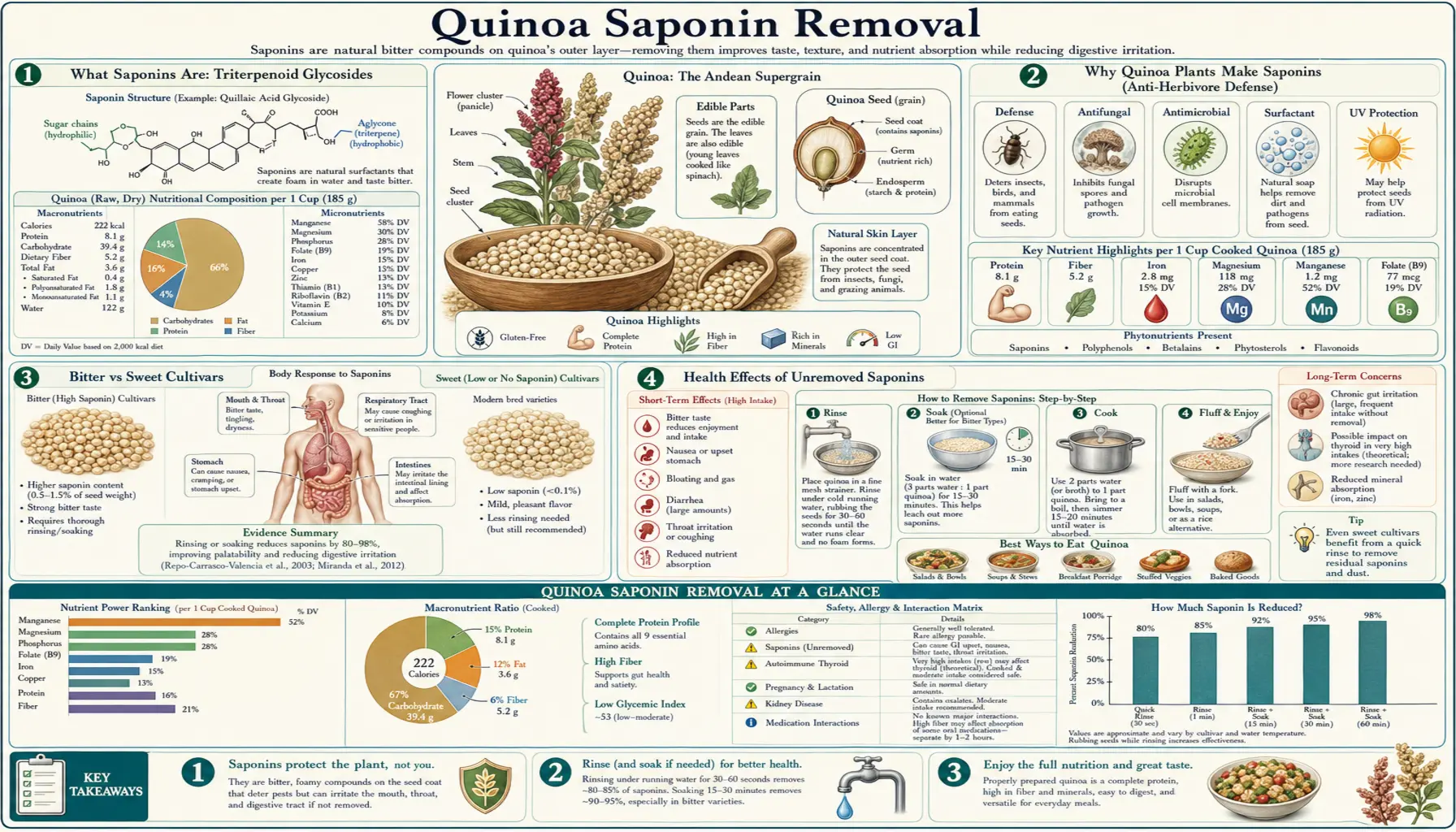
Raw quinoa seeds are coated with bitter triterpenoid saponins that the plant produces as natural pesticides — the same chemical class that powers the "soapwort" and "soapbark" plants and the foaming agent in Quillaja extract. The saponin content of unprocessed quinoa ranges from 0.1% in "sweet" cultivars to over 5% in "bitter" cultivars. Saponins disrupt cell membranes (mild hemolysis in vitro, GI mucosal irritation in vivo) and produce a powerfully bitter taste. They must be removed before eating — either by traditional water-washing, modern mechanical scarification, or a combination. The bitterness disappears with proper processing, but the same chemistry that makes saponins problematic at high dose makes them pharmacologically interesting at low dose, with documented adjuvant, anti-inflammatory, and even anti-cancer activity in research models. This page covers the chemistry, the removal protocols, the residual amounts in commercial pre-washed quinoa, and the unexpected pharmacology of quinoa saponins themselves.
Table of Contents
- What Saponins Are: Triterpenoid Glycosides
- Why Quinoa Plants Make Saponins (Anti-Herbivore Defense)
- Bitter vs Sweet Cultivars
- Health Effects of Unremoved Saponins
- Removal Methods: Water Wash, Scarification, Sprouting
- Commercial Pre-Washing and Residual Levels
- Home Rinsing Protocol
- Saponin Pharmacology at Low Dose
- Quinoa Saponins in Vaccine Adjuvant Research
- Environmental and Industrial Uses of Quinoa Saponins
- Cautions
- Key Research Papers
- Connections
- Featured Videos
What Saponins Are: Triterpenoid Glycosides
Saponins are a broad class of plant glycosides characterized by a hydrophobic steroid or triterpenoid backbone (the "aglycone" or sapogenin) attached to one or more hydrophilic sugar chains. The combination produces a soap-like amphiphilic molecule that lowers surface tension and forms a stable foam in water — hence the name (from Latin sapo, soap).
Quinoa saponins are triterpenoid rather than steroidal, with three primary aglycones identified by chromatographic analysis:
- Oleanolic acid — a pentacyclic triterpenoid also found in olive leaves, mistletoe, and Ligustrum berries. Has documented hepatoprotective and anti-inflammatory activity.
- Hederagenin — another pentacyclic triterpenoid, the principal aglycone in English ivy (Hedera helix) saponins. Has expectorant activity (the basis for ivy-leaf cough syrups in European phytotherapy).
- Phytolaccagenic acid — named for pokeweed (Phytolacca americana), where it was first isolated. The most quinoa-distinctive of the three sapogenins.
To these aglycones the quinoa seed coat attaches sugar chains of glucose, arabinose, galactose, and glucuronic acid in various combinations. At least 30 distinct saponins have been characterized in quinoa seed coats, with a four-sugar bidesmosidic structure (two sugar chains attached at carbons 3 and 28 of the aglycone) being most common in bitter cultivars.
The amphiphilic structure produces three properties that matter biologically: (1) surface activity that foams in water and emulsifies fats, (2) membrane-active behavior — saponins insert into lipid bilayers, complex with membrane cholesterol, and at high concentration can create pores that allow cell lysis, and (3) strongly bitter taste, recognized by the TAS2R bitter taste receptors on the tongue at sub-millimolar concentrations.
Why Quinoa Plants Make Saponins (Anti-Herbivore Defense)
From the plant's evolutionary perspective, the seed is the most valuable part — it carries the genetic material and the energy reserves for the next generation. Plants have evolved diverse chemical defenses to protect seeds from being eaten before they can germinate. Saponins are quinoa's primary defense, deposited densely in the seed coat (pericarp) where any insect or bird that bites into the seed encounters the bitter, membrane-active compounds at maximum concentration.
The protection is multi-modal. Saponins deter feeding through bitter taste; they irritate the insect gut and cause oxidative stress; they reduce nutritional value by binding with sterols and fat-soluble vitamins; and at sufficient concentration they cause lysis of insect midgut epithelial cells. Quinoa cultivars with high saponin content require essentially no pesticide application, which makes them attractive crops in low-input agricultural systems — one of the reasons quinoa has spread to so many marginal-land agricultural settings.
The trade-off is exactly the same set of properties that makes quinoa difficult to eat without processing. The Andean cultivators who first domesticated quinoa 5,000+ years ago must have very quickly identified that the seeds needed washing before consumption — archaeological evidence shows specialized washing vessels at pre-Columbian quinoa-processing sites. Modern Andean farmers continue to distinguish "sweet" cultivars (saponin-free or near-zero, palatable with minimal processing) from "bitter" cultivars (high saponin, requiring vigorous washing but with better insect resistance and yield in marginal soil).
Bitter vs Sweet Cultivars
Quinoa breeders categorize cultivars by saponin content along a continuum, but with a practical threshold around 0.11% saponin by dry weight (the level above which the bitter taste becomes objectionable to most consumers). Cultivars below this threshold are "sweet" (Spanish dulce), those above are "bitter" (amarga).
The genetics are reasonably well understood. The trait is controlled by a small number of major genes plus modifier loci, with sweetness being recessive. Sweet cultivars are easier to process and have been favored for export markets and large-scale modern agriculture. Bitter cultivars retain natural pest resistance, often grow better in extreme altitude and salinity conditions, and are still preferred for traditional cultivation in the Bolivian and Peruvian altiplano.
The Jarvis et al. 2017 Nature genome sequencing of C. quinoa identified candidate genes for the saponin biosynthesis pathway, opening the door to molecular breeding for predictable saponin content. Modern commercial quinoa is overwhelmingly sweet-cultivar genetics, processed mechanically and water-washed before packaging, and arrives at the consumer with residual saponin typically well under 0.06% — below the bitter taste threshold.
Health Effects of Unremoved Saponins
At the saponin concentrations of raw unprocessed bitter quinoa (1-5% by weight), the health effects of eating a substantial quantity are:
- Overwhelming bitterness — the primary immediate problem. Most adults find unwashed bitter quinoa unpalatable to the point of being uneatable.
- GI mucosal irritation — nausea, diarrhea, abdominal cramping, especially in children. The saponins disrupt the gut mucus layer and increase epithelial permeability.
- Mild hemolysis — saponins disrupt erythrocyte membranes in vitro. Hemolytic activity from quinoa saponins is measurable but modest; clinically meaningful hemolysis from dietary exposure has not been reported even with bitter quinoa.
- Reduced absorption of fat-soluble vitamins and sterols — saponins bind cholesterol and other sterols in the gut lumen, reducing their absorption. At low dose this can be cardiovascularly favorable (mild LDL-lowering effect, similar to oat beta-glucan); at high dose it interferes with vitamin A, D, E, and K absorption.
- Trypsin inhibition (modest) — reduces protein digestibility somewhat.
Children, infants, and patients with inflammatory bowel disease or gut barrier dysfunction (leaky gut) are most susceptible to GI symptoms from inadequately washed quinoa. The historical use of quinoa in pre-Columbian Andean infant weaning foods involved repeated washing protocols specifically because the developing infant gut was vulnerable. Modern parents adding quinoa to infant feeding should select pre-washed sweet cultivars and additionally rinse before cooking.
Acute toxicity in adults from dietary quinoa is essentially non-existent in the modern food supply, even with no additional rinsing of pre-washed commercial product. The bitter taste alone serves as a self-limiting deterrent long before any pharmacologically meaningful dose could be ingested.
Removal Methods: Water Wash, Scarification, Sprouting
Three principal methods remove saponins from raw quinoa.
Water washing is the traditional Andean method and remains the most thorough. Saponins are hydrophilic at their sugar-substituted end and dissolve readily in cold water. Pre-Columbian processing involved repeated rinsing in mountain streams, with the foaming runoff serving as a soap substitute for hand and clothes washing. Modern home water-rinsing for 1-2 minutes under cold running water in a fine-mesh strainer reduces saponin content by 60-80% from already-pre-washed commercial quinoa, well below the bitter threshold.
Mechanical scarification is the dominant modern industrial method. Dry quinoa seeds are passed between abrasive surfaces that physically rub off the saponin-rich outer pericarp without damaging the inner endosperm. This can remove 80-95% of saponins without water, conserving water and producing dry product ready for packaging. Most large-scale quinoa processing combines an initial mechanical scarification step with a subsequent water wash to achieve very low residual saponin.
Combined methods — almost all commercial quinoa today uses scarification followed by water wash. Some processors add a steam treatment to further reduce saponin and inactivate any residual enzymes, but heating can affect the lysine content (see the Complete Protein page) and is used sparingly.
Sprouting/germination additionally reduces saponins through enzymatic conversion. Germinated quinoa contains substantially less saponin than ungerminated, with the small added benefit of reducing phytate and improving mineral bioavailability. Sprouted quinoa is sold as a specialty product and used in some artisan cereals.
Alkali extraction using sodium hydroxide can solubilize saponins very efficiently but is not used in food processing because of safety and taste impact. It is occasionally used in research extraction to isolate saponins for pharmacology studies.
Commercial Pre-Washing and Residual Levels
Almost all quinoa sold in North American and European retail markets is labeled "pre-washed" or "ready to cook." This generally indicates that the processor has performed mechanical scarification plus water wash, reducing saponin content to well below the 0.11% bitter threshold. Independent laboratory testing of commercial U.S.-market quinoa typically finds residual saponin in the 0.03-0.08% range — below the taste threshold but not zero.
Bulk quinoa from grain stores and ethnic markets can be more variable. Some unprocessed or minimally-processed bulk quinoa requires the user to perform the saponin removal step. A quick test: drop a small amount of dry quinoa into a glass of water, shake vigorously, and look for persistent foam. Significant foaming indicates substantial residual saponin and the need for vigorous home rinsing.
The "to rinse or not to rinse" question for pre-washed commercial quinoa: most home cooks rinse anyway for the following reasons: (1) it removes any dust or debris from packaging and transport, (2) it removes the last traces of saponin that some consumers can still detect as faint bitterness, (3) it briefly hydrates the seeds for slightly more even cooking. The downside is loss of some water-soluble surface starch and minor reduction in cooking time. Most quinoa producers and chefs recommend a brief cold-water rinse even with pre-washed product.
Home Rinsing Protocol
The standard home rinsing procedure:
- Place the measured dry quinoa in a fine-mesh strainer (mesh too coarse will let the small seeds through). A 1-mm or finer mesh works well.
- Hold the strainer under cold running water and gently stir or shake the seeds with your hand for 1-2 minutes.
- Some recipes recommend an additional 30-second rub with a clean cloth or your palms to mechanically remove any final saponin film.
- Drain thoroughly; the rinsed quinoa is ready to cook.
- Standard cooking ratio: 1 part quinoa to 2 parts water (or broth), bring to a boil, reduce to simmer, cover, cook 15-20 minutes until the germ has spiraled away from the seed and the water is absorbed.
- Let stand covered off the heat for 5 minutes, then fluff with a fork.
If the quinoa is from a bulk source of uncertain provenance and tastes bitter after the first rinse-and-cook cycle, the saponin content is unusually high. Subsequent batches should be soaked in water for 30 minutes before cooking, with two or three water changes, to extract additional saponins. Discard the soak water (which will foam and taste bitter) before final cooking.
Saponin Pharmacology at Low Dose
The same membrane-active properties that make saponins problematic at high dietary doses make them pharmacologically interesting at low controlled doses. The general principle (familiar from many plant secondary metabolites) is that what is toxic in bulk can be useful in carefully calibrated quantity. Documented activities of quinoa saponins at low concentration include:
- Anti-inflammatory activity — quinoa saponin extracts suppress NF-kB signaling and inflammatory cytokine release in macrophage and intestinal epithelial cell culture models, at concentrations below the membrane-disrupting threshold.
- Anti-cancer activity in vitro — certain quinoa saponins induce apoptosis in cancer cell lines (colon cancer, breast cancer, leukemia) with relative selectivity over normal cells. Mechanisms include mitochondrial membrane permeabilization, caspase activation, and cell cycle arrest. Clinical relevance is uncertain.
- Antimicrobial activity — quinoa saponin extracts inhibit growth of several bacterial and fungal pathogens at moderate concentrations, including Candida albicans and several Gram-positive bacteria.
- Cholesterol-lowering effect — low residual saponin in cooked quinoa contributes mildly to the lipid-lowering effect observed in clinical trials, through gut-lumen binding of bile acids and cholesterol.
- Adjuvant activity — quinoa saponins enhance antibody responses to co-administered antigens in animal vaccine models, paralleling the well-known activity of Quillaja saponaria saponins (QS-21) used in human shingles and malaria vaccines.
None of these activities have produced an approved drug derived from quinoa saponins specifically. The QS-21 adjuvant used in the Shingrix shingles vaccine and the RTS,S malaria vaccine is structurally related but derived from a different plant (the South American soapbark tree). The quinoa research is best viewed as suggestive of the chemical-class potential rather than as evidence that quinoa itself provides these effects clinically — at the saponin doses present in properly processed dietary quinoa, the systemic exposure is minimal.
Quinoa Saponins in Vaccine Adjuvant Research
The most clinically translated saponin work has used Quillaja saponaria (the South American soapbark tree) rather than quinoa, but quinoa saponins share enough structural similarity to be of active research interest as next-generation vaccine adjuvants.
QS-21 is a purified saponin fraction from Quillaja that has been shown to enhance both antibody (Th2-type) and cell-mediated (Th1-type) immune responses to co-administered antigens. It is the adjuvant component of the GlaxoSmithKline AS01 adjuvant system used in the Shingrix shingles vaccine and the Mosquirix (RTS,S) malaria vaccine. The QS-21 supply chain depends on harvesting bark from mature Quillaja trees, which limits scaling.
Quinoa saponin research has explored whether the more abundant agricultural source could substitute. Several quinoa-derived saponin fractions have shown adjuvant activity in mouse models comparable to QS-21 for some antigen classes, although with somewhat different cytokine profiles. Whether quinoa saponins can match the safety profile of clinically validated QS-21 in human use remains under investigation. For dietary purposes, this body of research is largely irrelevant — the doses required for adjuvant activity are higher than dietary exposure provides, and the adjuvants are delivered parenterally with vaccine antigen, not orally with food.
Environmental and Industrial Uses of Quinoa Saponins
The quinoa industry generates substantial saponin-containing wastewater from the washing step. Rather than treating this as waste, several producers have begun recovering the saponins for industrial uses:
- Surfactants for personal care products — mild, plant-derived foaming agents for shampoos, body washes, and natural cleaning products.
- Agricultural pest control — quinoa saponin extracts function as natural insecticides and molluscicides, particularly effective against snails and slugs.
- Veterinary parasitology — activity against some animal gastrointestinal parasites has been documented.
- Mining and ore processing — saponins as natural surfactants for froth flotation in mineral separation.
This circular-economy approach turns a processing waste stream into an additional revenue source for quinoa growers and reduces environmental impact from saponin-laden wastewater discharge.
Cautions
- Rinse bulk quinoa from unknown sources — commercial pre-washed quinoa rarely needs aggressive rinsing, but bulk-bin quinoa or quinoa purchased in less-regulated markets may have significantly higher saponin content. When in doubt, rinse vigorously.
- Avoid raw quinoa — raw (uncooked) quinoa, even pre-washed, can still carry GI-irritating saponin levels and is not recommended for consumption. Always cook quinoa.
- Children and IBD patients — most vulnerable to GI symptoms from residual saponins. Use only well-rinsed sweet-cultivar quinoa and start with small servings to assess tolerance.
- Hemolytic anemia patients — theoretical concern given in vitro hemolytic activity of saponins; clinically meaningful effects from dietary quinoa exposure are not documented but a conservative approach is reasonable.
- Quinoa saponins are not a supplement — isolated saponin extracts marketed as dietary supplements lack adequate safety and efficacy data. The pharmacology research described above is preclinical and exploratory.
- Foaming during cooking is normal — some residual saponins produce minor foaming during the boil. Skim if it concerns you. Excessive foaming suggests inadequate rinsing.
Key Research Papers
- Kuljanabhagavad T, Wink M (2009). Biological activities and chemistry of saponins from Chenopodium quinoa Willd. Phytochemistry Reviews. — PubMed
- Ridout CL, Price KR, DuPont MS, Parker ML, Fenwick GR (1991). Quinoa saponins: analysis and preliminary investigations into the effects of reduction by processing. Journal of the Science of Food and Agriculture. — PubMed
- Mastebroek HD, Limburg H, Gilles T, Marvin HJP (2000). Occurrence of sapogenins in leaves and seeds of quinoa. Journal of the Science of Food and Agriculture. — PubMed
- Gomez-Caravaca AM, Iafelice G, Lavini A et al. (2012). Phenolic compounds and saponins in quinoa samples (Chenopodium quinoa Willd.) grown under different saline and nonsaline irrigation regimens. Journal of Agricultural and Food Chemistry. — PubMed
- Gianna V, Montes JM, Calandri EL, Guzman CA (2012). Impact of several variables on the microwave extraction of Chenopodium quinoa Willd saponins. International Journal of Food Science and Technology. — PubMed
- Lozano M, Tichez SM, Quintanar-Solis OG (2012). Saponin biosynthesis and removal in quinoa: agronomy, food processing, and nutritional implications. — PubMed
- Estrada A, Li B, Laarveld B (1998). Adjuvant action of Chenopodium quinoa saponins on the induction of antibody responses to intragastric and intranasal administered antigens in mice. Comparative Immunology, Microbiology and Infectious Diseases. — PubMed
- Yao Y, Yang X, Shi Z, Ren G (2014). Anti-inflammatory activity of saponins from quinoa (Chenopodium quinoa Willd.) seeds in lipopolysaccharide-stimulated RAW 264.7 macrophages. Journal of Food Science. — PubMed
- Suarez-Estrella D, Torri L, Pagani MA, Marti A (2018). Quinoa bitterness: causes and solutions for improving product acceptability. Journal of the Science of Food and Agriculture. — PubMed
- Vega-Galvez A et al. (2010). Nutrition facts and functional potential of quinoa (review including saponin chemistry). Journal of the Science of Food and Agriculture. — PubMed
- Jarvis DE et al. (2017). The genome of Chenopodium quinoa (includes saponin biosynthesis gene mapping). Nature. — PubMed
- Sun X et al. (2009). Advances in saponin-based adjuvants. Vaccine. — PubMed
PubMed Topic Searches
- PubMed: Quinoa saponin / triterpenoid
- PubMed: Saponin removal and processing
- PubMed: Quillaja / QS-21 adjuvant
- PubMed: Plant saponin pharmacology
- PubMed: Triterpenoid sapogenins
Connections
- All Food
- Quinoa Overview
- Quinoa Benefits Hub
- Quinoa Complete Protein
- Quinoa Glycemic Index
- Quinoa Andean Origins
- All Herbs
- All Toxins (anti-nutrients context)
- Inflammatory Bowel Disease
- Leaky Gut
- Iron (phytate context)
- Zinc (phytate context)
- Oats
- Lentils