Andean Origins of Quinoa
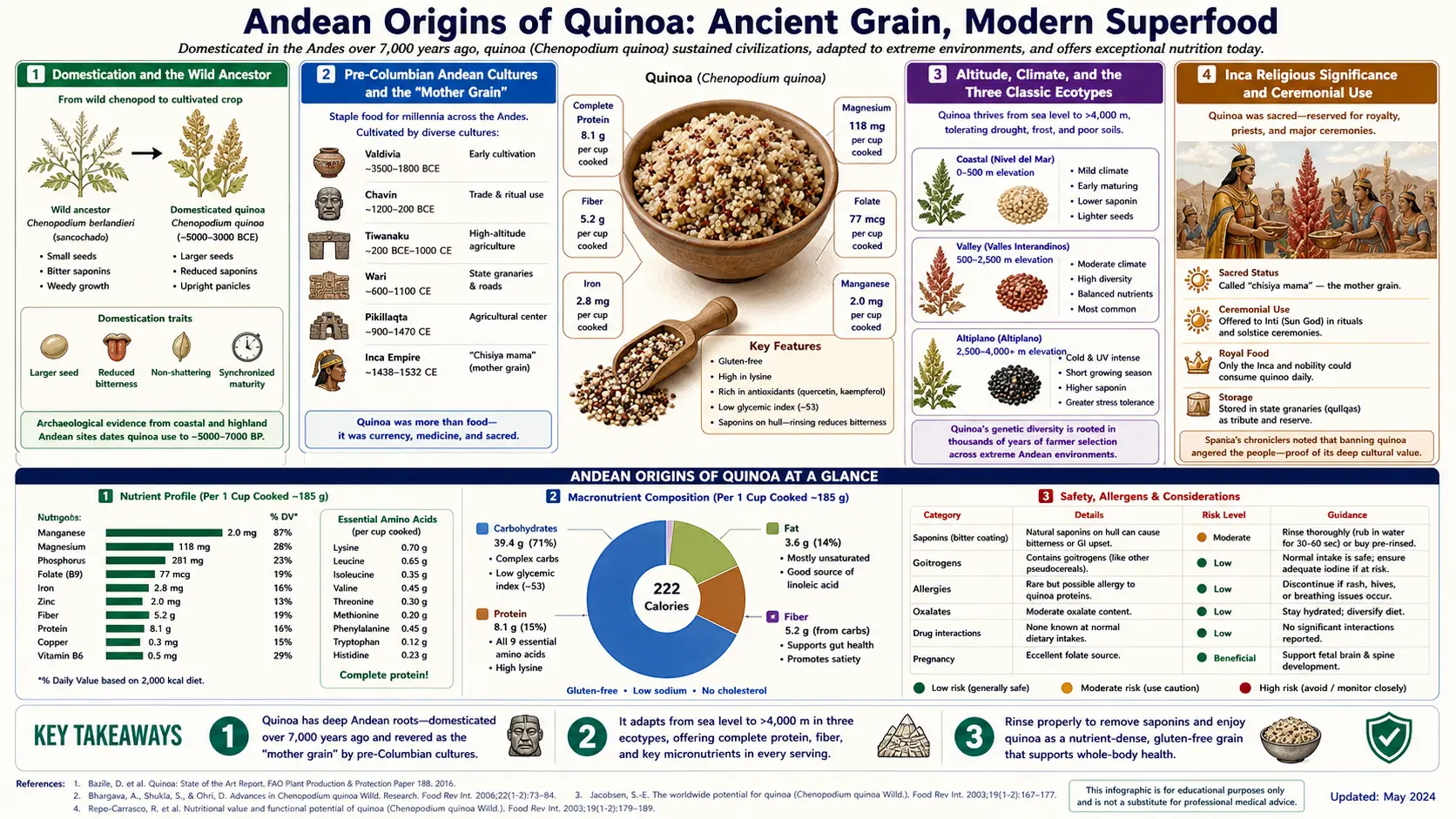
Quinoa (Chenopodium quinoa Willd.) was domesticated in the high Andes of present-day Peru and Bolivia roughly 5,000-7,000 years ago, making it one of the oldest cultivated crops of the Americas. The wild progenitor, Chenopodium hircinum, still grows on disturbed Andean slopes; the cultivated descendant fed the Tiwanaku, Wari, and Inca civilizations from elevations of 2,500 to 4,000 meters where maize cannot mature. The Inca called it chisaya mama, "mother of all grains," and the Sapa Inca opened each planting season by turning the first soil with a golden taqlla. Spanish colonial authorities suppressed quinoa cultivation for four centuries as a heathen crop tied to indigenous ceremony, replacing it with European cereals; it persisted on subsistence plots in the most marginal high-altitude communities. The 20th century saw cautious agronomic rediscovery, NASA selecting quinoa as a model crop for long-duration spaceflight in 1993, and the United Nations declaring 2013 the International Year of Quinoa. The boom that followed produced both new income for Aymara and Quechua farmers and serious questions about land use, export concentration, and the food sovereignty of communities for whom quinoa is staple, not commodity.
Table of Contents
- Domestication and the Wild Ancestor
- Pre-Columbian Andean Cultures and the Mother Grain
- Altitude, Climate, and the Three Classic Ecotypes
- Inca Religious Significance and Ceremonial Use
- Spanish Conquest and Four Centuries of Suppression
- 20th-Century Rediscovery and the 2013 UN Year
- Royal Bolivian Quinoa and the Southern Altiplano
- Fair Trade, Export Boom, and Food-Justice Concerns
- Climate-Resilience Traits and the Future Crop Argument
- Andean Cousins: Kaniwa and Amaranth
- Modern Cultivation Outside the Andes
- Key Research Papers
- Connections
- Featured Videos
Domestication and the Wild Ancestor
Quinoa is one of seven crops domesticated independently in the Americas (alongside maize, potato, cassava, beans, squash, and amaranth), and one of only two pseudocereals that achieved staple status (the other being amaranth). Archaeological evidence from the Ayacucho basin of Peru, the Lake Titicaca region straddling the Peru-Bolivia border, and the dry caves of the Atacama foothills places early quinoa cultivation between approximately 5,000 and 7,000 years before present. Charred quinoa seeds recovered from Panaulauca Cave in central Peru have been radiocarbon dated to roughly 5,000 BP, and macrobotanical remains from the Wankarani sites near Lake Titicaca push the record further back.
The wild progenitor is now identified by genomic evidence as Chenopodium hircinum, a weedy diploid annual that still grows on disturbed slopes throughout the Andes. C. quinoa itself is an allotetraploid (2n = 4x = 36), with one genome contributed by a hircinum-like ancestor and a second genome from a related New World Chenopodium. The 2017 sequencing of the quinoa genome by Jarvis and colleagues confirmed the polyploid origin and identified the genes responsible for seed saponin content, a key target for breeding the bitter-free varieties demanded by export markets.
Domestication selected primarily for three traits: larger seed size, loss of seed shattering (so seeds remain on the panicle until harvest), and reduction in seed-coat saponin. None of the three is fully fixed in cultivated landraces — traditional Aymara and Quechua varieties still vary considerably in seed size, dormancy, and bitterness, and some sweet-quinoa cultivars retain trace saponin as natural pest deterrent.
The same Lake Titicaca basin where quinoa was first domesticated remains its genetic homeland today, with the highest concentration of landrace diversity (over 3,000 distinct cultivars catalogued by Bolivian and Peruvian seed banks) and the active center of farmer-driven varietal selection.
Pre-Columbian Andean Cultures and the Mother Grain
By the time of the Tiwanaku civilization (roughly 500-1000 CE, centered on the southern shore of Lake Titicaca at 3,800 m elevation), quinoa was already a staple of high-altitude agriculture across what is now Bolivia, southern Peru, and northern Chile. Tiwanaku field systems included extensive raised-bed agriculture (suka kollu or waru waru) that exploited the heat-buffering properties of standing water in adjacent canals, allowing quinoa, potato, and kaniwa cultivation at elevations where overnight frost would otherwise destroy crops. These engineered fields supported population densities in the altiplano that contemporary modern farming has yet to match.
The Wari empire (600-1000 CE) of central highland Peru extended quinoa cultivation north into ecological zones already dominated by maize, where quinoa served as the cold-tolerant rotational complement. The succeeding Late Intermediate kingdoms (Lupaqa, Colla, Pacajes, Chimu) maintained the quinoa-potato-kaniwa trinity as the foundation of altiplano subsistence.
The Inca empire (roughly 1438-1533 CE) institutionalized quinoa as one of three sacred staples (alongside maize and the potato), and Inca chroniclers writing after the conquest record it under the Quechua name kinwa or kiuna and the Aymara name jupha. The phrase chisaya mama — "mother of all grains" — appears in 17th-century Spanish accounts attributing it to indigenous informants. Inca state granaries (qollqas) stored quinoa alongside chuno (freeze-dried potato) as a primary famine reserve, exploiting quinoa's natural saponin coating as a pest deterrent that allowed multi-year storage without significant loss to weevils.
For the rural Quechua and Aymara communities that descend from these civilizations, quinoa was never just a commodity. It functioned simultaneously as staple food, ceremonial offering, seed for next year's crop, currency for barter between altitude zones, and material expression of the community's relationship with the land (Pachamama) and with the ancestors who first domesticated it. The Spanish-language and English-language framings of quinoa as a "grain" or a "crop" miss this layered meaning.
Altitude, Climate, and the Three Classic Ecotypes
Quinoa's defining agronomic property is its ability to mature under conditions that destroy most crops — freezing nights, hailstorms, prolonged drought, salty soils, intense ultraviolet radiation, and elevations from sea level to nearly 4,500 m. This adaptive range is unmatched among major crops and traces directly to the diverse selection pressures applied during 5,000 years of domestication across the vertical archipelago of Andean microclimates.
Traditional Andean botany recognizes three classic ecotypes of cultivated quinoa, each adapted to a specific altitude band:
- Valley ecotype (Quechua-region quinoa) — cultivated at 2,500-3,500 m in inter-Andean valleys (Cuzco region, Ayacucho, Cajamarca, the Bolivian Yungas). Taller plants (up to 2.5 m), longer growing season (180-220 days), tolerant of mild frost but not extreme cold. Examples: Amarilla de Maranganí, Kancolla, Blanca de Juli.
- Altiplano ecotype (Lake Titicaca and southern Altiplano) — cultivated at 3,500-4,000 m on the high plain shared by Peru and Bolivia. Shorter plants (1-1.5 m), shorter growing season (150-180 days), highly frost-tolerant, drought-tolerant, halophyte tolerance (saline-tolerant). Examples: Sajama, Real Boliviano, Pasankalla, Salcedo INIA, Negra Collana.
- Sea-level (chilensis) ecotype — cultivated at low elevations on the coast of central and southern Chile (Maule, Bio-Bio, Araucanía). Adapted to long photoperiods, mild winters, and Mediterranean climate. Examples: Lito, Faro, traditional Mapuche landraces collectively called dawe.
A fourth grouping is sometimes added for the Yungas (subtropical eastern Andean foothills, 1,500-2,000 m) and a fifth for the Salares (saline flats of the Bolivian southern altiplano around the Salar de Uyuni, where the Real Boliviano variety is the only crop that produces commercial yields). The chilensis ecotype is particularly important to global expansion because its low-altitude long-photoperiod adaptation provides the genetic foundation for cultivars grown in Europe, North America, and East Asia, where the high-altitude short-photoperiod altiplano cultivars do not flower properly.
Within each ecotype, smallholder farmers maintain many distinct landraces, often selected for specific culinary or ceremonial uses (white quinoa for everyday cooking, red and black for chicha or for festival dishes, large-grained for toasted snacks). The Bolivian PROINPA institute and the Peruvian INIA seed bank together hold over 6,000 accessions; many additional landraces exist only in living seed-saver networks at the community level.
Inca Religious Significance and Ceremonial Use
Quinoa occupied a sacred niche in Inca cosmology distinct from but parallel to that of maize. Where maize was the prestige grain of imperial cuisine and the ceremonial brew (chicha) used in elite rituals, quinoa was the foundation grain of subsistence and the offering grain of household and community ceremony. The annual ritual calendar tied both grains to specific moments in the agricultural cycle.
The Sapa Inca opened the planting season at Cuzco each August with the taqlla ceremony, breaking the first soil with a ceremonial gold-tipped foot plough. Indigenous chronicler Felipe Guaman Poma de Ayala, writing around 1615 in Nueva Coronica y Buen Gobierno, depicts the Inca and the Coya (queen) sowing the first quinoa and maize seeds together as a paired offering to Inti (sun) and Pachamama (earth). The ritual was repeated at smaller scale by every ayllu (kinship community) across the empire, the local kuraka (chief) breaking ground in the community's most sacred field.
Cooked quinoa was offered as mukunchi at solstice and equinox festivals (Inti Raymi in June, Capac Raymi in December). Toasted quinoa flour mixed with water and llama fat formed kispina or kispino, a steamed bread used in funerary offerings. Fermented quinoa beer (kinwa aqha) was prepared for community festivals in regions where maize would not grow, providing the same ceremonial role that chicha de jora played at lower altitudes.
This religious centrality is precisely what alarmed the Spanish colonial church and the encomendero estate-holders. Sustaining quinoa as a sacred grain was, in the colonial reading, sustaining the indigenous religious system as an alternative to Catholic Christianity. The systematic discouragement and at times prohibition of quinoa cultivation that began in the 1540s was as much religious persecution as economic policy.
Spanish Conquest and Four Centuries of Suppression
The Spanish conquest of Tahuantinsuyu (1532-1572) inaugurated a period of roughly four centuries during which quinoa was actively marginalized in the central Andes. The colonial agricultural policy was straightforward: replace indigenous staples (quinoa, kaniwa, oca, ulluco, mashua) with European introductions (wheat, barley, broad beans, onions, livestock-pasture grasses), partly because Spanish settlers preferred familiar foods, partly because the encomienda labor system was easier to administer using crops the encomendero himself recognized, and partly because indigenous staples were entangled with indigenous religion in ways that the colonial church considered threatening.
Specific policy mechanisms included: forced relocations (reducciones) that moved indigenous populations off their ancestral high-altitude fields into lower-elevation Spanish-organized villages where wheat and barley grew better; tribute requirements (encomienda and later repartimiento) that demanded payment in Spanish-recognized goods rather than in quinoa or chuno; clerical proscription of quinoa offerings as "diabolical superstition" punishable by lashes or imprisonment; and the extirpation of indigenous religious practice generally, of which quinoa ceremony was one element.
The result was a four-century retreat of quinoa cultivation. By the late colonial and early republican periods (1700s-1800s), quinoa had been pushed out of valley agriculture entirely and survived only on subsistence plots in the highest, most isolated altiplano communities where wheat would not mature and where Spanish-mestizo settlement had never displaced indigenous farmers. It was treated in republican-era Peru and Bolivia as a "famine food" or "Indian food," carrying a class and ethnic stigma that discouraged consumption by urban populations.
Notably, the chilensis (sea-level) ecotype escaped the worst of this suppression because it was maintained in southern-Chile Mapuche communities largely outside the central-Andean colonial framework. The survival of chilensis genetics turned out to be agronomically critical for the late-20th-century global expansion of quinoa.
20th-Century Rediscovery and the 2013 UN Year
The path back from marginalization began slowly in the mid-20th century. Bolivian and Peruvian agronomists, beginning in the 1940s with Mario Tapia at Cuzco and Humberto Gandarillas at La Paz, began systematic collection of quinoa landraces and comparative agronomic trials, partly motivated by altiplano food security concerns during periods of drought-induced famine. The first formally bred quinoa cultivars (Sajama in Bolivia, 1965; Kancolla in Peru, 1971) were released for smallholder use.
In 1993, NASA published an analysis of quinoa as a candidate crop for Controlled Ecological Life Support Systems (CELSS) on long-duration crewed spaceflight, citing its complete amino acid profile, short growing season, and ability to tolerate the controlled atmospheric and lighting conditions of a closed-loop space habitat. The NASA endorsement — widely covered in the international press — gave quinoa its first global publicity moment and seeded interest in non-Andean consumers.
Through the 1990s and 2000s, quinoa moved progressively from health-food specialty shops into mainstream supermarkets in North America and Europe. The combination of "gluten-free," "complete plant protein," "high mineral content," and the appeal of an exotic ancient grain produced sustained demand growth at retail prices that climbed from roughly $1-2 per kilogram in 2000 to over $8 per kilogram at the 2014 peak.
The United Nations General Assembly, in resolution 66/221 (December 2011), declared 2013 the International Year of Quinoa. The official rationale cited quinoa's nutritional value, its biodiversity, and its potential to contribute to food security in the face of climate change. The campaign was driven primarily by the governments of Bolivia and Peru with support from Ecuador, Chile, and Argentina, all of which sought both to celebrate the indigenous origin of the crop and to expand its export markets.
The 2013 Year of Quinoa coincided with the absolute peak of the quinoa boom. By 2014, prices began to retreat as production outside the Andes ramped up (Peru briefly overtook Bolivia as the largest exporter through low-altitude coastal cultivation) and as global supply caught up with the previous demand-driven price spike. The post-2014 price decline created hardship for smallholder altiplano farmers who had expanded production during the boom; many returned to dual-purpose subsistence-plus-cash cropping or pivoted to other crops.
Royal Bolivian Quinoa and the Southern Altiplano
The most prestigious commercial quinoa in international markets is Real Boliviano (Royal Bolivian), grown almost exclusively in the southern Bolivian altiplano around the Salar de Uyuni and Salar de Coipasa at elevations of 3,650-3,800 m. The Real cultivar is distinguished by exceptionally large grains (typically 2.2-2.8 mm diameter vs 1.4-1.8 mm for standard altiplano cultivars), a uniform pearly-white seed coat, and a clean flavor profile preferred by European and North American specialty buyers.
The agroecological conditions of the southern Altiplano are uniquely suited to Real cultivation and unsuited to almost any other crop. The Salar de Uyuni region receives only about 150-300 mm of annual rainfall concentrated in a brief summer (January-February), experiences nightly frost during much of the growing season, and sits on saline-alkaline soils where most agriculture fails. Real quinoa thrives on these conditions because of its deep tap root (which accesses subsurface moisture stored in the saline pans), its phenological plasticity (which allows it to compress its life cycle when rainfall ends early), and its inherited halotolerance.
Traditional Real cultivation is extensive rather than intensive. Plots are tilled once with a tractor or ox-drawn plow, sown by hand, and left without irrigation or chemical inputs until harvest. Fields are typically rotated with multi-year fallow periods of 5-10 years to allow soil moisture recharge and nutrient regeneration. This low-intensity system produces yields of only about 600-900 kg per hectare in good years, far below the 2,000-3,000 kg/ha achievable in irrigated coastal Peruvian production. The premium price commanded by Real Boliviano partly compensates for the lower yields.
Real production is concentrated in the Bolivian departments of Oruro and Potosí, primarily in indigenous Aymara and Quechua communities organized in production cooperatives (notably ANAPQUI, the National Association of Quinoa Producers, founded 1983, and CECAOT, the Central de Cooperativas Agropecuarias Operacion Tierra, founded 1974). Many of these cooperatives are Fair Trade certified and organic certified, and they market directly to European and North American specialty importers.
Fair Trade, Export Boom, and Food-Justice Concerns
The 2008-2014 quinoa price boom produced unmistakable benefits and serious unintended consequences for Andean producer communities. The benefits are documented: per-capita income in the principal Bolivian producer departments rose substantially during the boom, household nutrition indicators improved (one Bolivian Ministry of Rural Development study found reduced stunting in producer-community children during the boom years), educational attainment rose as families could afford to keep children in school, and out-migration from rural altiplano communities slowed for the first time in decades.
The unintended consequences are also documented and were the subject of widely circulated criticism in the international press starting around 2013. Three concerns drew particular attention:
- Local price displacement — as international demand pushed retail prices in La Paz and Lima above what altiplano households could afford to pay, families that had grown quinoa for subsistence began selling their crop and substituting cheaper imported wheat, white rice, and processed foods. Per-capita quinoa consumption in producer communities declined during the boom even as production rose. The 2013 New York Times reporting framed this as "quinoa for sale, hunger at home," though subsequent academic analyses (notably the 2014 Stevens study) found a more complex pattern in which absolute caloric intake did not decline and dietary diversity actually expanded.
- Land use intensification — traditional Real cultivation depends on long fallow rotation, but boom-period demand pressure pushed many producers toward continuous cropping, which depletes soil moisture and nutrients on the marginal southern Altiplano. Soil degradation, wind erosion, and yield decline have been documented on plots that abandoned traditional fallow practice during the boom.
- Cooperative-vs-commodity tension — Fair Trade certified cooperatives compete with non-certified producers and intermediate aggregators for the same export market. As prices fluctuate, the certified Fair Trade premium can either provide a meaningful floor (during low-price periods) or be a small fraction of total margin (during high-price periods, when non-certified producers also command good prices).
The food-justice critique that emerged in the 2013-2015 international press was sometimes oversimplified ("Western quinoa demand is starving Andean farmers"), but the underlying concerns about land use, dietary substitution, and commodity dependence deserve continued attention. The constructive response has been to expand Fair Trade and organic certification, to support cooperative producer organizations that capture more of the export margin, and to promote consumer awareness of cultivar origin (Real Boliviano vs Peruvian coastal vs non-Andean cultivation).
Climate-Resilience Traits and the Future Crop Argument
One of the most-cited modern justifications for expanding quinoa cultivation globally is its potential as a climate-resilient crop for a warming, drying, salinizing world. The trait portfolio that allowed quinoa to thrive in the harsh Andean altiplano translates directly into stress-tolerance properties valuable in many global agricultural settings:
- Drought tolerance — quinoa can produce useful yields on 200-300 mm of annual rainfall, well below the 500-800 mm required by wheat or maize. Deep tap roots access subsurface moisture; leaf bladder cells provide reversible water storage; and the plant can shed leaves and compress its growth cycle when water becomes scarce.
- Salinity tolerance — quinoa can complete its life cycle on soils with electrical conductivity up to 40 dS/m, far above the tolerance of conventional cereals (wheat fails at about 8 dS/m, rice at about 3 dS/m). This makes it a candidate for soils degraded by salinization — an estimated 1 billion hectares globally and growing.
- Heat and cold tolerance — different cultivars span an extraordinary temperature range. Altiplano cultivars survive overnight frost down to about -4°C during vegetative stages; coastal Chilean cultivars produce viable seed under temperatures up to 35°C.
- UV tolerance — high-altitude Andean cultivars accumulate flavonoid sunscreens that protect against the intense UV-B radiation at 4,000 m elevation. This same trait may be valuable in regions experiencing increased UV exposure due to ozone depletion or thinner atmospheres at high latitudes.
- Marginal-soil tolerance — quinoa fixes carbon efficiently on low-nutrient sandy and rocky soils where most cereals fail entirely.
FAO and CGIAR have identified quinoa as a "future smart food" alongside teff (Ethiopian highland), millet, sorghum, fonio, amaranth, and a small number of other underutilized crops, and have funded breeding programs to adapt quinoa cultivars to South Asian, sub-Saharan African, and Middle Eastern growing conditions. The argument is not that quinoa should replace local staples, but that adding quinoa to crop rotations increases resilience against drought, salinization, and pest outbreaks that may compromise traditional staples in coming decades.
Andean Cousins: Kaniwa and Amaranth
Quinoa is part of a small group of Andean pseudocereals that share botanical relatives and dietary functions. Two cousin crops deserve mention because they survive in indigenous Andean cuisine and increasingly appear in international markets:
Kaniwa (Chenopodium pallidicaule Aellen) is quinoa's closest cultivated relative, a smaller-seeded annual native to the same Lake Titicaca basin and altiplano environment. Kaniwa seeds are tiny (about 1.0-1.2 mm diameter, roughly one-quarter the volume of standard quinoa), reddish-brown to black, and contain no saponins, so they require no washing before cooking. Kaniwa was domesticated separately from quinoa and remains a diploid (2n = 18) rather than the allotetraploid of quinoa. Its protein content (15-19% dry weight) and amino acid profile are comparable to quinoa, with similarly high lysine. Kaniwa cultivation has declined more sharply than quinoa in modern times because the seeds are tedious to harvest at scale; the surviving production is concentrated in subsistence and ceremonial use among Quechua and Aymara communities in southern Peru and northern Bolivia. Recent agronomic interest, driven by the same climate-resilience arguments that boosted quinoa, has produced some renewed commercial interest in kaniwa as a sweet-naturally-no-saponin alternative to quinoa.
Amaranth (Amaranthus caudatus, sometimes called kiwicha in Quechua) is botanically related (same Amaranthaceae family) but a different genus. Amaranth has a comparable history of pre-Columbian domestication, comparable suppression by Spanish colonial authorities (in the Aztec case for explicitly religious reasons — amaranth flour was used to make ceremonial figurines in indigenous Mesoamerican worship), and a comparable 20th-century rediscovery. Amaranth seed protein content (13-19%) and amino acid profile are also similar to quinoa, with notably high lysine. The principal botanical difference is that amaranth includes both grain-amaranth species (A. caudatus in the Andes, A. cruentus and A. hypochondriacus in Mesoamerica) and many leafy-vegetable species (A. tricolor, A. dubius) widely consumed in Asia and Africa.
A third Andean pseudocereal, achita (Amaranthus mantegazzianus), survives only in marginal Andean cultivation and is rarely encountered outside the region. All four (quinoa, kaniwa, amaranth, achita) share the lysine-rich, gluten-free profile that distinguishes pseudocereals from true cereals.
Modern Cultivation Outside the Andes
Until the late 20th century, virtually all commercial quinoa was grown in the Andes, with Bolivia and Peru jointly supplying over 95% of world production. The post-2008 demand boom drove rapid agronomic experimentation in many other countries, and by 2024 quinoa was being commercially cultivated on every inhabited continent. The principal non-Andean production zones are:
- North America — commercial production in the Colorado San Luis Valley (Quinoa Corporation, since 1983), in the Canadian prairie provinces (Saskatchewan, Manitoba, since 2006), and in Pacific Northwest organic farms in Oregon and Washington. Most North American production uses chilensis-derived low-altitude cultivars.
- Europe — commercial production in the United Kingdom (notably Norfolk and Cambridgeshire since 2007), France (Anjou region, since 2009), the Netherlands, Denmark, and Spain. European cultivation is dominated by the chilensis-derived "Titicaca" cultivar bred at the University of Copenhagen by Sven-Erik Jacobsen.
- Asia — commercial production in northwest China (Inner Mongolia, Qinghai, Tibet plateau since 2007), India (Karnataka, Rajasthan, Uttarakhand since 2010), and pilot programs in Pakistan and central Asia. Chinese production has grown rapidly and may approach or exceed Bolivian output within the next decade.
- Africa — pilot production in Morocco, Egypt, Kenya, Ethiopia, and Mali under FAO and ICARDA breeding programs targeting drought and salinity tolerance.
- Australia and New Zealand — small commercial production in Tasmania, Victoria, and the South Island of New Zealand since 2009.
The expansion has been agronomically successful in the sense that quinoa now grows almost everywhere it is planted, but it has been mixed in market terms: the absolute price premium that producers received during the 2008-2014 boom has compressed substantially as supply expanded, and many non-Andean cultivation projects struggle to compete with Andean cooperative producers who command the "origin premium" tied to Real Boliviano and other named regional cultivars. The longer-term significance of non-Andean cultivation may be less about market share than about genetic resilience — distributing quinoa cultivation across many global regions reduces the risk that a single climate or pest disaster could devastate the world supply.
Key Research Papers
- Jarvis DE, Ho YS, Lightfoot DJ et al. (2017). The genome of Chenopodium quinoa. Nature 542(7641):307-312. — Search PubMed
- Bazile D, Jacobsen SE, Verniau A (2016). The global expansion of quinoa: trends and limits. Frontiers in Plant Science 7:622. — Search PubMed
- Ruiz KB, Biondi S, Oses R et al. (2014). Quinoa biodiversity and sustainability for food security under climate change. A review. Agronomy for Sustainable Development 34(2):349-359. PubMed
- Jacobsen SE, Mujica A, Jensen CR (2003). The resistance of quinoa (Chenopodium quinoa Willd.) to adverse abiotic factors. Food Reviews International 19(1-2):99-109. PubMed
- Vega-Galvez A, Miranda M, Vergara J, Uribe E, Puente L, Martinez EA (2010). Nutrition facts and functional potential of quinoa (Chenopodium quinoa Willd.), an ancient Andean grain: a review. Journal of the Science of Food and Agriculture 90(15):2541-2547. — PubMed 20814881
- Bruno MC, Whitehead WT (2003). Chenopodium cultivation and formative period agriculture at Chiripa, Bolivia. Latin American Antiquity 14(3):339-355. PubMed
- Stevens A (2017). Quinoa quandary: cultural tastes and nutrition in Peru. Food Policy 71:132-142. PubMed
- Repo-Carrasco R, Espinoza C, Jacobsen SE (2003). Nutritional value and use of the Andean crops quinoa (Chenopodium quinoa) and kaniwa (Chenopodium pallidicaule). Food Reviews International 19(1-2):179-189. PubMed
- Adolf VI, Jacobsen SE, Shabala S (2013). Salt tolerance mechanisms in quinoa (Chenopodium quinoa Willd.) Environmental and Experimental Botany 92:43-54. PubMed
- Maughan PJ, Smith SM, Rojas-Beltran JA et al. (2012). Single nucleotide polymorphism identification, characterization, and linkage mapping in quinoa. The Plant Genome 5(3):114-125. PubMed
- Risi JC, Galwey NW (1984). The Chenopodium grains of the Andes: Inca crops for modern agriculture. Advances in Applied Biology 10:145-216. PubMed
- Bedoya-Perales NS, Pumi G, Mujica A, Talamini E, Domingos Padula A (2018). Quinoa expansion in Peru and its implications for land use management. Sustainability 10(2):532. PubMed
- Walters H, Carpenter-Boggs L, Desta K et al. (2016). Quinoa as an emerging US crop: review of recent research. Industrial Crops and Products 84:404-413. PubMed
PubMed Topic Searches
- PubMed: Quinoa domestication and Andean archaeology
- PubMed: Quinoa climate resilience
- PubMed: Andean altiplano ecotypes
- PubMed: Quinoa fair trade and food security
- PubMed: Kaniwa, amaranth, Andean pseudocereals
- PubMed: Quinoa genome and breeding
Connections
- All Food
- Quinoa Overview
- Quinoa Benefits Hub
- Quinoa Complete Protein
- Quinoa Saponin Removal
- Quinoa Glycemic Index
- Lentils
- Lysine
- Methionine
- All Amino Acids
- Celiac Disease
- Magnesium
- Iron
- Zinc