Quinoa — Benefits Deep Dive
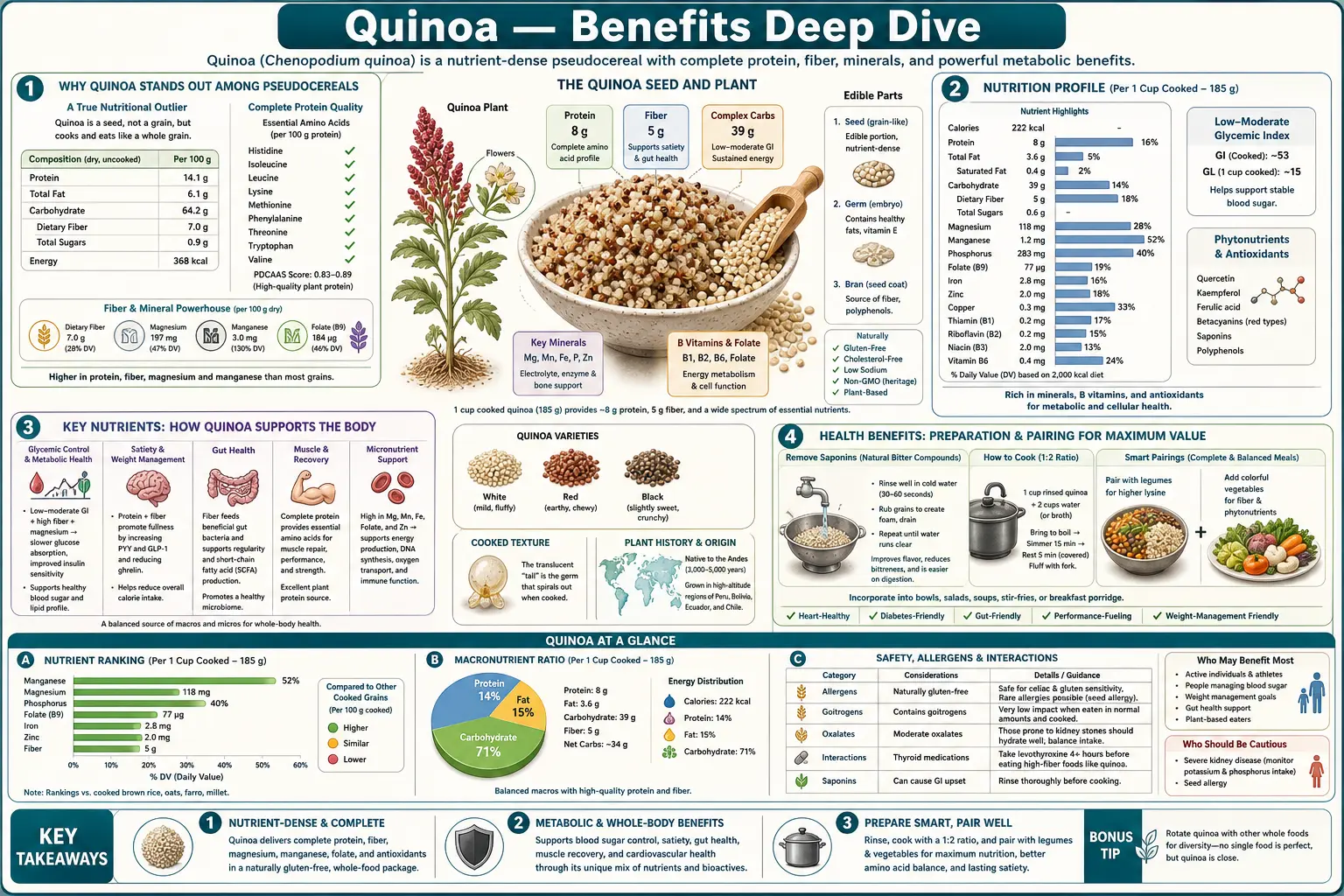
Quinoa (Chenopodium quinoa Willd.) is a pseudocereal grown in the Andean highlands of South America for more than 5,000 years and now cultivated on six continents. The United Nations declared 2013 the “International Year of Quinoa” in recognition of its unusual nutritional profile: it is one of the few plant foods supplying all nine essential amino acids in proportions matching the FAO/WHO reference pattern, it is gluten-free (suitable for celiac disease), it has a low to moderate glycemic index (around 53), and it is rich in magnesium, manganese, iron, and the flavonoids quercetin and kaempferol. Four benefit pages below explore the science behind its complete-protein status, the saponin coating that must be removed before eating, its favorable glycemic and cardiometabolic profile, and the agronomic and cultural history that made it a staple of pre-Columbian Andean civilization.
Deep-Dive Articles
Complete Protein
Why quinoa is one of the few plant foods classified as a complete protein. The PDCAAS (Protein Digestibility-Corrected Amino Acid Score) of ~0.73-0.83, lysine content roughly double that of wheat or rice, the limiting amino acid debate (lysine vs leucine depending on cultivar), how cooking and saponin removal affect digestibility, and the role of quinoa as a plant-based protein source for vegetarian and vegan athletes, children, and elderly patients.
Saponin Removal
The bitter triterpenoid saponins coating raw quinoa seeds act as natural pesticides for the plant, but cause GI distress and mild hemolysis if not removed. Mechanical scarification, water-rinsing protocols, the bitter vs sweet cultivar distinction, residual saponin levels in commercial pre-washed quinoa, and the unexpected pharmacology of quinoa saponins as adjuvants in vaccine research and as anti-inflammatory compounds at low doses.
Glycemic Index
Quinoa's glycemic index (GI ~53) and glycemic load (~13 per 150 g cooked serving) compared with white rice, brown rice, couscous, and bulgur. The cardiometabolic randomized trials in type 2 diabetes and overweight subjects, the role of resistant starch and beta-glucan, lipid-lowering effects, and why quinoa-based substitution for refined grains produces measurable improvements in fasting glucose and triglycerides.
Andean Origins
5,000+ years of domestication around Lake Titicaca, the Aymara and Quechua agricultural traditions, the Spanish colonial suppression of quinoa cultivation, the FAO “International Year of Quinoa 2013”, the post-2008 export boom and its mixed impact on Bolivian and Peruvian farmers, modern cultivar genetics (white, red, black, tricolor), and the spread of quinoa cultivation to North America, Europe, India, and East Africa.
Table of Contents
- Deep-Dive Articles
- Why Quinoa Stands Out Among Pseudocereals
- Research Papers: Complete Protein & Amino Acid Profile
- Research Papers: Saponins, Processing, and Antinutrients
- Research Papers: Glycemic Index & Cardiometabolic Effects
- Research Papers: Andean History, Agronomy, and Sustainability
- Research Papers: Cross-Cutting (Micronutrients, Phytochemistry, Celiac)
- External Authoritative Resources
- Connections
- Featured Videos
Why Quinoa Stands Out Among Pseudocereals
Quinoa is a pseudocereal, not a true grain. True grains (wheat, rice, oats, barley, corn) are the seeds of grass family plants (Poaceae). Pseudocereals are seeds of broadleaf plants that are used culinarily like grains but are botanically unrelated to grasses. Quinoa belongs to the Amaranthaceae family (formerly Chenopodiaceae) and shares this category with amaranth and buckwheat. The distinction matters nutritionally because pseudocereals tend to have higher protein content, better essential amino acid balance, and complete absence of gluten compared with true grains.
Three intersecting properties make quinoa unusual even among pseudocereals.
- Complete amino acid profile — quinoa supplies all nine essential amino acids in proportions that meet the FAO/WHO/UNU reference pattern for adult protein quality. Most plant foods are limited in either lysine (cereals) or methionine (legumes), requiring complementary food combining. Quinoa requires no combining. The PDCAAS for quinoa ranges from 0.73 to 0.83 depending on cultivar and processing — lower than dairy or egg protein (1.00) but higher than wheat (0.42), rice (0.47), or peanut (0.52). See the Complete Protein deep-dive.
- Low to moderate glycemic index — cooked quinoa has a glycemic index around 53, placing it firmly in the "low GI" category (less than 55), compared with white rice at 73, brown rice at 68, and couscous at 65. The glycemic load of a typical 150 g serving is about 13, which is modest. This translates to measurable improvements in postprandial glucose, fasting glucose, and serum lipids when quinoa substitutes for refined grains in cardiometabolic randomized trials. See the Glycemic Index deep-dive.
- Gluten-free with no need for fortification — quinoa is naturally gluten-free, suitable for celiac disease and non-celiac gluten sensitivity. Unlike rice flour or corn flour, which are nutritionally poor and require fortification, quinoa carries its own complete-protein, mineral-rich, fiber-rich profile into gluten-free baking and as a stand-alone side dish. Multiple studies in celiac patients show that adding 50 g quinoa daily for six weeks restores serum levels of several micronutrients commonly deficient on a strict gluten-free diet.
These nutritional advantages come with one practical complication: the seed coat carries bitter triterpenoid saponins (about 0.1-5% by weight depending on cultivar) that must be removed before eating. Most commercial quinoa is mechanically scarified and water-rinsed at the processing plant, but home rinsing under cold running water for 1-2 minutes remains the conservative practice. See the Saponin Removal deep-dive for processing science and the unexpected pharmacology of saponins themselves.
The fourth deep-dive turns from biochemistry to 5,000 years of Andean cultivation history: how quinoa survived the Spanish suppression that nearly extinguished it, why the Bolivian and Peruvian altiplano remain the largest producers, what the 2013 FAO "International Year of Quinoa" accomplished, and how the post-2008 quinoa export boom both lifted and stressed traditional growing regions.
Research Papers: Complete Protein & Amino Acid Profile
- FAO/WHO/UNU expert consultation on protein and amino acid requirements (reference pattern) — PubMed: FAO/WHO/UNU reference pattern
- PDCAAS of quinoa compared with cereals and legumes — PubMed: Quinoa PDCAAS
- Amino acid composition of Chenopodium quinoa seeds (Koziol classic 1992) — PubMed: Koziol 1992 composition
- Lysine content of quinoa vs wheat, rice, and other cereals — PubMed: Lysine comparison
- Quinoa protein in vegetarian and vegan diets — PubMed: Quinoa in vegan diets
- Protein quality of quinoa for infant and child nutrition — PubMed: Quinoa for child nutrition
- Cultivar variation in quinoa protein content (10-22% range) — PubMed: Cultivar protein variation
- Effect of cooking and saponin removal on quinoa protein digestibility — PubMed: Cooking and digestibility
- Quinoa albumins and globulins (storage proteins, 11S and 2S) — PubMed: Quinoa storage proteins
- Bioactive peptides derived from quinoa protein hydrolysates — PubMed: Quinoa bioactive peptides
Research Papers: Saponins, Processing, and Antinutrients
- Quinoa saponin chemistry: triterpenoid glycosides (oleanolic, hederagenin, phytolaccagenic acid) — PubMed: Quinoa saponin chemistry
- Bitter vs sweet quinoa cultivars (saponin content thresholds) — PubMed: Bitter vs sweet cultivars
- Mechanical scarification vs water rinsing for saponin removal — PubMed: Saponin removal methods
- Hemolytic activity of quinoa saponins — PubMed: Hemolytic activity
- Quinoa saponins as immunological adjuvants (parallel to Quillaja saponaria QS-21) — PubMed: Saponin adjuvants
- Anti-inflammatory and anti-cancer activity of low-dose quinoa saponins — PubMed: Saponin pharmacology
- Phytate content of quinoa and mineral bioavailability — PubMed: Phytate and minerals
- Oxalate content of quinoa (relevance for kidney stone formers) — PubMed: Quinoa oxalate
- Soaking, sprouting, and fermentation effects on quinoa antinutrients — PubMed: Processing and antinutrients
- Trypsin inhibitor activity in raw and processed quinoa — PubMed: Trypsin inhibitors
Research Papers: Glycemic Index & Cardiometabolic Effects
- Glycemic index of quinoa vs white rice, brown rice, couscous — PubMed: Quinoa GI comparison
- Quinoa randomized trial in type 2 diabetes (postprandial glucose) — PubMed: Quinoa in T2D RCT
- Quinoa substitution and serum lipid effects (LDL, triglycerides) — PubMed: Quinoa and lipids
- Quinoa intake and metabolic syndrome (Pourshahidi review) — PubMed: Quinoa and metabolic syndrome
- Resistant starch content of cooked-and-cooled quinoa — PubMed: Quinoa resistant starch
- Beta-glucan and soluble fiber content of quinoa — PubMed: Quinoa fiber profile
- Quinoa in overweight postmenopausal women (Navarro-Perez RCT) — PubMed: Quinoa in postmenopausal women
- Quinoa polyphenols (quercetin, kaempferol) and antioxidant capacity — PubMed: Quinoa polyphenols
- Quinoa starch granule structure and digestion kinetics — PubMed: Quinoa starch digestion
- Quinoa and gut microbiota modulation — PubMed: Quinoa and gut microbiota
Research Papers: Andean History, Agronomy, and Sustainability
- Archaeological evidence of quinoa domestication around Lake Titicaca — PubMed: Quinoa domestication
- FAO International Year of Quinoa 2013 background report — PubMed: FAO IYQ 2013
- Quinoa genome sequencing (Jarvis 2017 Nature) — PubMed: Quinoa genome 2017
- Quinoa cultivation in marginal lands (drought, salinity, frost tolerance) — PubMed: Quinoa stress tolerance
- Quinoa export boom impact on Bolivian and Peruvian farmers — PubMed: Quinoa export impact
- Cultivar genetics: white, red, black, and tricolor quinoa — PubMed: Cultivar genetics
- Quinoa cultivation expansion to North America and Europe — PubMed: Quinoa global expansion
- Quinoa cultivation in India and East Africa for food security — PubMed: Quinoa in India/Africa
- Quinoa as a climate-resilient crop for food security — PubMed: Quinoa climate resilience
- Bertero et al. multi-site quinoa cultivar performance trials — PubMed: Bertero cultivar trials
Research Papers: Cross-Cutting (Micronutrients, Phytochemistry, Celiac)
- Quinoa magnesium content vs other grains — PubMed: Quinoa magnesium
- Quinoa iron and zinc bioavailability — PubMed: Quinoa Fe/Zn bioavailability
- Quinoa manganese content (very high, ~70% DV per serving) — PubMed: Quinoa manganese
- Quinoa in celiac disease (Zevallos 2014 added benefit study) — PubMed: Zevallos celiac trial
- Quinoa flour in gluten-free bread formulations — PubMed: Quinoa gluten-free bread
- Quinoa lipid profile (omega-3, omega-6, omega-9 fatty acids) — PubMed: Quinoa fatty acids
- Quinoa squalene content (highest among edible grains) — PubMed: Quinoa squalene
- Quinoa ecdysteroids (insect-molting analog phytochemicals) and metabolic effects — PubMed: Quinoa ecdysteroids
- Quinoa leaves and microgreens nutritional profile — PubMed: Quinoa leaves and microgreens
- Repo-Carrasco-Valencia comprehensive nutritional review — PubMed: Repo-Carrasco-Valencia review
External Authoritative Resources
- FAO — International Year of Quinoa 2013 — the authoritative global agronomic and food-security overview
- USDA FoodData Central — Quinoa, cooked (full nutrient breakdown per 100 g)
- Harvard T.H. Chan School — The Nutrition Source: Quinoa
- Celiac Disease Foundation — Gluten-Free Foods (Quinoa listing)
- PubMed — All research on quinoa nutrition (~2,500+ papers)
Connections
- All Food
- Quinoa (Main Page)
- Quinoa Complete Protein
- Quinoa Saponin Removal
- Quinoa Glycemic Index
- Quinoa Andean Origins
- Lysine
- Leucine
- Methionine
- Magnesium
- Manganese
- Iron
- Celiac Disease
- Type 2 Diabetes