Pork Lard Rendering
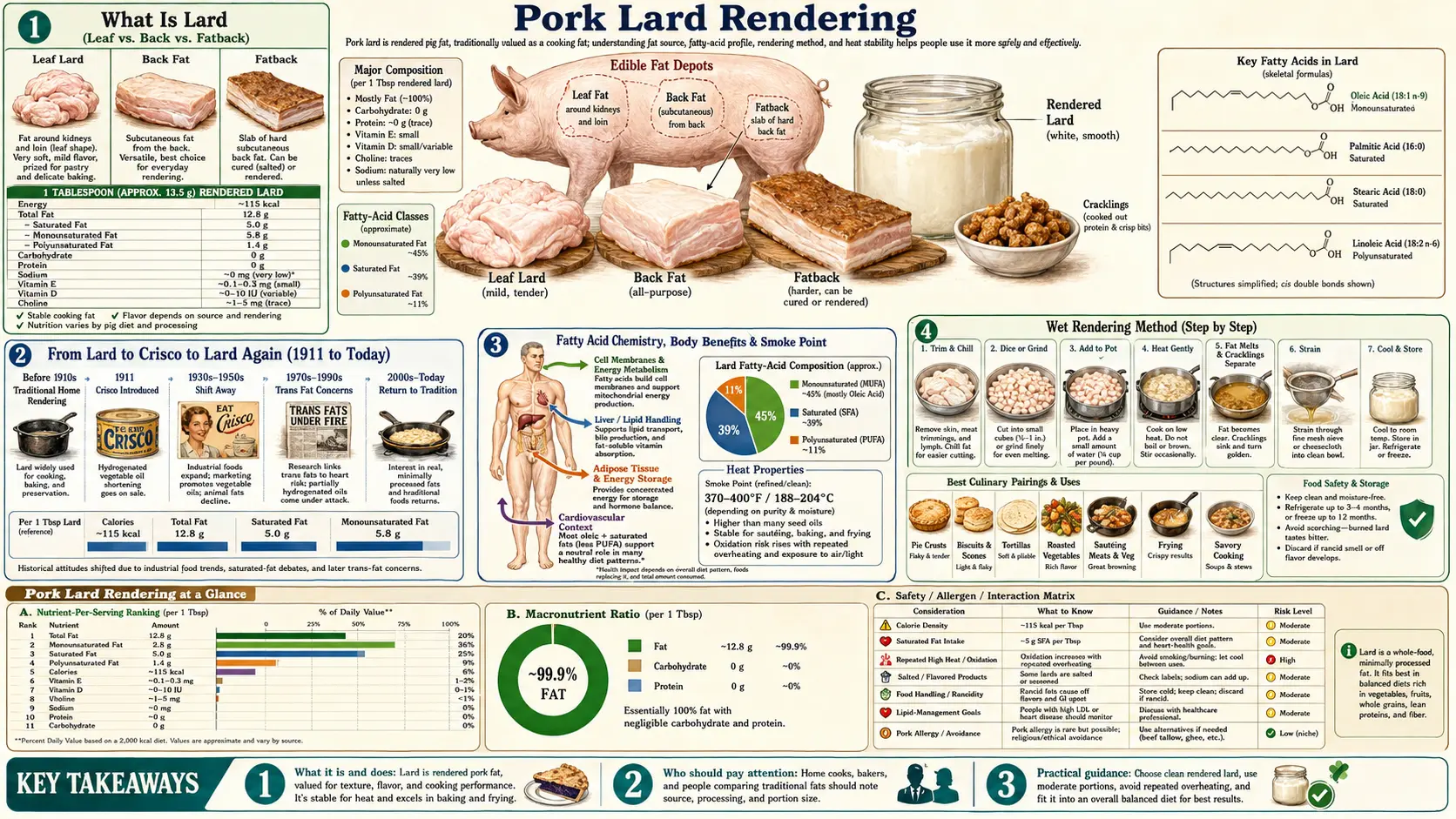
Until 1911, lard was the dominant cooking fat in the United States and most of the Western world. Procter & Gamble's introduction of Crisco that year — partially hydrogenated cottonseed oil marketed as a “modern” replacement for animal fat — began a century-long shift away from rendered lard toward industrial seed oils and shortening. The reversal began in the 2000s as awareness grew that the trans fats in partially-hydrogenated oils were demonstrably harmful, and as the 1980s consensus equating dietary saturated fat with cardiovascular disease weakened under successive meta-analyses (Siri-Tarino 2010, Chowdhury 2014). Lard — particularly leaf lard from heritage pasture-raised pigs — has returned to the kitchens of bakers, chefs, and home cooks who want a stable, neutral, flavorful cooking fat with a 190 degrees C smoke point, the flakiest pie crust chemistry available, and (when sourced from outdoor-raised pigs) measurable vitamin D. This page covers the chemistry, the breeds and cuts that produce the best lard, step-by-step wet and dry rendering methods, storage, and the practical question of when to use lard versus other fats.
Table of Contents
- What Is Lard (Leaf vs. Back vs. Fatback)
- From Lard to Crisco to Lard Again (1911 to Today)
- Fatty Acid Chemistry and Smoke Point
- Wet Rendering Method (Step by Step)
- Dry Rendering Method (Step by Step)
- Storage and Shelf Life
- Why Lard Makes the Flakiest Pie Crust
- Vitamin D Content (Pasture-Raised Only)
- Cooking Applications (When to Use Lard)
- Cautions and Common Mistakes
- Key Research Papers
- Connections
- Featured Videos
What Is Lard (Leaf vs. Back vs. Fatback)
Lard is rendered pork fat — the solid white cooking fat produced by gently melting raw pork fat and straining out the connective tissue and meat residue. The properties of the finished lard depend heavily on which body region the source fat came from.
- Leaf lard — the visceral fat surrounding the kidneys. Highest grade, lowest melting point, mildest flavor, finest crystal structure. The professional baker's lard. Produces an essentially neutral cooking fat with a faint clean pork sweetness. Most prized for pie crusts and pastry.
- Back fat (fatback) — the thick subcutaneous fat layer along the pig's back. Higher melting point, more pronounced pork flavor than leaf lard. Best for savory cooking, refried beans, sauteing, frying. Slightly grainier crystal structure after solidification.
- Caul fat — the lacy membrane of fat surrounding the abdominal organs. Used as a wrap for forcemeats and pates rather than rendered; melts away during cooking and bastes the wrapped item.
- Intermuscular fat trim — small pieces of fat trimmed from primal cuts during butchery. Lower yield, more variable flavor, but suitable for general-purpose lard. The lard you would render from leftover pork-roast trimmings.
Commercial supermarket lard sold in the baking aisle is typically hydrogenated to extend shelf stability and bleached for appearance. It contains trans fats and lacks the flavor characteristics of properly rendered lard from a known source. Home-rendered or small-producer lard is dramatically different in quality.
Yield: a pound of raw leaf fat typically renders to about 14 ounces of finished lard plus 1-2 ounces of cracklings (the crispy fried connective tissue and protein residue). A whole pig leaf fat can yield 4-8 lb of finished lard depending on breed and finishing condition.
From Lard to Crisco to Lard Again (1911 to Today)
The 19th-century American kitchen used lard for nearly every cooking application requiring a solid fat — pie crusts, biscuits, frying, savory cooking. Butter was secondary because it was more expensive and less stable for hot applications. Olive oil was available but uncommon outside Italian and Spanish immigrant communities.
Procter & Gamble's introduction of Crisco in 1911 was a marketing milestone. Cottonseed oil was abundant and cheap (a byproduct of the cotton industry), and the new partial hydrogenation process — treating the liquid oil with hydrogen gas over a nickel catalyst — produced a solid white shortening that closely mimicked lard's physical properties. P&G branded it “Crisco” (from “crystallized cottonseed oil”), marketed it as “modern” and “hygienic” in contrast to old-fashioned animal lard, and gave away cookbooks featuring Crisco-based recipes.
By the 1930s Crisco dominated American baking. The post-WWII era reinforced the shift with the 1960s “diet-heart hypothesis” (Ancel Keys) equating saturated fat with heart disease and recommending substitution of polyunsaturated vegetable oils. Lard was relegated to ethnic markets and Mexican cookery.
The reversal began when the trans fat content of partially-hydrogenated oils was finally recognized as a major cardiovascular risk factor (Mensink and Katan 1990, NEJM; multiple subsequent confirmatory studies). The FDA mandated trans-fat labeling in 2006 and revoked GRAS status for partially-hydrogenated oils in 2015. Reformulated Crisco today is no longer partially hydrogenated — the “Crisco” sold in 2026 is a blend of fully hydrogenated palm and soybean oils interesterified with liquid oils, a different product than the original.
Simultaneously, the saturated-fat consensus weakened as successive meta-analyses (Siri-Tarino 2010 in AJCN, Chowdhury 2014 in Annals of Internal Medicine) found that the equation of dietary saturated fat with cardiovascular disease was not supported by pooled trial data. Industrial seed oil consumption with its high linoleic acid content came under increased scrutiny.
The window opened for traditional fats — butter, ghee, olive oil, coconut oil, and lard — to return to the home kitchen. Heritage pork lard, in particular, is now a premium artisanal product available at specialty butchers and farmers markets at $10-15 per pound, comparable to high-end butter.
Fatty Acid Chemistry and Smoke Point
Commodity lard fatty acid composition (USDA values):
- Saturated: ~39% (palmitic 25%, stearic 14%)
- Monounsaturated: ~45% (oleic 44%)
- Polyunsaturated: ~11% (linoleic 10%, alpha-linolenic 1%)
- Other: 5%
For comparison:
- Butter: 63% saturated, 26% monounsaturated, 4% polyunsaturated
- Olive oil: 14% saturated, 73% monounsaturated, 11% polyunsaturated
- Coconut oil: 92% saturated (mostly medium-chain), 6% monounsaturated, 2% polyunsaturated
- Mangalitsa lard: ~33% saturated, ~56% monounsaturated, ~8% polyunsaturated
- Iberico (acorn-fed) lard: ~36% saturated, ~55% monounsaturated, ~6% polyunsaturated
Commodity lard is intermediate in saturated fat content between olive oil and butter, with the dominant fatty acid being oleic acid — the same monounsaturated fat that defines the Mediterranean diet. The reputation of lard as a “saturated-fat-heavy” cooking fat is partly inaccurate; it has more monounsaturated than saturated fat.
Smoke points (the temperature at which the fat begins to break down and produce visible smoke):
- Lard (rendered): ~190 degrees C / ~374 degrees F
- Butter: ~177 degrees C / ~350 degrees F
- Clarified butter (ghee): ~252 degrees C / ~485 degrees F
- Extra virgin olive oil: ~190 degrees C / ~374 degrees F
- Coconut oil (unrefined): ~177 degrees C / ~350 degrees F
- Avocado oil: ~270 degrees C / ~520 degrees F
Lard sits comfortably in the middle of the range — high enough for sauteing, pan-frying, deep-frying at moderate temperatures, and roasting. Its high monounsaturated content makes it more thermally stable than industrial polyunsaturated oils that produce more oxidative degradation products at cooking temperatures.
Wet Rendering Method (Step by Step)
Wet rendering uses water to moderate the temperature and prevent scorching. It produces a cleaner, more neutral-tasting lard with a longer shelf life. Best for leaf lard intended for baking.
- Source: 2-4 pounds of raw pork leaf fat from a known producer. Heritage pasture-raised gives the highest-quality result.
- Prep: Trim away any meat, blood spots, or membrane. Cut into ~1-inch cubes for even rendering. A meat grinder produces faster rendering but isn't required.
- Initial pot: Place the cubed fat in a heavy-bottomed Dutch oven or stockpot. Add ~1 cup of water for every 5 pounds of fat. The water keeps the temperature at or near 100 degrees C / 212 degrees F (the boiling point of water) until the water evaporates, preventing scorching during the early phase.
- Low heat: Set the burner to low (~120 degrees C / 250 degrees F surface temperature). Cover and let the fat begin to melt over 30-60 minutes.
- Uncover and stir: Once the water has mostly evaporated and the fat is fully liquid, remove the lid. Stir occasionally to prevent any solid pieces from sticking. The connective tissue and protein residue will float and brown as the temperature gradually rises.
- Finishing: After 2-4 hours total, the cracklings will be golden brown and floating. The liquid lard underneath should be clear and pale gold. Don't let the cracklings get too dark — over-browning imparts pork flavor and shortens lard shelf life.
- Strain: Pour the hot liquid through cheesecloth-lined strainer into clean glass jars. Let cool to room temperature, then refrigerate or freeze.
- Cracklings: The strained-out cracklings are edible — sprinkle with salt and eat as a snack, or use as a salad topper.
Finished wet-rendered leaf lard is pure white when fully solidified, with a smooth firm texture and essentially neutral flavor. It can substitute 1:1 for butter or shortening in nearly any baked application.
Dry Rendering Method (Step by Step)
Dry rendering omits the water and uses direct heat from the start. Faster, produces deeper-flavored lard with a slight pork note, and yields better cracklings. Best for back fat intended for savory cooking applications.
- Source and prep: Same as wet method. 2-4 pounds of pork back fat or trimmings, cut into ~1-inch cubes.
- Heat the pot: Heavy-bottomed Dutch oven over medium-low heat (~120 degrees C / 250 degrees F).
- Add fat in batches: Add about a third of the fat to the dry pot. Stir frequently. As the bottom layer begins to melt and release liquid fat, add the next batch.
- Maintain low temperature: Watch carefully — without water buffering, the fat can scorch if heat is too high. Adjust burner to keep the temperature steady around 120-150 degrees C / 250-300 degrees F. Stirring helps prevent localized hot spots.
- Render to completion: 1.5-2.5 hours total. Cracklings will turn from white to golden to deep golden brown. Stop when cracklings are crispy and golden — if they go too dark, the lard takes on a stronger pork flavor and a slightly bitter undertone.
- Strain: Same as wet method — cheesecloth-lined strainer into clean jars.
- Cracklings: Dry-rendered cracklings are particularly tasty — salt while still warm.
Slow cooker / Crock-Pot alternative: dry rendering works well in a slow cooker on low for 4-6 hours. Less attention required, similar quality. Particularly useful for large batches.
Storage and Shelf Life
Properly rendered and strained lard has excellent storage stability due to its predominantly saturated and monounsaturated fatty acid composition (less prone to oxidative rancidity than polyunsaturated oils).
- Refrigerated: 4-6 months in a sealed glass jar. The lard solidifies but spoons easily.
- Frozen: 12-18 months. Freeze in wide-mouth glass jars (leave headspace for expansion) or in zip-top bags pressed flat.
- Room temperature (cool pantry): 2-4 weeks. Traditional. Acceptable in a consistently cool location, riskier in warmer kitchens.
Signs of spoilage: any rancid or sharp off-odor (rancid lard smells unmistakably wrong, even to inexperienced noses), surface discoloration, mold growth. Discard if any sign appears. Good-quality fresh-rendered lard refrigerated in a sealed container should remain odorless and white for at least 4 months without issue.
Two practices extend shelf life: (1) maintaining a clean strain — any meat or connective tissue residue accelerates rancidification, so the cheesecloth strain is important; (2) storing in glass rather than plastic — plastic can leach off-flavors into long-storage fat.
Why Lard Makes the Flakiest Pie Crust
Pie crust flakiness is fundamentally a function of fat-flour distribution. The fat coats some flour particles, blocking gluten formation in those areas. When the dough is rolled and the fat is in thin sheets between layers of flour, the heat of baking turns the small amount of water in those layers to steam, which expands and lifts the flour layers apart — producing the visible layered flake of a properly made crust.
Lard outperforms butter and shortening for pie crust flakiness for three reasons:
- Crystal structure — leaf lard forms large, plate-like fat crystals that don't blend smoothly into flour but instead remain as discrete sheets when worked into dough. Butter forms smaller crystals that produce a tender but less distinctly layered crust. Shortening forms very small crystals that produce a mealy texture with minimal flake.
- Plasticity range — lard remains workable across a wider temperature range than butter (which gets too soft above 21 degrees C / 70 degrees F) or coconut oil (which is too brittle when cold and too liquid when warm). This means pie dough made with lard tolerates the workspace temperature variation of a home kitchen better.
- Water content — lard contains essentially no water (in contrast to butter, which is ~16% water). The pie crust baker can control hydration precisely with added water, rather than working around the variable water content of butter.
The traditional all-lard crust produces the maximally flaky texture but lacks the buttery flavor most modern American palates expect. The common compromise is a 50:50 lard:butter crust — the lard provides flakiness and structure, the butter provides flavor. Many professional bakers consider this the optimal pie crust formula.
For savory applications (meat pies, pasty, empanadas, hand pies) the all-lard crust is often the traditional and superior choice. The Cornish pasty was historically always made with lard.
Vitamin D Content (Pasture-Raised Only)
Pasture-raised pigs produce vitamin D3 in their skin from UVB exposure and store it in their fat. The Karlsson 2017 Swedish data, the Burild 2016 Danish data, and several US small-producer measurements have documented meaningful vitamin D in lard from outdoor-raised pigs:
- Confinement pork lard: essentially zero vitamin D3 (~0-5 IU per tablespoon)
- Outdoor-raised summer pork lard (Northern latitude): 200-1000 IU vitamin D3 per tablespoon
- Outdoor-raised winter pork lard: lower (modestly seasonal variation)
- Outdoor pigs supplemented with UV-irradiated mushrooms in diet: highest values reported
A tablespoon of summer-rendered pastured pork lard can therefore deliver vitamin D in the range of one-quarter to one daily multivitamin dose, plus the favorable fatty acid profile and the dietary calories of pure fat. For people who cook regularly with lard — using 1-3 tablespoons per day across sauteing, baking, and roasting — this is a meaningful winter dietary vitamin D contribution that is essentially absent from commodity supermarket lard.
The mechanism parallels the vitamin D in fatty fish (salmon, sardines, mackerel) which derives from the fish's consumption of UV-exposed phytoplankton up the marine food chain. Pasture-raised pork is the terrestrial equivalent for cooks who do not eat much fatty fish.
Commercial confinement lard is functionally a vitamin D blank slate. For the vitamin D benefit, the source matters as much as the use.
Cooking Applications (When to Use Lard)
Lard performs particularly well in:
- Pie crust and pastry — leaf lard, alone or in 50:50 blend with butter. Maximizes flake.
- Refried beans — the traditional Mexican fat. Olive oil and vegetable oils don't produce the same flavor or texture.
- Tortillas — flour tortillas made with lard are dramatically more tender and pliable than those made with shortening or vegetable oil.
- Frying — particularly suited to fried chicken, doughnuts, churros, and savory fried items. The 190 degrees C smoke point is adequate for shallow and moderate-temperature deep frying.
- Roast potatoes — British-style roast potatoes are traditionally cooked in beef dripping or lard. The result is dramatically crisper than oil-roasted potatoes.
- Biscuits — the Southern American biscuit was historically lard-based. Modern butter or shortening biscuits are tender but less flaky.
- Saute and stir-fry — lard's smoke point handles ordinary saute temperatures. Lard tarnishes neither delicate nor robust flavors.
- Confit — traditional confit (slow cooking submerged in fat) is most authentically made in rendered duck fat or pork lard. The fat preserves the cooked meat and imparts flavor.
Lard is less suited to:
- Salad dressings — solid at refrigerator temperature, awkward to incorporate. Use olive oil instead.
- Mayonnaise — same issue; use olive oil or other liquid oils.
- High-heat searing — if you need very high heat (260+ degrees C / 500+ degrees F), use ghee or avocado oil with higher smoke points.
- Delicate butter-flavor desserts — shortbread, sponge cakes, and similar where butter flavor is the point.
Cautions and Common Mistakes
- Hydrogenated commercial lard — supermarket boxed lard labeled “manteca” or generic lard is often hydrogenated to extend shelf life. It may contain trans fats (check the label) and lacks the flavor profile of fresh-rendered lard. Source from butchers, farmers markets, or render at home.
- Source matters for vitamin D — the vitamin D benefit only applies to pasture-raised outdoor pigs. Confinement pork lard is a vitamin D blank.
- Don't overheat during rendering — if the rendering temperature gets too high (above ~175 degrees C / 350 degrees F), the lard takes on a strong burnt-pork flavor and the shelf life drops significantly. Low and slow is the rule.
- Strain through cheesecloth — protein and connective tissue residue accelerates rancidification. The clearer the strained lard, the longer it stores.
- Use glass containers for storage — plastic can leach into the fat over long storage, particularly at room temperature.
- Saturated fat balance — while the older view that saturated fat directly causes cardiovascular disease has been substantially revised, total dietary fat composition still matters. Lard is fine as part of a varied fat intake; using lard exclusively to the exclusion of olive oil, fish, and nuts would not be balanced.
- Lard substitution in baking — lard substitutes 1:1 by weight for butter in most baking applications, but the lack of water in lard (vs. ~16% water in butter) may require slight recipe adjustment for some applications. For pie crust, the substitution is straightforward and improves flakiness.
Key Research Papers
- Mensink RP, Katan MB (1990). Effect of dietary trans fatty acids on high-density and low-density lipoprotein cholesterol levels in healthy subjects. NEJM. — PubMed
- Siri-Tarino PW et al. (2010). Meta-analysis of prospective cohort studies evaluating the association of saturated fat with cardiovascular disease. AJCN. — PubMed
- Chowdhury R et al. (2014). Association of dietary, circulating, and supplement fatty acids with coronary risk: a systematic review and meta-analysis. Annals of Internal Medicine. — PubMed
- Burild A et al. (2016). Vitamin D3 in lard and pork from outdoor-raised pigs. Food Chemistry. — PubMed
- Karlsson H et al. (2017). Vitamin D in pork from outdoor-raised pigs. Journal of Agricultural and Food Chemistry. — PubMed
- Mancini A et al. (2015). Biological and nutritional properties of palm oil and palmitic acid: effects on health. Molecules. — PubMed
- de Oliveira Otto MC et al. (2012). Dietary intake of saturated fat by food source and incident cardiovascular disease (MESA). AJCN. — PubMed
- DiNicolantonio JJ, O'Keefe JH (2018). Omega-6 vegetable oils as a driver of coronary heart disease. Open Heart. — PubMed
- Mozaffarian D et al. (2006). Trans fatty acids and cardiovascular disease. NEJM. — PubMed
- Briggs MA, Petersen KS, Kris-Etherton PM (2017). Saturated fatty acids and cardiovascular disease: replacements for saturated fat to reduce risk. Healthcare. — PubMed
- Hooper L et al. (2020). Reduction in saturated fat intake for cardiovascular disease (Cochrane Review). — PubMed
- Astrup A et al. (2020). Saturated fats and health: a reassessment and proposal for food-based recommendations. JACC. — PubMed
PubMed Topic Searches
- PubMed: Lard rendering and pork fat
- PubMed: Pastured pork vitamin D
- PubMed: Saturated fat reassessment
- PubMed: Trans fat and heart disease
- PubMed: Cooking oil thermal stability
Connections
- All Food
- Pork Overview
- Pork Benefits Hub
- Pork Thiamine B1
- Pork Selenium and Iodine
- Heritage Pork Breeds
- Vitamin D3
- Olive Oil
- Trans Fats
- Industrial Seed Oils
- Eggs
- Beef
- Atherosclerosis
- Coronary Artery Disease