Pork: History and Origins
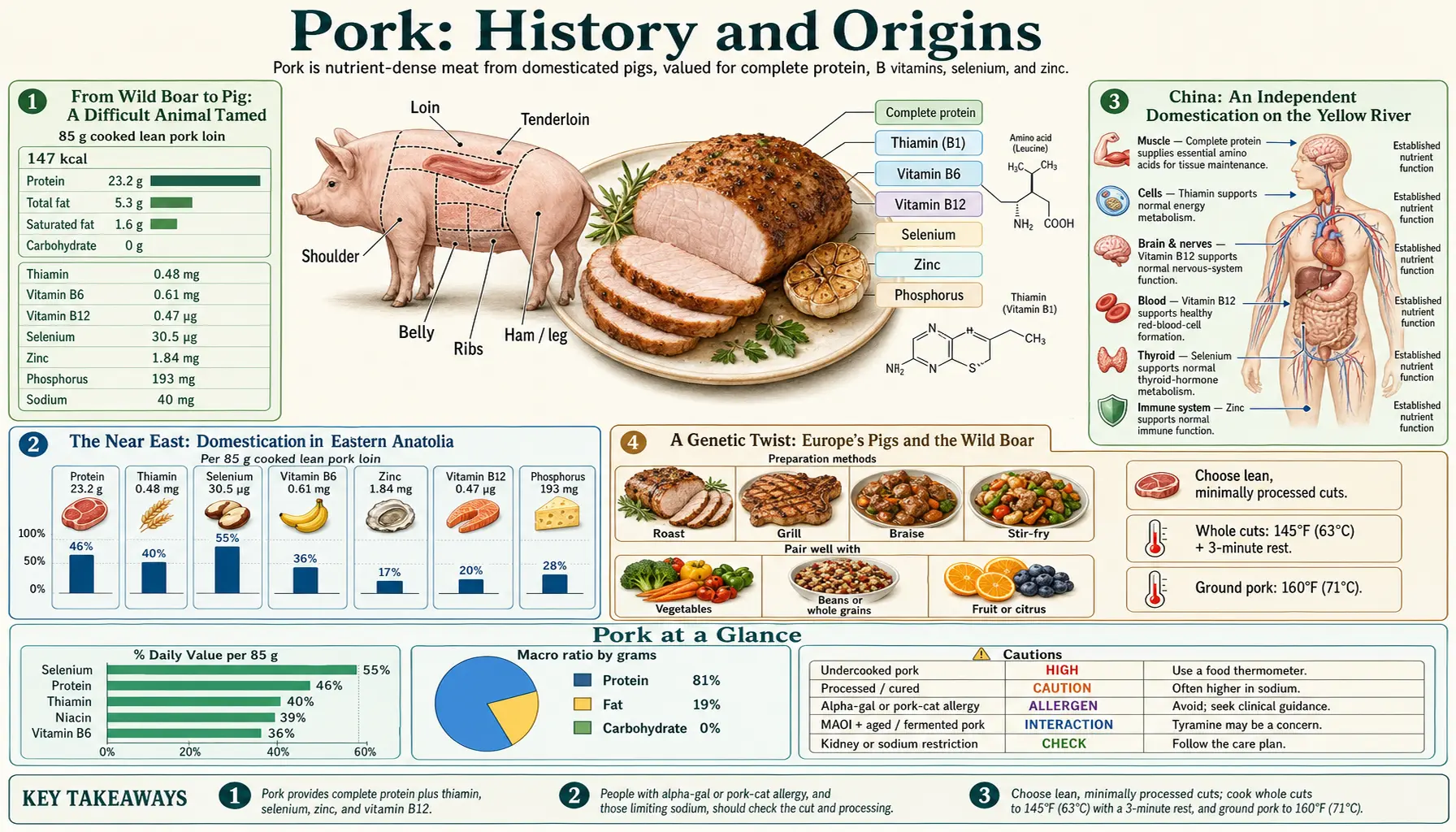
Pork has no single inventor and no single homeland. It begins with the wild boar (Sus scrofa) — a tough, intelligent, fast-breeding animal that ranged across most of Eurasia and North Africa — and with Neolithic communities who, in at least two widely separated places, learned to keep and breed it. Archaeology and genetics agree on the broad shape of the story: pigs were domesticated independently in the Near East, around the upper Tigris and the Taurus–Zagros foothills of eastern Anatolia (fully domestic pigs by roughly nine thousand years ago), and again in China, in the Yellow River basin (by roughly eight thousand years ago). From those beginnings the pig became one of the most contradictory of foods: the central meat of Chinese and much of European cooking, the heart of a vast tradition of salting, smoking, and curing — ham, bacon, prosciutto — and, at the same time, the one common meat that two of the world's great religious traditions, Judaism and Islam, set firmly apart as forbidden. This article follows what the archaeological and genetic record actually supports, treats the religious dimension factually and with respect, and flags where a claim is tradition or an actively debated chronology rather than settled fact.
Table of Contents
- From Wild Boar to Pig: A Difficult Animal Tamed
- The Near East: Domestication in Eastern Anatolia
- China: An Independent Domestication on the Yellow River
- A Genetic Twist: Europe's Pigs and the Wild Boar
- The Pig as a Village and Farmstead Animal
- Forbidden Meat: Pork in Judaism and Islam
- Salt, Smoke, and Time: Ham, Bacon, and Prosciutto
- Pork at the Center: Chinese, European, and American Tables
- From Backyard Pig to Industrial Pork
- Research Papers and References
- Connections
- Featured Videos
From Wild Boar to Pig: A Difficult Animal Tamed
Every domestic pig — from a 300-kilogram show hog to a pot-bellied pet — descends from the wild boar, Sus scrofa. The wild boar is one of the most widespread large mammals on Earth, historically ranging across Europe, North Africa, and Asia all the way to the Pacific. It is fast, strong, armed with tusks, and famously clever, and it will eat almost anything: roots, nuts, fruit, fungi, insects, eggs, carrion. That flexibility is exactly why the pig became such a successful farm animal — and also why taming it was anything but simple. A wild boar is not an obvious candidate for the farmyard.
Domestication is not a single event but a long, two-way process in which a wild population is gradually caught, contained, and bred over many generations into a tamer, smaller-tusked, shorter-faced, more docile form. Across the archaeological record, the visible signs that a pig has crossed from wild to domestic include a reduction in overall body and tooth size, a shortening of the snout, and shifts in the age and sex of the animals people were killing — the marks of a herd that is being managed rather than hunted. Because wild boar and domestic pigs continued to live side by side and interbreed, these signs appear gradually rather than all at once, which is part of why pig domestication is such a genuinely complicated story to reconstruct.
One of the most important findings of modern research is that this did not happen in only one place. Drawing on the DNA of hundreds of wild and domestic pigs, a landmark 2005 study by Greger Larson and colleagues showed multiple independent centres of pig domestication across Eurasia. The two that the evidence supports most strongly — and the two this page focuses on — are the Near East and China. Pigs, in other words, were tamed more than once, by different peoples, from a wild animal that happened to live almost everywhere they did.
The Near East: Domestication in Eastern Anatolia
The earliest part of the world where wild boar were brought under human control appears to be the Near East — specifically the uplands of eastern Anatolia (in present-day Turkey) and the neighbouring foothills of the Taurus and Zagros mountains, around the headwaters of the Tigris. This is part of the broader Fertile Crescent, the same arc of land where wheat, barley, sheep, goats, and cattle were also first domesticated during the Neolithic. The pig was one of the founding farm animals of that agricultural revolution.
At the early village of Hallan Çemi, in the Tigris basin of southeastern Turkey — dated to roughly 11,700–11,300 years ago — some researchers have argued that wild boar were already being managed or loosely herded, which would make the pig a candidate for the very first livestock animal in the region. That early claim is debated. What is far less contested is the long sequence at the nearby site of Çayönü, also in the Tigris valley, where the shift can be watched unfolding over centuries: there, the bones indicate that fully domestic pigs had emerged by around 9,000 years ago (roughly 7000 BCE). This is the figure most often cited for established pig domestication in the Near East.
From these Anatolian beginnings, domestic pigs spread with the first farmers — westward into Europe and outward across the Near East — as part of the same wave that carried Neolithic farming itself. It is worth being honest about the uncertainty in the early dates: estimates for when boar management began range across a couple of thousand years and are an active research question, because the line between an intensively hunted wild herd and a loosely kept domestic one is genuinely blurry. The solid, widely agreed point is that the Near East — eastern Anatolia in particular — was one of the world's first centres of pig keeping, with clearly domestic pigs present by about nine thousand years ago.
China: An Independent Domestication on the Yellow River
On the other side of the continent, and entirely separately, the wild boar was tamed again in China. The evidence points to the basin of the Yellow River in northern China as a key independent centre, where pigs were domesticated alongside the local crops of broomcorn and foxtail millet rather than the wheat and barley of the Near East. This was not a technique that travelled from Anatolia to China; it was a parallel invention by a different people working with a different population of the same wild animal.
Several early Neolithic sites in the middle and lower Yellow River region document this process. At Jiahu, in Henan Province, analyses of pig teeth indicate domestic pigs were present by at least around 8,000–8,600 years ago (with the site itself occupied from roughly 7000 BCE), and the somewhat younger site of Cishan (about 7,500 years old) shows pig keeping as a firmly established part of village life. Ancient-DNA work spanning some ten thousand years has found that the earliest pigs of this region already carried the maternal genetic lineages that still dominate Chinese pigs today — strong evidence for a long, continuous, in situ domestication rather than animals imported from elsewhere.
The cultural depth of this relationship is preserved in the Chinese language itself. The common written character for "home" or "family," 家 (jiā), is composed of the radical for a roof placed over the radical for a pig — a household, in the oldest sense, being a dwelling with a pig beneath it. The exact origin and the most literal reading of the character are discussed by scholars in more than one way, but the pairing reflects a real and very old truth: in early China the pig was the quintessential domestic animal of the ordinary farmstead. That status never went away — pork remains, by a wide margin, the most-eaten meat in China to this day.
A Genetic Twist: Europe's Pigs and the Wild Boar
There is a fascinating wrinkle in the European chapter of this story, and it is worth telling carefully because it is easy to get wrong. The first domestic pigs to reach Europe were brought by Neolithic farmers migrating out of the Near East, carrying their Anatolian livestock with them. So Europe's pigs started as Near Eastern domestic animals. But that is not where they ended up genetically.
Larson and colleagues' DNA work revealed that, over the following millennia, the Near Eastern maternal lineages in European pigs were progressively replaced by those of local European wild boar. Because domestic pigs and wild boar readily interbreed, European farmers' herds repeatedly absorbed genes from the wild boar all around them — whether through escaped pigs, deliberate crossing, or boar wandering into the pens — until the imported Near Eastern signature had largely washed out. The practical upshot, established by that genetic evidence, is that modern European domestic pigs derive principally from European wild boar, not from the original Anatolian stock that first introduced pigs to the continent.
This is a good example of why domestication is better understood as an ongoing relationship than as a one-time founding event. The pig was not simply tamed once and then bred in isolation; herds kept mixing with their wild relatives for thousands of years. It is also a reminder to be precise: it is accurate to say domestic pigs arrived in Europe from the Near East, and equally accurate to say today's European pigs are mostly of local wild-boar ancestry. Both are true, and the genetics explains how.
The Pig as a Village and Farmstead Animal
For most of history the pig filled a very particular niche: it was the animal of the village, the smallholding, and the backyard. Unlike cattle or sheep, pigs are not herded over open pasture — they do not eat grass well — and they give no milk, wool, or muscle-power. What they do, supremely well, is turn scraps, surplus, and forest food into meat and fat. A pig could be fed on household waste, kitchen leftovers, dairy by-products, spoiled grain, and whatever it could root up itself, then slaughtered to feed a family through the winter. For poor and ordinary households across much of Eurasia, the pig was the single most efficient way to bank food on the hoof.
In medieval and early-modern Europe this took an organised form known as pannage (or the "common of mast"): the right to drive pigs into woodland in autumn to fatten on fallen acorns, beechmast, and chestnuts. The autumn fattening and the slaughter that followed were so central to the farming year that they became the standard image for the late-autumn months in medieval calendars — a herdsman knocking acorns from an oak for his pigs. In England the pannage season traditionally ran into mid-November, around the feast of Martinmas (11 November), after which the pigs were killed and the long winter work of salting and curing began. A household pig was, in a very real sense, a larder that fed and walked itself until the day it was needed.
This humble, scavenging, household role shaped the pig's entire reputation. It made pork the meat of the common people in much of Europe and China, available where beef was a luxury; it tied the animal to the home so closely that, as noted above, the Chinese word for "home" pictures a pig under a roof; and — as the next section explores — the very habits that made the pig such an efficient village scavenger may also lie behind why some societies came to set it apart entirely.
Forbidden Meat: Pork in Judaism and Islam
Pork is unusual among common meats in that two major world religions explicitly prohibit it. In Judaism, the dietary laws known as kashrut are drawn from the Hebrew Bible. For a land animal to be permitted (kosher) it must both have a fully split (cloven) hoof and chew the cud. The pig has cloven hooves but does not chew the cud, and so it is named as forbidden — the prohibition is stated directly in Leviticus 11:7–8 and again in Deuteronomy 14:8. The pig is thus singled out in the text as the animal that meets one criterion but not the other.
In Islam, the prohibition of pork (it is haram, forbidden) is likewise grounded in scripture. The Qur'an names the flesh of swine among the foods that are not permitted, listing it alongside carrion, blood, and meat dedicated to any other than God (the relevant verses include those in chapters 2, 5, 6, and 16). For observant Muslims this is a clear and binding dietary rule, and pork avoidance is, alongside the rules of halal slaughter, one of the most widely recognised features of Islamic dietary practice.
Scholars have proposed many explanations for how these taboos arose — ecological arguments that pigs are poorly suited to hot, dry, pastoral regions and compete with people for food and water; economic ones; and the powerful role that distinctive food rules play in marking and preserving a community's identity. The honest position is that the ultimate origins are debated and not settled by the evidence. What is not in dispute, and what matters here, is the religious reality: for Jews who keep kosher and for Muslims, pork is simply not food, and that conviction has shaped the diet, law, and culture of large parts of the world for thousands of years. It is presented here as a matter of fact and of respect, not as a verdict on whether pork is "good" or "bad" to eat.
Salt, Smoke, and Time: Ham, Bacon, and Prosciutto
In the societies that did eat pork, a second great history runs in parallel to the animal's domestication: the history of preserving it. A freshly killed pig is a sudden glut of meat that will spoil within days, so almost everywhere pigs were raised, people learned to make the meat last by drawing out its water and shutting out decay — chiefly through salting, drying, and smoking. The preservation of pork is one of the oldest and most refined branches of the whole human art of curing meat, which itself reaches back thousands of years into the ancient Near East.
The classic products are familiar around the world. Ham — the salt-cured hind leg of the pig — was already being made in the ancient Mediterranean: the Roman statesman and writer Cato the Elder, in his farming manual De Agri Cultura (around 160 BCE), gives detailed instructions for salting hams, showing the technique was well established in Roman Italy more than two thousand years ago. Bacon — cured (and often smoked) pork, usually from the side or belly — became a staple of preservation across northern Europe, valued precisely because, once cured, it kept for months. And in Italy the dry-cured ham tradition matured into prosciutto, the famous air-dried hams of regions such as Parma, made with little more than salt, clean air, and many months of patient aging.
This was never a European monopoly. China developed its own deep tradition of cured pork: the celebrated dry-cured Jinhua ham, from Zhejiang Province, has been produced for many centuries (with documentary references reaching back roughly a thousand years), and salt-preserved and air-dried pork remain everyday ingredients in Chinese cooking. Across these very different cuisines the underlying logic is the same one the Anatolian and Yellow River farmers would have recognised: a pig is a windfall of food, and salt, smoke, and time are how you keep that windfall from going to waste. Ham, bacon, and prosciutto are, at bottom, ancient solutions to the problem of having too much pork at once.
Pork at the Center: Chinese, European, and American Tables
Wherever it was not forbidden, pork tended to become not just a meat but the meat. In China this is most striking of all: pork has long been the dominant meat of the cuisine, so much so that the everyday word for "meat" is, in many contexts, understood to mean pork unless another animal is specified. From red-braised pork belly to char siu to countless dumplings and stir-fries, the pig sits at the heart of Chinese cooking, and China today both raises and eats more pigs than any other nation on Earth.
In much of Europe the pig played a similar role as the common household meat, and it left its mark on national cuisines in the form of an enormous family of pork products — the sausages, salami, hams, and bacons of Germany, Italy, Spain, France, the Balkans, and beyond. Because so much of a pig can be salted, smoked, or turned into sausage, European pork culture is above all a charcuterie culture: a tradition of using and preserving every part of the animal. The autumn pig slaughter, followed by weeks of salting and sausage-making, was for centuries a fixture of rural life across the continent.
Pork crossed to the Americas with European colonisation. Pigs were aboard Christopher Columbus's second voyage in 1493, among the first livestock introduced to the Caribbean. In 1539 the Spanish explorer Hernando de Soto is recorded as bringing a small herd — commonly given as thirteen pigs — ashore in Florida; that herd reportedly multiplied into the hundreds within a few years, and animals that escaped or were traded to Native communities became founders of North America's feral pig populations, the ancestors of today's wild "razorbacks." Because pigs were so easy to feed and so quick to breed, they thrived in the New World, and pork — salted, smoked, and barreled — became one of the foundational meats of the American diet, from country ham to barbecue.
From Backyard Pig to Industrial Pork
For nearly all of the ten thousand years sketched above, pork was the product of small numbers of pigs kept close to home — fattened on scraps and forest mast, slaughtered locally, and preserved by hand. The pork most people eat today is the product of a very recent and very different system. Over roughly the last century, pig keeping in much of the world shifted from the farmstead to large-scale industrial production: pigs bred intensively for fast growth and lean meat, raised in large indoor operations, and slaughtered and processed on an industrial scale to supply year-round demand.
This transformation made pork cheaper and more abundant than at any point in history — a meat once banked one pig at a time against the winter is now an everyday commodity in much of the world. But it also brought modern questions the older history never had to face: the welfare of animals raised in confinement, the environmental footprint of large piggeries, the management of disease in dense herds, and the nutritional difference between simply-cooked fresh pork and heavily processed products such as some bacon, ham, and sausage. These are live debates rather than settled matters, and they sit outside the scope of a history page.
Those nutritional and practical questions — how pork fits into a balanced diet, what it provides in the way of protein, B-vitamins, zinc, and other nutrients, and how fresh cuts differ from processed pork products — are taken up on the companion Pork Benefits articles and on the main Pork page. This history has aimed only to explain how a wild boar of Anatolia and the Yellow River became, over ten thousand years, one of the most eaten, most preserved, and most contested foods on the planet. Nothing here is dietary or medical advice; it is the long story of where pork came from, told as plainly and as honestly as the record allows.
Research Papers and References
The list below combines peer-reviewed studies on pig domestication and history with curated PubMed topic-search links and reputable reference sources. Author names, titles, and journals are given as plain text; only the stable DOI, PMID, or archive link is hyperlinked, and each opens in a new tab. Where the article above describes religion, language, tradition, or an actively debated chronology, that uncertainty is stated in the text rather than hidden in the citations.
- Larson G, Dobney K, Albarella U, Fang M, Matisoo-Smith E, Robins J, et al. Worldwide phylogeography of wild boar reveals multiple centers of pig domestication. Science. 2005;307(5715):1618-1621. — doi:10.1126/science.1106927 · PMID: 15761152
- Larson G, Albarella U, Dobney K, Rowley-Conwy P, Schibler J, Tresset A, et al. Ancient DNA, pig domestication, and the spread of the Neolithic into Europe. Proceedings of the National Academy of Sciences. 2007;104(39):15276-15281. — doi:10.1073/pnas.0703411104 Search PubMed
- Frantz LAF, Schraiber JG, Madsen O, Megens HJ, Cagan A, Bosse M, et al. Evidence of long-term gene flow and selection during domestication from analyses of Eurasian wild and domestic pig genomes. Nature Genetics. 2015;47(10):1141-1148. — doi:10.1038/ng.3394 · PMID: 26323058
- Larson G, Fuller DQ. The evolution of animal domestication. Annual Review of Ecology, Evolution, and Systematics. 2014;45:115-136. — doi:10.1146/annurev-ecolsys-110512-135813
- Cucchi T, Hulme-Beaman A, Yuan J, Dobney K. Early Neolithic pig domestication at Jiahu, Henan Province, China: clues from molar shape analyses using geometric morphometric approaches. Journal of Archaeological Science. 2011;38(1):11-22. — doi:10.1016/j.jas.2010.07.024
- Wang H, Martin L, Hu S, Wang W. Pig domestication and husbandry practices in the middle Neolithic of the Wei River valley, northwest China: evidence from linear enamel hypoplasia. Journal of Archaeological Science. 2012;39(12):3662-3670. — doi:10.1016/j.jas.2012.06.024
- Rowley-Conwy P, Dobney K. Wild boar and domestic pigs in Mesolithic and Neolithic southern Scandinavia. In: Albarella U, et al., eds. Pigs and Humans: 10,000 Years of Interaction. Oxford University Press; 2007. — doi:10.1093/acprof:oso/9780199207046.001.0001
- Pig domestication, wild boar (Sus scrofa), and the Near Eastern Neolithic PubMed: pig domestication and the Near Eastern Neolithic
- Independent pig domestication in East Asia — ancient and modern DNA PubMed: pig domestication in China and ancient DNA
- Domestication and gene flow between domestic pigs and wild boar PubMed: pig and wild boar gene flow and domestication
External Authoritative Resources
- Journal of Archaeological Research — The Archaeology of Pig Domestication in Eurasia (review)
- Pannage — medieval woodland pig-fattening (overview)
- Encyclopædia Britannica — "Pig"
Connections
- All Food
- Pork
- Pork Benefits
- Beef
- Beef: History and Origins
- Organ Meats
- Bone Broth
- Lentils
- Zinc
- Iron
- Selenium
- Vitamin B1 (Thiamine)