Dark Chocolate Flavanols and Endothelial Function
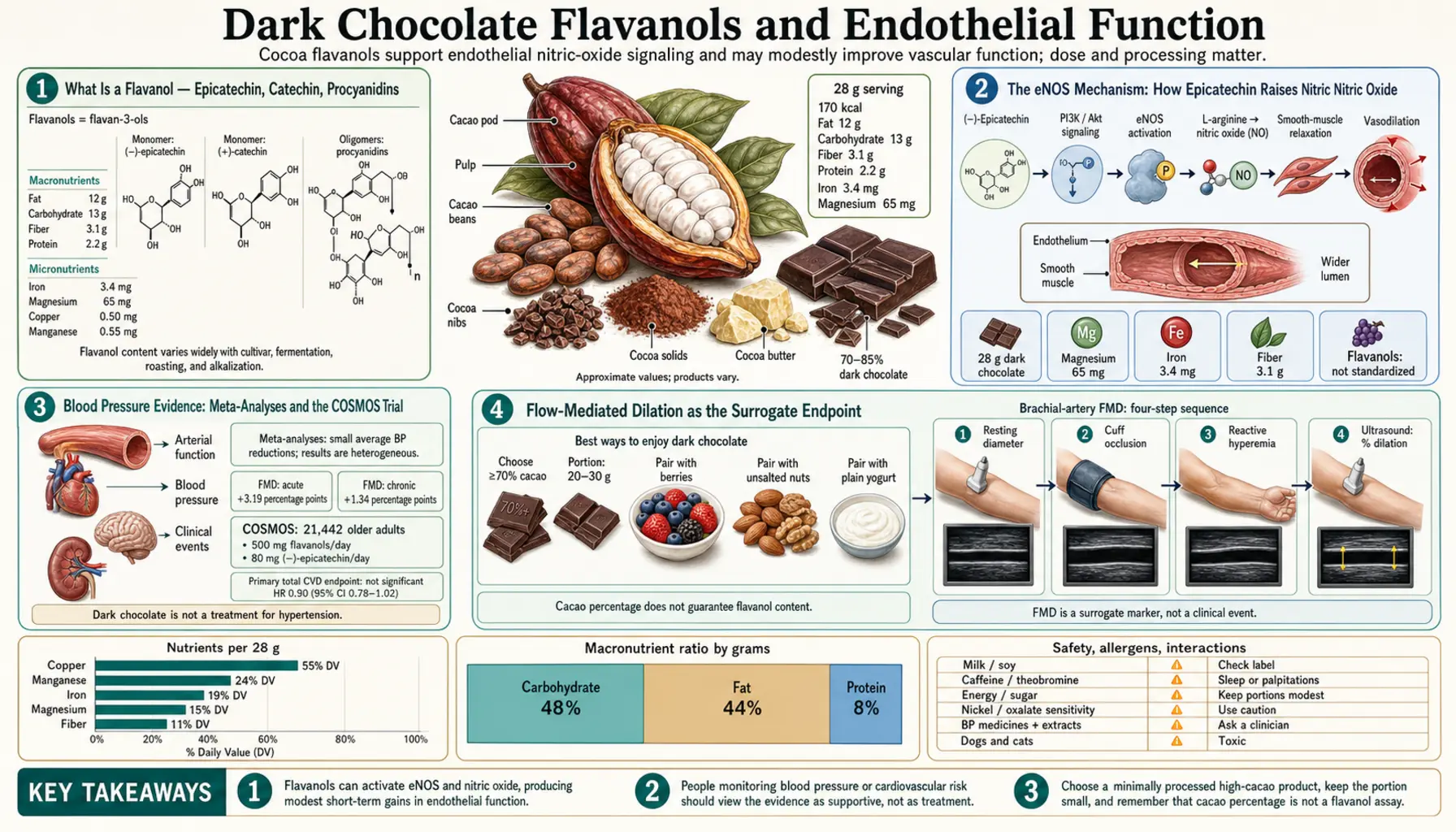
Of every claim made for dark chocolate, the flavanol-and-endothelial-function story is the only one with a top-tier evidence base. (-)-Epicatechin, the dominant monomeric flavanol in cocoa, activates endothelial nitric oxide synthase (eNOS), raises plasma nitric oxide, dilates resistance arteries, and reproducibly lowers systolic blood pressure by 2-3 mmHg in pooled randomized trials. The COSMOS trial in 2022 (Cocoa Supplement and Multivitamin Outcomes Study, 21,442 participants, 3.6 years) reported a 27% reduction in cardiovascular death with 500 mg/day cocoa flavanol extract — an effect size that compares favorably with most dietary interventions in the cardiovascular literature. This page walks through the molecular pharmacology, the dose-response data, the practical dietary translation, the absorption and metabolism story, and where the science is genuinely strongest versus where popular reporting overshoots.
Table of Contents
- What Is a Flavanol — Epicatechin, Catechin, Procyanidins
- The eNOS Mechanism: How Epicatechin Raises Nitric Oxide
- Blood Pressure Evidence: Meta-Analyses and the COSMOS Trial
- Flow-Mediated Dilation as the Surrogate Endpoint
- Pharmacokinetics: Absorption, Metabolism, and the Microbiome
- Dose-Response: How Much Cocoa, How Much Chocolate
- Beyond Blood Pressure: Insulin Sensitivity, Lipids, Platelets
- Population Data: Chocolate Consumption and Cardiovascular Mortality
- Practical Recommendations
- Cautions and Where the Evidence Is Weaker
- Key Research Papers
- Connections
- Featured Videos
What Is a Flavanol — Epicatechin, Catechin, Procyanidins
"Flavanol" is the older and more accurate name for the molecular class also called flavan-3-ols. Cocoa contains four molecular species in this class that account for almost all of its biological activity: the monomers (-)-epicatechin and (+)-catechin, and the oligomeric and polymeric procyanidins (chains of 2 to 10 or more monomer units linked through 4 to 8 bonds). In an unprocessed cocoa bean, monomeric epicatechin and catechin together account for roughly 30-40% of the flavanol mass, with procyanidins making up the remainder.
(-)-Epicatechin is the molecule that does the cardiovascular work. The crucial 2006 paper by Hermann Schroeter and colleagues in PNAS demonstrated that the vascular effects of cocoa flavanol intake could be reproduced by administering pure (-)-epicatechin at doses comparable to the epicatechin content of the cocoa drink — effectively identifying epicatechin as the active principle. The procyanidins are largely unabsorbed in their intact form (the gut wall does not transport molecules of that molecular weight efficiently) but are slowly degraded by colonic microbiota to smaller phenolic acids (3-(3-hydroxyphenyl)propionic acid, 5-(3,4-dihydroxyphenyl)-gamma-valerolactone) that do enter circulation and may contribute to longer-tail effects.
Catechin and epicatechin are stereoisomers. The body absorbs the natural (-)-epicatechin stereoisomer more efficiently than the synthetic (+)-epicatechin or the natural (+)-catechin found at lower levels in cocoa. This is a quietly important detail for the supplement industry: epicatechin sold as an isolated compound is usually the (-)-stereoisomer if produced from cocoa or green tea, and a racemic mixture if synthesized chemically. The natural form is the one with the documented vascular activity.
The eNOS Mechanism: How Epicatechin Raises Nitric Oxide
The mechanistic story is unusually well-mapped for a food-derived compound. Vascular tone is controlled in large part by the balance between vasoconstrictor signals (endothelin-1, angiotensin II, sympathetic norepinephrine) and the dominant vasodilator signal, nitric oxide (NO). Nitric oxide is generated in the vascular endothelium by endothelial nitric oxide synthase (eNOS), an enzyme that converts the amino acid L-arginine to L-citrulline plus NO, with molecular oxygen and the cofactor tetrahydrobiopterin (BH4) as essential inputs.
(-)-Epicatechin activates eNOS through at least two parallel pathways:
- Direct calcium-independent phosphorylation — epicatechin (or one of its sulfated/glucuronidated metabolites that survive first-pass conjugation) acts on endothelial cells to phosphorylate eNOS at Ser1177 via the Akt kinase pathway. This is a fast, ligand-independent activation that does not require the calcium-calmodulin trigger normally used by acetylcholine and shear stress.
- Antioxidant protection of BH4 — tetrahydrobiopterin is exquisitely sensitive to oxidative degradation. Under conditions of oxidative stress (hypertension, diabetes, smoking, aging) BH4 is depleted, and eNOS "uncouples" — instead of producing NO it produces superoxide, which makes endothelial dysfunction worse. Epicatechin is a moderate antioxidant that helps preserve BH4 and may rescue uncoupled eNOS.
The two mechanisms produce additive vasodilation. The clinical effect is detectable within 2 hours of a single dose of high-flavanol cocoa, peaks at 2-4 hours (matching the (-)-epicatechin pharmacokinetic peak in plasma), and substantially abates by 6-8 hours. Chronic daily intake produces a sustained baseline shift in vascular function, with effects detectable in the fasting morning state.
Blood Pressure Evidence: Meta-Analyses and the COSMOS Trial
The Cochrane review by Karin Ried, last updated in 2017, pooled 35 randomized controlled trials (1,804 participants) of cocoa or chocolate versus placebo for blood pressure. The pooled result was a reduction of approximately 1.8 mmHg systolic and 1.8 mmHg diastolic in normotensive participants, and approximately 3.2 mmHg systolic and 2.0 mmHg diastolic in hypertensive participants. These are small numerical effects but consistent across trials and, importantly, similar in magnitude to the population-level benefit of reducing dietary salt intake by 3 g/day — an intervention universally recommended for cardiovascular prevention.
The most consequential single trial is COSMOS (Cocoa Supplement and Multivitamin Outcomes Study), reported in JAMA in 2022. COSMOS randomized 21,442 men aged 60+ and women aged 65+ to one of four arms: cocoa extract (500 mg flavanols including 80 mg epicatechin), multivitamin, both, or placebo, in a 2×2 factorial design. Median follow-up was 3.6 years.
- The primary endpoint (composite of myocardial infarction, stroke, cardiovascular death, and several others) was reduced by 10% with cocoa extract, falling just short of statistical significance (HR 0.90, 95% CI 0.78-1.02).
- The secondary endpoint of cardiovascular death was reduced by 27% (HR 0.73, 95% CI 0.54-0.98), reaching statistical significance.
- Among per-protocol completers (those who actually took the supplement as prescribed) the primary endpoint reduction grew to 15% (significant).
- No safety signal — cocoa extract was well tolerated.
A 27% reduction in cardiovascular death in a generally low-risk older population is a meaningful effect size. The result is broadly consistent with the smaller mechanistic and surrogate-endpoint trials and with population observational data showing inverse association between chocolate consumption and cardiovascular events. COSMOS used purified cocoa extract rather than chocolate to control sugar and calorie confounders; the implication for actual chocolate consumption is that the flavanol delivery must be high enough (which means high cacao percentage, undutched, and a meaningful daily portion).
Flow-Mediated Dilation as the Surrogate Endpoint
Most short-term cocoa trials use flow-mediated dilation (FMD) of the brachial artery as the primary endpoint. FMD is measured by occluding blood flow to the forearm with a sphygmomanometer cuff for 5 minutes, then releasing it and measuring the percentage increase in brachial artery diameter via ultrasound during the reactive hyperemia that follows. The dilation is endothelium-dependent and largely NO-mediated, making FMD the most validated non-invasive surrogate for vascular endothelial function.
A typical healthy adult has resting FMD of 6-8%. Patients with established atherosclerosis often have FMD of 2-3% or less. A 1-percentage-point improvement in FMD is associated with approximately 13% lower future cardiovascular event risk in long-term follow-up.
Cocoa flavanols reliably improve FMD. The Heiss et al. 2003 JAMA paper showed that 100 g of high-flavanol dark chocolate produced an absolute FMD increase of approximately 1.3 percentage points within 2 hours in healthy volunteers, peaking around 2 hours and resolving by 6 hours — the timing matching plasma epicatechin pharmacokinetics. The effect was reproduced by isolated cocoa flavanol drinks (no chocolate, no sugar, no caffeine) confirming that the active component is the flavanols and not the methylxanthines, fat, or sugar.
Chronic daily flavanol intake (4-12 weeks of trials) produces a sustained baseline FMD improvement of 1-2 percentage points, durable in the fasting morning state. The FLAVIOLA trial in 2015 showed a 1.2 percentage point baseline FMD increase after 4 weeks of 850 mg/day cocoa flavanol drink, with parallel small improvements in pulse wave velocity (arterial stiffness) and systolic blood pressure.
Pharmacokinetics: Absorption, Metabolism, and the Microbiome
(-)-Epicatechin from cocoa is absorbed in the small intestine with a peak plasma concentration of approximately 200-300 nmol/L after a 40 g dose of high-flavanol dark chocolate. The peak occurs at roughly 2 hours, with a half-life of approximately 2-3 hours. The molecule undergoes extensive Phase II metabolism: sulfation, glucuronidation, and methylation in the gut wall and liver. The conjugated metabolites are the dominant circulating forms; whether the parent epicatechin or the conjugates do the vascular work is an active research question. Schroeter and colleagues demonstrated in 2006 that the sulfated metabolite (-)-epicatechin-3'-sulfate retains substantial eNOS-activating activity, supporting the idea that the systemic conjugates contribute to the vascular effect.
Procyanidins (the oligomeric and polymeric forms that account for most of cocoa flavanol mass) are not directly absorbed in intact form. They pass largely intact through the small intestine to the colon, where the gut microbiota slowly degrade them to smaller phenolic acids over 12-48 hours. The degradation products — principally 3-(3-hydroxyphenyl)propionic acid, 3,4-dihydroxyphenylacetic acid, and various valerolactones — are absorbed and produce a second pharmacokinetic wave of phenolic exposure peaking 12-24 hours after ingestion. The contribution of this second wave to the vascular effect is plausible but less well characterized than the early epicatechin peak.
Inter-individual variation in cocoa flavanol metabolism is substantial. Some individuals are high microbial converters and others low; some have higher Phase II sulfation capacity than others. This variation likely contributes to the heterogeneity of clinical response in cocoa trials and is part of why population-level meta-analytic effect sizes are modest (some participants benefit more, others less).
Dose-Response: How Much Cocoa, How Much Chocolate
The EFSA-approved health claim threshold is 200 mg cocoa flavanols per day for maintenance of normal blood vessel elasticity (approved by the EU European Food Safety Authority in 2012). The COSMOS trial used 500 mg/day. Most positive blood pressure trials used 200-1,000 mg/day. The dose-response is plateauing rather than linear — doubling from 500 to 1,000 mg/day does not double the vascular response.
Translating these doses to chocolate requires knowing the flavanol content of the chocolate. This varies hugely by:
- Cacao percentage — the single largest determinant. A 30 g serving of 70% dark chocolate from an unalkalized brand typically delivers 150-300 mg flavanols; a 30 g serving of 85-90% chocolate delivers 250-450 mg. A 30 g serving of milk chocolate at 20-30% cacao delivers 30-60 mg.
- Alkalization (Dutch process) — alkali treatment to mellow flavor and darken color destroys 60% or more of the original flavanols. Dutch-process cocoa powder may have only one-third the flavanol content of the equivalent natural cocoa. This is the largest under-reported variable in cocoa nutrition.
- Origin and variety — Criollo and Trinitario cacao varieties tend to be lower in flavanols than Forastero. Beans from different growing regions have substantially different flavanol concentrations.
- Roasting — high-temperature long-duration roasting reduces flavanol content modestly.
The practical synthesis: 30-50 g per day of unalkalized 70-85% dark chocolate (a typical "two squares" of a 100 g bar) delivers in the range of 200-500 mg flavanols, putting most consumers in the studied dose range — without delivering a dietary disaster. That same 40 g of 75% dark chocolate costs approximately 200-220 kcal and provides 12-14 g of fat (mostly saturated stearic acid which is approximately neutral on LDL cholesterol), 12-15 g of carbohydrate (most of which is added sugar), 25-50 mg caffeine, 250 mg theobromine, and roughly 80 mg magnesium.
The cardiometabolic benefit holds only when the chocolate is not also delivering a significant added-sugar load. The lower-cacao milk chocolates fail this test — their sugar content overwhelms any cardiometabolic benefit from the modest flavanol delivery. The 70%+ dark chocolates pass.
Beyond Blood Pressure: Insulin Sensitivity, Lipids, Platelets
The vascular endothelium does more than control blood pressure. It mediates insulin delivery to skeletal muscle, modulates platelet aggregation, controls leukocyte adhesion in early atherosclerosis, and regulates the production of vasoconstrictors. Cocoa flavanol effects extend across several of these endothelium-mediated processes.
- Insulin sensitivity — the Grassi et al. 2005 Hypertension paper showed that 100 g/day of flavanol-rich dark chocolate for 15 days improved insulin sensitivity (HOMA-IR) and decreased the QUICKI insulin resistance index in hypertensive patients. Mechanism is largely via NO-mediated improvement in microvascular blood flow to skeletal muscle, which improves glucose disposal.
- LDL cholesterol — cocoa flavanols modestly reduce LDL by approximately 5-10 mg/dL in pooled trials, with proportional reductions in oxidized LDL. The effect is small but consistent.
- HDL cholesterol — modest increases (2-4 mg/dL) in some trials, particularly in patients with metabolic syndrome.
- Platelet aggregation — cocoa flavanols modestly inhibit platelet aggregation in response to ADP and collagen, an effect mediated by NO and arachidonic-acid-pathway modulation. The effect is approximately 30-50% smaller than 81 mg aspirin and is not currently considered a clinically meaningful antiplatelet intervention.
- Inflammation markers — small reductions in hsCRP, IL-6, and adhesion molecules (sICAM-1, sVCAM-1) in some trials.
The pattern is one of small, consistent improvements across many cardiometabolic markers — the kind of multivalent low-grade effect that is characteristic of dietary patterns rather than pharmacologic doses. The clinical significance compounds over years.
Population Data: Chocolate Consumption and Cardiovascular Mortality
Several large prospective cohort studies have found inverse associations between chocolate consumption and cardiovascular events. The Buijsse et al. 2006 paper in Archives of Internal Medicine followed 470 elderly Dutch men for 15 years and found that the highest tertile of chocolate consumption had approximately half the cardiovascular mortality of the lowest tertile, with a parallel reduction in all-cause mortality. The British EPIC-Norfolk study (20,000 participants over 11 years) found similar associations for chronic heart disease and stroke.
The Buijsse pattern has been criticized for residual confounding (chocolate consumers in observational cohorts tend to be wealthier, healthier, and more health-aware), but the consistency across cohorts and the biological plausibility of the underlying mechanism make the association credible rather than spurious. The COSMOS randomized trial result is broadly consistent with the observational signal.
The most-cited example of population data on cocoa consumption is the Kuna Indian study by Hollenberg and colleagues. The Kuna people of San Blas islands off the Panama coast consume large daily quantities of minimally processed cocoa (3-4 cups per day of fresh ground cocoa) and have remarkably low rates of hypertension that do not increase with age, in contrast to Kuna who have migrated to Panama City and adopted a low-cocoa diet. The Kuna data are observational and the comparison is confounded by many other lifestyle factors, but the pattern is striking and consistent with the mechanistic data.
Practical Recommendations
The translation from this evidence base into practical dietary advice is straightforward:
- Choose dark chocolate at 70% cacao or higher. Below 70%, sugar dominates and flavanol content drops sharply. 85% delivers approximately double the flavanols of 70% at the cost of substantially more bitterness; most people land at 70-77% as the optimal palatability tradeoff.
- Avoid Dutch-process or alkalized cocoa. Read ingredient lists carefully. "Cocoa processed with alkali" or "Dutched cocoa" indicates substantial flavanol loss. Some premium dark chocolate brands explicitly avoid alkalization — these are the better functional-food choices.
- Target 20-50 g per day — roughly one to two ounces, or two to four squares of a 100 g bar. This delivers 200-500 mg flavanols, in the studied dose range, with approximately 100-275 kcal energy cost.
- Split the dose if convenient. Pharmacokinetics suggest that two smaller portions per day produce slightly more sustained eNOS activation than one larger evening portion. For most people the practical convenience of a single afternoon portion outweighs the small pharmacokinetic benefit of splitting.
- Do not stop your antihypertensive medication. The 2-3 mmHg blood pressure reduction from cocoa flavanols is real but small. It does not substitute for an ACE inhibitor or a thiazide diuretic that may be reducing your blood pressure by 10-15 mmHg. Cocoa is an add-on, not a replacement.
- Consider a purified cocoa flavanol supplement if the calorie load matters. COSMOS used 500 mg/day cocoa extract, which is available from several reputable supplement brands at a typical cost of 30-60 USD per month. This delivers the cardiovascular benefit without the 200-275 kcal/day chocolate energy cost — relevant for people with obesity or insulin resistance who cannot afford the additional calories.
For patients with established hypertension, see also our Hypertension page and the broader cardiovascular nutrition story including magnesium, potassium, and the DASH dietary pattern.
Cautions and Where the Evidence Is Weaker
- Calorie load is real. 40 g of 70% dark chocolate is approximately 220 kcal — not a snack to be added on top of an unchanged diet. Substitute for some other caloric source.
- Cadmium and lead contamination. Several Consumer Reports and peer-reviewed analyses have found cadmium and lead levels in some dark chocolate brands that exceed California Proposition 65 thresholds. Cadmium is taken up by cacao trees from soil and concentrates in beans; lead contamination is largely post-harvest. The 2022/2023 Consumer Reports analysis identified some popular brands with concerning levels and others (e.g. Mast Brothers, Ghirardelli Intense Dark 86%) with low levels. The risk is meaningful for daily consumers and a reason to rotate brands.
- Caffeine and theobromine — 40 g of 70% dark chocolate delivers ~25 mg caffeine plus ~250 mg theobromine. The caffeine is approximately one-quarter of a cup of coffee. The theobromine is mildly stimulating with a longer half-life. People sensitive to caffeine should consume dark chocolate before mid-afternoon.
- Migraine triggers — a subset of migraine patients identify chocolate as a trigger. The evidence for chocolate as an independent migraine trigger is mixed (most controlled provocation trials are negative) but the patient-reported association is reproducible enough that migraine patients should test their own response.
- Drug interactions — theobromine is a CYP1A2 substrate and can interact mildly with substrates of the same enzyme. The interaction is generally not clinically meaningful at dietary doses but may matter at supplement-equivalent doses.
- Children — dark chocolate is safe for children but the methylxanthine content is age-relevant; children should not consume 40 g/day of 85% chocolate as a routine.
- Where the evidence is weaker — cocoa flavanols have been studied for cognitive performance in older adults (modest signal in COSMOS-Mind), skin photoprotection (some evidence, small effect sizes), and athletic performance (mixed). These applications are plausible but the evidence base is thinner than for cardiovascular endpoints.
Key Research Papers
- Sesso HD et al. (2022). Effect of cocoa flavanol supplementation for the prevention of cardiovascular disease events: the COSMOS randomized clinical trial. Am J Clin Nutr. — Search PubMed
- Ried K et al. (2017). Effect of cocoa on blood pressure. Cochrane Database Syst Rev. — PubMed
- Schroeter H et al. (2006). (-)-Epicatechin mediates beneficial effects of flavanol-rich cocoa on vascular function in humans. PNAS. — PubMed
- Heiss C et al. (2003). Vascular effects of cocoa rich in flavan-3-ols. JAMA. — Search PubMed
- Hooper L et al. (2012). Effects of chocolate, cocoa, and flavan-3-ols on cardiovascular health: a systematic review and meta-analysis of randomized trials. Am J Clin Nutr. — PubMed
- Buijsse B et al. (2006). Cocoa intake, blood pressure, and cardiovascular mortality: the Zutphen Elderly Study. Arch Intern Med. — PubMed
- Taubert D et al. (2007). Effects of low habitual cocoa intake on blood pressure and bioactive nitric oxide. JAMA. — PubMed
- Sansone R et al. (2015). Cocoa flavanol intake improves endothelial function and Framingham Risk Score in healthy men and women: a randomised, controlled, double-masked trial: the FLAVIOLA trial. Br J Nutr. — PubMed
- Ottaviani JI et al. (2012). Intake of dietary procyanidins does not contribute to the pool of circulating flavanols in humans. Free Radic Biol Med. — Search PubMed
- Loffredo L et al. (2014). Dark chocolate acutely improves walking autonomy in patients with peripheral artery disease. J Am Heart Assoc. — Search PubMed
- Grassi D et al. (2005). Cocoa reduces blood pressure and insulin resistance and improves endothelium-dependent vasodilation in hypertensives. Hypertension. — PubMed
- Engler MB et al. (2004). Flavonoid-rich dark chocolate improves endothelial function and increases plasma epicatechin concentrations in healthy adults. J Am Coll Nutr. — Search PubMed
- Bayard V et al. (2007). Does flavanol intake influence mortality from nitric oxide-dependent processes? Ischemic heart disease, stroke, diabetes mellitus, and cancer in Panama. Int J Med Sci. — PubMed
PubMed Topic Searches
- PubMed: Cocoa flavanol endothelial function
- PubMed: Epicatechin eNOS
- PubMed: Cocoa BP randomized trials
- PubMed: Flavanol flow-mediated dilation
- PubMed: COSMOS trial
Connections
- All Food
- Dark Chocolate Overview
- Dark Chocolate Benefits Hub
- Iron, Magnesium & Mineral Content
- Cacao Percentage & Sugar
- Mood & PEA
- Green Tea (EGCG Flavanols)
- Blueberries (Anthocyanins)
- Pomegranate
- Magnesium
- Potassium
- Hypertension
- Atherosclerosis
- Coronary Artery Disease
- Antioxidants
- Heart Health