Dark Chocolate — Benefits Deep Dive
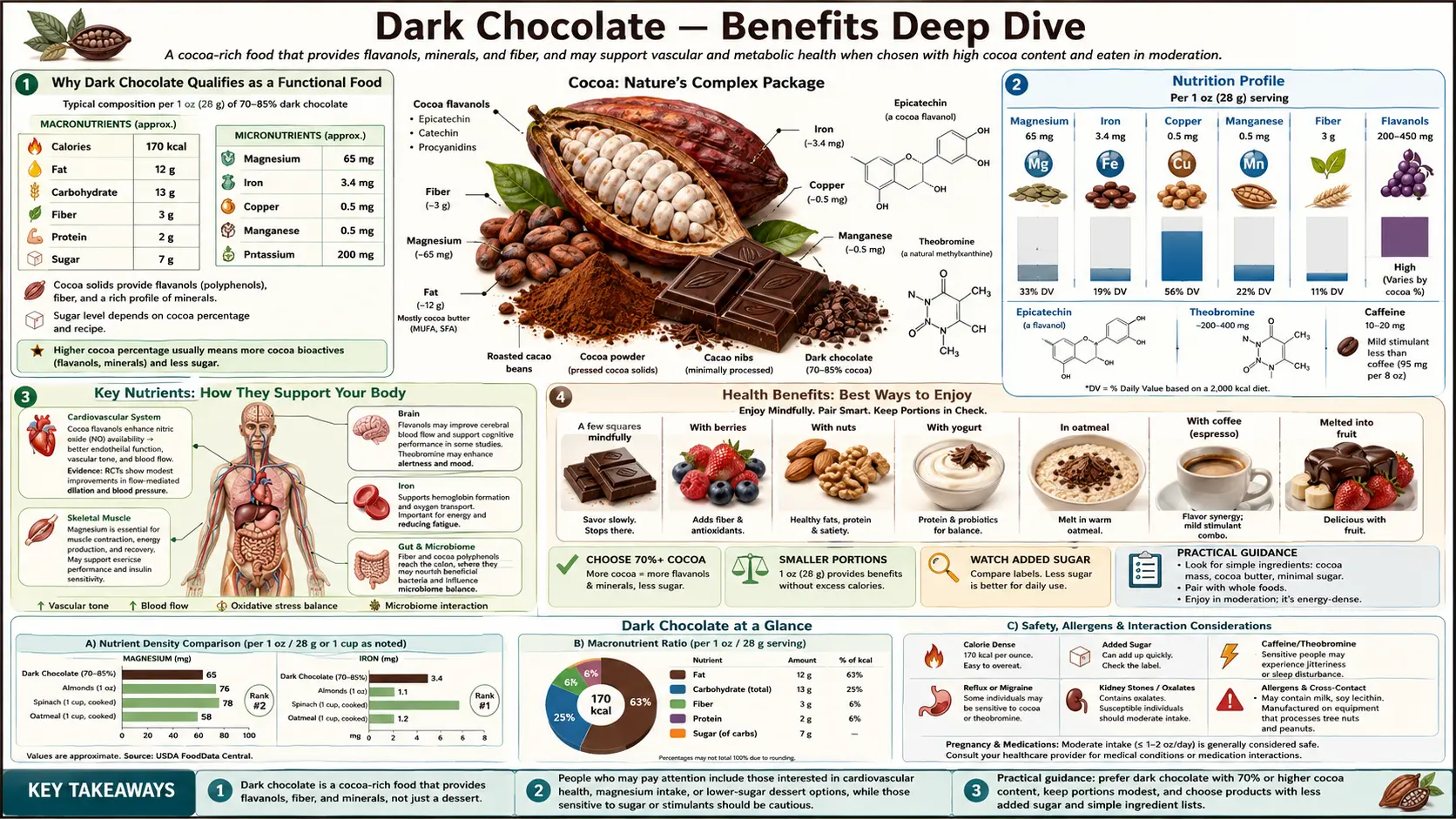
Dark chocolate is the rare confection that registers as a legitimate functional food. The active molecules — cocoa flavanols (principally epicatechin), a substantial dose of magnesium and iron per ounce, theobromine as a longer-acting alternative to caffeine, and phenylethylamine (PEA) as an endogenous mood molecule — were all on the research bench long before the marketing arrived. Four benefit pages below trace where the science is strongest (flavanol-driven endothelial nitric oxide production and blood pressure reduction), where the mineral story is meaningful but easy to misread (iron content sounds impressive but is non-heme and modestly absorbed; magnesium content is the more useful claim), where consumer choices actually move the dose (cacao percentage, added sugar, alkalization losses), and where the cultural mythology overshoots the data (the mood-and-PEA story is real but smaller than chocolate marketing implies).
Deep-Dive Articles
Flavanols & Endothelial Function
The best-validated benefit. Cocoa epicatechin activates endothelial nitric oxide synthase (eNOS), raising plasma nitric oxide, dilating vessels, and producing reproducible 2-3 mmHg systolic blood pressure reductions in meta-analyses of randomized trials. The COSMOS trial (Cocoa Supplement and Multivitamin Outcomes Study, 21,000 participants, JAMA 2022) found a 27% reduction in cardiovascular death with a 500 mg/day cocoa flavanol extract over 3.6 years.
Iron, Magnesium & Mineral Content
One ounce (28 g) of 70-85% dark chocolate delivers ~3.4 mg iron (19% RDA), ~64 mg magnesium (15% RDA), ~0.5 mg copper (56% RDA), ~0.5 mg manganese, plus phosphorus, zinc, and potassium. The iron is non-heme and absorption is modest, particularly because chocolate is rich in phytate, tannins, and oxalate that all inhibit non-heme iron uptake. The magnesium and copper claims are more practically useful.
Cacao Percentage & Sugar
The single consumer decision that determines whether dark chocolate behaves as a functional food or a confection. Cacao content drives flavanol dose; added sugar offsets the cardiometabolic benefit; Dutch-process alkalization can destroy 60% or more of the original flavanol content. Practical buying rules: 70% cacao minimum, sugar listed third or later on the ingredient list, no Dutch process or alkali listed.
Mood & PEA
Beta-phenylethylamine (PEA) is an endogenous trace amine released during attraction and elevated mood. Cocoa contains small amounts (0.5-3 mg per 100 g), but oral PEA from chocolate is largely degraded by monoamine oxidase B in the gut wall before reaching the brain. The genuine mood benefit comes through theobromine's mild dopaminergic effect, anandamide and N-acyl-ethanolamine signaling at cannabinoid receptors, and the well-documented placebo/hedonic-reward component of palatable food intake.
Table of Contents
- Deep-Dive Articles
- Why Dark Chocolate Qualifies as a Functional Food
- Research Papers: Flavanols & Cardiovascular
- Research Papers: Mineral Content & Bioavailability
- Research Papers: Processing, Cacao%, and Sugar
- Research Papers: Mood, PEA, and Neuroactives
- Research Papers: Cross-Cutting (Insulin, Cognition, Skin)
- External Authoritative Resources
- Connections
- Featured Videos
Why Dark Chocolate Qualifies as a Functional Food
A "functional food" is one that produces a reproducible physiological benefit beyond basic nutrition. Most candy fails this test. Dark chocolate, in its higher-cacao forms, passes for four mechanistic reasons that map onto the four deep-dive pages below.
- Flavanol-driven endothelial nitric oxide signaling — (-)-epicatechin and (+)-catechin from cocoa upregulate endothelial nitric oxide synthase (eNOS), raising plasma nitric oxide concentration and producing vasodilation, reduced systolic blood pressure (typically 2-3 mmHg in meta-analyses), and improved flow-mediated dilation. This is the best-validated single mechanism in cocoa science. See Flavanols & Endothelial Function.
- Concentrated mineral micronutrient density — dark chocolate is among the most magnesium-dense foods commonly consumed, with secondary contributions of copper, manganese, iron, and zinc. The mineral density is genuine but easy to misread because much of the iron is non-heme and absorption is limited by the same polyphenols that drive the cardiovascular benefit. See Iron, Magnesium & Mineral Content.
- Methylxanthine pharmacology (theobromine and caffeine) — theobromine is the dominant methylxanthine in cocoa (about 250 mg per ounce of 70%+ dark chocolate) with caffeine present in smaller amounts. Theobromine is a mild diuretic and weak phosphodiesterase inhibitor with a longer half-life than caffeine, producing the gentle stimulant character of chocolate without the abrupt onset of coffee. This is part of the mood-and-energy effect explored in Mood & PEA.
- Endocannabinoid-system signaling — cocoa contains anandamide (an endogenous cannabinoid) plus two N-acyl-ethanolamines (N-oleoylethanolamine, N-linoleoylethanolamine) that inhibit anandamide degradation. The doses are small relative to endogenous production but plausibly contribute to the mood and pleasure effect at the margin.
The therapeutic dose problem is real. Most of the cardiovascular trials use 500-1,000 mg cocoa flavanols per day, which corresponds to roughly 30-50 g of high-quality 70%+ dark chocolate. That is a daily caloric load of 150-275 kcal — not trivial, but tractable. The cardiometabolic benefit holds only when the chocolate is not also delivering a significant added-sugar load and when the cacao has not been Dutch-processed (alkali treatment to mellow the flavor destroys most flavanols). The fourth deep-dive on cacao percentage and sugar walks through the buyer's decision tree in detail.
Two notes on what dark chocolate is not. First, it is not a meaningful source of dietary phenylethylamine (PEA) in any pharmacologically relevant sense — the gut-wall MAO-B barrier degrades nearly all of it before systemic absorption. The cultural "chocolate = love hormone" association is a real cultural fact but a thin physiological one. Second, dark chocolate is not a weight-loss food. The 150-275 kcal daily therapeutic dose is meaningful and must be accounted for in overall energy balance.
Research Papers: Flavanols & Cardiovascular
- COSMOS trial: cocoa flavanol and multivitamin supplementation, cardiovascular outcomes (JAMA 2022) — Search PubMed
- Ried K, Ried K et al., effect of cocoa on blood pressure (Cochrane Database Syst Rev 2017) — PubMed: Ried Cochrane cocoa BP
- Schroeter H et al., (-)-epicatechin mediates beneficial effects of flavanol-rich cocoa on vascular function (PNAS 2006) — PubMed: Schroeter epicatechin PNAS
- Heiss C et al., cocoa flavanols and endothelium-dependent vasodilation (JAMA 2003) — Search PubMed
- Hooper L et al., effects of chocolate, cocoa, and flavan-3-ols on cardiovascular health (Am J Clin Nutr 2012) — PubMed: Hooper AJCN meta
- Buijsse B et al., cocoa intake, blood pressure, and cardiovascular mortality: the Zutphen Elderly Study (Arch Intern Med 2006) — PubMed: Buijsse cardiovascular mortality
- Taubert D et al., effects of low habitual cocoa intake on blood pressure (JAMA 2007) — PubMed: Taubert JAMA cocoa
- FLAVIOLA trial: cocoa flavanols on cardiovascular function in healthy individuals (Br J Nutr 2015) — PubMed: FLAVIOLA flavanols
- Ottaviani JI et al., cocoa flavanols and pharmacokinetics of (-)-epicatechin metabolites (Free Radic Biol Med 2012) — Search PubMed
- Loffredo L et al., dark chocolate acutely improves walking autonomy in peripheral artery disease (J Am Heart Assoc 2014) — Search PubMed
Research Papers: Mineral Content & Bioavailability
- USDA FoodData Central composition of dark chocolate 70-85% cacao PubMed: USDA cocoa composition
- Hurrell RF, Reddy M, Cook JD, inhibition of non-heme iron absorption by polyphenolic-containing beverages (Br J Nutr 1999) — Search PubMed
- Cinquanta L et al., mineral essential and toxic content of dark, milk and white chocolate (Food Chem 2016) — Search PubMed
- Volpe SL, magnesium in disease prevention and overall health (Adv Nutr 2013) — PubMed: Volpe magnesium health
- Klevay LM, dietary copper deficiency and cardiovascular disease PubMed: Klevay copper cardiovascular
- Yanagisawa H, zinc deficiency and clinical practice PubMed: Yanagisawa zinc deficiency
- Rasmussen HM et al., manganese requirements and toxicity PubMed: Manganese dietary requirements
- Lee BK, Kim Y, blood cadmium, lead, and mercury in cocoa products (Environ Res 2014) PubMed: Cocoa heavy metals
- As You Sow / Consumer Reports cadmium and lead in chocolate (peer-reviewed analyses) PubMed: Chocolate cadmium consumer
- Kruger J et al., the effect of phytate on non-heme iron absorption from cocoa-containing products PubMed: Phytate iron cocoa
Research Papers: Processing, Cacao%, and Sugar
- Miller KB et al., impact of alkalization on the antioxidant and flavanol content of natural cocoa powders (J Agric Food Chem 2008) — PubMed: Miller alkalization flavanols
- Andres-Lacueva C et al., flavanol and flavonol contents of cocoa powder products: influence of the manufacturing process PubMed: Andres-Lacueva cocoa processing
- Vinson JA et al., chocolate is a powerful ex vivo and in vivo antioxidant PubMed: Vinson chocolate antioxidant
- Steinberg FM et al., cocoa and chocolate flavonoids: implications for cardiovascular health PubMed: Steinberg flavonoid cardiovascular
- Belscak A et al., comparative study of commercially available cocoa products in terms of their bioactive composition PubMed: Cocoa products bioactive
- Lippi G, dark chocolate: consumption for pleasure or therapy? PubMed: Lippi chocolate pleasure therapy
- Visioli F et al., chocolate, lifestyle, and health (Crit Rev Food Sci Nutr 2009) — Search PubMed
- Jalil AMM, Ismail A, polyphenols in cocoa and cocoa products: is there a link between antioxidant properties and health? PubMed: Jalil cocoa polyphenols
- Kim J et al., effects of cacao bean roasting conditions on cocoa flavanol and antioxidant content PubMed: Roasting flavanol content
- WHO sugar intake guideline (2015) free sugars to under 10% of total energy intake PubMed: WHO free sugars guideline
Research Papers: Mood, PEA, and Neuroactives
- di Tomaso E, Beltramo M, Piomelli D, brain cannabinoids in chocolate (Nature 1996) — Search PubMed
- Pase MP et al., cocoa polyphenols enhance positive mood states but not cognitive performance PubMed: Pase cocoa mood
- Scholey AB et al., consumption of cocoa flavanols results in acute improvements in mood and cognitive performance PubMed: Scholey cocoa cognition
- Sabelli HC et al., clinical studies on the phenylethylamine hypothesis of affective disorder PubMed: Sabelli PEA affective
- Mumford GK et al., absorption rate of methylxanthines following capsules, cola and chocolate PubMed: Mumford methylxanthines
- Smit HJ, Gaffan EA, Rogers PJ, methylxanthines are the psycho-pharmacologically active constituents of chocolate — PubMed: Smit chocolate methylxanthines
- Mitchell ES et al., differential contributions of theobromine and caffeine on mood, psychomotor performance and blood pressure Search PubMed
- Macht M, Mueller J, immediate effects of chocolate on experimentally induced mood states PubMed: Macht chocolate mood
- Parker G, Parker I, Brotchie H, mood state effects of chocolate — PubMed: Parker mood chocolate
- Sokolov AN et al., chocolate and the brain: neurobiological impact of cocoa flavanols on cognition and behavior — PubMed: Sokolov chocolate brain
Research Papers: Cross-Cutting (Insulin, Cognition, Skin)
- Grassi D et al., cocoa reduces blood pressure and insulin resistance and improves endothelium-dependent vasodilation in hypertensives (Hypertension 2005) — PubMed: Grassi cocoa insulin BP
- Brickman AM et al., enhancing dentate gyrus function with dietary flavanols improves cognition in older adults (Nat Neurosci 2014) — PubMed: Brickman flavanols dentate gyrus
- Sloan RP et al., cocoa flavanol consumption improves cognitive function in older adults Search PubMed
- Heinrich U et al., long-term ingestion of high-flavanol cocoa provides photoprotection against UV-induced erythema — PubMed: Heinrich cocoa skin photoprotection
- Neukam K et al., consumption of flavanol-rich cocoa acutely increases microcirculation in human skin Search PubMed
- Jenkins DJA et al., supplementation with dark chocolate may improve fasting lipid profile PubMed: Jenkins chocolate lipids
- Mellor DD et al., high-cocoa polyphenol-rich chocolate improves HDL cholesterol in type 2 diabetes — PubMed: Mellor dark chocolate diabetes
- Hooper L et al., flavonoids, flavonoid-rich foods, and cardiovascular risk: a meta-analysis of randomized controlled trials Search PubMed
- Crews C et al., a survey of bioactive amine levels in chocolate and other cocoa products PubMed: Crews biogenic amines chocolate
- Davinelli S et al., cocoa flavanols and microbial metabolism for cardiometabolic health PubMed: Cocoa microbiome
External Authoritative Resources
- Linus Pauling Institute — Cocoa Micronutrient Information Center — the most authoritative ongoing scientific summary of cocoa biology and clinical evidence
- USDA FoodData Central — canonical nutrient composition tables for dark chocolate by cacao percentage
- European Food Safety Authority (EFSA) — the 2012 EFSA panel approved a health claim that 200 mg cocoa flavanols per day contributes to normal blood vessel elasticity
- American Heart Association — dietary guidance on cocoa and chocolate
- PubMed — cocoa flavanol cardiovascular literature (10,000+ papers)
Connections
- All Food
- Dark Chocolate (Main Page)
- Flavanols & Endothelial Function
- Iron, Magnesium & Mineral Content
- Cacao Percentage & Sugar
- Mood & PEA
- Green Tea (Flavanols)
- Coffee (Methylxanthines)
- Blueberries (Polyphenols)
- Walnuts
- Magnesium
- Iron
- Copper
- Hypertension
- Antioxidants