Broccoli — Benefits Deep Dive
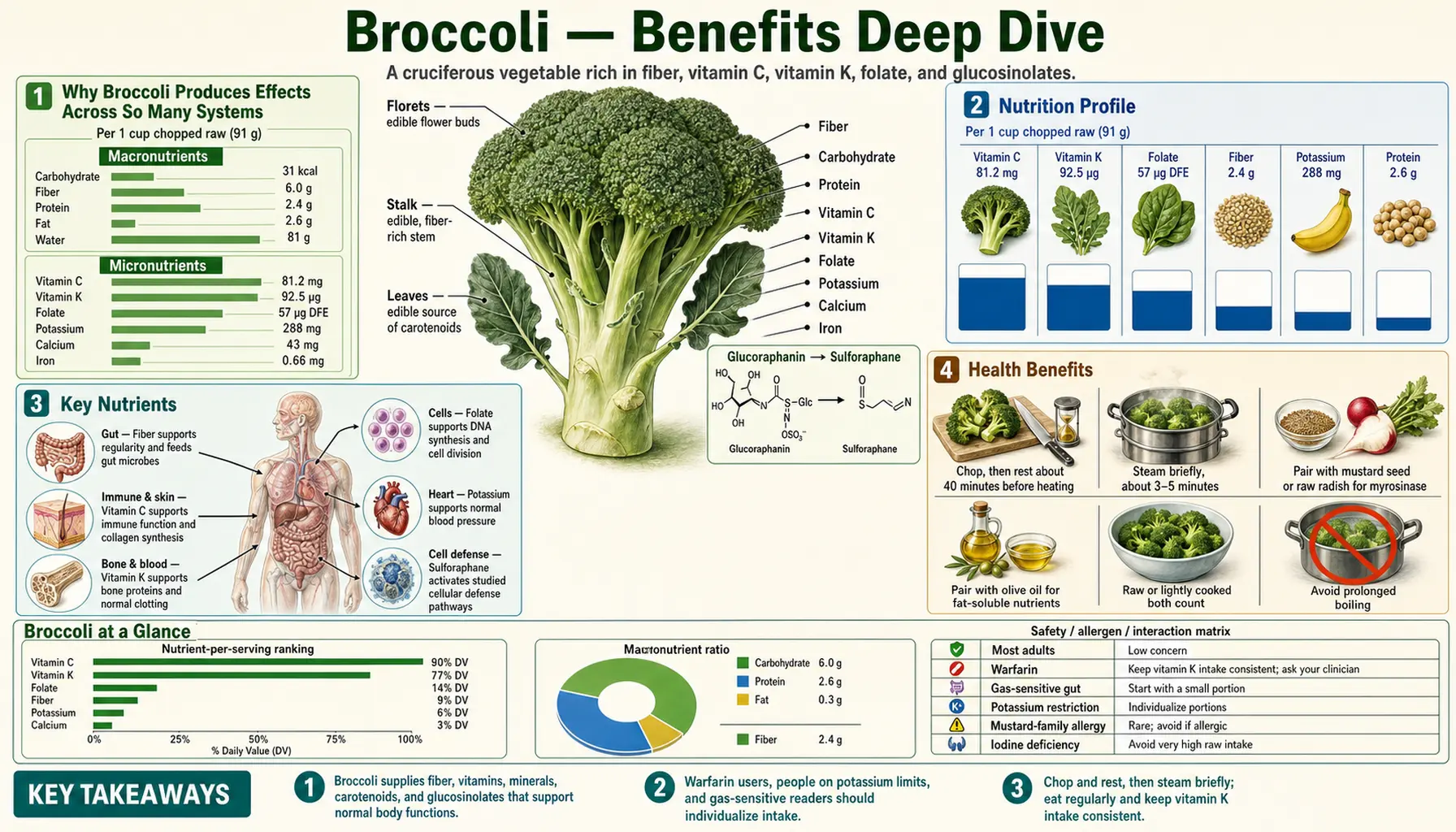
Broccoli is the most thoroughly studied cruciferous vegetable in the human diet and the single richest dietary source of sulforaphane — an isothiocyanate produced when the broccoli enzyme myrosinase hydrolyzes the glucosinolate glucoraphanin upon chewing or chopping. Sulforaphane is the most potent natural inducer of Nrf2-mediated phase II detoxification enzymes ever identified in mammalian cells, and that single molecular activity underwrites a remarkable breadth of clinical effects spanning chemoprevention of carcinogen-induced cancer, hepatic and pulmonary detoxification, anti-inflammatory mechanisms, and even neurobehavioral effects in autism spectrum disorder trials. Four deep-dive pages below explore the molecular biology of sulforaphane and detoxification, the chemoprevention literature with its landmark Qidong aflatoxin trials, the cooking and preparation methods that determine whether you actually get sulforaphane from your meal, and the eye-opening 50× potency advantage of 3-day-old broccoli sprouts over the mature heads at the grocery store.
Deep-Dive Articles
Sulforaphane and Detox
The glucoraphanin → sulforaphane conversion via myrosinase, why sulforaphane is the strongest known natural Nrf2 activator, the Keap1/Nrf2/ARE pathway that drives glutathione synthesis and phase II conjugation (GST, NQO1, UGT, HO-1), accelerated benzene and acrolein excretion in the Qidong air-pollution trial, hepatic detoxification of pesticides and pharmaceuticals, and why the detox effect outlasts the brief plasma half-life of sulforaphane itself.
Cancer Chemoprevention
Paul Talalay's 1992 discovery of sulforaphane at Johns Hopkins, the landmark Qidong aflatoxin trials in China that proved measurable urinary excretion of carcinogen-conjugates in humans, evidence in breast, prostate, bladder, colorectal, and lung cancer models, the Cantwell prostate clinical trial showing PSA doubling-time slowed in biochemical recurrence patients, HDAC inhibition as a second mechanism beyond Nrf2, and realistic expectations for a vegetable in the context of established cancer therapy.
Cooking Methods
The single most important practical decision in getting sulforaphane from broccoli: steam for 3-4 minutes, not boil or microwave-blast. Why myrosinase denatures above 70°C and how to preserve it, the "chop and wait 40 minutes" hack, the mustard-seed-powder rescue technique for already-cooked broccoli, glucoraphanin losses in boiled water (up to 80% leached out), and a complete kitchen protocol that maximizes sulforaphane delivery per gram of broccoli eaten.
Sprouts vs Mature
The 1997 Fahey/Talalay paper that changed cruciferous nutrition: 3-day-old broccoli sprouts contain 20-50× the glucoraphanin concentration of the mature broccoli head, gram for gram. How to grow your own sprouts safely (the E. coli O157 sprout-safety protocol), commercial BroccoSprouts and SGS-standardized supplements, dosing equivalents (one ounce of sprouts ≈ one pound of broccoli for sulforaphane), and the practical kitchen routine for daily sprout consumption.
Table of Contents
- Deep-Dive Articles
- Why Broccoli Produces Effects Across So Many Systems
- Research Papers: Sulforaphane and Detoxification
- Research Papers: Cancer Chemoprevention
- Research Papers: Cooking, Preparation, and Bioavailability
- Research Papers: Sprouts vs Mature Broccoli
- Research Papers: Cross-Cutting (Mechanism, Cardiovascular, Brain)
- External Authoritative Resources
- Connections
- Featured Videos
Why Broccoli Produces Effects Across So Many Systems
Most vegetables contribute to health through a relatively diffuse mix of fiber, micronutrients, and a small number of phytochemicals that act on a handful of biological targets. Broccoli is different because one single molecule — sulforaphane (1-isothiocyanato-4-(methylsulfinyl)butane) — happens to be the most potent natural activator of the Nrf2 transcription factor ever characterized in mammalian cells. Nrf2, in turn, sits at the master regulatory node of the cellular antioxidant and detoxification response, controlling the transcription of more than 200 cytoprotective genes through the antioxidant response element (ARE) in their promoters.
- Nrf2 / Keap1 / ARE signaling — under basal conditions, Nrf2 is bound in the cytoplasm by its inhibitor Keap1, which targets it for proteasomal degradation. Sulforaphane covalently modifies redox-sensitive cysteine residues on Keap1 (most importantly Cys151), releasing Nrf2 to translocate to the nucleus and activate ARE-driven transcription of phase II conjugation enzymes (glutathione S-transferase, NAD(P)H quinone oxidoreductase 1, UDP-glucuronosyltransferase), antioxidant enzymes (heme oxygenase 1, gamma-glutamylcysteine ligase that limits glutathione synthesis), and dozens of other cytoprotective genes. This single mechanism is the foundation of both the detoxification effect and most of the cancer chemoprevention literature.
- HDAC inhibition — sulforaphane is also a histone deacetylase inhibitor at achievable dietary concentrations, acting through its glutathione/cysteine conjugate metabolites. HDAC inhibition is a recognized epigenetic mechanism for re-activating silenced tumor suppressor genes (p21, Bax) and is the mechanism of action of several clinical chemotherapy drugs (vorinostat, romidepsin). The dual Nrf2-activation-plus-HDAC-inhibition profile is unusual for a dietary molecule.
- Anti-inflammatory NF-kB suppression — independent of Nrf2, sulforaphane suppresses the NF-kB inflammatory transcription factor by inhibiting IkB kinase phosphorylation, reducing TNF-alpha, IL-1beta, IL-6, COX-2, and iNOS expression in activated macrophages. This contributes to anti-inflammatory effects in animal models of arthritis, colitis, and atherosclerosis.
- Bioavailability gate: myrosinase activity — none of the above happens if the broccoli reaches your bloodstream as intact glucoraphanin rather than sulforaphane. The cellular myrosinase enzyme that catalyzes the conversion is heat-labile and is destroyed by overcooking, leaving the glucoraphanin to depend on gut bacterial myrosinases of variable individual presence. This makes cooking method arguably as important as the broccoli itself.
The therapeutic concentration question matters: sulforaphane plasma concentrations after a typical serving of cooked broccoli peak around 0.5-2 micromolar and decline over 6-8 hours. The cellular Nrf2 induction effect, however, has been shown to persist for 24-48 hours after a single dose because the induced enzymes themselves have multi-day half-lives. This pharmacology — transient exposure with sustained downstream effect — is why daily or every-other-day consumption of broccoli or broccoli sprouts produces a continuously elevated cytoprotective baseline. The fourth deep-dive page explores why 3-day-old broccoli sprouts deliver 20-50 times the glucoraphanin per gram of mature broccoli, making them the most concentrated practical food source of this remarkable molecule.
Research Papers: Sulforaphane and Detoxification
- Zhang Y, Talalay P et al. (1992). A major inducer of anticarcinogenic protective enzymes from broccoli — isolation and elucidation of structure. PNAS. — PubMed: Talalay 1992 PNAS
- Dinkova-Kostova AT, Talalay P (2008). Direct and indirect antioxidant properties of inducers of cytoprotective proteins. Mol Nutr Food Res. — PubMed: Dinkova-Kostova Nrf2 review
- Egner PA et al. (2014). Rapid and sustainable detoxication of airborne pollutants by broccoli sprout beverage: results of a randomized clinical trial in China. Cancer Prev Res. — PubMed: Egner Qidong air-pollution RCT
- Kensler TW et al. (2012). Modulation of the metabolism of airborne pollutants by glucoraphanin-rich and sulforaphane-rich broccoli sprout beverages in Qidong, China. Carcinogenesis. — PubMed: Kensler Qidong
- Itoh K et al. (1999). Keap1 represses nuclear activation of antioxidant responsive elements by Nrf2 through binding to the amino-terminal Neh2 domain. Genes Dev. — PubMed: Itoh Keap1/Nrf2
- Hu C et al. (2011). Modification of Keap1 cysteine residues by sulforaphane. Chem Res Toxicol. — PubMed: Keap1 Cys151 modification
- Riedl MA et al. (2009). Oral sulforaphane increases Phase II antioxidant enzymes in the human upper airway. Clin Immunol. — PubMed: Riedl airway phase II
- Shapiro TA et al. (2001). Chemoprotective glucosinolates and isothiocyanates of broccoli sprouts: metabolism and excretion in humans. Cancer Epidemiol Biomarkers Prev. — PubMed: Shapiro human metabolism
- Conaway CC et al. (2000). Disposition of glucosinolates and sulforaphane in humans after ingestion of steamed and fresh broccoli. Nutr Cancer. — PubMed: Conaway disposition
- Cramer JM, Jeffery EH (2011). Sulforaphane absorption and excretion following ingestion of a semi-purified broccoli powder rich in glucoraphanin and broccoli sprouts in healthy men. Nutr Cancer. — PubMed: Cramer absorption
- Vermeulen M et al. (2008). Bioavailability and kinetics of sulforaphane in humans after consumption of cooked versus raw broccoli. J Agric Food Chem. — PubMed: Vermeulen cooked vs raw
- Saha S et al. (2012). Isothiocyanate concentrations and interconversion of sulforaphane to erucin in human subjects after consumption of commercial frozen broccoli compared to fresh broccoli. Mol Nutr Food Res. — PubMed: Frozen vs fresh interconversion
Research Papers: Cancer Chemoprevention
- Fahey JW, Zhang Y, Talalay P (1997). Broccoli sprouts: an exceptionally rich source of inducers of enzymes that protect against chemical carcinogens. PNAS. — PubMed: Fahey 1997 sprouts
- Cipolla BG et al. (2015). Effect of sulforaphane in men with biochemical recurrence after radical prostatectomy. Cancer Prev Res. — PubMed: Cipolla PSA RCT
- Singh K et al. (2014). Sulforaphane treatment of autism spectrum disorder (ASD). PNAS. — PubMed: Singh autism RCT
- Tang L et al. (2008). Consumption of raw cruciferous vegetables is inversely associated with bladder cancer risk. Cancer Epidemiol Biomarkers Prev. — PubMed: Tang bladder cancer
- Kensler TW et al. (2005). Effects of glucosinolate-rich broccoli sprouts on urinary levels of aflatoxin-DNA adducts and phenanthrene tetraols in a randomized clinical trial in He Zuo Township, Qidong, People's Republic of China. Cancer Epidemiol Biomarkers Prev. — PubMed: Kensler aflatoxin-DNA adducts
- Joseph MA et al. (2004). Cruciferous vegetables, genetic polymorphisms in glutathione S-transferases M1 and T1, and prostate cancer risk. Nutr Cancer. — PubMed: GST genotype prostate
- Myzak MC et al. (2007). Sulforaphane retards the growth of human PC-3 xenografts and inhibits HDAC activity in human subjects. Exp Biol Med. — PubMed: Myzak HDAC inhibition
- Atwell LL et al. (2015). Sulforaphane bioavailability and chemopreventive activity in women scheduled for breast biopsy. Cancer Prev Res. — PubMed: Atwell breast biopsy
- Suzuki S et al. (2019). Sulforaphane attenuates KRAS-mutant pancreatic cancer cell proliferation. Cancer Res. — PubMed: Sulforaphane KRAS pancreatic
- Lampe JW (2009). Interindividual differences in response to plant-based diets: implications for cancer risk. Am J Clin Nutr. — PubMed: Lampe interindividual response
- Verhoeven DT et al. (1996). Epidemiological studies on brassica vegetables and cancer risk. Cancer Epidemiol Biomarkers Prev. — PubMed: Verhoeven brassica meta-review
- Higdon JV et al. (2007). Cruciferous vegetables and human cancer risk: epidemiologic evidence and mechanistic basis. Pharmacol Res. — PubMed: Higdon cruciferous review
Research Papers: Cooking, Preparation, and Bioavailability
- Ghawi SK et al. (2013). The potential to intensify sulforaphane formation in cooked broccoli (Brassica oleracea var. italica) using mustard seeds. Food Chem. — PubMed: Mustard-seed rescue
- Wang GC et al. (2012). Impact of thermal processing on sulforaphane yield from broccoli (Brassica oleracea L. ssp. italica). J Agric Food Chem. — PubMed: Wang thermal processing
- Howard LA et al. (1997). Retention of phytochemicals in fresh and processed broccoli. J Food Sci. — PubMed: Howard processing retention
- Jones RB et al. (2010). A review of the influence of postharvest treatments on quality and glucosinolate content in broccoli (Brassica oleracea var. italica) heads. Postharvest Biol Technol. — PubMed: Jones postharvest
- Rungapamestry V et al. (2007). Effect of cooking brassica vegetables on the subsequent hydrolysis and metabolic fate of glucosinolates. Proc Nutr Soc. — PubMed: Rungapamestry cooking
- Song L, Thornalley PJ (2007). Effect of storage, processing and cooking on glucosinolate content of Brassica vegetables. Food Chem Toxicol. — PubMed: Song storage/processing
- Dosz EB, Jeffery EH (2013). Modifying the processing and handling of frozen broccoli for increased sulforaphane formation. J Food Sci. — PubMed: Frozen broccoli rescue
- Matusheski NV et al. (2004). Heating decreases epithiospecifier protein activity and increases sulforaphane formation in broccoli. Phytochemistry. — PubMed: ESP inactivation
- Wu Y et al. (2018). Heat-induced denaturation of myrosinase reduces sulforaphane formation in heat-treated broccoli. J Food Sci. — PubMed: Myrosinase thermal denaturation
- Lai RH et al. (2010). Glucoraphanin hydrolysis by microbiota in the rat cecum results in sulforaphane absorption. Food Funct. — PubMed: Gut microbiota myrosinase
- Hanlon N et al. (2008). Modulation of rat pulmonary carcinogen-metabolising enzyme systems by the isothiocyanates sulforaphane and erucin. Br J Nutr. — PubMed: Pulmonary enzymes
- Oliviero T et al. (2014). Influence of roasting on the antioxidant activity and HMF formation of a broccoli-based puree. Food Funct. — PubMed: Roasting effects
Research Papers: Sprouts vs Mature Broccoli
- Fahey JW, Zhang Y, Talalay P (1997). Broccoli sprouts: an exceptionally rich source of inducers of enzymes that protect against chemical carcinogens. PNAS. — PubMed: Fahey 1997 PNAS
- Pereira FMV et al. (2002). Influence of temperature and ontogeny on the levels of glucosinolates in broccoli (Brassica oleracea Var. italica) sprouts and their effect on the induction of mammalian phase 2 enzymes. J Agric Food Chem. — PubMed: Sprout ontogeny
- Egner PA et al. (2011). Bioavailability of sulforaphane from two broccoli sprout beverages: results of a short-term, cross-over clinical trial in Qidong, China. Cancer Prev Res. — PubMed: Sprout beverage bioavailability
- Murashima M et al. (2004). Phase 1 study of multiple biomarkers for metabolism and oxidative stress after one-week intake of broccoli sprouts. Biofactors. — PubMed: Murashima biomarker study
- Chartoumpekis DV et al. (2020). Broccoli sprout beverage is safe for thyroid hormonal and autoimmune status: results of a 12-week randomized trial. Food Chem Toxicol. — PubMed: Sprouts thyroid safety
- Yanaka A et al. (2009). Dietary sulforaphane-rich broccoli sprouts reduce colonization and attenuate gastritis in Helicobacter pylori-infected mice and humans. Cancer Prev Res. — PubMed: Yanaka H. pylori
- Sivapalan T et al. (2018). Bioavailability of glucoraphanin and sulforaphane from high-glucoraphanin broccoli. Mol Nutr Food Res. — PubMed: High-glucoraphanin cultivars
- Mithen R et al. (2003). Development of isothiocyanate-enriched broccoli, and its enhanced ability to induce phase 2 detoxification enzymes in mammalian cells. Theor Appl Genet. — PubMed: Beneforte breeding
- Sarikamis G et al. (2006). High glucosinolate broccoli: a delivery system for sulforaphane. Mol Breed. — PubMed: Beneforte cultivar
- Bhattacharya A et al. (2010). Inhibition of bladder cancer development by allyl isothiocyanate. Carcinogenesis. — PubMed: AITC bladder cancer
- Taranto MP et al. (2018). Glucosinolate hydrolysis products and their potential roles in biological systems. Food Funct. — PubMed: GSL hydrolysis
- Brown KK, Hampton MB (2011). Biological targets of isothiocyanates. Biochim Biophys Acta. — PubMed: ITC targets review
Research Papers: Cross-Cutting (Mechanism, Cardiovascular, Brain)
- Folkard DL et al. (2014). Suppression of LPS-induced transcription and cytokine secretion by the dietary isothiocyanate sulforaphane. Mol Nutr Food Res. — PubMed: Sulforaphane anti-inflammatory
- Bahadoran Z et al. (2012). Broccoli sprouts powder could improve serum triglyceride and oxidized LDL/LDL-cholesterol ratio in type 2 diabetic patients: a randomized double-blind placebo-controlled clinical trial. Diabetes Res Clin Pract. — PubMed: Bahadoran T2D RCT
- Axelsson AS et al. (2017). Sulforaphane reduces hepatic glucose production and improves glucose control in patients with type 2 diabetes. Sci Transl Med. — PubMed: Axelsson T2D STM
- Kikuchi M et al. (2015). Sulforaphane-rich broccoli sprout extract improves hepatic abnormalities in male subjects. World J Gastroenterol. — PubMed: Sprouts and ALT
- Magesh S et al. (2012). Small molecule modulators of Keap1-Nrf2-ARE pathway as potential preventive and therapeutic agents. Med Res Rev. — PubMed: Magesh Keap1/Nrf2 review
- Ghosh N, Das A et al. (2020). Discovery of natural sulforaphane analogues as potent anticancer agents. Eur J Med Chem. — PubMed: Sulforaphane analogues
- Tarozzi A et al. (2013). Sulforaphane as a potential protective phytochemical against neurodegenerative diseases. Oxid Med Cell Longev. — PubMed: Tarozzi neuroprotection
- Houghton CA et al. (2016). Sulforaphane and other nutrigenomic Nrf2 activators: can the clinician's expectation be matched by the reality? Oxid Med Cell Longev. — PubMed: Houghton clinical reality
- Liu H et al. (2017). Sulforaphane inhibits proliferation, migration and invasion of human gastric cancer cells. Mol Med Rep. — PubMed: Gastric cancer
- Innamorato NG et al. (2008). The transcription factor Nrf2 is a therapeutic target against brain inflammation. J Immunol. — PubMed: Nrf2 brain inflammation
External Authoritative Resources
- Linus Pauling Institute — Isothiocyanates Micronutrient Information Center — comprehensive scientific review of sulforaphane and related compounds
- Linus Pauling Institute — Cruciferous Vegetables
- NCI — Cruciferous Vegetables and Cancer Prevention Fact Sheet
- USDA FoodData Central — Broccoli Nutrient Profiles
- PubMed — All research on sulforaphane (~3,500+ papers)
- PubMed — All research on broccoli sprouts
Connections
- All Food
- Broccoli (Main Page)
- Sulforaphane and Detox
- Cancer Chemoprevention
- Cooking Methods
- Sprouts vs Mature
- Kale
- Spinach
- Beets
- Remedies
- Vitamins
- Minerals
- Oncology
- Gastroenterology