Broccoli Sprouts vs Mature Broccoli
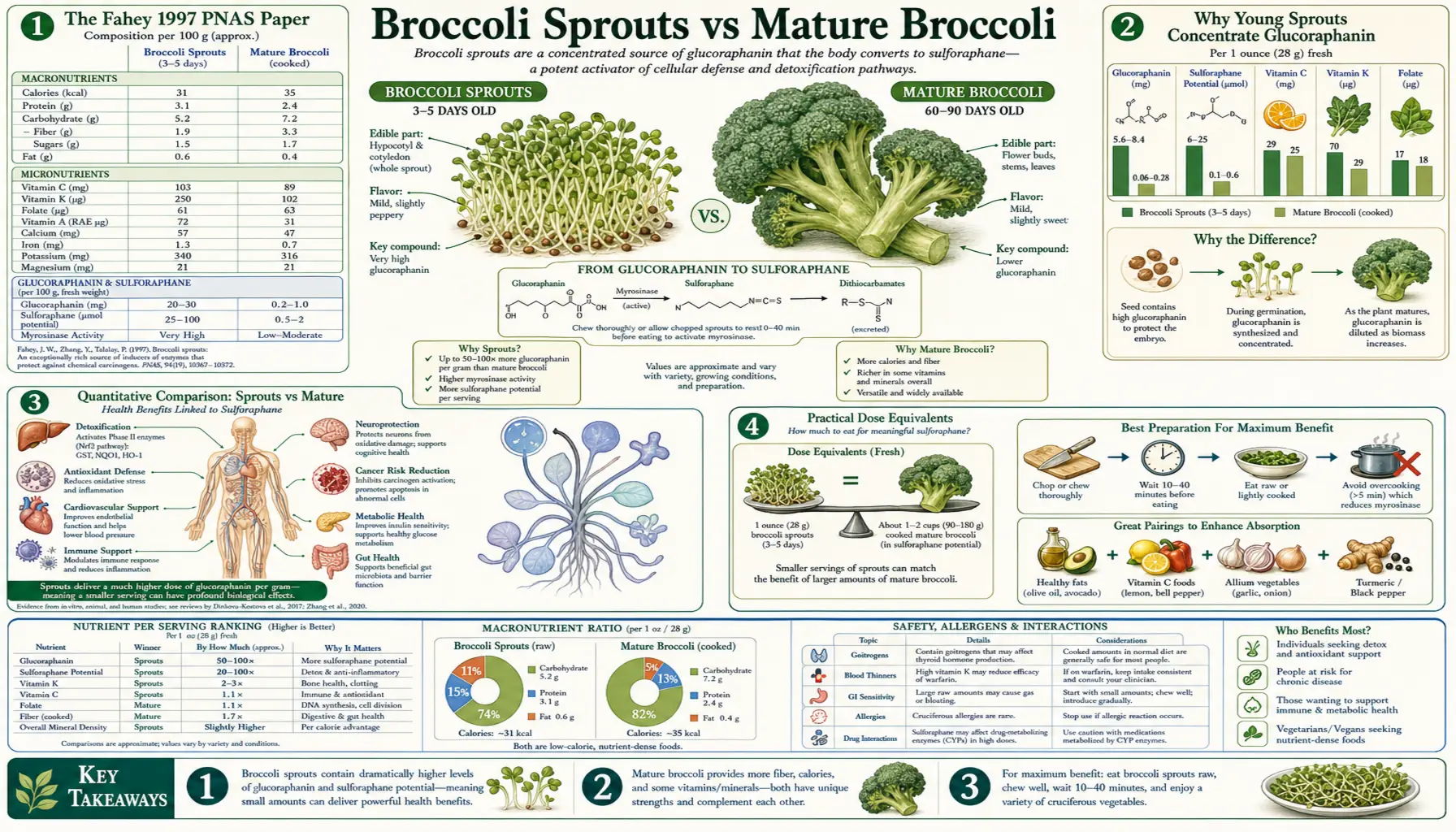
The single most important finding in modern cruciferous-vegetable nutrition is buried in the Fahey, Zhang, and Talalay 1997 PNAS paper: three-day-old broccoli sprouts contain 20 to 50 times the glucoraphanin per gram of the mature broccoli heads you can buy at the grocery store. The mechanism is developmental — the young sprout invests heavily in defensive glucosinolate accumulation as an antimicrobial and antifeedant strategy during its vulnerable early growth stage, then steadily dilutes that investment as the mature plant grows leaves, stalks, and head tissue. Gram for gram, one ounce of broccoli sprouts (about 28 g) delivers the sulforaphane equivalent of roughly one pound of optimally prepared mature broccoli. The sprouts can be home-grown safely in a Mason jar over four days, eaten raw on salads or sandwiches with no cooking required (their natural myrosinase is fully intact). For patients motivated to maximize sulforaphane intake without consuming pounds of broccoli daily, home-grown sprouts are the most concentrated, lowest-cost, and most reliable delivery system in the food supply.
Table of Contents
- The Fahey 1997 PNAS Paper
- Why Young Sprouts Concentrate Glucoraphanin
- Quantitative Comparison: Sprouts vs Mature
- Practical Dose Equivalents
- How to Grow Your Own Sprouts
- Sprout Food Safety: The E. coli O157 Problem
- Commercial BroccoSprouts and SGS Supplements
- Beneforte and Other High-Glucoraphanin Cultivars
- Taste, Texture, and Eating Style
- Building a Daily Sprout Routine
- Key Research Papers
- Connections
- Featured Videos
The Fahey 1997 PNAS Paper
The seminal paper that changed cruciferous nutrition was published by Jed Fahey, Yuesheng Zhang, and Paul Talalay in the Proceedings of the National Academy of Sciences USA in 1997, titled "Broccoli sprouts: an exceptionally rich source of inducers of enzymes that protect against chemical carcinogens." The Johns Hopkins group had been studying mature broccoli's glucoraphanin content for five years following the 1992 sulforaphane discovery, and during that work noticed that broccoli sprouts — the young seedlings of the same plant — appeared to contain dramatically more glucoraphanin than the mature head.
Their systematic measurements confirmed the impression. Three-day-old broccoli sprouts (germinated from seeds and harvested before the first true leaves emerged) contained 20 to 50 times the glucoraphanin concentration of mature broccoli heads on a fresh-weight basis. The induction of phase II enzymes in murine hepatoma cells per gram of sprout extract was correspondingly 20 to 50 times higher than per gram of mature broccoli extract.
The paper's key practical conclusion: "Small quantities of crucifer sprouts may protect against the risk of cancer as effectively as much larger quantities of mature vegetables of the same variety." The authors had effectively identified a 20-50× more concentrated food source of the most potent natural Nrf2 activator known to science. The paper has been cited over 1,000 times and is the founding document of the modern broccoli-sprout supplement industry.
Why Young Sprouts Concentrate Glucoraphanin
The biological reason for the sprout concentration effect is defensive ecology. Glucosinolates including glucoraphanin function in the plant as an antimicrobial and antifeedant defense system. The intact glucosinolate is essentially inert; when an insect chews the plant or a fungal hyphal attack damages cells, the cellular myrosinase contacts the glucosinolate and releases isothiocyanates that are toxic to insects, herbivores, and microbes. This "glucosinolate-myrosinase mustard oil bomb" is a classical example of a constitutive plant defense.
The young seedling is the most vulnerable stage of the plant's life cycle — it cannot escape predation, it has very limited reserves to fight infection, and a single severe attack can kill it outright. Plants therefore invest defensive chemistry heavily in the seedling stage. As the plant matures, the relative investment in glucosinolate accumulation declines: the mature plant can tolerate some insect damage, has multiple growing points, and can regrow damaged tissue, so the marginal value of further glucosinolate investment falls.
The result of this developmental gradient: per gram of fresh weight, the 2-3 day old sprout contains 20-50 times the glucoraphanin of the mature broccoli head. This is not specific to broccoli — similar developmental gradients exist for radish, watercress, mustard, and other glucosinolate-producing crops. Broccoli sprouts have become the focus of commercial development because broccoli's specific glucosinolate (glucoraphanin) produces the most potent Nrf2 activator (sulforaphane), and because the seeds are inexpensive and the sprouting protocol is well-developed.
One important caveat: the high glucosinolate concentration of sprouts is also the reason they have a sharp, slightly bitter, peppery taste. This is glucoraphanin and its rapidly-formed sulforaphane that you are tasting. People who find broccoli sprouts unpleasantly strong are essentially tasting the active ingredient.
Quantitative Comparison: Sprouts vs Mature
Concrete numbers from the published literature:
- Mature broccoli head (fresh) — approximately 50-100 mg glucoraphanin per 100 g fresh weight, with substantial cultivar variation. Beneforte broccoli (a high-glucoraphanin cultivar discussed below) contains 2-4 times that amount.
- 3-day-old broccoli sprouts (fresh) — approximately 1,000-2,000 mg glucoraphanin per 100 g fresh weight, again with cultivar variation. Some commercial sprout cultivars selected for high glucoraphanin reach 2,500-3,000 mg per 100 g.
- Dried broccoli sprout powder — approximately 5,000-15,000 mg glucoraphanin per 100 g (the dried powder concentrates by approximately 10× from fresh weight).
- Standardized broccoli sprout extract (e.g. SGS, BroccoMax, ProstaPhane) — manufacturers standardize to a specific glucoraphanin content per capsule, typically 100-300 mg glucoraphanin per capsule (delivered as the precursor, with myrosinase added separately or expected to be supplied by gut bacteria).
To convert glucoraphanin (the precursor) into sulforaphane (the bioactive product), divide by the molar mass ratio (glucoraphanin is approximately 2.4 times heavier than sulforaphane). The yield of sulforaphane per glucoraphanin is well under 100% due to the ESP-mediated diversion to nitriles and other factors; in optimally prepared broccoli sprouts (which have high myrosinase and lower ESP than mature broccoli), conversion efficiency is around 60-90%.
The bottom-line conversion that matters most for the consumer: one ounce (28 g) of fresh broccoli sprouts delivers approximately 30-50 mg of sulforaphane equivalent — comparable to about 1 pound (450 g) of optimally prepared mature broccoli, or to a 100-300 mg standardized sulforaphane supplement. This is a substantial daily clinical dose at minimal cost (a few cents per serving when home grown).
Practical Dose Equivalents
Translating the chemistry into practical daily routines:
- Sulforaphane dose used in the Cipolla prostate cancer RCT: 60 mg standardized sulforaphane daily. Equivalent: about 60 g of fresh broccoli sprouts (a generous 2-ounce serving) or about 2 pounds of optimally cooked mature broccoli per day.
- Sulforaphane dose used in the Egner Qidong air-pollution trial: broccoli sprout beverage delivering 600 micromol glucoraphanin and 40 micromol sulforaphane daily. Equivalent: about 30 g of fresh sprouts daily.
- Sulforaphane dose used in the Bahadoran type 2 diabetes trial: 10 g broccoli sprout powder daily (corresponding to about 100 g fresh sprouts).
- Typical daily intake for primary prevention: 28 g (one ounce) fresh sprouts on a salad or sandwich. Achievable, palatable, and delivers a meaningful sulforaphane dose to maintain elevated phase II enzyme activity.
For comparison, achieving the same sulforaphane dose from mature broccoli requires consuming about 1 pound of optimally prepared (briefly steamed, properly chewed) broccoli daily — a substantial commitment that most people will not maintain. This is why broccoli sprouts have become the practical sulforaphane delivery vehicle for patients motivated to maximize intake.
How to Grow Your Own Sprouts
Home-grown broccoli sprouts cost approximately 2-5 cents per ounce versus $3-5 per ounce for commercial sprouts. The growing process takes 4 days from seed to harvest and requires only a mason jar, water, and a screen lid or cheesecloth. The classical protocol:
Day 0 (evening):
- Measure 2-3 tablespoons of food-grade broccoli sprouting seeds into a 1-quart wide-mouth Mason jar.
- Add about 1 cup of cool filtered water (chlorinated tap water also works if you let it sit out for an hour to off-gas).
- Cover with a sprouting lid (a stainless steel mesh screen with a band ring) or with cheesecloth secured with a rubber band.
- Let soak overnight in a dark, cool location (kitchen counter is fine).
Days 1-3 (morning and evening):
- Drain through the screen lid completely. The seeds should be moist but not standing in water.
- Refill the jar with cool water, swish to rinse, and drain completely again.
- Invert the jar at a 45 degree angle (in a bowl or rack) so excess water can continue to drip out and air can circulate.
- Place out of direct sunlight (the kitchen counter is fine, or inside a cabinet for darker conditions that produce whiter sprouts).
- Repeat the rinse-and-drain twice daily (every 8-12 hours).
Day 4 (morning):
- The sprouts should now be about an inch long, with two small yellow-green seed leaves and white roots. Some will have green leaves if you have given them indirect light during the last 24 hours.
- Optional: expose the sprouts to indirect light for 4-12 hours to develop chlorophyll (greens up the leaves). The light exposure does not appreciably change the glucoraphanin content but improves the visual appeal.
- Give a final rinse, drain thoroughly, and transfer to an airtight container in the refrigerator. Use within 5-7 days.
Yield: 2-3 tablespoons of dry seeds yields about 200-300 g (7-10 ounces) of fresh sprouts — about a week's supply at one ounce per day. Start a new jar every 3-4 days to maintain a steady supply.
For about $20 you can buy 1 pound of food-grade broccoli sprouting seeds (NOT garden seeds, which may be treated with fungicides not safe to eat) from any of several reputable suppliers. This will produce roughly 8-12 pounds of fresh sprouts, enough for 6-12 months of daily consumption depending on serving size.
Sprout Food Safety: The E. coli O157 Problem
Sprouts have a documented food-safety history that requires honest discussion. The warm, moist, nutrient-rich environment that supports sprouting is also nearly ideal for bacterial growth. Commercial sprouts have been associated with multiple outbreaks of Escherichia coli O157:H7, Salmonella, and Listeria monocytogenes. The largest single such outbreak was the 2011 European E. coli O104:H4 outbreak (linked to fenugreek sprouts grown from contaminated seed) that caused about 50 deaths and over 4,000 illnesses, including over 800 cases of hemolytic-uremic syndrome.
The risk is real but manageable with proper protocols:
- Buy seeds, not sprouts. Commercial sprouts have a much higher contamination history than home-grown sprouts. The risk in commercial sprouts comes primarily from contaminated seed lots that go through the sprouting process; home-grown sprouts use the same seed lots but are not warehoused, transported, or stored under conditions that allow bacterial overgrowth.
- Buy seeds from reputable suppliers that test for E. coli O157 and Salmonella. Most reputable broccoli sprouting seed vendors publish certificates of analysis. Avoid garden-center seeds intended for planting, which are not certified for food use and may carry pathogen contamination.
- Sanitize the seeds before sprouting. The FDA-recommended protocol is to soak the seeds for 5 minutes in a dilute hydrogen peroxide solution (3% food-grade hydrogen peroxide, used at full strength), rinse thoroughly, then proceed with the standard soak. This kills surface-contaminating bacteria without harming the seed's viability.
- Maintain hygiene throughout. Wash hands before handling seeds and sprouts. Clean the sprouting jar between batches. Use filtered water if possible.
- Refrigerate promptly and use within 5-7 days. Cold storage greatly slows bacterial growth.
- Inspect before eating. Discard any sprouts with off odors, sliminess, or visible mold. Healthy sprouts have a mild fresh smell and crisp texture.
- High-risk populations should cook sprouts before eating. Pregnant women, immunocompromised patients, the elderly, and young children should avoid raw sprouts and instead briefly cook them — ironically this destroys some of the myrosinase but trades sulforaphane yield for food safety. Or skip sprouts entirely and use a standardized broccoli sprout extract supplement.
For healthy adults following the sanitization protocol, the foodborne illness risk from home-grown broccoli sprouts is small. But the risk is non-zero and should be weighed honestly against the substantial sulforaphane benefit.
Commercial BroccoSprouts and SGS Supplements
For patients unwilling to grow their own sprouts, commercial products provide alternatives at higher cost:
- BroccoSprouts — the original commercial broccoli sprout brand, founded by Jed Fahey (one of the Talalay 1997 PNAS paper authors). Pre-sprouted, packaged in plastic clamshells, sold in produce sections of natural-food stores. Typical retail cost $3-5 per 4-ounce container, equivalent to about $12-20/lb. Convenience-oriented but expensive compared to home growing.
- SGS (sulforaphane glucosinolate) standardized broccoli sprout extract — a powdered or capsule product standardized to a specific glucoraphanin content per dose. Various brands: BroccoMax, ProstaPhane, Avmacol, Crucera-SGS, others. Typically delivers 100-300 mg glucoraphanin per capsule, sometimes with myrosinase included to ensure conversion.
- Sulforaphane-only supplements — concentrated pre-formed sulforaphane in capsule form. Theoretical advantages (no conversion needed) but practical disadvantages (sulforaphane is unstable in storage, so potency at consumer purchase is often less than label claim).
- Broccoli sprout powder — freeze-dried whole sprout material, sold as a culinary ingredient (smoothie additive, capsule filling). Quality varies dramatically by manufacturer; look for products that publish third-party glucoraphanin assays.
Cost-effectiveness comparison: home-grown sprouts at 2-5 cents per ounce versus commercial BroccoSprouts at 75 cents per ounce versus SGS capsules at $0.50-2.00 per daily dose. Home growing is by far the most cost-effective, with the trade-off of about 5 minutes per day of attention to the sprouting jar.
For travel or for periods when home sprouting is not feasible, SGS standardized capsules are a reasonable stopgap. Look for products that include myrosinase as a separate ingredient (Avmacol is one) rather than rely on gut bacterial conversion, which is variable.
Beneforte and Other High-Glucoraphanin Cultivars
An alternative strategy to switching from mature to sprouts is to use a mature broccoli cultivar specifically bred for high glucoraphanin content. The leading example is Beneforte (also marketed in the US as Beneforte broccoli or in the UK as Booster broccoli), developed by Richard Mithen and colleagues at the John Innes Centre in the UK through conventional crossbreeding (not genetic engineering) of cultivated broccoli with a wild Sicilian Brassica accession that naturally produces high glucoraphanin levels.
Beneforte mature broccoli contains 2-4 times the glucoraphanin of standard supermarket broccoli on a fresh weight basis — a meaningful but modest improvement compared to the 20-50× advantage of sprouts. The advantage of Beneforte is that consumers can eat ordinary-sized servings of cooked broccoli through normal recipes and get a more concentrated dose. The Mithen 2003 paper and follow-up Sivapalan 2018 paper documented the bioavailability advantage in human subjects.
Beneforte is available in some supermarkets (especially in the UK and Northern Europe) but is not universally distributed in the US. When available, it represents a reasonable alternative for patients who prefer the texture and culinary versatility of mature broccoli over the strong taste of sprouts.
Taste, Texture, and Eating Style
Broccoli sprouts have a pronounced sharp, peppery, slightly bitter flavor — you are literally tasting the high concentration of glucoraphanin and the rapidly-forming sulforaphane in your mouth as you chew. The flavor is similar to mild raw mustard greens or arugula, with a recognizable broccoli aftertaste. Some people love the flavor immediately; others find it strong at first and develop a taste for it over a few weeks.
Texture is crisp and watery (about 90% water content), with the small seed leaves giving a delicate mouthfeel similar to alfalfa sprouts but coarser.
Practical ways to incorporate broccoli sprouts into a daily diet:
- Sandwiches — layer one ounce of sprouts onto sandwiches just before eating. They add crunch and visual appeal as well as flavor.
- Salads — mix one ounce of sprouts into a green salad. Olive oil dressing helps tame the bitterness if needed.
- Smoothies — blend half an ounce of sprouts into a fruit-based smoothie. The fruit largely masks the bitterness while delivering full sulforaphane content. This is the most palatable option for people who dislike the taste.
- Wraps and burritos — add sprouts to tortilla-based meals as a fresh element.
- Avocado toast topper — arrange sprouts on top of mashed avocado on toast.
- As a garnish on cooked dishes — sprinkle sprouts on top of hot soup, pasta, or rice dishes at serving time. The brief contact with hot food does not appreciably destroy sulforaphane that has already formed during chewing.
What to avoid: cooking sprouts. Doing so destroys the myrosinase that is one of the main reasons sprouts are superior to mature broccoli, eliminating the convenience advantage. Eat them raw.
Building a Daily Sprout Routine
For patients motivated to incorporate broccoli sprouts into a daily routine, a sustainable protocol:
- Set up two sprouting jars, started 4 days apart, so you always have one batch maturing and one ready to eat. Total time investment: about 5 minutes a day for rinsing.
- Commit to one specific meal for the daily sprout serving — for most people this is lunch (sprouts on a sandwich or salad). Building the habit around a fixed meal makes adherence much easier than trying to remember the sprouts as an ad-hoc addition.
- Start with one ounce per day. This is a generous handful and provides a meaningful sulforaphane dose (30-50 mg equivalent) without overwhelming the meal.
- Refrigerate sprouts immediately after harvest and use within 5-7 days. After about a week the sprouts begin to discolor and develop off odors; discard at that point.
- If you skip a day or two, no problem — the cellular phase II enzyme effect persists for 24-48 hours after each dose, so daily intake is good but not strictly necessary. Every-other-day intake produces nearly the same cumulative cytoprotective benefit.
- Reassess after 4-8 weeks. The sprout-eating habit either feels sustainable and pleasant, or it feels like a chore. If it feels like a chore, switch to an SGS standardized capsule supplement at lower frequency — even 2-3 days per week of supplement is far better than no sulforaphane intake at all.
The realistic expectation: daily broccoli sprout intake will not produce dramatic short-term changes in how you feel. The benefits are cumulative and prophylactic — reduced lifetime carcinogen burden, sustained baseline phase II detoxification capacity, modest adjunctive support to cardiovascular and metabolic health, possibly modest effects on systemic inflammation. The intervention is one of the more evidence-supported dietary chemoprevention strategies available, with mechanism mapped at molecular detail and multiple positive human RCTs. Whether to incorporate it is a values judgment about how much trouble you are willing to take for an intervention with modest but well-documented expected benefit.
Key Research Papers
- Fahey JW, Zhang Y, Talalay P (1997). Broccoli sprouts: an exceptionally rich source of inducers of enzymes that protect against chemical carcinogens. PNAS. — PubMed
- Egner PA et al. (2011). Bioavailability of sulforaphane from two broccoli sprout beverages: results of a short-term, cross-over clinical trial in Qidong, China. Cancer Prev Res. — PubMed
- Shapiro TA, Fahey JW, Wade KL, Stephenson KK, Talalay P (2001). Chemoprotective glucosinolates and isothiocyanates of broccoli sprouts: metabolism and excretion in humans. Cancer Epidemiol Biomarkers Prev. — PubMed
- Yanaka A et al. (2009). Dietary sulforaphane-rich broccoli sprouts reduce colonization and attenuate gastritis in Helicobacter pylori-infected mice and humans. Cancer Prev Res. — PubMed
- Chartoumpekis DV et al. (2020). Broccoli sprout beverage is safe for thyroid hormonal and autoimmune status: results of a 12-week randomized trial. Food Chem Toxicol. — PubMed
- Bahadoran Z et al. (2012). Broccoli sprouts powder could improve serum triglyceride and oxidized LDL/LDL-cholesterol ratio in type 2 diabetic patients. Diabetes Res Clin Pract. — PubMed
- Axelsson AS et al. (2017). Sulforaphane reduces hepatic glucose production and improves glucose control in patients with type 2 diabetes. Sci Transl Med. — PubMed
- Singh K et al. (2014). Sulforaphane treatment of autism spectrum disorder (ASD). PNAS. — PubMed
- Mithen R et al. (2003). Development of isothiocyanate-enriched broccoli, and its enhanced ability to induce phase 2 detoxification enzymes in mammalian cells. Theor Appl Genet. — PubMed
- Sivapalan T et al. (2018). Bioavailability of glucoraphanin and sulforaphane from high-glucoraphanin broccoli. Mol Nutr Food Res. — PubMed
- Murashima M et al. (2004). Phase 1 study of multiple biomarkers for metabolism and oxidative stress after one-week intake of broccoli sprouts. Biofactors. — PubMed
- Pereira FMV et al. (2002). Influence of temperature and ontogeny on the levels of glucosinolates in broccoli sprouts. J Agric Food Chem. — PubMed
PubMed Topic Searches
- PubMed: Broccoli sprout clinical trials
- PubMed: Sprout glucoraphanin concentration
- PubMed: Beneforte cultivar
- PubMed: Sprout food safety
- PubMed: Sprouts and H. pylori
Connections
- All Food
- Broccoli (Main Page)
- Broccoli Benefits Hub
- Sulforaphane and Detox
- Cancer Chemoprevention
- Cooking Methods
- Kale
- Spinach
- Beets
- Oncology
- Gastroenterology
- All Toxins
- Remedies
- All Vitamins