Broccoli Cooking Methods for Maximum Sulforaphane
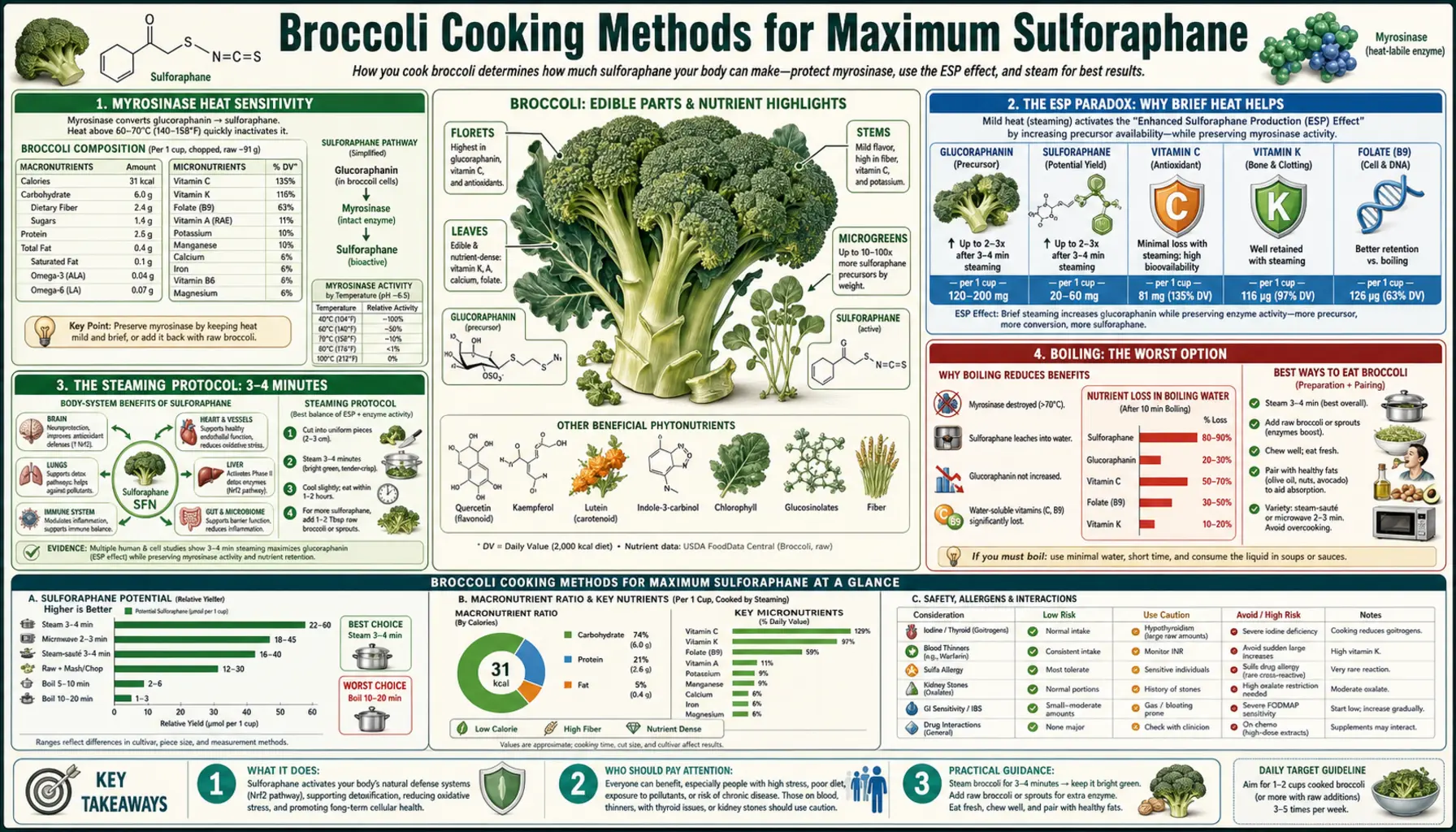
Cooking method is arguably as important as broccoli itself when the goal is sulforaphane delivery. The myrosinase enzyme that catalyzes glucoraphanin into sulforaphane in your chewed broccoli is heat-labile and is irreversibly denatured above roughly 70°C (158°F). Boiling broccoli for 10 minutes destroys nearly all myrosinase and also leaches 80% of the water-soluble glucoraphanin into the cooking water, which most people discard. Microwaving on high power for several minutes does the same. The optimal protocol is a brief steam (3-4 minutes) that softens the broccoli enough to release the precursor from cellular compartmentation, partially denatures the competing ESP enzyme that diverts the reaction toward inactive products, but leaves enough active myrosinase intact to produce a high yield of sulforaphane when chewed and digested. A second-best is the chop-and-wait technique that exploits room-temperature myrosinase to pre-form sulforaphane before cooking, allowing for longer cooking without losing the bioactive product. And if you have already overcooked broccoli, sprinkling on a few hundred milligrams of mustard seed powder — which contains its own heat-stable myrosinase — can rescue much of the lost sulforaphane potential.
Table of Contents
- Myrosinase Heat Sensitivity
- The ESP Paradox: Why Brief Heat Helps
- The Steaming Protocol: 3-4 Minutes
- Boiling: The Worst Option
- Microwave: Surprisingly Bad
- Stir-Fry and Roasting
- The "Chop and Wait 40 Minutes" Hack
- The Mustard Seed Powder Rescue
- Raw vs Cooked: The Right Comparison
- Frozen Broccoli: The Industrial Problem
- A Complete Kitchen Protocol
- Key Research Papers
- Connections
- Featured Videos
Myrosinase Heat Sensitivity
Myrosinase (beta-thioglucosidase, EC 3.2.1.147) is the single enzyme that converts the stable storage glucosinolate glucoraphanin into the bioactive isothiocyanate sulforaphane. Without active myrosinase — either in the broccoli itself or in the gut microbiome or supplied externally — ingested glucoraphanin will be partially absorbed and excreted unchanged, with only a small fraction converted to sulforaphane.
The thermal denaturation profile of broccoli myrosinase has been mapped in detail. The enzyme retains substantial activity up to about 60°C (140°F), begins to lose activity noticeably between 60-70°C, and is largely inactivated above 70°C (158°F). Sustained exposure to boiling water (100°C) for more than 1-2 minutes essentially eliminates myrosinase activity. The denaturation is irreversible: once myrosinase loses its tertiary structure, cooling back to room temperature does not restore activity.
This is the central practical issue. Most home cooking of broccoli — boiling 8-10 minutes until "soft," microwaving on high power 3-5 minutes, or stir-frying in a hot pan for several minutes — pushes interior temperatures well above 70°C for long enough to destroy most or all myrosinase activity. The result: the cooked broccoli still contains its full original glucoraphanin content, but no enzyme is left to convert it. When you eat that broccoli, the glucoraphanin reaches your colon largely intact, where it depends on gut microbial myrosinase of variable individual activity.
Some individuals have substantial bacterial myrosinase activity in their gut microbiome and convert a meaningful fraction of glucoraphanin to sulforaphane even from overcooked broccoli; others have minimal bacterial activity and effectively get no sulforaphane from cooked broccoli. The variation is large — one Cramer/Jeffery study found a 5-fold range across healthy adults. This is one of the reasons preserving plant myrosinase activity through cooking method is so important: you cannot rely on your gut bacteria.
The ESP Paradox: Why Brief Heat Helps
If myrosinase is heat-labile, why is raw broccoli not the optimal preparation? The answer is the second enzyme in the system: ESP (epithiospecifier protein). ESP is a metal-cofactored protein that, when present and active during the myrosinase reaction, redirects the reaction toward an alternative product — a much less biologically active epithionitrile or simple nitrile, rather than the desired isothiocyanate (sulforaphane).
In raw broccoli at room temperature and neutral pH, ESP can divert up to 50-80% of the glucoraphanin's rearrangement away from sulforaphane and toward the epithionitrile. The exact fraction depends on the cultivar, freshness, and pH. This is the reason raw broccoli is not the maximum sulforaphane preparation, despite raw broccoli having intact myrosinase activity.
The good news: ESP denatures at lower temperatures than myrosinase — ESP is largely inactivated by exposure to 60°C, while myrosinase survives that exposure. This creates a thermal "sweet spot" where you can deactivate ESP (eliminating the nitrile diversion) while preserving myrosinase (enabling sulforaphane formation). The Matusheski 2004 paper (Phytochemistry) demonstrated that mild heat treatment in this temperature range can actually increase sulforaphane yield from broccoli relative to completely raw broccoli — the ESP-inactivation benefit outweighs the modest myrosinase loss.
This sweet spot corresponds practically to a brief light steam of 3-4 minutes. The interior temperature of the broccoli florets reaches approximately 60-70°C during this timeframe, denaturing ESP while leaving most myrosinase active. The result is the maximum sulforaphane yield achievable with mature broccoli — substantially higher than either raw or fully cooked.
The Steaming Protocol: 3-4 Minutes
The optimal preparation, supported by the Wang 2012 and Conaway 2000 studies on broccoli thermal processing, is a brief steam:
- Wash and trim the broccoli into bite-size florets (1-2 inch pieces). Use stems too — the stem contains as much glucoraphanin as the florets.
- Bring 1-2 inches of water to a vigorous boil in a saucepan with a steamer basket above the water line. The broccoli should sit in the steam, not the water.
- Add the broccoli, cover, and steam for exactly 3-4 minutes. The broccoli should be bright green and crisp-tender — slight resistance when pierced with a fork, but no longer raw.
- Immediately remove from heat and serve. Do not over-steam waiting for "softer" texture; the texture you should aim for is barely-tender.
- Chew thoroughly before swallowing. This is critical — the myrosinase reaction requires the chewing to bring myrosinase and glucoraphanin into contact within the broccoli cells.
The "exactly 3-4 minutes" is not a soft suggestion. Five minutes of steaming begins to push interior temperatures into the myrosinase-denaturation range. Six to seven minutes typically destroys most myrosinase activity. Many home cooks habitually steam broccoli for 6-10 minutes; this overshoots the sweet spot by a wide margin.
If you prefer a softer texture, the alternative is to steam for the optimal 3-4 minutes for sulforaphane preservation and then chew very thoroughly — the crisp-tender texture is structural to the chemistry, not just an aesthetic preference. You can also use the chop-and-wait technique (below) to pre-form sulforaphane before cooking, after which longer cooking will not destroy the already-formed product.
Boiling: The Worst Option
Boiling broccoli is the worst common cooking method for sulforaphane preservation, for two independent reasons that combine to nearly eliminate the bioactive yield:
- Leaching — glucoraphanin is water-soluble. When broccoli is submerged in boiling water, the glucoraphanin diffuses out of the broccoli into the water. The Song and Thornalley 2007 paper documented that boiling broccoli for 10 minutes results in loss of approximately 50-80% of the original glucoraphanin content into the cooking water. Most home cooks discard the water.
- Myrosinase destruction — the broccoli interior reaches close to 100°C within 1-2 minutes of vigorous boiling, completely denaturing the myrosinase. So the small remaining fraction of glucoraphanin in the broccoli has no enzyme available to convert it to sulforaphane.
The net result: boiled broccoli typically provides 5-10% of the sulforaphane yield achievable with optimally steamed broccoli of the same starting weight. If you must boil broccoli (for example, as part of a soup), at least retain the cooking water to capture the leached glucoraphanin, and add a source of active myrosinase (mustard seed powder, see below) to the bowl before eating.
The exception that might save boiled broccoli: if you pre-chop the broccoli, wait 40 minutes for myrosinase to convert glucoraphanin to sulforaphane in situ before boiling, then briefly cook, the already-formed sulforaphane will be largely preserved during the cooking. This is the rationale for the chop-and-wait technique discussed below.
Microwave: Surprisingly Bad
Microwaving has the convenience advantage but is unfortunately also a sulforaphane-destroying method. The microwave heats by exciting water molecules throughout the broccoli simultaneously, producing rapid temperature rise above the myrosinase denaturation threshold within 1-2 minutes at typical home microwave powers. Long microwaving (3-5 minutes at high power) destroys most myrosinase activity.
One mitigation: very brief, low-power microwaving (1-2 minutes at 50% power, total around 30 seconds at full power equivalent) can partially preserve myrosinase while heating enough to wilt the broccoli. The Vermeulen 2008 paper compared cooked vs raw broccoli bioavailability and found this brief microwave preparation produced intermediate but still suboptimal sulforaphane yield. The brief-light-steam method remains superior in head-to-head comparisons.
The other mitigation, again: chop-and-wait 40 minutes before microwaving, then microwave as needed for desired texture — the already-formed sulforaphane is much more heat-stable than the myrosinase enzyme.
Stir-Fry and Roasting
Stir-frying broccoli in a hot wok for several minutes at oil-frying temperatures (160-200°C oil temperature) destroys most myrosinase activity rapidly. The texture appeal of charred broccoli edges is real but comes at the cost of bioactive yield. Mitigation: pre-chop and wait 40 minutes before stir-frying, allowing room-temperature sulforaphane formation. The formed sulforaphane has substantially better thermal stability than the precursor myrosinase enzyme and will largely survive the brief stir-fry.
Roasting broccoli at 200°C (400°F) oven temperature for 20-25 minutes produces appealing caramelized texture but again destroys most original-broccoli myrosinase activity. The mitigation strategies are the same: pre-chop and wait, or sprinkle on mustard seed powder after roasting to supply external myrosinase activity.
The takeaway: any high-heat preparation will destroy myrosinase. If you are committed to roasting or stir-frying for texture, you can largely preserve sulforaphane yield through either pre-cooking room-temperature enzyme work (chop and wait) or post-cooking enzyme supplementation (mustard seed powder).
The "Chop and Wait 40 Minutes" Hack
The chop-and-wait technique exploits the fact that the myrosinase reaction proceeds steadily at room temperature once the broccoli cells are damaged. By chopping broccoli into small pieces (or, ideally, briefly pulsing in a food processor), then letting the chopped broccoli sit at room temperature for 30-40 minutes before cooking, you allow the room-temperature myrosinase activity to convert most of the glucoraphanin to sulforaphane before any heat is applied.
The advantages:
- The already-formed sulforaphane is much more heat-stable than the myrosinase enzyme. The Wang 2012 study found that sulforaphane is largely preserved through subsequent cooking up to 100°C as long as the cooking duration is short.
- This eliminates dependence on the cooking method for myrosinase preservation — you can then boil, microwave, stir-fry, or roast as you like without losing as much bioactive yield.
- It also bypasses the ESP problem partly, because at room temperature ESP can divert toward nitriles but the fraction lost is less than at hot-pan temperatures.
Practical protocol: chop broccoli into small pieces (the smaller the pieces, the more cellular damage and the faster the reaction), spread on a cutting board or plate, let sit at room temperature for 40 minutes uncovered, then cook as desired. The 40-minute wait time is supported by the Wang 2012 paper, which mapped the kinetics of glucoraphanin conversion at room temperature and found near-complete conversion by 40 minutes.
This technique is particularly valuable for recipes where you want fully cooked broccoli (soups, casseroles, stir-fries) but still want maximum sulforaphane yield. It is the "cheat code" for sulforaphane delivery in any high-heat preparation.
The Mustard Seed Powder Rescue
Mustard seeds (yellow or brown) are another Brassicaceae family member and contain their own active myrosinase enzyme. Importantly, mustard seed myrosinase has different thermal stability characteristics than broccoli myrosinase — it survives short-term heating better — and can be added externally to already-cooked broccoli to provide enzymatic conversion of the broccoli's glucoraphanin to sulforaphane.
The Ghawi 2013 paper (Food Chemistry) is the canonical study on this approach. Their experiment cooked broccoli to the point of complete myrosinase destruction (extended boiling), then added either ground mustard seed powder, ground brown mustard seed, or no enzyme source as a control. The mustard-seed-treated cooked broccoli produced sulforaphane yields approaching the best fresh-broccoli levels — the external enzyme effectively rescued the lost in-broccoli activity.
Practical implementation: keep a small jar of ground mustard seed powder or brown mustard seed powder in the spice rack. After cooking broccoli (boiled, microwaved, roasted, or steamed too long), sprinkle 1/4 to 1/2 teaspoon of mustard seed powder on the broccoli at serving time. Stir to distribute. The reaction begins immediately in the warm moist broccoli and continues in your mouth and stomach. Yellow mustard (the prepared condiment) also works but provides less concentrated myrosinase activity.
This is the most practical rescue for anyone who has overcooked broccoli, who eats at restaurants where they have no control over cooking method, or who simply prefers the texture of fully cooked broccoli. The mustard flavor is mild at the suggested doses and complements most broccoli preparations. Wasabi, horseradish, and arugula are alternative external myrosinase sources — all Brassicaceae family members with similar enzyme activity.
Raw vs Cooked: The Right Comparison
There is a popular nutrition meme that "raw broccoli is more nutritious than cooked broccoli." For sulforaphane specifically, this is more nuanced than the meme suggests:
- Raw broccoli — has intact myrosinase, but also has active ESP that diverts the reaction toward inactive nitriles. Sulforaphane yield per gram is moderate, around 50% of what is achievable in fully optimal preparation.
- Briefly steamed (3-4 min) broccoli — the optimum. ESP is denatured, myrosinase is preserved, full sulforaphane conversion can occur. Yield around 100% of maximum.
- Boiled, microwaved-long, stir-fried, or roasted broccoli — myrosinase is destroyed. Sulforaphane yield drops to 5-15% of maximum, depending on individual gut microbiome bacterial myrosinase.
- Any of the high-heat preparations with the chop-and-wait technique — restores yield to about 70-90% of maximum.
- Any of the high-heat preparations with mustard seed powder added — restores yield to about 80-95% of maximum.
The right comparison, then, is not raw vs cooked. The right comparison is briefly steamed vs overcooked. Raw is intermediate — better than overcooked, worse than briefly steamed.
Other nutritional considerations — vitamin C, folate, fiber, magnesium — have their own thermal-stability profiles, mostly degraded by long cooking but largely preserved by brief steaming. So briefly steamed broccoli optimizes both the sulforaphane chemistry and the broader nutrient retention.
Frozen Broccoli: The Industrial Problem
Frozen broccoli is convenient and reasonably affordable, but the commercial freezing process is largely incompatible with sulforaphane delivery. The standard industrial protocol is:
- Wash and chop broccoli
- Blanch in boiling water for 2-3 minutes (specifically to inactivate enzymes, including myrosinase)
- Cool and freeze
The blanching step is intentional — the industry blanches vegetables before freezing to deactivate enzymes that would otherwise cause color, texture, and flavor degradation during long-term frozen storage. Unfortunately, the enzyme they most want to deactivate is the very myrosinase that we want to preserve for sulforaphane production. The Saha 2012 paper (Molecular Nutrition and Food Research) measured isothiocyanate yield from commercial frozen broccoli vs fresh broccoli and found dramatically reduced sulforaphane production from frozen, consistent with the blanching protocol.
Mitigation strategies:
- Cook frozen broccoli briefly to desired texture, then add 1/4-1/2 teaspoon mustard seed powder at serving
- Or: thaw the frozen broccoli, chop into small pieces, let sit at room temperature for 40 minutes to allow gut-bacterial-and-residual-myrosinase reactions — though this is less reliable than mustard seed
- Best alternative: home-freeze your own broccoli without blanching. Wash, chop, and freeze raw on a tray. Cook briefly straight from frozen. This preserves substantial myrosinase activity
Or: get your sulforaphane from sprouts instead (see Sprouts vs Mature) — home-grown 3-day sprouts have not been industrially processed and retain full myrosinase activity.
A Complete Kitchen Protocol
Putting it all together as a single kitchen routine for maximum sulforaphane from a mature broccoli head:
- Buy fresh broccoli, ideally locally grown and recently harvested. Glucoraphanin content is highest in freshly harvested broccoli and declines modestly with storage time. Tight, dark green florets are a sign of freshness.
- Store properly — refrigerated, loosely wrapped in a perforated bag, used within 5-7 days of purchase. Wilted or yellowing broccoli has lost much of its glucoraphanin.
- Wash and chop — cut into bite-size pieces, including the stem (peel the tough outer layer if desired). The chopping itself initiates myrosinase release within the cellular debris.
- Two preparation paths:
- Path A (briefly steamed): steam 3-4 minutes, serve immediately, chew thoroughly
- Path B (chop-and-wait, then cook as desired): chop small, let sit at room temperature 40 minutes, then cook by any method to desired texture
- Optional enhancement: sprinkle 1/4 to 1/2 teaspoon ground mustard seed powder on the broccoli at serving. Especially valuable if you took shortcuts in steps 1-4 or if you are eating restaurant broccoli of unknown preparation.
- Eat regularly — the sulforaphane induction effect on phase II enzymes persists for 24-48 hours per serving. Daily or every-other-day consumption maintains continuously elevated cellular detoxification capacity.
For convenience-oriented patients who will not do all of this routinely, the simpler recommendation is: grow broccoli sprouts in a mason jar (see Sprouts vs Mature), and eat one ounce per day on salads or sandwiches. The sprouts deliver the equivalent of about one pound of optimally prepared mature broccoli with no cooking required — and the home-grown sprouts retain full myrosinase activity by definition.
Key Research Papers
- Wang GC, Farnham M, Jeffery EH (2012). Impact of thermal processing on sulforaphane yield from broccoli (Brassica oleracea L. ssp. italica). J Agric Food Chem. — PubMed
- Ghawi SK et al. (2013). The potential to intensify sulforaphane formation in cooked broccoli using mustard seeds. Food Chem. — PubMed
- Matusheski NV, Juvik JA, Jeffery EH (2004). Heating decreases epithiospecifier protein activity and increases sulforaphane formation in broccoli. Phytochemistry. — PubMed
- Conaway CC et al. (2000). Disposition of glucosinolates and sulforaphane in humans after ingestion of steamed and fresh broccoli. Nutr Cancer. — PubMed
- Vermeulen M et al. (2008). Bioavailability and kinetics of sulforaphane in humans after consumption of cooked versus raw broccoli. J Agric Food Chem. — PubMed
- Song L, Thornalley PJ (2007). Effect of storage, processing and cooking on glucosinolate content of Brassica vegetables. Food Chem Toxicol. — PubMed
- Saha S et al. (2012). Isothiocyanate concentrations and interconversion of sulforaphane to erucin in human subjects after consumption of commercial frozen broccoli compared to fresh broccoli. Mol Nutr Food Res. — PubMed
- Dosz EB, Jeffery EH (2013). Modifying the processing and handling of frozen broccoli for increased sulforaphane formation. J Food Sci. — PubMed
- Howard LA et al. (1997). Retention of phytochemicals in fresh and processed broccoli. J Food Sci. — PubMed
- Rungapamestry V et al. (2007). Effect of cooking brassica vegetables on the subsequent hydrolysis and metabolic fate of glucosinolates. Proc Nutr Soc. — PubMed
- Lai RH et al. (2010). Glucoraphanin hydrolysis by microbiota in the rat cecum results in sulforaphane absorption. Food Funct. — PubMed
- Cramer JM, Jeffery EH (2011). Sulforaphane absorption and excretion following ingestion of a semi-purified broccoli powder rich in glucoraphanin and broccoli sprouts in healthy men. Nutr Cancer. — PubMed
PubMed Topic Searches
- PubMed: Myrosinase thermal denaturation
- PubMed: Broccoli cooking and sulforaphane
- PubMed: Mustard seed myrosinase
- PubMed: ESP and sulforaphane
- PubMed: Glucoraphanin bioavailability
Connections
- All Food
- Broccoli (Main Page)
- Broccoli Benefits Hub
- Sulforaphane and Detox
- Cancer Chemoprevention
- Sprouts vs Mature
- Kale
- Spinach
- Beets
- All Herbs
- Remedies
- All Vitamins
- All Minerals
- Gastroenterology