Broccoli: History and Origins
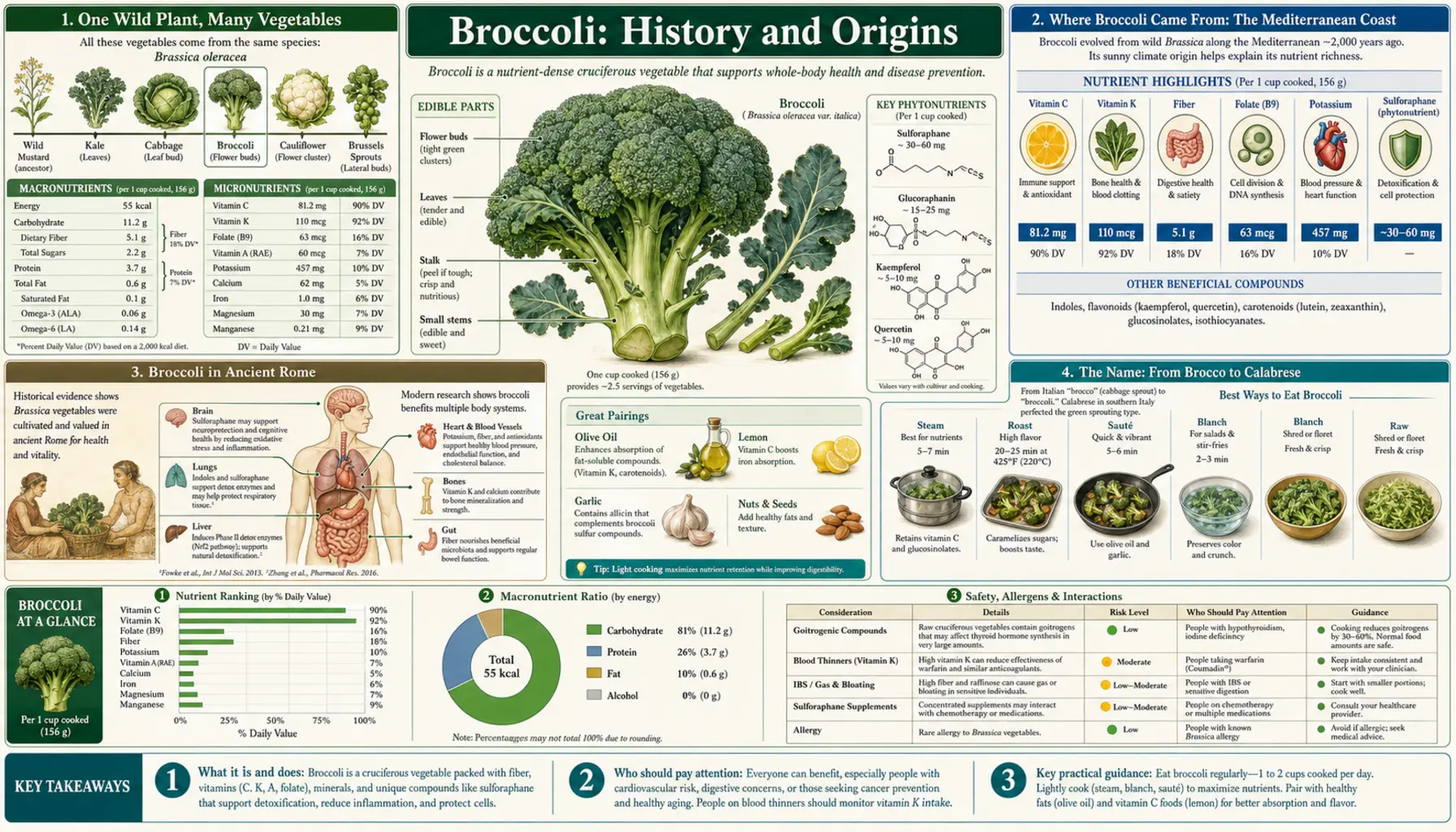
Broccoli did not exist in the wild. It is not a plant nature handed us ready-made but one that people slowly built — over many human lifetimes — out of a scrubby, bitter sea-cliff weed called wild cabbage. The same wild ancestor was coaxed, by patient selection, into cabbage, cauliflower, kale, kohlrabi, and Brussels sprouts; broccoli is the version where growers favoured the fat, tightly packed flower heads. This article traces what the historical and botanical record actually supports: where that wild cabbage grew, when and where its descendants were first bred into something broccoli-like, the herb's place on Roman and Italian tables, the journey to France and England, and the much later arrival in America. Where the record is firm we say so; where a story is tradition, folklore, or still argued over by scholars, we name it as such.
Table of Contents
- One Wild Plant, Many Vegetables
- Where Broccoli Came From: The Mediterranean Coast
- Broccoli in Ancient Rome
- The Name: From Brocco to Calabrese
- Catherine de' Medici and the Journey to France
- "Italian Asparagus" in England
- Crossing the Atlantic: Jefferson and the D'Arrigo Brothers
- A Regional Crop Goes Global
- Research Papers and References
- Connections
- Featured Videos
One Wild Plant, Many Vegetables
One of the most surprising facts about broccoli is that it is the same species as cabbage. Botanically, broccoli is Brassica oleracea — and so are cauliflower, kale, collard greens, kohlrabi, Brussels sprouts, and ordinary head cabbage. They look nothing alike on the plate, yet they are all cultivated forms of a single wild plant, shaped by generations of farmers who each favoured a different part: a swollen leaf bud became the cabbage, a thick edible stem became kohlrabi, a cluster of side buds became Brussels sprouts, and a dense mass of immature flower buds became broccoli and, by a closely related path, cauliflower. Broccoli is usually written as Brassica oleracea var. italica — the "italica" pointing straight at the Italian peninsula where its modern form took shape.
This matters for a history page because it tells us what kind of origin story broccoli has. There is no inventor and no single moment of creation. Broccoli is the product of artificial selection — the same slow process Charles Darwin pointed to in On the Origin of Species, where he used the many forms bred from wild cabbage as a textbook example of how much variety human selection can draw out of one plant. To ask "who invented broccoli?" is a little like asking who invented the bulldog: the honest answer is that many people did, gradually, by choosing which plants to save seed from, year after year.
The wider Brassica family also includes mustard, turnip, and rapeseed, which is why these vegetables share a faintly peppery, sulfurous character — the same sulfur compounds that give broccoli both its distinctive smell and much of its modern reputation as a healthful food.
Where Broccoli Came From: The Mediterranean Coast
The wild ancestor of broccoli, wild cabbage (Brassica oleracea in its uncultivated form), is a hardy, salt-tolerant herb that grows on limestone sea cliffs around the Mediterranean and along the Atlantic coasts of western Europe. A plant of stony, wind-blown, sun-baked ground, it is bitter and unpromising in the wild — not an obvious candidate for the dinner table — which makes the long human effort to improve it all the more striking.
Pinning down exactly where that improvement began has proved genuinely difficult, and here the honest position is that scholarship has recently shifted. The older and still widely repeated account places the domestication of Brassica oleracea on the northern and western coasts of the Mediterranean. A 2021 genomic study by Makenzie Mabry and colleagues in the journal Molecular Biology and Evolution, however, compared many wild and cultivated brassicas and concluded that the closest living wild relative of cultivated B. oleracea is a species called Brassica cretica, pointing instead toward an eastern Mediterranean origin for the crop as a whole. The question of the precise birthplace is, in other words, still being actively worked out; what is not in doubt is that the cradle of all these vegetables lies somewhere along the Mediterranean rim.
Broccoli specifically — as opposed to cabbage or kale — is generally traced to the Italian peninsula. According to Brassica researchers, broccoli resulted from the breeding of landrace (traditional, locally adapted) Brassica crops in the northern Mediterranean beginning around the sixth century BCE, and was most likely refined by selection in the southern Italian peninsula or in Sicily. That Italian connection runs through the whole of broccoli's later story, from its name to the immigrants who eventually carried it across the Atlantic.
Broccoli in Ancient Rome
By the time of the Roman Empire, cabbage-family vegetables were thoroughly woven into Mediterranean cooking, and broccoli-like forms appear in the historical picture of Roman food. Italian food historians note that the famous Roman naturalist Pliny the Elder (23–79 CE), in his encyclopaedic Natural History, described how such vegetables were grown, harvested, and cooked, and that recipes attributed to the Roman gourmet Apicius call for boiling these greens with seasonings such as onion, wine, and oil. The Romans, in short, clearly knew and ate brassicas closely related to — and quite possibly including — what we would now call broccoli.
A note of caution is warranted, because ancient plant names are slippery. The Latin and Greek words the Romans used covered a range of cabbages and sprouting greens, and it is not always possible to say with certainty that a given ancient passage describes broccoli in the specific sense we mean today rather than a cousin like cabbage or sprouting kale. Reputable accounts therefore speak of Roman references that "may" be broccoli. What can be said firmly is that the dense-headed, flower-budding vegetable we recognise as broccoli is an Italian achievement of the broader Roman and post-Roman era, prized on the Italian peninsula long before it travelled elsewhere.
Some popular histories also credit the Etruscans — the people of pre-Roman central Italy — with an early hand in domesticating these cabbages. This is plausible and often repeated, but it is best treated as a traditional claim rather than a firmly documented fact, and this page presents it that way.
The Name: From Brocco to Calabrese
The word broccoli is unmistakably Italian. It is the plural of the Italian broccolo, meaning the flowering top or sprout of a cabbage, which in turn descends from brocco (a shoot or sprout) and ultimately from the Latin brachium, "arm" or "branch." The name is a small piece of botany in itself: it describes exactly the part of the plant we eat — the branching, arm-like cluster of flower stalks topped with tight green buds.
The most common broccoli sold today is Calabrese broccoli, the large single-headed green type, named after Calabria in the south of Italy where this form was traditionally grown. The name preserves, in everyday grocery-store language, the vegetable's deep roots in southern Italy. Other forms carry their own descriptive names: sprouting broccoli, which produces many small loose florets on slender stalks rather than one big head, and the newer broccolini (sometimes sold as "baby broccoli"), a modern hybrid between broccoli and Chinese kale (gai lan) developed in the twentieth century. These names are a reminder that "broccoli" is not one fixed thing but a family of closely related cultivated forms.
Catherine de' Medici and the Journey to France
For centuries broccoli remained largely an Italian specialty. The most often-told account of how it began to travel centres on Catherine de' Medici (Caterina de' Medici), the Florentine noblewoman who in 1533 married the future King Henry II of France. By tradition she brought Italian cooks and Italian vegetables — broccoli among them — to the French court, helping introduce the vegetable to France.
This is a beloved story, and the date of the marriage is firm, but it deserves an honest caveat. Food historians have grown sceptical of the broader legend that Catherine single-handedly revolutionised French cuisine and introduced a long list of foods — broccoli, peas, spinach, and more — to France. The reality was almost certainly more gradual, with many Italian cooks, gardeners, and traded seeds carrying these vegetables north over a longer period. So while it is fair to say that broccoli's spread beyond Italy is associated with this sixteenth-century moment of Italian influence at the French court, anyone who states flatly that "Catherine de' Medici introduced broccoli to France" is repeating a tidy legend in place of a messier truth. We present it here as the traditional account, not as established fact.
"Italian Asparagus" in England
Broccoli reached England somewhat later, and the English reaction tells us how exotic it once seemed. Eighteenth-century English gardeners regarded it as a foreign novelty and called it "Italian asparagus," a nickname recorded in Philip Miller's Gardeners Dictionary, the great English horticultural reference of the day, in its 1724 edition. The label captures both broccoli's Italian pedigree and the way the English first understood it: a tender, sprouting spring vegetable eaten rather as one might eat asparagus.
The early reception in both France and England was not always warm. One frequently cited reason is simple: the sulfurous smell broccoli and its cabbage relatives give off while cooking, which not everyone found appealing. Acceptance came slowly, and broccoli would remain a minor, somewhat aristocratic garden vegetable in northern Europe for a long time before it became the everyday staple it is now.
Crossing the Atlantic: Jefferson and the D'Arrigo Brothers
Broccoli's arrival in North America came in two distinct waves: an early, curious, small-scale introduction, and a much later commercial breakthrough that put it on the national table.
The early chapter belongs to Thomas Jefferson, the avid gardener and future president, who obtained seed from Italy and, according to the records kept at his Monticello estate, sowed broccoli there in 1767 — experimenting with it alongside many other vegetables in his famous garden. Jefferson's broccoli was a gentleman-naturalist's experiment, however, not the start of a popular crop; for well over a century afterwards broccoli stayed a rarity in America.
The real turning point came in the 1920s, and it was driven by Italian immigration. As large numbers of southern Italians settled in the United States, they brought their cooking — and their appetite for broccoli — with them. The decisive commercial step is well documented: the D'Arrigo brothers, Stefano and Andrea, immigrants from Messina in Sicily, made trial plantings of broccoli near San Jose, California, in 1922 and shipped the first crates east by rail to the Italian community of Boston. Their produce was marketed under the brand name "Andy Boy," named for Stefano's young son, and promoted — unusually for the time — on the radio. From those tentative crates, broccoli grew within a few decades into one of America's most widely eaten vegetables, and the company they founded remains a major California broccoli grower today.
A Regional Crop Goes Global
The arc of broccoli's history is the story of a bitter coastal weed transformed, over roughly two and a half thousand years, into a global vegetable. From its Mediterranean cradle and its Italian refinement, broccoli has spread to almost every temperate growing region on earth, helped along in recent decades by a steady stream of scientific findings about the health properties of its sulfur compounds.
Modern production has shifted far from the Italian peninsula where the vegetable took shape. The United Nations Food and Agriculture Organization reports broccoli together with cauliflower as a single combined category, "cauliflowers and broccoli," so the two cannot be separated cleanly in the official figures — a caveat worth keeping in mind whenever you see a "broccoli production" statistic. For that combined category, world output is on the order of 27 million tonnes a year, and the leading producers by a wide margin are now China and India, which together account for the great majority of global supply. A vegetable born on the rocky coasts of the Mediterranean and perfected in southern Italy is today grown most of all on the other side of the world.
Plant breeders continue the work that began in antiquity. A 2020 genomic study by Zachary Stansell and Thomas Björkman in Horticulture Research traced the path "from landrace to modern hybrid broccoli," documenting how the loose, variable sprouting types of earlier centuries were converted into the uniform, dense-headed hybrids that fill modern supermarket shelves — and, in some programmes, into new cultivars bred for higher levels of beneficial compounds. The nutritional and medicinal science behind that effort is covered in the companion Broccoli Benefits articles and on the main Broccoli page; this history is concerned only with how the vegetable came to exist and to spread in the first place.
Research Papers and References
The list below combines peer-reviewed studies on the domestication of Brassica oleracea with reputable food-history and authoritative reference sources, plus curated PubMed topic-search links into the botanical and domestication literature. Historical primary texts (the Natural History of Pliny the Elder and the recipes attributed to Apicius) are named in the article as historical sources rather than as modern citations. Author names, titles, and journals are given as plain text; only the stable DOI, PMID, or archive link is hyperlinked, and each opens in a new tab.
- Mabry ME, Turner-Hissong SD, Gallagher EY, McAlvay AC, An H, Edger PP, et al. The Evolutionary History of Wild, Domesticated, and Feral Brassica oleracea (Brassicaceae). Molecular Biology and Evolution. 2021;38(10):4419-4434. — doi:10.1093/molbev/msab183 · PMID: 34157722
- Stansell Z, Björkman T. From landrace to modern hybrid broccoli: the genomic and morphological domestication syndrome within a diverse B. oleracea collection. Horticulture Research. 2020;7:159. — doi:10.1038/s41438-020-00375-0
- Broccoli. Wikipedia — cultivar classification, breeding origin (sixth century BCE, northern Mediterranean), Calabrese naming, and FAOSTAT production figures. — en.wikipedia.org/wiki/Broccoli
- The history of broccoli: from the Etruscans till today. La Cucina Italiana — Pliny the Elder, Apicius, Catherine de' Medici (1533), and the "Italian asparagus" nickname in Miller's Gardeners Dictionary (1724). — lacucinaitaliana.com
- Thomas Jefferson, the Scientist and Gardener. The Thomas Jefferson Foundation at Monticello — Jefferson's cultivation of broccoli and other imported vegetables. — monticello.org
- Brassica oleracea domestication and evolutionary history — PubMed: Brassica oleracea domestication
- Broccoli breeding, landraces, and cultivar history — PubMed: broccoli breeding and landrace history
External Authoritative Resources
- Wikipedia — Broccoli
- Monticello — Jefferson the Scientist and Gardener
- FAOSTAT — Crops and livestock products (UN FAO)
Connections
- All Food
- Broccoli
- Broccoli Benefits
- Kale
- Cabbage — the same wild ancestor, bred for a tight leafy head instead of flower buds.
- Spinach
- Beets