Coffee and Parkinson's Disease: Caffeine, Adenosine, and Neuroprotection
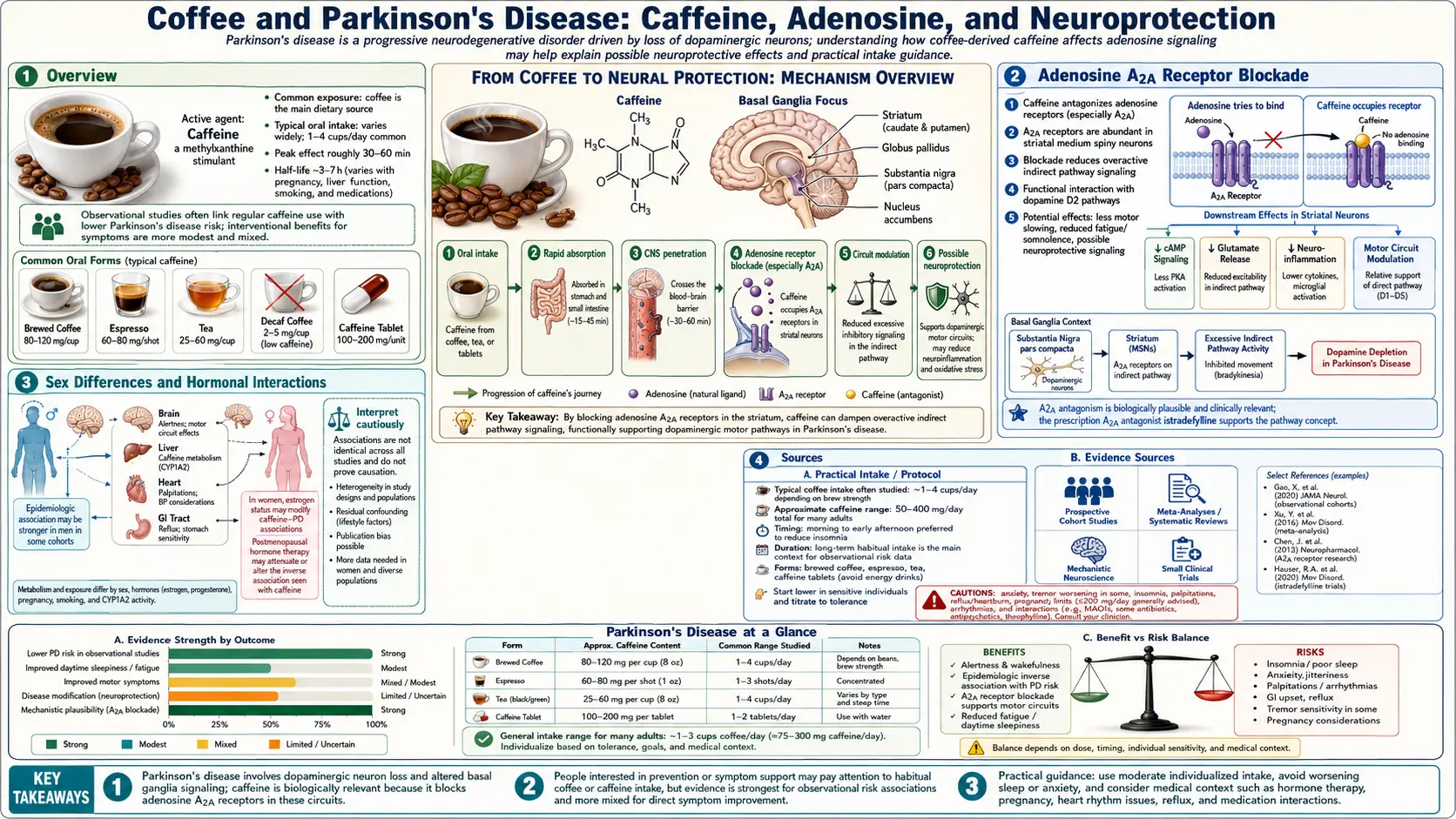
Table of Contents
Overview
Parkinson's disease is the second most common neurodegenerative disorder after Alzheimer's, affecting roughly one percent of adults over 60. Of all dietary and lifestyle factors ever examined in relation to Parkinson's risk, coffee and caffeine stand out as having among the most consistent inverse associations. Meta-analyses of prospective cohort studies repeatedly show that regular coffee drinkers have a 25 to 40 percent lower risk of developing Parkinson's disease compared with non-drinkers, with a clear dose-response pattern.
Unlike the type 2 diabetes or liver disease associations—where decaffeinated coffee retains most of the benefit—the Parkinson's protective effect is driven primarily by caffeine itself. This is one of the strongest arguments for caffeine as a bioactive compound with real neurological effects beyond simple stimulation.
Parkinson's Disease Explained
Parkinson's disease is a progressive movement disorder caused by the degeneration of dopamine-producing neurons in the substantia nigra, a region of the midbrain that projects to the basal ganglia. The loss of dopamine signaling produces the characteristic motor symptoms: resting tremor, bradykinesia (slowness of movement), muscle rigidity, and postural instability. Non-motor features such as loss of smell, REM sleep behavior disorder, constipation, and mood changes often precede the motor symptoms by years or decades.
Current pharmacologic treatment is based on dopamine replacement (levodopa) and dopamine agonists, which manage symptoms but do not halt the underlying neurodegeneration. A disease-modifying therapy remains elusive, which is why any natural compound with a strong epidemiological link to reduced risk receives sustained research attention.
The Epidemiological Evidence
The landmark study in this field is Ascherio and colleagues' 2001 analysis of the Health Professionals Follow-up Study and the Nurses' Health Study, published in Annals of Neurology. Men in the top fifth of caffeine intake had less than half the risk of Parkinson's disease of men in the bottom fifth (relative risk 0.42). In men the inverse association was also seen with coffee, with caffeine from non-coffee sources and with tea, but not with decaffeinated coffee. In women the pattern was U-shaped: the lowest risk was at moderate intakes of 1 to 3 cups of coffee a day.
Subsequent prospective cohort studies from Asia, Europe, and North America have largely replicated this finding. A 2020 meta-analysis by Hong and colleagues pooled 13 studies, nine of them in people without Parkinson's: regular caffeine consumers had about a 20 percent lower risk of developing the disease than non-consumers (hazard ratio 0.797). A 2024 population-based study published in Neurology by Zhao and colleagues (the EPIC4PD study, 184,024 people in 6 European countries) found that people with the highest coffee intake had a lower risk than non-drinkers (hazard ratio 0.63). In a nested comparison of 351 people who later developed Parkinson's and 351 matched controls, blood levels of caffeine and of its breakdown products paraxanthine and theophylline, measured years before diagnosis, were each linked to lower risk (odds ratios 0.80, 0.82 and 0.78); adjusting for smoking and alcohol did not substantially change this. The authors concluded that coffee's protective link is attributed to caffeine and its metabolites.
A 2014 dose-response meta-analysis by Qi and Li (13 coffee studies with 901,764 participants) found that the protective association with coffee was not a straight line: it was strongest at about 3 cups a day (relative risk 0.72, adjusted for smoking). For tea and caffeine the pattern was a straight line: risk fell by 26 percent for every extra two cups of tea a day and by 17 percent for every extra 200 mg of caffeine a day. The links with coffee and tea were stronger in men than in women.
Adenosine A2A Receptor Blockade
The proposed primary mechanism is caffeine's action as a non-selective antagonist of adenosine receptors, and particularly the adenosine A2A receptor subtype, which is densely expressed in the striatum—the region of the basal ganglia most affected by dopamine loss in Parkinson's disease. A2A receptors form heteromers with dopamine D2 receptors and modulate dopamine signaling: blocking A2A enhances dopaminergic transmission and reduces the excessive output from the indirect motor pathway that drives Parkinsonian symptoms.
This mechanism is so well-established that selective A2A antagonists have been developed as Parkinson's drugs. Istradefylline, approved by the U.S. Food and Drug Administration (FDA) in 2019, is a selective A2A antagonist used as an add-on therapy to levodopa for patients with motor fluctuations. In a sense, caffeine is a natural dietary analogue of this pharmaceutical—a mild, lifelong A2A antagonist that may protect striatal neurons and reduce Parkinson's risk.
Dopamine Preservation and Additional Mechanisms
Beyond A2A blockade, caffeine and coffee polyphenols appear to protect dopamine neurons through several additional mechanisms:
- Mitochondrial protection: Caffeine and chlorogenic acid reduce oxidative stress and preserve mitochondrial respiratory chain function in dopaminergic neurons, which are especially vulnerable to energetic failure.
- Alpha-synuclein reduction: Preclinical studies suggest caffeine reduces the accumulation of misfolded alpha-synuclein, the pathological hallmark of Parkinson's disease, via autophagy induction.
- Anti-inflammatory effects: Coffee polyphenols dampen neuroinflammation driven by activated microglia, a key contributor to dopaminergic cell death.
- Blood-brain barrier preservation: Caffeine has been shown in animal models to strengthen the blood-brain barrier, reducing entry of peripheral inflammatory mediators into the brain.
Sex Differences and Hormonal Interactions
An interesting wrinkle in the epidemiology is that the protective effect of coffee appears stronger in men than in women, and in women the effect is modified by hormone replacement therapy (HRT). Ascherio and colleagues' 2003 and 2004 analyses found that the inverse association between caffeine and Parkinson's was attenuated or absent in postmenopausal women on hormone replacement therapy, while it was preserved in women not on hormones. In the 2003 Nurses' Health Study analysis (77,713 postmenopausal women), hormone use went with a higher risk among women with high caffeine intake (relative risk 2.44), and hormone users drinking six or more cups of coffee a day had about four times the risk of women who never drank coffee (relative risk 3.92). The 2004 study looked at deaths from Parkinson's disease in the Cancer Prevention Study II: women drinking 4 or more cups a day had a relative risk of 0.47 if they had never used estrogen, and 1.31 if they had. Estrogen appears to interact with the caffeine-adenosine system in ways that complicate the simple dose-response seen in men.
These studies do not show that coffee raises Parkinson's risk for women in general—in women not using hormones the association was protective—but they suggest the size of any benefit may be smaller and more variable in women than in men.
Limitations and Caveats
Most of the evidence for coffee and Parkinson's comes from observational cohort studies, which cannot prove causation. Reverse causation is a concern: early prodromal Parkinson's disease can reduce the enjoyment of coffee and lead to self-selection out of coffee drinking, potentially inflating the apparent protective effect. Well-designed studies attempt to adjust for this by excluding early cases, but the concern has never been fully eliminated.
Randomized trials of caffeine in people already diagnosed with Parkinson's have shown mixed results. A 2017 trial published in Neurology (Café-PD) gave 121 people with Parkinson's either caffeine 200 mg twice a day (60 people) or placebo (61 people) for six to eighteen months. Caffeine did not improve motor symptoms (a difference of -0.48 points on the movement score) or quality of life. Side effects were about as common as on placebo, but caffeine brought a slight increase in dyskinesia (involuntary movements) and slightly worse scores on a memory and thinking test (the Montreal Cognitive Assessment), with a slight improvement in daytime sleepiness over the first 6 months that faded. The authors concluded that the link between caffeine and lower risk is not explained by symptom relief, suggesting that caffeine's benefit lies in prevention rather than treatment. This fits the hypothesis that lifelong A2A blockade protects neurons before they are lost, but cannot rescue dopaminergic neurons that are already dying.
Practical Takeaways
- Moderate long-term coffee consumption (2–4 cups per day) is associated with a lower risk of developing Parkinson's disease, particularly in men.
- The effect is driven primarily by caffeine; decaffeinated coffee shows weaker or no protective association for Parkinson's specifically.
- Coffee is not a treatment for established Parkinson's disease and does not substitute for levodopa or dopamine agonists.
- In the Café-PD trial, people with Parkinson's who took caffeine 200 mg twice a day on top of their usual medicines had a slight increase in dyskinesia and slightly worse cognitive test scores than those on placebo. Caffeine can also interact with some drugs and affect sleep quality.
Sources
- Ascherio A et al. (2001). "Prospective study of caffeine consumption and risk of Parkinson's disease in men and women." Annals of Neurology. PMID: 11456310
- Ascherio A, Chen H, Schwarzschild MA, Zhang SM, Colditz GA, Speizer FE (2003). "Caffeine, postmenopausal estrogen, and risk of Parkinson's disease." Neurology 60(5):790-5. PMID: 12629235
- Ascherio A et al. (2004). "Coffee consumption, gender, and Parkinson's disease mortality in the Cancer Prevention Study II cohort: the modifying effects of estrogen." American Journal of Epidemiology. PMID: 15522854
- Kim IY et al. (2017). "Differences in Parkinson's disease risk with caffeine intake and postmenopausal hormone use." Journal of Parkinson's Disease. PMID: 28984617
- Ren X, Chen JF (2020). "Caffeine and Parkinson's disease: multiple benefits and emerging mechanisms." Frontiers in Neuroscience. PMID: 33390888
- Qi H, Li S (2014). "Dose-response meta-analysis on coffee, tea and caffeine consumption with risk of Parkinson's disease." Geriatrics and Gerontology International 14(2):430-9. PMID: 23879665
- Postuma RB et al. (2017). "Caffeine as symptomatic treatment for Parkinson disease (Café-PD): a randomized trial." Neurology. PMID: 28954882
- Hong CT, Chan L, Bai CH (2020). "The Effect of Caffeine on the Risk and Progression of Parkinson's Disease: A Meta-Analysis." Nutrients 12(6):1860. PMID: 32580456
- Zhao Y et al. (2024). "Association of Coffee Consumption and Prediagnostic Caffeine Metabolites With Incident Parkinson Disease in a Population-Based Cohort." Neurology 102(8):e209201. PMID: 38513162
Connections
- All Food
- Caffeine, Adenosine & Why Coffee Stops Working — interactive animation
- Coffee
- Coffee (Food)
- Parkinson's Disease
- Constipation
- Coffee & Type 2 Diabetes
- Coffee & Liver Disease
- Coffee & Cancer Prevention
- Coffee & Mental Health
- Liver Disease
- Oxidative Stress
- Lead
- Coffee & Cardiovascular Health
- Coffee Health Benefits
- Coffee & Kidney Injury