Beets — Benefits Deep Dive
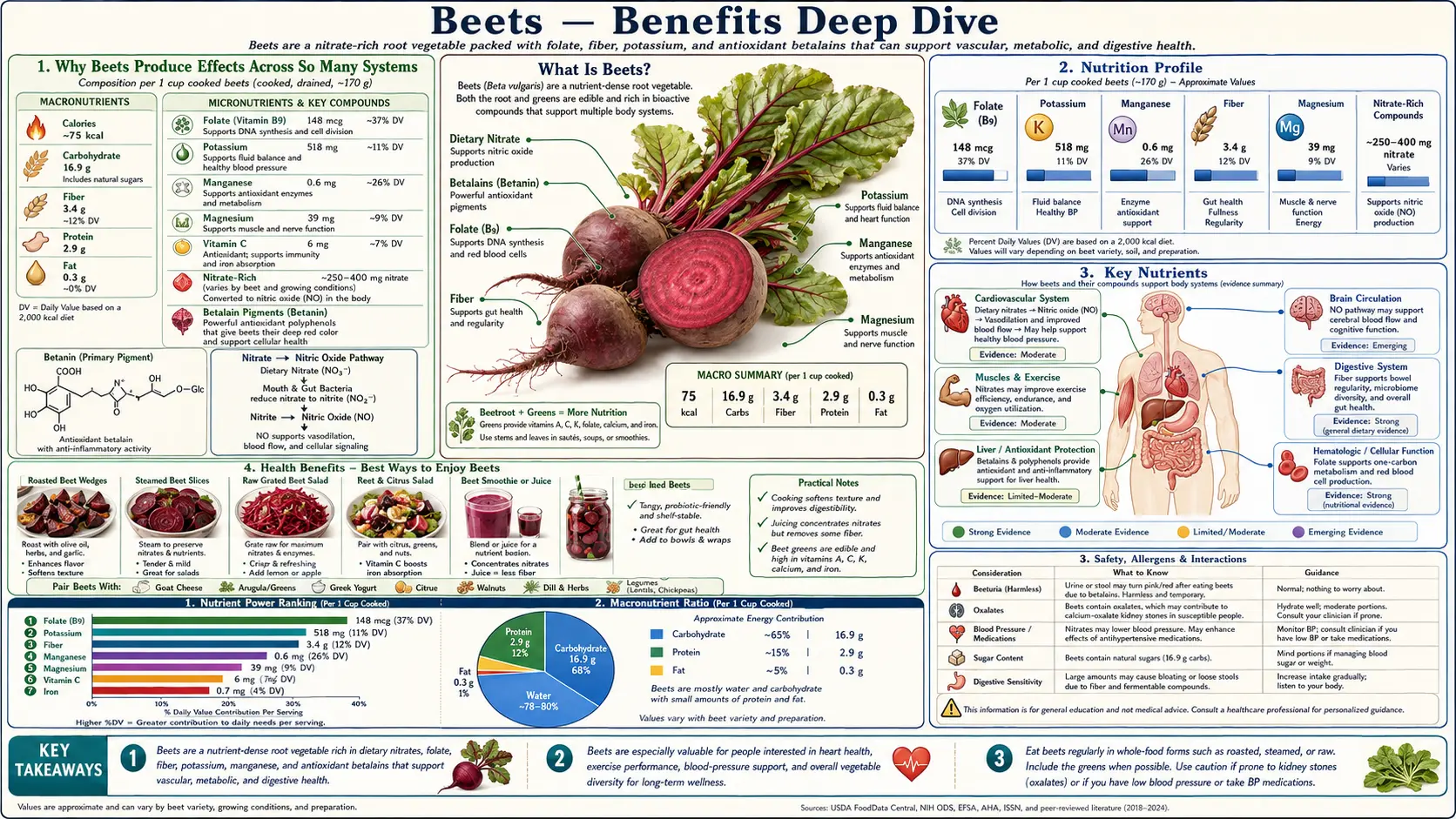
Beets (Beta vulgaris) are among the most concentrated dietary sources of inorganic nitrate (NO3−), which the human enterosalivary circulation converts to bioactive nitric oxide. They also contain a unique class of nitrogen-containing red-violet pigments — the betalains (betacyanins and betaxanthins) — that function as direct radical scavengers and induce phase 2 detoxification enzymes. Beets are uncommon among red-pigmented foods in that they contain no anthocyanins; the distinctive deep magenta color comes entirely from betanin. Four benefit pages below explore the four best-characterized clinical effect domains: cardiovascular and blood-pressure lowering via the nitrate-nitrite-nitric-oxide pathway, hepatic phase 2 detoxification via betalain-driven Nrf2 activation, athletic endurance via mitochondrial efficiency gains from nitrate, and the betalain pigment chemistry that underlies the antioxidant and anti-inflammatory effects.
Deep-Dive Articles
Nitrates & Blood Pressure
The enterosalivary nitrate-nitrite-nitric-oxide pathway: dietary NO3− is concentrated by the salivary glands, reduced to NO2− by oral commensal bacteria, and reduced again to NO in the acidic stomach and hypoxic tissues. Meta-analyses of randomized trials show a roughly 4–5 mmHg reduction in systolic blood pressure within 2–3 hours of a single 500 mL beetroot juice dose, with sustained benefit in hypertensives. Antibacterial mouthwash abolishes the effect — a striking demonstration that the host depends on the oral microbiome to activate the nutrient.
Liver Phase 2 Support
Betalain pigments activate the Nrf2/Keap1 antioxidant response pathway, inducing transcription of phase 2 detoxification enzymes including glutathione S-transferase (GST), NAD(P)H quinone dehydrogenase 1 (NQO1), heme oxygenase-1 (HO-1), and the glutamate-cysteine ligase subunits that drive glutathione synthesis. Beet feeding raises hepatic glutathione and reduces markers of oxidative liver damage in animal models. Betaine (trimethylglycine) provides an additional methyl-donor pathway for homocysteine remethylation and protection against fatty liver.
Athletic Endurance
Beetroot juice has become one of the most-studied legal ergogenic aids in endurance sports. The mechanism is twofold: dietary nitrate lowers the oxygen cost of submaximal exercise (greater work per unit O2 consumed, ~3% mitochondrial efficiency gain via reduced ATP/ADP slip at complex I) and increases blood flow to working muscle through NO-mediated vasodilation. Time-trial performance gains are typically 1–3% in events lasting 5–30 minutes. Effects are blunted in already-trained elite athletes whose baseline NO bioavailability is high.
Pigments & Antioxidants
The betalain pigments are nitrogen-containing alkaloid pigments (not phenolics), built around the chromophore betalamic acid. Betanin (the dominant betacyanin) has measured ORAC values rivaling anthocyanins and donates electrons to neutralize peroxyl, hydroxyl, and peroxynitrite radicals. Betalains also inhibit lipid peroxidation and the NF-kB inflammatory cascade. The pigments are surprisingly bioavailable — intact betanin is detectable in human urine within 2 hours of beet ingestion, and beeturia (red urine) is a benign genetic variant affecting roughly 10–14% of the population.
Table of Contents
- Deep-Dive Articles
- Why Beets Produce Effects Across So Many Systems
- Research Papers: Nitrate & Blood Pressure
- Research Papers: Liver Phase 2 & Detoxification
- Research Papers: Athletic Endurance
- Research Papers: Betalain Pigments & Antioxidants
- Research Papers: Cross-Cutting (Microbiome, Bioavailability, Safety)
- External Authoritative Resources
- Connections
- Featured Videos
Why Beets Produce Effects Across So Many Systems
Most foods produce their health effects through a single dominant phytochemical class. Beets are unusual in that they combine three distinct bioactive systems, each operating through a different mechanism, each well-supported by mechanistic and clinical evidence.
- Inorganic nitrate (NO3−) and the enterosalivary nitric-oxide pathway — beets are among the densest dietary sources of nitrate (typically 150–300 mg per 100 g fresh root, comparable to leafy greens like arugula and spinach). Dietary nitrate is the substrate for an entirely separate NO-generating pathway that runs parallel to the classical L-arginine / endothelial NO synthase route. It depends on oral commensal bacteria (chiefly Veillonella and Actinomyces species) to reduce nitrate to nitrite, after which mammalian enzymes including xanthine oxidoreductase, deoxyhemoglobin, and myoglobin further reduce nitrite to bioactive NO under hypoxic and acidic conditions. This drives the blood-pressure-lowering and vasodilatory effects and the mitochondrial-efficiency gains in endurance exercise.
- Betalain pigments (betacyanins and betaxanthins) — the deep magenta-violet color of red beets comes from betanin (a glucoside of betanidin), with smaller amounts of isobetanin, prebetanin, and the yellow-orange betaxanthins. Betalains are nitrogen-containing alkaloids built around the chromophore betalamic acid. They are a botanically unusual pigment class restricted to the order Caryophyllales (beets, chard, amaranth, prickly pear) and never co-occur with anthocyanins in the same plant. Betalains are direct radical scavengers and indirect Nrf2 activators, driving the antioxidant and anti-inflammatory effects and the induction of hepatic phase 2 detoxification enzymes.
- Betaine (trimethylglycine) and folate — beets are among the densest dietary sources of betaine (114–297 mg per 100 g), a methyl donor that supports the betaine-homocysteine methyltransferase (BHMT) pathway for converting homocysteine back to methionine. This provides a redundant remethylation pathway parallel to the folate / B12 / methionine synthase cycle and contributes to protection against fatty liver and cardiovascular risk from elevated homocysteine.
The therapeutic complication is that nitrate-to-NO conversion depends entirely on the oral microbiome. Chlorhexidine mouthwash and many antibacterial mouth rinses abolish the blood-pressure effect within 24 hours by killing the nitrate-reducing commensal bacteria. Patients seeking the cardiovascular benefit of beets should avoid prolonged use of antibacterial mouthwash. Acid-suppressing medications (proton pump inhibitors, H2 blockers) also blunt the effect because the acidic stomach is one site of nitrite-to-NO reduction. Finally, individuals with calcium-oxalate kidney stones should moderate intake — beet greens are extremely high in oxalate (610 mg per 100 g), and the root is moderately high (about 76 mg per 100 g).
Research Papers: Nitrate & Blood Pressure
- Webb AJ et al. (2008). Acute blood pressure lowering, vasoprotective, and antiplatelet properties of dietary nitrate via bioconversion to nitrite. Hypertension. — PubMed 18250365
- Kapil V et al. (2015). Dietary nitrate provides sustained blood pressure lowering in hypertensive patients (DASH-Nitrate). Hypertension. — PubMed 25421976
- Siervo M et al. (2013). Inorganic nitrate and beetroot juice supplementation reduces blood pressure in adults: a systematic review and meta-analysis. Journal of Nutrition. — PubMed 23596162
- Bondonno CP et al. (2015). Antibacterial mouthwash blunts oral nitrate reduction and increases blood pressure in treated hypertensive men. American Journal of Hypertension. — PubMed 25359409
- Lundberg JO, Weitzberg E, Gladwin MT (2008). The nitrate-nitrite-nitric oxide pathway in physiology and therapeutics. Nature Reviews Drug Discovery. — PubMed 18167491
- Hobbs DA et al. (2012). Acute ingestion of beetroot bread increases endothelium-independent vasodilation and lowers diastolic blood pressure in healthy men: a randomized controlled trial. Journal of Nutrition. — Search PubMed
- Coles LT, Clifton PM (2012). Effect of beetroot juice on lowering blood pressure in free-living, disease-free adults: a randomized, placebo-controlled trial. Nutrition Journal. — Search PubMed
- Velmurugan S et al. (2016). Dietary nitrate improves vascular function in patients with hypercholesterolemia. American Journal of Clinical Nutrition. — PubMed 26607938
- Bahadoran Z et al. (2017). Dietary nitrate and risk of cardiovascular disease: a systematic review and meta-analysis. European Journal of Nutrition. — Search PubMed
- Larsen FJ et al. (2006). Effects of dietary nitrate on blood pressure in healthy volunteers. New England Journal of Medicine. — Search PubMed
Research Papers: Liver Phase 2 & Detoxification
- Krajka-Kuzniak V et al. (2013). Betanin, a beetroot component, induces nuclear factor erythroid-2-related factor 2-mediated expression of detoxifying/antioxidant enzymes in human liver cell lines. British Journal of Nutrition. — Search PubMed
- Vulic JJ et al. (2014). Antioxidant and cell-protective effects of purified red beet (Beta vulgaris) betalains on HepG2 cells. Food & Function. — Search PubMed
- Wang S et al. (2017). Betaine improves nonalcoholic fatty liver and associated hepatic insulin resistance: a potential mechanism for hepatoprotection by betaine. American Journal of Physiology — Gastrointestinal & Liver Physiology. — Search PubMed
- Vasconcelos MG et al. (2017). Beetroot juice prevents acetaminophen-induced hepatotoxicity in adult rats by upregulating Nrf2 and downregulating NF-kappaB. Phytomedicine. — Search PubMed
- Olumese FE, Oboh HA (2016). Hepatoprotective effect of beetroot juice on liver injury in male Sprague-Dawley rats. Annals of Nigerian Medicine. PubMed: Olumese hepatoprotection
- Lee CH et al. (2009). Betaine homocysteine methyltransferase is active in the mitochondria of human hepatocytes: implications for SAMe/SAH cycling. FASEB Journal. PubMed: BHMT mitochondria
- Esatbeyoglu T et al. (2015). Betanin — a food colorant with biological activity. Molecular Nutrition & Food Research. — Search PubMed
- Lechner JF et al. (2010). Drinking water with red beetroot food color antagonizes esophageal carcinogenesis in N-nitrosomethylbenzylamine-treated rats. Journal of Medicinal Food. — Search PubMed
- Mirmiran P et al. (2020). A comprehensive systematic review and meta-analysis of the effects of betaine on serum lipids and homocysteine. Phytotherapy Research. PubMed: Mirmiran betaine meta-analysis
- Sztanke M et al. (2020). Antioxidant and hepatoprotective properties of red beetroot in animal studies: a review. Polish Annals of Medicine. PubMed: Sztanke review
Research Papers: Athletic Endurance
- Bailey SJ et al. (2009). Dietary nitrate supplementation reduces the O2 cost of low-intensity exercise and enhances tolerance to high-intensity exercise in humans. Journal of Applied Physiology. — PubMed 19661447
- Larsen FJ et al. (2011). Dietary inorganic nitrate improves mitochondrial efficiency in humans. Cell Metabolism. — PubMed 21284982
- Lansley KE et al. (2011). Acute dietary nitrate supplementation improves cycling time trial performance. Medicine & Science in Sports & Exercise. — PubMed 21471821
- Domínguez R et al. (2017). Effects of beetroot juice supplementation on cardiorespiratory endurance in athletes: a systematic review. Nutrients. — PubMed 28067808
- Jones AM (2014). Dietary nitrate supplementation and exercise performance. Sports Medicine. — PubMed 24791915
- Wylie LJ et al. (2013). Beetroot juice and exercise: pharmacodynamic and dose-response relationships. Journal of Applied Physiology. — Search PubMed
- Cermak NM, Gibala MJ, van Loon LJ (2012). Nitrate supplementation's improvement of 10-km time-trial performance in trained cyclists. International Journal of Sport Nutrition and Exercise Metabolism. — PubMed 22248502
- Hoon MW et al. (2013). The effect of nitrate supplementation on exercise performance in healthy individuals: a systematic review and meta-analysis. International Journal of Sport Nutrition and Exercise Metabolism. — PubMed 23580439
- McMahon NF, Leveritt MD, Pavey TG (2017). The effect of dietary nitrate supplementation on endurance exercise performance in healthy adults: a systematic review and meta-analysis. Sports Medicine. — PubMed 27600147
- Boorsma RK et al. (2014). Beetroot juice supplementation does not improve performance of elite 1500-m runners. Medicine & Science in Sports & Exercise. — Search PubMed
Research Papers: Betalain Pigments & Antioxidants
- Strack D, Vogt T, Schliemann W (2003). Recent advances in betalain research. Phytochemistry. — Search PubMed
- Kanner J, Harel S, Granit R (2001). Betalains — a new class of dietary cationized antioxidants. Journal of Agricultural and Food Chemistry. — Search PubMed
- Clifford T et al. (2015). The potential benefits of red beetroot supplementation in health and disease. Nutrients. — PubMed 25875121
- Tesoriere L et al. (2003). Absorption, excretion, and distribution in low-density lipoproteins of dietary antioxidant betalains. Potential health effects of betalains in humans. American Journal of Clinical Nutrition. — Search PubMed
- Reddy MK, Alexander-Lindo RL, Nair MG (2005). Relative inhibition of lipid peroxidation, cyclooxygenase enzymes, and human tumor cell proliferation by natural food colors. Journal of Agricultural and Food Chemistry. — Search PubMed
- Allegra M et al. (2005). The chemistry of melanins and melanogenesis. Betalain pigments and their radical-scavenging activities. Biochemical & Biophysical Research Communications. PubMed: Allegra betalain radical scavenging
- Vidal PJ et al. (2014). Betalains as antiradical and antioxidant biomolecules. During the in vitro digestion process. Food Chemistry. — Search PubMed
- Gandia-Herrero F, Escribano J, Garcia-Carmona F (2016). Biological activities of plant pigments betalains. Critical Reviews in Food Science and Nutrition. — Search PubMed
- Pavokovic D, Krsnik-Rasol M (2011). Complex biochemistry and biotechnological production of betalains. Food Technology and Biotechnology. PubMed: Pavokovic betalain biotechnology
- Khan MI (2016). Plant betalains: safety, antioxidant activity, clinical efficacy, and bioavailability. Comprehensive Reviews in Food Science and Food Safety. — Search PubMed
Research Papers: Cross-Cutting (Microbiome, Bioavailability, Safety)
- Hyde ER et al. (2014). Metagenomic analysis of nitrate-reducing bacteria in the oral cavity: implications for nitric oxide homeostasis. PLoS ONE. — Search PubMed
- Mitchell SC (2001). Food idiosyncrasies: beetroot and asparagus. Drug Metabolism and Disposition. — Search PubMed
- Hord NG, Tang Y, Bryan NS (2009). Food sources of nitrates and nitrites: the physiologic context for potential health benefits. American Journal of Clinical Nutrition. — PubMed 19439460
- Vasconcellos J et al. (2016). A chemical study of betalains from beetroot during in vitro gastrointestinal digestion. International Journal of Food Sciences and Nutrition. — Search PubMed
- Watts AR et al. (1993). Beeturia and the biological fate of beetroot pigments. Pharmacogenetics. — Search PubMed
- Mosher TJ et al. (2016). The dietary nitrate effect on resting blood pressure and cycling time trial performance is not blunted by acetylsalicylic acid administration. Nitric Oxide. PubMed: Aspirin and nitrate
- Massa NM et al. (2018). Effects of beetroot juice supplementation on oxidative stress markers in resistance-trained men. Journal of the International Society of Sports Nutrition. PubMed: Beetroot oxidative stress
- Massey LK, Roman-Smith H, Sutton RA (1993). Effect of dietary oxalate and calcium on urinary oxalate and risk of formation of calcium oxalate kidney stones. Journal of the American Dietetic Association. — Search PubMed
- Holscher HD (2017). Dietary fiber and prebiotics and the gastrointestinal microbiota. Gut Microbes. — PubMed 28165863
- Mirmiran P et al. (2020). Functional properties of beetroot (Beta vulgaris) in management of cardio-metabolic diseases. Nutrition & Metabolism. — Search PubMed
External Authoritative Resources
- Linus Pauling Institute — Phytochemicals (includes betalain context)
- NIH Office of Dietary Supplements — Choline / Betaine Fact Sheet
- USDA FoodData Central — Beets, raw
- PubMed — Beetroot juice blood pressure research
- PubMed — Dietary nitrate and exercise performance
Connections
- All Food
- Beets (Main Page)
- Beets for Blood Pressure
- Beets for Liver Phase 2
- Beets for Athletic Endurance
- Beets Pigments & Antioxidants
- Hypertension
- Cardiology
- Hepatology
- Kale
- Spinach
- Vitamin C
- Potassium
- Detoxification