Beets for Athletic Endurance
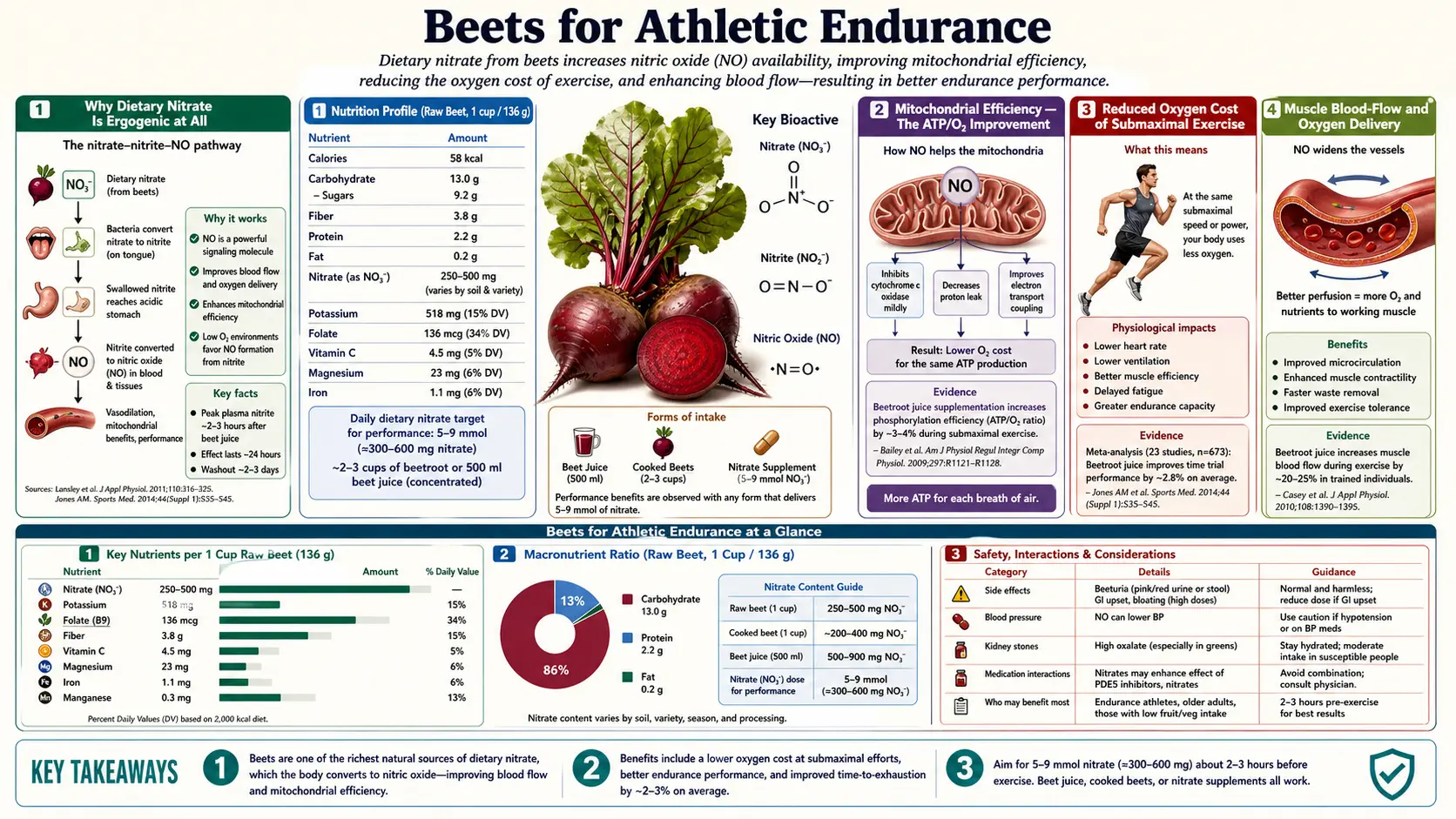
Beetroot juice has earned a place in elite endurance sport as one of the most-studied legal ergogenic aids of the past two decades. The mechanism is well-mapped: dietary nitrate is reduced through the enterosalivary pathway to bioactive nitric oxide, which produces two distinct ergogenic effects. First, NO lowers the oxygen cost of submaximal exercise by improving mitochondrial efficiency — specifically by reducing proton slip at the inner mitochondrial membrane, meaning more ATP is produced per molecule of O2 consumed. Second, NO-mediated vasodilation increases blood flow and oxygen delivery to working skeletal muscle. Time-trial performance gains average 1–3% in events lasting 5–30 minutes — small in absolute terms, but the difference between winning and not in elite competition. Effects are blunted in already-trained elite athletes whose baseline NO bioavailability is high. This page walks through the mitochondrial-efficiency mechanism, the major performance trials, the dose-response relationship, sport-specific applications, and the limitations and caveats.
Table of Contents
- Why Dietary Nitrate Is Ergogenic at All
- Mitochondrial Efficiency — The ATP/O2 Improvement
- Reduced Oxygen Cost of Submaximal Exercise
- Muscle Blood-Flow and Oxygen Delivery
- Pivotal Performance Trials — Bailey, Larsen, Lansley
- Dose-Response and Timing
- Elite vs Recreational Athlete Effect Size
- Sport-Specific Applications
- Combining With Other Ergogenic Strategies
- Cautions and Practical Considerations
- Key Research Papers
- Connections
- Featured Videos
Why Dietary Nitrate Is Ergogenic at All
The discovery that dietary nitrate has ergogenic effects was almost accidental. In 2007, Larsen and colleagues at the Karolinska Institute were studying nitrate's blood-pressure-lowering effect when they incidentally measured oxygen consumption during cycle ergometry in healthy volunteers given dietary nitrate. To their surprise, the same workload required significantly less oxygen consumption after three days of dietary nitrate supplementation. This was the first demonstration that nitrate could improve metabolic efficiency, and it triggered a wave of follow-up research that has now produced hundreds of trials.
The conceptual leap was that NO had previously been thought to act primarily as a vasodilator and signaling molecule. The Larsen finding suggested NO also had direct effects on cellular bioenergetics — specifically on mitochondrial respiratory efficiency. Subsequent work has mapped two distinct ergogenic mechanisms: mitochondrial efficiency improvement at the cellular level, and vasodilation-mediated oxygen delivery improvement at the tissue level. Both contribute to the overall performance benefit, and the relative magnitude varies between individuals, training states, and exercise intensities.
The nitrate doses studied in athletic research are typically higher than those needed for blood-pressure effects. Performance trials commonly use 6–10 mmol nitrate as a single dose 2–3 hours before exercise (the time of peak plasma nitrite), or 6–8 mmol/day for 3–7 days as a loading regimen before competition. The athletic dose is comparable to one or two concentrated beetroot juice shots (Beet It Sport and similar products), or about 500–750 mL of fresh beetroot juice.
Mitochondrial Efficiency — The ATP/O2 Improvement
The mitochondrial efficiency effect was directly demonstrated in the Larsen 2011 Cell Metabolism paper. Working with isolated human skeletal-muscle mitochondria from biopsies taken before and after three days of dietary nitrate, the investigators measured the P/O ratio — the molar ratio of ATP synthesized per oxygen atom consumed. The P/O ratio improved by approximately 6% with nitrate supplementation, indicating that the same oxygen consumption produced more ATP.
The mechanism appears to involve nitric oxide's effect on complex IV (cytochrome c oxidase) of the electron transport chain. NO competes with oxygen at the binuclear heme-copper active site of complex IV. At low NO concentrations, this competition slows electron transport through complex IV slightly, reducing the rate of proton pumping across the inner mitochondrial membrane. Counterintuitively, this is beneficial: it reduces the rate of proton slip (proton leakage that produces heat rather than driving ATP synthesis) and increases coupling efficiency at the ATP synthase.
An alternative or complementary mechanism is reduced expression of mitochondrial uncoupling proteins (UCPs) and adenine nucleotide translocase, both of which contribute to baseline proton slip. The net effect across mechanisms is that the same workload (the same ATP demand) produces less oxygen consumption — the athlete becomes more economical.
The magnitude is small but consistent: 3–5% improvement in steady-state oxygen consumption at submaximal workloads. For an endurance athlete operating near their physiological limit, a 3% reduction in oxygen cost translates to a meaningful increase in sustainable workload at a given VO2max, or equivalently, longer time to exhaustion at a fixed workload.
Reduced Oxygen Cost of Submaximal Exercise
The downstream consequence of improved mitochondrial efficiency is a reduced steady-state oxygen consumption at any given submaximal workload. This has been measured in over 50 randomized trials, with consistent results: dietary nitrate reduces VO2 at submaximal workloads by roughly 3–5% in untrained and recreationally trained subjects, and by smaller amounts (1–3%) in highly trained subjects.
The practical significance is illustrated by walking economy. Larsen 2007 showed that the oxygen cost of walking at 5 km/h was reduced by 5% with dietary nitrate. For a sedentary or elderly subject, that translates to perceived ease of movement and reduced fatigue during routine activity. For an endurance athlete, the equivalent effect at competition workloads means they can sustain a given pace for longer before reaching VO2max.
The effect on the VO2-vs-workload relationship is a downward shift of the curve — same workload produces less VO2. This is a different effect from training adaptation, which typically shifts the lactate threshold rightward without changing the VO2-vs-workload relationship. Dietary nitrate and training are complementary, with effects that combine additively.
Interestingly, the oxygen-cost reduction is more pronounced at moderate-intensity submaximal workloads (40–70% VO2max) than at low or very high intensities. This is consistent with the mitochondrial mechanism — at very low workloads, mitochondrial respiration is not limiting; at very high workloads near VO2max, other constraints (cardiac output, oxygen extraction) become rate-limiting. The middle range where nitrate works best happens to be the range relevant to most endurance competition.
Muscle Blood-Flow and Oxygen Delivery
The second mechanism of ergogenic effect is NO-mediated vasodilation in working skeletal muscle. Exercising muscle generates local hypoxia and acidosis, both of which preferentially trigger the nitrite-to-NO reduction pathway in the muscle vasculature. The result is enhanced perfusion of the exact muscle fibers that need oxygen, with much less effect on resting tissue.
Ferguson and colleagues using radioactive microspheres in rats found that dietary nitrate increased blood flow specifically to type II (fast-twitch) muscle fibers during exercise. Type II fibers are normally less well-perfused than type I (slow-twitch) fibers because the resistance arterioles serving fast-twitch fibers are more constricted at rest. Dietary nitrate appears to selectively relieve this constriction, redistributing blood flow to where it is most needed during exercise.
In humans, contrast-enhanced ultrasound and near-infrared spectroscopy studies have shown that dietary nitrate increases muscle blood flow during exercise without changing it at rest. The hypoxia-targeted nature of the nitrite-to-NO conversion explains this selectivity — resting well-oxygenated muscle does not generate NO from nitrite, while hypoxic exercising muscle does.
The combined effect of improved mitochondrial efficiency (each O2 molecule produces more ATP) and improved oxygen delivery (more O2 molecules reach the working muscle) is a multiplicative improvement in muscle bioenergetic capacity at any given external workload.
Pivotal Performance Trials — Bailey, Larsen, Lansley
The foundational performance trial was Bailey 2009 (Journal of Applied Physiology). Eight recreationally active men consumed 500 mL/day of beetroot juice (5.6 mmol nitrate) for 6 days, then performed standardized cycle ergometry. Results:
- Oxygen consumption at moderate-intensity (45% VO2max) exercise reduced by 5%
- Time to exhaustion at severe-intensity (110% gas-exchange threshold) exercise increased by 16%
- The first study to combine the metabolic-efficiency measurement with a performance outcome
Lansley 2011 (Medicine & Science in Sports & Exercise) extended this to cycling time trials. Nine competitive cyclists performed 4-km and 16.1-km time trials after 500 mL/day beetroot juice or nitrate-depleted placebo for 6 days. The beetroot juice arm showed:
- 4-km time-trial performance improved by 2.8% (faster)
- 16.1-km time-trial performance improved by 2.7%
- Average power output during the time trials increased
- Oxygen cost at sub-time-trial intensity reduced
For context, a 2.7% improvement in 16.1-km cycling time trial is roughly the difference between a winning and a losing performance in elite competition.
Wylie 2013 mapped the dose-response curve in 10 healthy men. Three doses of beetroot juice (70, 140, and 280 mL of concentrated juice, providing 4.2, 8.4, and 16.8 mmol nitrate respectively) were tested. Results were dose-dependent for blood-pressure reduction but plateaued for performance effect somewhere between 4.2 and 8.4 mmol. The 16.8 mmol dose was not meaningfully more ergogenic than the 8.4 mmol dose — an important finding that bounds the practical dose-response.
Multiple meta-analyses have since pooled the performance trials. McMahon, Leveritt, and Pavey (2017, Sports Medicine) pooled 76 trials and concluded that dietary nitrate produces small but reliable improvements in time-to-exhaustion (mean improvement about 5%) and time-trial performance (mean improvement about 1.5–2%), with effects clearer in events lasting 5–30 minutes than in shorter sprints or much longer events.
Dose-Response and Timing
The effective dose of nitrate for athletic performance is roughly 6–10 mmol per dose, with optimal timing approximately 2–3 hours before exercise. Practical protocols:
- Acute single dose — 2–3 hours before competition, take 1–2 concentrated beetroot juice shots (Beet It Sport, similar products) providing 6–10 mmol nitrate total. Plasma nitrite peaks at 2–3 hours and remains elevated for 6–8 hours. Effective for time-trial-style events.
- Loading regimen — 6–8 mmol nitrate per day for 3–7 days before competition, then a final acute dose 2–3 hours before the event. Some studies have found loading regimens produce slightly larger and more consistent effects than acute dosing alone, particularly in less-trained athletes whose baseline NO levels are lower.
- Daily training regimen — 5–6 mmol nitrate per day during heavy training blocks. Theoretically supports training adaptation through chronically improved muscle perfusion and oxygen extraction. Evidence is suggestive but not as strong as for acute pre-competition dosing.
- Whole-food alternative — two large roasted beets contain roughly the same nitrate as one concentrated juice shot. Practical for daily intake but inconvenient for immediately pre-competition loading.
Timing is important. The plasma nitrite curve peaks 2–3 hours after ingestion. Consuming beetroot juice within 30–60 minutes of exercise produces less benefit because plasma nitrite has not yet peaked. Consuming it 6+ hours before exercise also produces less benefit because plasma nitrite has begun to decline.
Consistent with the oral microbiome dependence covered in the blood-pressure deep dive, antibacterial mouthwash use abolishes the ergogenic effect just as completely as it abolishes the blood-pressure effect. Athletes using daily mouthwash for oral hygiene should switch to alcohol-free non-antiseptic rinses.
Elite vs Recreational Athlete Effect Size
One of the most consistent findings in nitrate-performance research is that the ergogenic effect is larger in recreational and moderately-trained athletes than in elite athletes. The Boorsma 2014 trial in highly trained 1500-m runners found no significant performance benefit from beetroot juice supplementation. Several subsequent trials in elite cyclists, runners, and rowers have shown either no benefit or small marginal effects that fail to reach statistical significance.
The leading explanation is that elite endurance athletes have already maximized their endogenous NO bioavailability through years of high-volume training. Their baseline plasma nitrite is high, their eNOS expression in muscle vasculature is upregulated, and the marginal benefit of adding more NO from dietary nitrate is small. Recreational athletes start from lower baseline NO bioavailability and have more headroom for nitrate-induced improvement.
This is not a complete explanation — some elite athletes do respond to dietary nitrate, and the response is unpredictable on an individual basis. Pragmatically, elite athletes who want to assess whether they are responders should systematically trial beetroot juice during training (not for the first time at major competition) and measure performance variables themselves.
The other relevant variable is exercise intensity. Dietary nitrate has its largest measured effects in events of moderate-to-high intensity lasting 5–30 minutes (1500m and 5000m running, 4–20 km cycling time trial, 2000m rowing). Events lasting less than 1 minute show little or no benefit (the ergogenic mechanism is too slow). Events lasting more than 1 hour show inconsistent effects, partly because intramuscular nitrate-to-NO conversion may saturate and partly because the underlying constraints on ultra-endurance performance are different (glycogen depletion, thermoregulation, fatigue beyond the oxygen-cost limitation).
Sport-Specific Applications
- Cycling time trials (4–40 km) — one of the best-established applications. Multiple trials show 1–3% performance improvement with acute or loaded dosing. Standard recommendation: 1–2 concentrated beetroot juice shots (6–10 mmol nitrate) 2–3 hours pre-event.
- Distance running (1500m to 10,000m) — smaller but reliable benefit in recreational and sub-elite runners. Effect is less consistent in elite runners. Same dose-and-timing as cycling.
- Rowing (2000m) — mixed results in the limited number of trials. The repeated near-maximal intensity may exceed the workload range where nitrate is most effective.
- Cross-country skiing and triathlon — theoretical benefit for both, limited direct trial data. Loaded dosing is probably the right approach for multi-hour events.
- Team sports (soccer, hockey, basketball) — growing evidence that dietary nitrate improves intermittent high-intensity performance, possibly through faster recovery between sprints and reduced oxygen cost of the aerobic background. Useful for in-season nutritional support.
- Sprint and power events — no meaningful benefit. The ergogenic mechanism requires aerobic ATP production over many seconds; pure-anaerobic events bypass the relevant pathways.
- High-altitude exercise — particularly promising application. The hypoxic environment of high altitude makes the nitrite-to-NO reduction pathway even more favorable (the enzymes are more active at low O2), and altitude-induced impairment of mitochondrial efficiency may be partially offset. Limited but encouraging trial data.
- Resistance training — some recent evidence that dietary nitrate improves muscle contractile force and repeated-rep performance. Mechanism may involve calcium handling at the sarcoplasmic reticulum. Worth experimenting with but not yet a standard recommendation.
Combining With Other Ergogenic Strategies
- Caffeine — works through different mechanisms (adenosine antagonism, central nervous system effects on perceived exertion, fatty-acid mobilization). The two are complementary; effects appear to be additive. Standard approach: 3–6 mg/kg caffeine 30–60 minutes pre-event, plus beetroot juice 2–3 hours pre-event.
- Beta-alanine — buffers muscle pH through carnosine accumulation. Different mechanism, additive with nitrate for high-intensity events.
- Creatine — phosphocreatine buffering. Different mechanism, additive.
- Sodium bicarbonate — blood pH buffering. Different mechanism, can be combined though both have GI side-effects that may compound.
- Carbohydrate loading — the standard glycogen-maximization protocol. Compatible with beetroot loading; beets contain some sugar but not enough to substantially affect a structured carb-loading plan.
- Cherry juice (Montmorency tart cherry) — ergogenic through different anti-inflammatory mechanism, often combined with beetroot during heavy training blocks for recovery support.
Cautions and Practical Considerations
- GI upset — concentrated beetroot juice can cause cramping, loose stools, and gas in some athletes, particularly those not habituated to it. Test in training, never debut on competition day.
- Beeturia (red urine) — harmless but can be alarming if mistaken for hematuria. Reassure athletes who are new to beet juice use.
- Red stools — similar to beeturia, betalain pigment passes through some individuals' GI tracts intact and produces red-pink stools. Benign.
- Antibacterial mouthwash dependence — reiterate: any antibacterial mouthwash abolishes the effect. Switch to alcohol-free non-antiseptic rinses during the training and competition period.
- Proton pump inhibitors — reduce gastric acid and partially blunt the conversion of swallowed nitrite to NO. Athletes on chronic PPI therapy should discuss with their physician whether the medication is still needed.
- WADA / IOC status — dietary nitrate from beets is not on any banned-substance list and is fully permitted in tested sport. There has been periodic discussion about whether concentrated nitrate products should be reclassified, but no action has been taken.
- Hypotension during heat stress — combining high-dose beetroot juice with prolonged hot-weather exercise can theoretically produce excessive vasodilation and orthostatic symptoms. Hydrate aggressively and monitor for dizziness.
- Combining with sildenafil or other PDE5 inhibitors — both work through the NO-cGMP pathway. Athletes occasionally use sildenafil for high-altitude performance; combining with high-dose beet juice could produce excessive hypotension.
- Diabetic athletes — whole beets contain some sugar (about 7 g per medium beet). Concentrated beetroot juice shots contain less. Adjust insulin or carb-load planning accordingly.
- Pediatric athletes — the same blood-pressure and ergogenic effects apply but most of the trial data is in adults. The Beet It Sport-style concentrated shots are typically marketed for adults; food-form beets are appropriate for any age.
Key Research Papers
- Larsen FJ et al. (2007). Effects of dietary nitrate on oxygen cost during exercise. Acta Physiologica 191:59-66. — PubMed 17635415
- Bailey SJ et al. (2009). Dietary nitrate supplementation reduces the O2 cost of low-intensity exercise and enhances tolerance to high-intensity exercise in humans. Journal of Applied Physiology 107:1144-1155. — PubMed 19661447
- Larsen FJ et al. (2011). Dietary inorganic nitrate improves mitochondrial efficiency in humans. Cell Metabolism 13:149-159. — PubMed 21284982
- Lansley KE et al. (2011). Acute dietary nitrate supplementation improves cycling time trial performance. Medicine & Science in Sports & Exercise 43:1125-1131. — PubMed 21471821
- Wylie LJ et al. (2013). Beetroot juice and exercise: pharmacodynamic and dose-response relationships. Journal of Applied Physiology 115:325-336. — Search PubMed
- Jones AM (2014). Dietary nitrate supplementation and exercise performance. Sports Medicine 44 (Suppl 1):S35-S45. — PubMed 24791915
- Cermak NM, Gibala MJ, van Loon LJ (2012). Nitrate supplementation's improvement of 10-km time-trial performance in trained cyclists. International Journal of Sport Nutrition and Exercise Metabolism 22:64-71. — PubMed 22248502
- McMahon NF, Leveritt MD, Pavey TG (2017). The effect of dietary nitrate supplementation on endurance exercise performance in healthy adults: a systematic review and meta-analysis. Sports Medicine 47:735-756. — PubMed 27600147
- Domínguez R et al. (2017). Effects of beetroot juice supplementation on cardiorespiratory endurance in athletes: a systematic review. Nutrients 9:43. — PubMed 28067808
- Boorsma RK et al. (2014). Beetroot juice supplementation does not improve performance of elite 1500-m runners. Medicine & Science in Sports & Exercise 46:2326-2334. — Search PubMed
- Hoon MW et al. (2013). The effect of nitrate supplementation on exercise performance in healthy individuals: a systematic review and meta-analysis. International Journal of Sport Nutrition and Exercise Metabolism 23:522-532. — PubMed 23580439
- Ferguson SK et al. (2013). Impact of dietary nitrate supplementation via beetroot juice on exercising muscle vascular control in rats. Journal of Physiology 591:547-557. — Search PubMed
PubMed Topic Searches
- PubMed: Beetroot endurance performance
- PubMed: Dietary nitrate mitochondrial efficiency
- PubMed: Nitrate and oxygen cost
- PubMed: Beetroot cycling time trial
- PubMed: Nitrate team sports
Connections
- All Food
- Beets Overview
- Beets Benefits Hub
- Beets & Blood Pressure
- Beets Liver Support
- Beets Pigments & Antioxidants
- L-Arginine
- L-Citrulline
- Beta-Alanine
- Creatine
- Caffeine
- Magnesium
- Potassium
- Cardiology
- Hypertension