Beef — Benefits Deep Dive
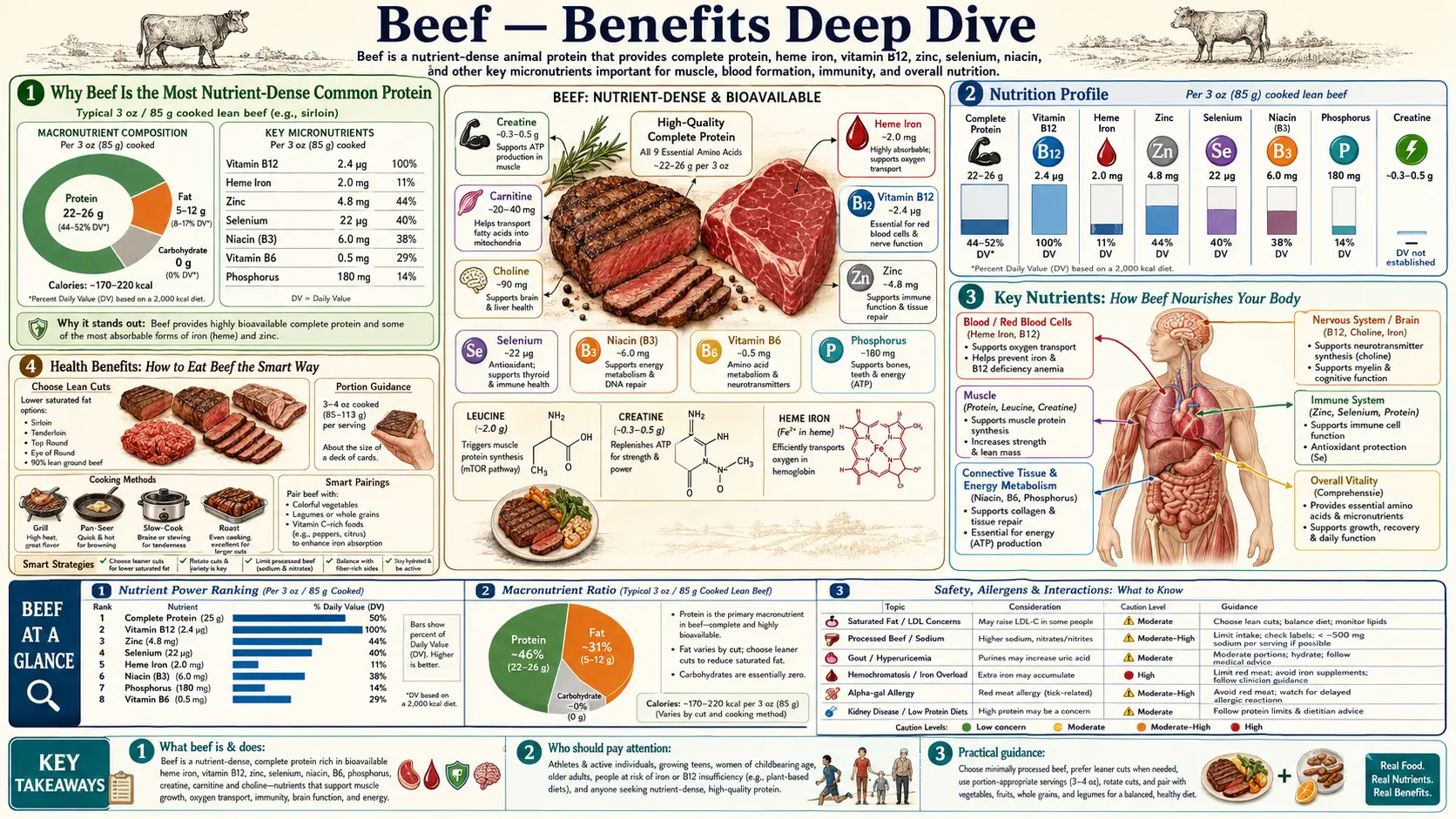
Beef is the most nutrient-dense common protein in the human diet on a per-calorie basis, supplying complete protein with all nine essential amino acids in optimal ratios, the highly bioavailable heme form of iron, vitamin B12 in quantities no plant food can match, zinc with the same absorption advantage as iron, plus muscle-tissue-only nutrients like creatine, carnosine, and taurine that vegetarian diets cannot supply at meaningful concentrations. Four benefit pages below explore the science behind beef's most consequential nutritional contributions — the bioavailability gap between heme and non-heme iron that explains why iron-deficiency anemia is concentrated in low-meat populations, the muscle-performance nutrients exclusive to animal tissue, the measurable differences between grass-fed and grain-fed beef, and the omega-6 to omega-3 ratio question that drives much of the popular discussion around red meat.
Deep-Dive Articles
Bioavailable Iron and B12
Heme iron from beef is absorbed at 15-35% efficiency versus 2-20% for non-heme plant iron, with absorption that is not suppressed by phytates, polyphenols, or calcium. A 3-oz serving of beef supplies 2.7 mg of heme iron and 2.4 µg of vitamin B12 — 100% of the adult RDA for B12 from a single serving. Why iron-deficiency anemia and B12 deficiency remain concentrated in vegetarian and vegan populations, and the clinical evidence supporting beef as a first-line dietary intervention.
Creatine and Carnosine
Beef supplies approximately 2 g of creatine and 1.5 g of carnosine per pound of raw muscle tissue — nutrients present in only trace amounts in plant foods. Creatine supports the phosphocreatine energy system, lean muscle mass, and cognitive function. Carnosine acts as an intracellular pH buffer and as a scavenger of reactive carbonyl species. Why vegetarians have lower brain and muscle creatine stores and the supplementation strategies that close the gap.
Grass-Fed vs Grain-Fed
Grass-finished beef contains roughly 2-3 times more omega-3 fatty acids, 2-3 times more conjugated linoleic acid (CLA), and 4-5 times more carotenoids and vitamin E than grain-finished beef from feedlot operations. Protein and mineral content are similar. The clinically meaningful differences are concentrated in the fat fraction. Cost, labeling claims (100% grass-fed vs grass-fed/grain-finished), and the practical question of whether the nutritional difference justifies the price premium.
CLA and Omega-3 Ratio
Conjugated linoleic acid (CLA) is a family of naturally occurring trans fatty acids produced by ruminant bacteria from linoleic acid. Grass-fed beef contains 300-500% more CLA than grain-fed. The omega-6 to omega-3 ratio in beef ranges from approximately 2:1 in grass-finished to 8:1 in grain-finished — both substantially better than the 15:1 ratio of the modern industrial diet. What the human evidence actually shows for CLA on body composition, insulin sensitivity, and inflammation markers.
Table of Contents
- Deep-Dive Articles
- Why Beef Is the Most Nutrient-Dense Common Protein
- Research Papers: Iron and B12 Bioavailability
- Research Papers: Creatine, Carnosine, and Taurine
- Research Papers: Grass-Fed vs Grain-Fed
- Research Papers: CLA and Fatty Acid Ratios
- Research Papers: Cross-Cutting (Protein Quality, DIAAS, Sarcopenia)
- External Authoritative Resources
- Connections
- Featured Videos
Why Beef Is the Most Nutrient-Dense Common Protein
The case for beef as the single most nutrient-dense common protein rests on three independent biological facts that combine in ruminant muscle tissue and nowhere else in the food supply:
- Complete protein at the gold-standard quality score. Beef has a Digestible Indispensable Amino Acid Score (DIAAS) of approximately 1.12 — meaning it exceeds the reference amino acid pattern for human requirements. By comparison, wheat protein scores around 0.43, rice protein around 0.59, and even pea protein only reaches 0.65. The amino acid leucine, which triggers muscle protein synthesis through the mTOR pathway, is present in beef at concentrations that reliably push older adults past the leucine threshold (~2.5 g per meal) needed to overcome anabolic resistance.
- Heme-iron and intrinsic-factor-bound B12 with bioavailability no plant food can match. The iron in beef is contained in myoglobin (the muscle oxygen-carrying protein), in the chemical form of heme — the same porphyrin ring that carries oxygen in human hemoglobin. Heme iron is absorbed via a dedicated transporter (HCP1) that bypasses the regulation and inhibition that limit non-heme iron absorption. Vitamin B12 is synthesized only by bacteria, and the bacteria that produce it in usable quantity live in ruminant rumens — cattle, sheep, goats, and deer. Plants do not produce B12, and B12 analogs in algae and fermented foods are not bioidentical to the form humans absorb. See the dedicated deep-dive page for the absorption data and clinical implications.
- Muscle-tissue nutrients that vegetarian diets cannot supply. Creatine, carnosine, taurine, and anserine are all present in beef at clinically meaningful concentrations because they are stored in animal muscle tissue. They are present in only trace amounts in plants. Vegetarians and vegans have measurably lower tissue stores of all four, with documented effects on muscle creatine content, brain creatine content, and exercise performance. See the creatine and carnosine deep dive.
The complications are concentrated in two areas: the production system (grass-fed pasture-raised vs grain-fed concentrated animal feeding operations produce meaningfully different products in the fat fraction, though the protein and mineral content is similar), and the fatty acid composition (the omega-6 to omega-3 ratio, the conjugated linoleic acid content, and the saturated fat profile all vary with feed and breed). The grass-fed vs grain-fed deep dive and the CLA and omega-3 ratio deep dive address both questions with the clinical-trial evidence.
The historic concerns about red meat and cardiovascular disease have been substantially revised over the last decade. The 2019 NutriRECS meta-analysis (Annals of Internal Medicine) and the 2020 Harvard meta-analyses found that the absolute risk increase associated with unprocessed red meat consumption is small, statistically marginal, and confounded by other lifestyle factors. Processed meat (bacon, deli meat, hot dogs) shows clearer signal for adverse outcomes. The evidence currently does not support general avoidance of unprocessed beef for cardiovascular reasons, particularly when consumed in the context of a Mediterranean-pattern or whole-food diet.
Research Papers: Iron and B12 Bioavailability
- Hallberg L, Hulthen L (2000). Prediction of dietary iron absorption: an algorithm for calculating absorption and bioavailability of dietary iron. American Journal of Clinical Nutrition. — Search PubMed
- West AR, Oates PS (2008). Mechanisms of heme iron absorption: current questions and controversies. World Journal of Gastroenterology. — Search PubMed
- Pawlak R, Lester SE, Babatunde T (2014). The prevalence of cobalamin deficiency among vegetarians assessed by serum vitamin B12: a review of literature. European Journal of Clinical Nutrition. — PMID 24667752
- Pawlak R, Parrott SJ, Raj S, et al. (2013). How prevalent is vitamin B(12) deficiency among vegetarians? Nutrition Reviews. — PMID 23356638
- Allen LH (2009). How common is vitamin B-12 deficiency? American Journal of Clinical Nutrition. — Search PubMed
- Hurrell R, Egli I (2010). Iron bioavailability and dietary reference values. American Journal of Clinical Nutrition. — PMID 20200263
- Pasricha SR, Tye-Din J, Muckenthaler MU, Swinkels DW (2021). Iron deficiency. The Lancet. — Search PubMed
- Stabler SP (2013). Vitamin B12 deficiency. NEJM. — PMID 23301732
- Watanabe F, Yabuta Y, Bito T, Teng F (2014). Vitamin B12-containing plant food sources for vegetarians. Nutrients. — PMID 24803097
- Cook JD, Reddy MB (2001). Effect of ascorbic acid intake on nonheme-iron absorption from a complete diet. American Journal of Clinical Nutrition. — Search PubMed
Research Papers: Creatine, Carnosine, and Taurine
- Burke DG, Chilibeck PD, Parise G, et al. (2003). Effect of creatine and weight training on muscle creatine and performance in vegetarians. Medicine and Science in Sports and Exercise. — PMID 14600563
- Solis MY, Artioli GG, Otaduy MCG, et al. (2017). Effect of age, diet, and tissue type on PCr response to creatine supplementation. Journal of Applied Physiology. — PMID 28572496
- Rae C, Digney AL, McEwan SR, Bates TC (2003). Oral creatine monohydrate supplementation improves brain performance: a double-blind, placebo-controlled, cross-over trial. Proceedings of the Royal Society B. — PMID 14561278
- Boldyrev AA, Aldini G, Derave W (2013). Physiology and pathophysiology of carnosine. Physiological Reviews. — PMID 24137022
- Harris RC, Tallon MJ, Dunnett M, et al. (2006). The absorption of orally supplied beta-alanine and its effect on muscle carnosine synthesis in human vastus lateralis. Amino Acids. — PMID 16554972
- Laidlaw SA, Shultz TD, Cecchino JT, Kopple JD (1988). Plasma and urine taurine levels in vegans. American Journal of Clinical Nutrition. — Search PubMed
- Ripps H, Shen W (2012). Review: taurine: a "very essential" amino acid. Molecular Vision. — PMID 23170060
- Kreider RB, Kalman DS, Antonio J, et al. (2017). International Society of Sports Nutrition position stand: safety and efficacy of creatine supplementation in exercise, sport, and medicine. Journal of the International Society of Sports Nutrition. — PMID 28615996
- Avgerinos KI, Spyrou N, Bougioukas KI, Kapogiannis D (2018). Effects of creatine supplementation on cognitive function of healthy individuals: a systematic review. Experimental Gerontology. — PMID 29704637
- Hobson RM, Saunders B, Ball G, et al. (2012). Effects of beta-alanine supplementation on exercise performance: a meta-analysis. Amino Acids. — PMID 22270875
Research Papers: Grass-Fed vs Grain-Fed
- Daley CA, Abbott A, Doyle PS, et al. (2010). A review of fatty acid profiles and antioxidant content in grass-fed and grain-fed beef. Nutrition Journal. — PMID 20219103
- Davis H, Magistrali A, Butler G, Stergiadis S (2022). Nutritional benefits from fatty acids in organic and grass-fed beef. Foods. — Search PubMed
- Provenza FD, Kronberg SL, Gregorini P (2019). Is grassfed meat and dairy better for human and environmental health? Frontiers in Nutrition. — PMID 30941351
- Van Elswyk ME, McNeill SH (2014). Impact of grass/forage feeding versus grain finishing on beef nutrients and sensory quality. Meat Science. — Search PubMed
- Wood JD, Enser M, Fisher AV, et al. (2008). Fat deposition, fatty acid composition and meat quality: a review. Meat Science. — PMID 22062452
- Duckett SK, Neel JP, Fontenot JP, Clapham WM (2009). Effects of winter stocker growth rate and finishing system on beef tissues. Journal of Animal Science. — Search PubMed
- Descalzo AM, Sancho AM (2008). A review of natural antioxidants and their effects on oxidative status, odor and quality of fresh beef. Meat Science. — Search PubMed
- Realini CE, Duckett SK, Brito GW, et al. (2004). Effect of pasture vs. concentrate feeding with or without antioxidants on carcass characteristics, fatty acid composition, and quality of Uruguayan beef. Meat Science. — Search PubMed
- Ponnampalam EN, Mann NJ, Sinclair AJ (2006). Effect of feeding systems on omega-3 fatty acids, conjugated linoleic acid and trans fatty acids in Australian beef cuts. Asia Pacific Journal of Clinical Nutrition. — PMID 16500874
- Garcia PT, Pensel NA, Sancho AM, et al. (2008). Beef lipids in relation to animal breed and nutrition in Argentina. Meat Science. — Search PubMed
Research Papers: CLA and Fatty Acid Ratios
- Whigham LD, Watras AC, Schoeller DA (2007). Efficacy of conjugated linoleic acid for reducing fat mass: a meta-analysis in humans. American Journal of Clinical Nutrition. — PMID 17490954
- Simopoulos AP (2002). The importance of the ratio of omega-6/omega-3 essential fatty acids. Biomedicine & Pharmacotherapy. — PMID 12442909
- Belury MA (2002). Dietary conjugated linoleic acid in health: physiological effects and mechanisms of action. Annual Review of Nutrition. — Search PubMed
- Dilzer A, Park Y (2012). Implication of conjugated linoleic acid (CLA) in human health. Critical Reviews in Food Science and Nutrition. — PMID 22452730
- Bhattacharya A, Banu J, Rahman M, et al. (2006). Biological effects of conjugated linoleic acids in health and disease. Journal of Nutritional Biochemistry. — PMID 16650752
- den Hartigh LJ (2019). Conjugated linoleic acid effects on cancer, obesity, and atherosclerosis: a review of pre-clinical and human trials with current perspectives. Nutrients. — Search PubMed
- Field CJ, Blewett HH, Proctor S, Vine D (2009). Human health benefits of vaccenic acid. Applied Physiology, Nutrition, and Metabolism. — Search PubMed
- Mozaffarian D, Wu JH (2011). Omega-3 fatty acids and cardiovascular disease: effects on risk factors, molecular pathways, and clinical events. Journal of the American College of Cardiology. — PMID 22051327
- Calder PC (2017). Omega-3 fatty acids and inflammatory processes: from molecules to man. Biochemical Society Transactions. — PMID 28900017
- Ridker PM, Everett BM, Thuren T, et al. (2017). Antiinflammatory therapy with canakinumab for atherosclerotic disease (CANTOS trial). NEJM. — PMID 28845751
Research Papers: Cross-Cutting (Protein Quality, DIAAS, Sarcopenia)
- Phillips SM (2017). Current concepts and unresolved questions in dietary protein requirements and supplements in adults. Frontiers in Nutrition. — Search PubMed
- Wolfe RR, Baum JI, Starck C, Moughan PJ (2018). Factors contributing to the selection of dietary protein food sources. Clinical Nutrition. — Search PubMed
- Moughan PJ, Wolfe RR (2019). Determination of dietary amino acid digestibility in humans. Journal of Nutrition. — Search PubMed
- Bauer J, Biolo G, Cederholm T, et al. (2013). Evidence-based recommendations for optimal dietary protein intake in older people: PROT-AGE Study Group. JAMDA. — PMID 23867520
- Cruz-Jentoft AJ, Bahat G, Bauer J, et al. (2019). Sarcopenia: revised European consensus on definition and diagnosis. Age and Ageing. — PMID 30312372
- Johnston BC, Zeraatkar D, Han MA, et al. (2019). Unprocessed red meat and processed meat consumption: dietary guideline recommendations from NutriRECS. Annals of Internal Medicine. — PMID 31569235
- Zeraatkar D, Han MA, Guyatt GH, et al. (2019). Red and processed meat consumption and risk for all-cause mortality and cardiometabolic outcomes: a systematic review and meta-analysis. Annals of Internal Medicine. — PMID 31569213
- Rondanelli M, Klersy C, Terracol G, et al. (2016). Whey protein, amino acids, and vitamin D supplementation with physical activity increases fat-free mass and strength in sarcopenic elderly. American Journal of Clinical Nutrition. — PMID 26864356
- Berryman CE, Lieberman HR, Fulgoni VL, Pasiakos SM (2018). Protein intake trends and conformity with the Dietary Reference Intakes in the United States. American Journal of Clinical Nutrition. — Search PubMed
- Pasiakos SM, Lieberman HR, Fulgoni VL (2015). Higher-protein diets are associated with higher HDL cholesterol and lower BMI and waist circumference in US adults. Journal of Nutrition. — Search PubMed
External Authoritative Resources
- USDA FoodData Central — comprehensive nutrient database for all beef cuts, raw and cooked, by cooking method
- Beef Cattle Research Council — primary industry science resource on beef nutrition and production systems
- NIH Office of Dietary Supplements — Iron Fact Sheet
- NIH Office of Dietary Supplements — Vitamin B12 Fact Sheet
- PubMed — Beef nutrition research
Connections
- All Food
- Beef Main Page
- Beef for Iron and B12
- Beef for Creatine and Carnosine
- Grass-Fed vs Grain-Fed
- CLA and Omega-3 Ratio
- Iron
- Zinc
- Vitamin B12
- Leucine
- Taurine
- Organ Meats
- Omega-3 Fatty Acids
- Iron Deficiency Anemia
- Eggs