Grass-Fed vs Grain-Fed Beef
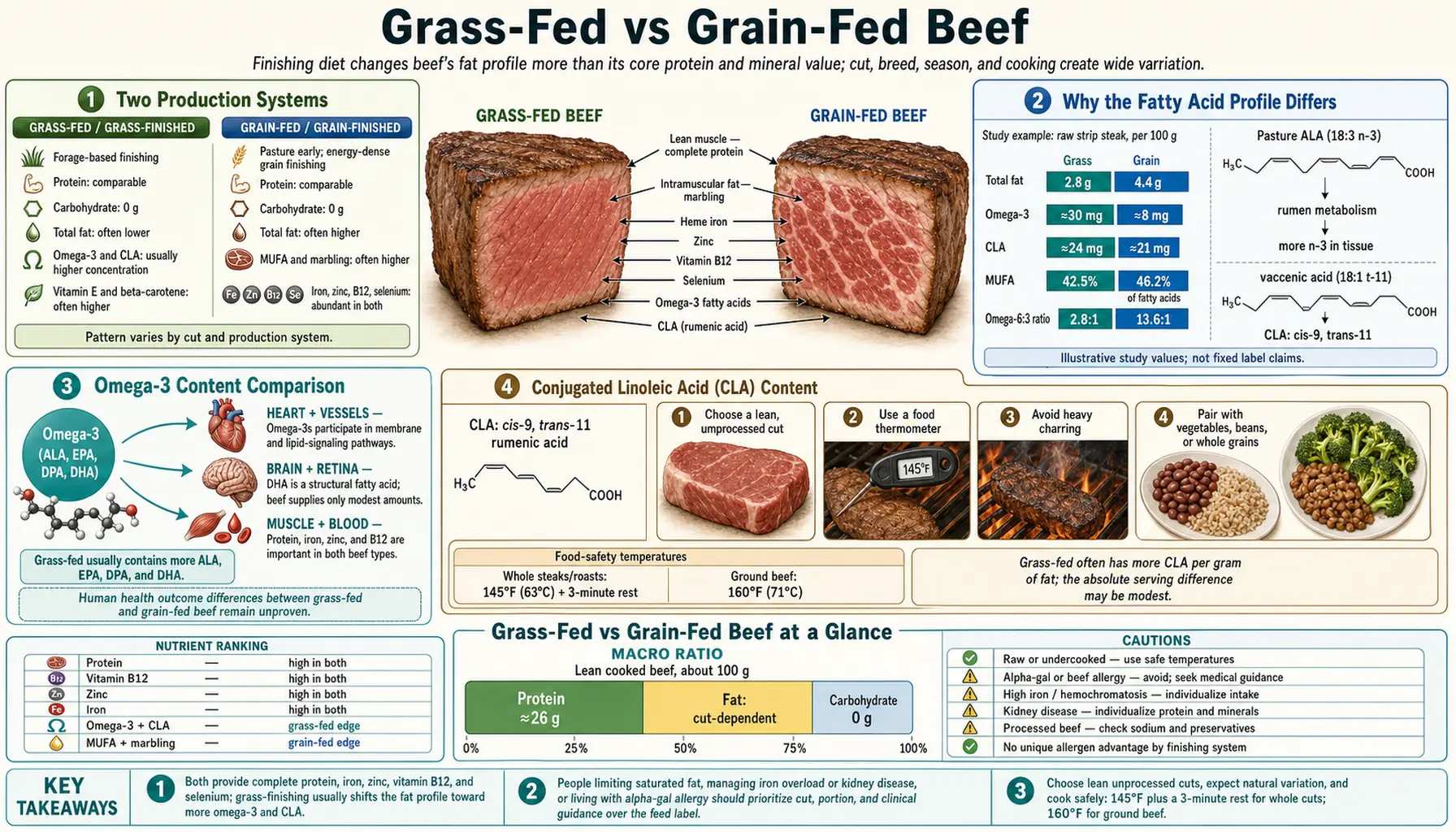
The grass-fed vs grain-fed beef question is one of the most consequential and most misunderstood in modern food choice. The nutritional differences are real, but they are concentrated in the fat fraction (fatty acid profile, fat-soluble vitamins, carotenoids) rather than the protein or mineral content, which is largely similar between the two production systems. The most reliable nutritional advantages of grass-finished beef — established across dozens of comparative analyses including the Daley 2010 Nutrition Journal review of 92 studies — are 2-3 times more omega-3 fatty acids, 2-3 times more conjugated linoleic acid (CLA), 4-5 times more carotenoids and vitamin E, and a better omega-6 to omega-3 ratio. This page works through the underlying biology of why the differences exist, what they mean clinically, how to read the often-confusing labeling (100% grass-fed vs grass-fed/grain-finished vs pasture-raised vs USDA Organic), the cost-benefit analysis from the consumer perspective, and where the differences are large enough to justify the price premium versus where conventional beef is the more practical choice.
Table of Contents
- Two Production Systems
- Why the Fatty Acid Profile Differs
- Omega-3 Content Comparison
- Conjugated Linoleic Acid (CLA) Content
- Carotenoids and Vitamin E
- What Is Similar (Protein, Iron, B12, Zinc)
- Labeling Claims and Their Meanings
- Cost-Benefit Analysis
- Environmental Claims Briefly Considered
- Practical Purchasing Guidance
- Key Research Papers
- Connections
- Featured Videos
Two Production Systems
Modern beef production in the United States and most developed countries operates in two stages with two distinct finishing models. All beef cattle, regardless of finishing method, spend their first 6-12 months on pasture eating forage (grass, legumes, hay). This is called the cow-calf or backgrounding phase, and during this period there is little nutritional difference between cattle destined for different finishing systems.
The divergence occurs in the finishing phase, the final 4-8 months before slaughter:
- Grain-finished (conventional / feedlot) — cattle are moved to concentrated animal feeding operations (CAFOs) where they consume a high-energy ration composed primarily of corn, soybean meal, and other grains with hay and forage as a smaller fraction. The high-energy ration accelerates weight gain and produces the well-marbled, calorie-dense beef that dominates the US supermarket case. Approximately 95% of US beef is grain-finished.
- Grass-finished (100% grass-fed / pasture-finished) — cattle remain on pasture for their entire lives, consuming only grass, legumes, and other forages. Some operations supplement with hay during winter months in cold climates; this is still considered grass-fed if no grain is fed. Time-to-finish is longer (typically 24-30 months vs 18-22 months for grain-finished). Carcasses are leaner and smaller. This category represents approximately 4-5% of US beef.
- Grass-fed / grain-finished (intermediate) — some labels claim "grass-fed" but the cattle are finished on grain in the final months. The American Grassfed Association certification requires no grain at any point; the older USDA "grass-fed" claim (now no longer enforced) was less strict. International labels (Australian, New Zealand) typically mean truly grass-finished by their domestic standards.
The choice of finishing system substantially determines the nutritional profile of the resulting meat — not because the breeds are different, but because diet determines fatty acid composition, fat-soluble vitamin content, and the carotenoid pigments that give grass-finished fat its slightly yellow tint.
Why the Fatty Acid Profile Differs
The fatty acid composition of ruminant fat is determined by the lipid composition of the feed and by the action of rumen bacteria. Grass and other forages contain primarily alpha-linolenic acid (ALA, 18:3n-3), the parent omega-3 fatty acid. Corn and soy contain primarily linoleic acid (LA, 18:2n-6), the parent omega-6 fatty acid.
Rumen bacteria partially hydrogenate dietary fatty acids before they reach the cow's tissues — this is called biohydrogenation. The intermediates of incomplete biohydrogenation are the trans fatty acids and the conjugated linoleic acids that are unique to ruminant fat. The fatty acid pool that escapes the rumen biohydrogenation and is absorbed into the cow's tissues reflects the feed, but with significant modification.
The net result:
- Grass-finished beef has higher absolute omega-3 content and a much better omega-6 to omega-3 ratio (typically 1.5:1 to 2:1)
- Grain-finished beef has higher absolute omega-6 content and a worse omega-6 to omega-3 ratio (typically 7:1 to 10:1)
- Grass-finished beef has 2-5 times more CLA (the most studied beneficial fatty acid in beef) because of more substrate (linoleic acid in grass) and longer rumen retention
- Total fat content of grass-finished beef is significantly lower (often 50-70% less) because of less intramuscular marbling
- Saturated fat profile is similar in proportion but lower in absolute amount
The differences are real but should be kept in perspective: even grass-finished beef is not an omega-3-rich food in the way that fatty fish are. A 3-oz serving of grass-finished beef provides ~80 mg of long-chain omega-3 fatty acids; a 3-oz serving of salmon provides ~1,800 mg. Beef of either type is a complete protein with excellent iron, zinc, and B12 content; the fatty acid differences are a nutritional upgrade rather than a transformation. See the dedicated CLA and Omega-3 Ratio deep dive for the full clinical evidence.
Omega-3 Content Comparison
Per 100 g of cooked beef (combining typical values from the Daley 2010 review, USDA database, and the Davis 2022 Foods analysis):
- Grass-finished sirloin — total long-chain omega-3 (EPA + DPA + DHA): ~50-80 mg; alpha-linolenic acid (ALA, the precursor): ~40-60 mg
- Grain-finished sirloin — total long-chain omega-3: ~15-25 mg; ALA: ~15-25 mg
- Ratio difference — grass-finished beef has approximately 2-3 times more long-chain omega-3 per serving
The proportion that contributes meaningfully to total dietary omega-3 intake depends on the rest of the diet:
- For an adult who eats fatty fish 2-3 times per week (the standard cardiology recommendation), the omega-3 contribution from beef of either type is small and the grass-fed advantage matters less.
- For an adult who eats little or no fish, beef can be a meaningful source of omega-3 fatty acids, and the grass-fed difference becomes more relevant.
- For a low-fish vegetarian who consumes some beef, the grass-fed advantage is most consequential.
The omega-6 to omega-3 ratio is, by some accounts, more important than absolute omega-3 quantity. The modern industrial Western diet has a ratio of approximately 15:1 to 20:1, far above the 1:1 to 4:1 range thought to be evolutionarily typical and associated with lower inflammation in cross-population comparisons. Grass-finished beef has a ratio of approximately 1.5:1 to 2:1; grain-finished beef has 7:1 to 10:1. Substituting grass-finished for grain-finished beef, alongside other dietary changes like reduced industrial seed oil consumption, can meaningfully shift the overall dietary ratio toward the lower end.
Conjugated Linoleic Acid (CLA) Content
CLA represents a family of positional and geometric isomers of linoleic acid where the two double bonds are separated by a single carbon-carbon bond (conjugated) rather than the methylene-interrupted pattern of standard linoleic acid. The dominant isomer in ruminant fat is cis-9, trans-11 CLA (rumenic acid), making up 80-90% of total CLA.
CLA per 100 g of beef:
- Grass-finished beef — 30-50 mg per 100 g (varies with breed, pasture quality, and season; spring/summer pasture peaks highest)
- Grain-finished beef — 5-15 mg per 100 g
- Ratio difference — grass-finished beef has approximately 3-5 times more CLA
Whether the difference is clinically meaningful depends on whether CLA has clinical effects at dietary intake levels. Most CLA research has used supplemental doses of 1-6 g/day, which is much higher than achievable from any reasonable beef intake. The Whigham et al. 2007 meta-analysis of CLA supplementation found modest effects on body composition (small reduction in fat mass), but the doses used (~3.4 g/day) would require eating ~7 lbs of grass-finished beef per day to match from food alone.
The argument that dietary CLA from grass-finished beef has clinical relevance therefore rests on cumulative chronic intake. Whether this matters in practice is unsettled. See the CLA deep dive for the detailed clinical literature.
Carotenoids and Vitamin E
Carotenoids (beta-carotene, lutein, zeaxanthin) and vitamin E (alpha-tocopherol) are fat-soluble nutrients that cattle obtain from fresh forage. They accumulate in adipose tissue and intramuscular fat. Grass-finished beef contains:
- Beta-carotene — 4-5 times more than grain-finished; sufficient to give grass-fed fat a slightly yellow tint that is one of the visual markers of grass-finished beef
- Alpha-tocopherol (Vitamin E) — 3-4 times more
- Lutein and zeaxanthin — significantly higher, though absolute amounts are still small
The absolute quantities are modest — a 100 g serving of grass-finished beef provides perhaps 40 IU of vitamin E vs 10 IU for grain-finished, and 20-50 µg of beta-carotene vs 5-10 µg. These are not dietary replacements for the carotenoid content of orange/yellow vegetables (a single carrot provides ~5,000 µg of beta-carotene) or the vitamin E content of nuts and seeds (an ounce of almonds provides ~7 IU). But they contribute incrementally and represent a meaningful upgrade over conventional beef.
The fat-soluble vitamin advantage is most pronounced in cuts with higher fat content (ribeye, brisket, ground beef with normal fat percentage). Very lean cuts (top round, eye of round) show smaller absolute differences because there is less fat to carry the fat-soluble nutrients.
What Is Similar (Protein, Iron, B12, Zinc)
The grass-fed vs grain-fed comparison is sometimes presented as if grass-finished beef is nutritionally superior across the board. This overstates the case. Several key nutrients are similar between the two production systems:
- Protein content and quality — both supply complete protein with all essential amino acids; DIAAS scores are similar (~1.1). Total protein per ounce is similar (slightly higher in lean grass-finished cuts because they have less fat displacing protein on a per-gram basis).
- Iron, including heme iron — concentrated in muscle myoglobin; similar in both production systems. The bioavailability advantage of heme iron is independent of feed.
- Vitamin B12 — produced by rumen bacteria in both systems; similar in finished beef tissue.
- Zinc — concentrated in muscle; similar between the two.
- Creatine, carnosine, taurine — muscle-tissue nutrients similar between the two systems.
- B vitamins (B6, niacin, riboflavin) — similar.
The implication is that someone choosing beef primarily for protein, iron, B12, or the muscle-tissue nutrients (creatine and friends, covered in the Creatine and Carnosine deep dive) gets essentially the same benefit from grain-finished as from grass-finished beef. The grass-fed advantage applies specifically to the fatty acid profile and fat-soluble vitamins.
Labeling Claims and Their Meanings
Beef labeling in the United States is more confusing than it should be. The USDA discontinued enforcement of its "grass-fed" marketing claim in 2016, leaving the term unregulated at the federal level. Several third-party certifications fill the gap:
- American Grassfed Association (AGA) Certified — the strictest US standard. Requires 100% grass and forage diet, no grain ever, no confinement, no antibiotics or hormones. The most reliable certification for consumers wanting truly grass-finished beef.
- PCO Certified Grassfed (Pennsylvania Certified Organic) — similar strict standard.
- "100% grass-fed" or "grass-finished" — without third-party certification, these claims are essentially producer self-attestation. Many small operations are genuinely 100% grass-fed without paying for certification, but verification requires trusting the producer.
- "Grass-fed" — without a qualifier, may mean grass-fed for some of the animal's life and grain-finished for the last months. Less reliable than "grass-finished."
- "Pasture-raised" — vague; could mean pasture during some of the cattle's life with grain finishing.
- USDA Organic — requires access to pasture during the grazing season (minimum 120 days) but does not prohibit grain finishing. Organic grain-finished beef is common.
- "Grass-fed/grain-finished" — honest labeling for an intermediate product. Better fatty acid profile than purely grain-finished, not as good as 100% grass-finished.
- Australian and New Zealand grass-fed — both countries have substantially grass-based beef industries by national norm; imported beef labeled grass-fed from these origins is generally reliable.
For consumers prioritizing the fatty acid and carotenoid benefits, AGA Certified or genuinely traceable 100% grass-finished from a known producer is the recommendation. For consumers who simply want above-average production conditions, USDA Organic plus "grass-finished" claim is a reasonable middle option.
Cost-Benefit Analysis
Grass-finished beef typically costs 50-150% more per pound than conventional grain-finished beef at US retail. The price premium reflects the longer time to finish, the larger land area required, the lower carcass yield, and the smaller scale of most grass-finishing operations.
From a strict nutritional cost-effectiveness standpoint:
- If the goal is omega-3 intake, a portion of fatty fish (salmon, sardines, mackerel) provides 20-30 times more long-chain omega-3 per serving than even grass-finished beef, at lower cost in most US markets. See our Omega-3 page.
- If the goal is carotenoids, a serving of dark leafy greens or carrots provides 50-100 times more beta-carotene at a fraction of the cost.
- If the goal is vitamin E, a small handful of almonds provides several times more at minimal cost.
- If the goal is CLA, dietary intake from any source falls far short of supplementation doses; the difference between grass-fed and grain-fed CLA matters only as cumulative chronic intake of modest amounts.
The strongest case for grass-finished beef is the overall package: somewhat better fatty acid profile, somewhat higher fat-soluble vitamins, generally higher production standards (less crowded, often no antibiotics or hormones), and for those who place value on environmental and animal-welfare considerations, the production system itself. None of these alone justifies the price premium on a per-serving nutritional cost basis, but together they may justify it for consumers who can afford it.
A practical compromise: prioritize grass-finished for cuts where the fat differences matter most (ribeye, ground beef, chuck) and use conventional grain-finished for lean cuts where fat differences are smaller (top round, eye of round, sirloin tip). Or buy grass-finished in bulk directly from a producer at significantly lower per-pound cost than retail.
Environmental Claims Briefly Considered
The environmental comparison of grass-fed vs grain-fed beef is contested and beyond the scope of a nutrition-focused page, but a brief note is warranted because environmental claims are intertwined with nutritional claims in consumer marketing:
- Grass-finished cattle produce more total methane per pound of meat over their longer lifespan (due to lower-efficiency rumen fermentation on grass vs grain), but no net additional methane on a per-pasture-area basis if managed correctly.
- Well-managed rotational grazing can sequester soil carbon and improve soil health, partially offsetting the methane impact.
- Grain-fed cattle have higher feed conversion efficiency (less feed per pound of beef) but the feed itself (corn, soy) has substantial energy and environmental cost.
- The total environmental impact of any beef is high compared to plant proteins; the choice between grass-finished and grain-finished is incremental.
- Animal welfare considerations generally favor grass-finished pasture-based systems.
These are individual ethical and economic choices that vary by personal priorities. The nutritional case for grass-finished beef stands on its own merits independent of environmental considerations.
Practical Purchasing Guidance
- For the fatty acid and carotenoid benefits to matter most, prioritize fattier cuts — the differences are concentrated in the fat fraction; lean cuts show smaller absolute differences.
- Buy from a local rancher when feasible — a half-cow or quarter-cow purchase directly from a small grass-finishing operation typically costs $6-10/lb hanging weight, much less than retail grass-finished beef at $15-30/lb. Freezer space is the limiting factor.
- Ask the questions that matter — "Is the cattle grass-finished?" (the critical question) is different from "Is the cattle grass-fed?" (which all cattle are, in their first stage).
- Look for AGA Certified or international grass-fed sources — Australian and New Zealand grass-fed imports are typically reliable.
- Conventional grain-finished beef remains a high-quality protein source — the protein, iron, B12, zinc, and muscle-tissue nutrient content is essentially equivalent. Do not feel compelled to skip beef entirely if grass-finished is not accessible or affordable.
- Combine with fatty fish for omega-3 sufficiency — the most cost-effective omega-3 strategy is fatty fish 2-3 times per week regardless of beef type, with beef serving as the iron/B12/protein backbone.
- Cook conservatively — the fatty acid advantages of grass-finished beef are partially lost to oxidation in high-heat cooking; medium rare preserves more than well done. The fat-soluble vitamins are heat-stable but can leach into pan drippings — use the drippings.
Key Research Papers
- Daley CA, Abbott A, Doyle PS, et al. (2010). A review of fatty acid profiles and antioxidant content in grass-fed and grain-fed beef. Nutrition Journal. — PMID 20219103
- Davis H, Magistrali A, Butler G, Stergiadis S (2022). Nutritional benefits from fatty acids in organic and grass-fed beef. Foods. — Search PubMed
- Provenza FD, Kronberg SL, Gregorini P (2019). Is grassfed meat and dairy better for human and environmental health? Frontiers in Nutrition. — PMID 30941351
- Van Elswyk ME, McNeill SH (2014). Impact of grass/forage feeding versus grain finishing on beef nutrients and sensory quality. Meat Science. — Search PubMed
- Duckett SK, Neel JP, Fontenot JP, Clapham WM (2009). Effects of winter stocker growth rate and finishing system on beef carcass and meat tissues. Journal of Animal Science. — Search PubMed
- Descalzo AM, Sancho AM (2008). A review of natural antioxidants and their effects on oxidative status, odor and quality of fresh beef. Meat Science. — Search PubMed
- Realini CE, Duckett SK, Brito GW, et al. (2004). Effect of pasture vs. concentrate feeding with or without antioxidants on carcass characteristics, fatty acid composition, and quality of Uruguayan beef. Meat Science. — Search PubMed
- Ponnampalam EN, Mann NJ, Sinclair AJ (2006). Effect of feeding systems on omega-3 fatty acids, conjugated linoleic acid and trans fatty acids in Australian beef cuts. Asia Pacific Journal of Clinical Nutrition. — PMID 16500874
- Garcia PT, Pensel NA, Sancho AM, et al. (2008). Beef lipids in relation to animal breed and nutrition in Argentina. Meat Science. — Search PubMed
- Wood JD, Enser M, Fisher AV, et al. (2008). Fat deposition, fatty acid composition and meat quality: a review. Meat Science. — PMID 22063240
- Wright AT, Pickering EM, Rouzer SK, et al. (2015). Differences in muscle fatty acid composition of beef cattle finished on pasture versus grain. Journal of Animal Science. — PMID 26641043
- Klurfeld DM (2018). What is the role of meat in a healthy diet? Animal Frontiers. — PMID 32002230
PubMed Topic Searches
- PubMed: Grass-fed beef fatty acids
- PubMed: Pasture-finished omega-3 CLA
- PubMed: Beef vitamin E and carotenoids
- PubMed: Rumen biohydrogenation
- PubMed: Beef omega-6 to omega-3 ratio
Connections
- All Food
- Beef Overview
- Beef Benefits Hub
- Iron and B12
- Creatine and Carnosine
- CLA and Omega-3 Ratio
- Omega-3 Fatty Acids
- Organ Meats
- Vitamin A (Beta-Carotene)
- Vitamin E
- Vitamin D3
- Vitamin K2
- Salmon
- Sardines
- Cardiology