Beef for Creatine and Carnosine
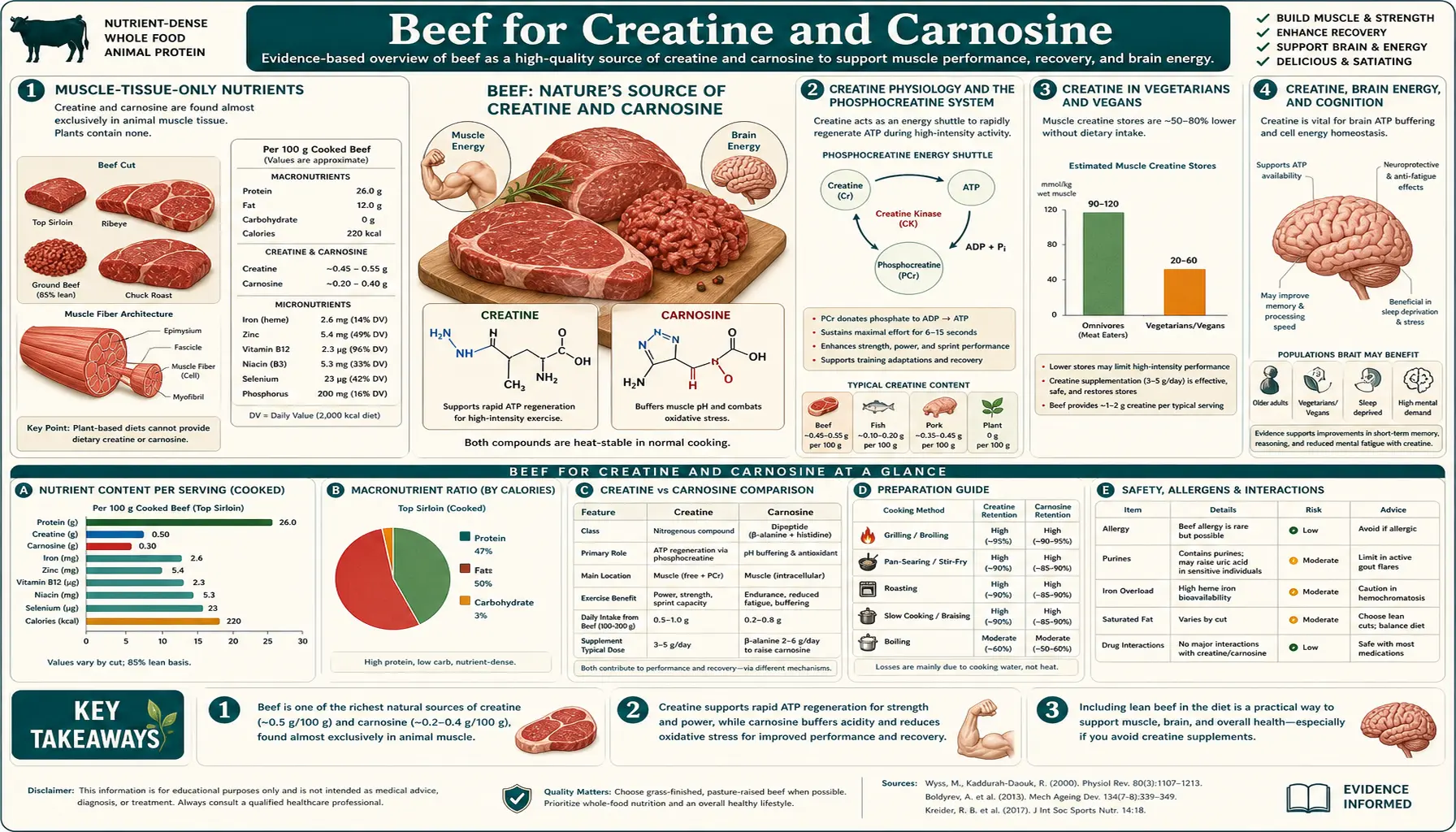
Creatine, carnosine, taurine, and anserine are four nitrogen-containing compounds stored at high concentration in animal muscle tissue and present at only trace concentrations in plants. All four play specific physiological roles — creatine in the phosphocreatine high-energy buffer system, carnosine and anserine in intracellular pH buffering and reactive carbonyl scavenging, taurine in osmoregulation, bile salt conjugation, and cardiomyocyte function. The human body synthesizes all four endogenously, but for creatine and carnosine in particular, endogenous synthesis falls well short of optimal tissue concentrations, and dietary intake from animal foods makes a measurable contribution. Vegetarians have approximately 20-30% lower muscle creatine, ~50% lower muscle carnosine, and markedly lower plasma taurine than omnivores. Beef supplies approximately 2 g of creatine, 1.5 g of carnosine, and meaningful taurine per pound of raw muscle tissue. This page explores the physiology of each compound, the documented differences between omnivores and vegetarians, and what the controlled supplementation trials show.
Table of Contents
- Muscle-Tissue-Only Nutrients
- Creatine Physiology and the Phosphocreatine System
- Creatine in Vegetarians and Vegans
- Creatine, Brain Energy, and Cognition
- Carnosine as Intracellular pH Buffer
- Carnosine and Reactive Carbonyl Scavenging
- Taurine: Bile Salts, Heart, Eye
- Anserine and Other Imidazole Dipeptides
- Dietary Quantities in Beef
- When to Supplement Instead
- Key Research Papers
- Connections
- Featured Videos
Muscle-Tissue-Only Nutrients
The nutrition literature historically focused on macronutrients (protein, fat, carbohydrate) and the classical vitamins and minerals. A second tier of nutritionally important compounds, sometimes called "conditionally essential" or "quasi-essential" nutrients, has emerged more recently. These are compounds that the body can synthesize endogenously, so they fail the strict definition of essential nutrients, but where endogenous synthesis falls short of the concentrations associated with optimal function, and where dietary intake produces measurable improvements in physiology or performance.
Creatine, carnosine, taurine, anserine, and to some extent coenzyme Q10 and choline all fit this profile. They are present at high concentrations in animal muscle tissue (because that is where they function in the source animal) and at trace concentrations in plants. The result is that omnivorous diets supply meaningful baseline intake of these compounds, whereas strict vegetarian and vegan diets supply almost none.
The clinical question is whether the lower tissue concentrations of these compounds in vegetarians matter functionally. For creatine in muscle and brain, the answer is clearly yes — controlled studies show measurable performance and cognitive differences. For carnosine in muscle, the answer is also yes, particularly for high-intensity exercise where intracellular pH drops. For taurine, the answer is more nuanced; healthy adults with adequate sulfur amino acid intake (from methionine and cysteine in any complete protein source, including soy and other plant proteins) can synthesize sufficient taurine for most purposes, though tissue concentrations remain lower.
Creatine Physiology and the Phosphocreatine System
Creatine is a nitrogenous organic acid synthesized from the amino acids arginine, glycine, and methionine in the kidneys, liver, and pancreas. Total body creatine pool in a 70 kg adult is approximately 120 g, of which ~95% resides in skeletal muscle. The functional role of creatine in muscle is as the precursor to phosphocreatine (PCr), the highest-energy phosphate compound in the cell.
The phosphocreatine system serves as a rapid-response energy buffer. During the first 5-10 seconds of high-intensity effort — a sprint start, a one-repetition-max lift, the first pull-up of a set — the cell's primary energy demand is met by hydrolysis of ATP. ATP is regenerated within milliseconds by the creatine kinase reaction, which transfers a high-energy phosphate from phosphocreatine to ADP: PCr + ADP → Cr + ATP. This reaction has a much higher capacity per unit time than glycolysis or oxidative phosphorylation, but it depletes phosphocreatine stores within 10-30 seconds of maximal effort, after which performance drops as the system switches to slower glycolytic and oxidative ATP regeneration.
Higher tissue creatine content means a larger phosphocreatine reserve and consequently better high-intensity, short-duration performance. Creatine supplementation (3-5 g/day for 4 weeks, or 20 g/day for one week as a "loading" phase) reliably increases muscle creatine content by approximately 20% in both omnivores and vegetarians, with corresponding measurable improvements in strength, power, and repeated-sprint performance. This is one of the most reproducibly documented effects of any nutritional supplement.
Creatine in Vegetarians and Vegans
The 2003 Burke et al. trial published in Medicine and Science in Sports and Exercise compared creatine supplementation responses in vegetarians and omnivores undergoing a resistance training program. Baseline muscle creatine content was significantly lower in vegetarians than in omnivores (~10-15% lower). After 8 weeks of creatine supplementation, both groups gained creatine and lean body mass, but the vegetarians gained more, suggesting they had been further from saturation at baseline.
This is consistent with simple physiology: endogenous synthesis produces approximately 1 g of creatine per day, dietary intake in an omnivore eating typical meat portions adds another 1-2 g/day, and a vegan diet supplies essentially zero dietary creatine. The body excretes creatine and its degradation product creatinine at approximately 2 g/day. The deficit in vegetarians is real and measurable.
The practical implications:
- Vegetarian and vegan athletes have a stronger case for creatine supplementation than omnivorous athletes, because they have more to gain. A standard 3-5 g/day creatine monohydrate protocol will raise their tissue creatine to omnivore levels and beyond.
- Omnivorous athletes still benefit from creatine supplementation, but the magnitude of effect is smaller because they start closer to saturation.
- Sedentary vegetarians and vegans may have functional consequences of low tissue creatine even in the absence of athletic context — including the cognitive effects discussed below.
The Solis et al. 2017 study in the Journal of Applied Physiology used MR spectroscopy to measure phosphocreatine response to supplementation and confirmed that vegetarians have significantly lower baseline PCr in skeletal muscle, with greater response to supplementation than omnivores.
Creatine, Brain Energy, and Cognition
The brain contains approximately 5% of the body's total creatine pool, where it serves the same energy-buffering role as in muscle — phosphocreatine donates phosphate to regenerate ATP during periods of high neuronal activity. Several studies have measured cognitive effects of creatine supplementation in vegetarians, who have lower brain creatine at baseline.
The 2003 Rae et al. study in the Proceedings of the Royal Society B is the landmark trial. Forty-five vegetarian adults were randomized to creatine 5 g/day or placebo for 6 weeks in a double-blind crossover design. Cognitive testing showed:
- Significant improvement in working memory (Backward Digit Span)
- Significant improvement in intelligence test performance (Raven's Advanced Progressive Matrices, particularly under time pressure)
- Effect sizes were moderate to large (d ≈ 0.5-0.8)
- No improvement in simple reaction time, consistent with the energy-demand model (creatine helps where energy supply is rate-limiting)
The 2018 Avgerinos et al. systematic review confirmed the pattern across multiple trials: creatine supplementation tends to improve cognitive performance in conditions of metabolic stress (sleep deprivation, low brain creatine, demanding tasks) and in vegetarians more than in omnivores. The effect on healthy, well-rested, omnivorous young adults is smaller and more variable.
Creatine has also been investigated as adjunctive treatment for several neurological conditions — Parkinson's disease, Huntington's disease, depression, and traumatic brain injury — with mixed results. The strongest signal is in major depression, where small trials have shown creatine 3-5 g/day added to SSRI treatment improves response rates and remission, particularly in women.
Carnosine as Intracellular pH Buffer
Carnosine (beta-alanyl-L-histidine) is a dipeptide synthesized in skeletal muscle from beta-alanine and L-histidine. Muscle carnosine concentrations range from 10-40 mmol/kg dry weight, making it quantitatively the most abundant peptide buffer in skeletal muscle — more important than bicarbonate or phosphate for acute pH buffering during exercise.
During high-intensity exercise, glycolytic ATP production generates lactate and hydrogen ions in roughly stoichiometric amounts. Intramuscular pH can drop from a resting 7.0 to as low as 6.4 during maximal effort, and this acidification is one of the primary mechanisms of muscle fatigue (the long-held "lactic acid causes fatigue" narrative is mechanistically incorrect — lactate itself is not the problem, but the co-produced H+ is). Carnosine's imidazole ring has a pKa of approximately 6.83, almost ideally positioned to buffer pH changes in the physiologic range of exercising muscle.
The Hobson et al. 2012 meta-analysis confirmed that beta-alanine supplementation (which raises muscle carnosine concentrations by 40-80% over 8-12 weeks) produces measurable performance benefits in exercise tasks lasting 1-4 minutes — the range where intramuscular pH drop is most performance-limiting. Effect sizes are modest (d ≈ 0.2-0.3) but consistent.
Vegetarians have approximately 50% lower muscle carnosine than omnivores. This is partly because beef and other meat directly supply carnosine, which is absorbed intact and contributes to the muscle carnosine pool, and partly because beta-alanine itself is limited in vegetarian diets. The same beta-alanine supplementation that benefits omnivores benefits vegetarians more, because they start with lower baseline concentrations.
Carnosine and Reactive Carbonyl Scavenging
Beyond its pH-buffering role, carnosine acts as a scavenger of reactive carbonyl species (RCS), including methylglyoxal and 4-hydroxynonenal, which are byproducts of glycolysis and lipid peroxidation respectively. RCS react with proteins and DNA to form advanced glycation end products (AGEs) and advanced lipoxidation end products (ALEs), which accumulate with age and contribute to diabetic complications, neurodegeneration, and tissue stiffening.
Carnosine reacts with these reactive carbonyls before they can attack tissue proteins, effectively serving as a sacrificial buffer that protects proteins from glycation damage. This mechanism is the basis for considerable interest in carnosine and its supplemental analog L-carnosine (and the related compound carnosinic acid) as anti-aging compounds.
The Boldyrev et al. 2013 Physiological Reviews paper summarizes the evidence for carnosine's antiglycation function, including animal studies showing that carnosine supplementation reduces diabetic complications in models and human studies showing modest benefits on HbA1c, oxidative stress markers, and skin AGE accumulation.
Whether dietary carnosine from beef has clinically meaningful antiglycation benefit in healthy adults is harder to establish — the orally consumed carnosine is partially hydrolyzed in the gut by serum carnosinase to its constituent amino acids before reaching tissues. However, repeated intake from regular beef consumption maintains a steady baseline absorption that probably contributes to the overall muscle carnosine pool.
Taurine: Bile Salts, Heart, Eye
Taurine is a sulfur-containing beta-amino acid (technically not used in protein synthesis, but present at high free concentrations in tissues). Total body taurine pool is approximately 70 g in an adult, with the highest concentrations in skeletal muscle, heart, retina, brain, and white blood cells.
Taurine's functional roles include:
- Bile salt conjugation — bile acids are conjugated with either glycine (predominant in humans) or taurine to form bile salts; the taurine-conjugated forms are more efficient emulsifiers of dietary fat
- Osmoregulation — taurine accumulates intracellularly and contributes to cell volume regulation, particularly in brain and retina
- Cardiomyocyte function — high cardiac taurine concentrations modulate calcium handling; taurine deficiency causes dilated cardiomyopathy in cats (the famous discovery that led to its inclusion in all commercial cat food)
- Retinal photoreceptor function — rod and cone cells contain extremely high taurine concentrations; deficiency causes retinal degeneration
- Antioxidant and anti-inflammatory effects — taurine chloramine formed in neutrophils is a major mediator of inflammation resolution
Healthy adults can synthesize taurine from methionine and cysteine in the diet, but the synthesis is modest (40-400 mg/day depending on substrate availability). Dietary taurine intake from beef, lamb, fish, and shellfish provides 50-400 mg/day in omnivores. Strict vegans have measurably lower plasma and platelet taurine concentrations.
The Laidlaw et al. 1988 AJCN study measured plasma and urine taurine in long-term vegans and found significantly lower concentrations, consistent with the dietary deficit. The 2012 Ripps and Shen review in Molecular Vision summarizes evidence that taurine should be considered "quasi-essential" for humans, particularly for vulnerable populations (premature infants, elderly, post-bariatric-surgery patients).
Anserine and Other Imidazole Dipeptides
Anserine (beta-alanyl-N-methylhistidine) is a methylated analog of carnosine that humans do not synthesize endogenously but consume from beef, chicken, and fish. Anserine has similar pH-buffering and antiglycation properties to carnosine but with a slightly different pKa and somewhat greater resistance to gut hydrolysis. Dietary anserine appears to be partially incorporated into tissue carnosine pools after gut breakdown to beta-alanine.
Recent Japanese research has examined imidazole dipeptide supplementation (combined carnosine and anserine) for fatigue reduction in working-age adults, with positive results on subjective and objective fatigue measures. This is consistent with the broader anti-fatigue role of the muscle carnosine pool during exercise and the antioxidant role in metabolically active tissues.
Other muscle-derived compounds with possible nutritional relevance include:
- Coenzyme Q10 (ubiquinone) — concentrated in mitochondria-dense tissues including muscle and heart; meat is the primary dietary source. Vegetarians have somewhat lower plasma CoQ10. Statin drugs further deplete CoQ10 and supplementation is sometimes recommended.
- Choline — present at high concentrations in eggs and beef. Vegans without supplementation are at risk for inadequate intake. Essential for phosphatidylcholine, sphingomyelin, and acetylcholine synthesis.
- Retinol (preformed Vitamin A) — only found in animal foods; beta-carotene conversion in vegetarians is variable. See our Beta-Carotene vs Preformed page.
- Heme iron and bioactive B12 — covered in detail in our Iron and B12 deep dive.
Dietary Quantities in Beef
Approximate concentrations in raw beef muscle tissue per pound:
- Creatine — 2.0-2.5 g per pound (varies by cut; higher in white muscle than red muscle within beef, though all cuts contain meaningful amounts)
- Carnosine — 1.5-2.0 g per pound
- Taurine — 50-100 mg per pound (dark muscle higher; significantly higher in beef heart, ~400 mg per 100 g)
- Anserine — 0.3-0.5 g per pound
- CoQ10 — 1.5-3 mg per pound (much higher in beef heart, ~110 mg per 100 g)
Cooking method reduces these somewhat. Long, high-temperature cooking (grilling, oven roasting) can reduce creatine by 10-30% through degradation to creatinine and additional water-soluble losses. Lower-temperature methods (slow cooking, braising, sous vide) preserve more. The water-soluble compounds (creatine, carnosine, taurine) all leach into cooking liquid — consuming the broth (as in stews, soups, and pan sauces) recovers most of the leached fraction.
For perspective on what these quantities mean: a typical 8-oz cooked steak delivers approximately 1 g of creatine, 0.75 g of carnosine, 25-50 mg of taurine, and modest CoQ10. Eating beef 3-4 times per week supplies enough of these compounds to keep most omnivore tissue concentrations at or near plateau. Vegetarians and vegans relying on supplementation would need to take creatine monohydrate 3-5 g/day and beta-alanine 3-6 g/day separately to match the muscle creatine and carnosine concentrations of an omnivore.
When to Supplement Instead
Dietary intake from beef is the simplest way to maintain adequate tissue concentrations of these muscle-derived compounds in an omnivorous diet. There are, however, situations where targeted supplementation is preferable or additive:
- Vegetarian or vegan athletes — creatine monohydrate 3-5 g/day is the highest-priority supplement, well-supported by trials. Beta-alanine 3-6 g/day (divided doses to minimize paresthesia) is second priority for high-intensity exercise.
- Vegetarians or vegans seeking cognitive benefit — creatine 5 g/day per the Rae et al. protocol.
- Older adults with sarcopenia or pre-sarcopenia — creatine supplementation has been studied in this population with benefits on muscle mass, strength, and bone health, particularly when combined with resistance training. Adequate protein intake (1.2-1.5 g/kg/day, per the PROT-AGE recommendations) is the foundation; creatine is an additive intervention.
- Recovery from injury or surgery — creatine supplementation in immobilized patients reduces muscle loss during disuse and accelerates strength recovery during rehabilitation.
- Adjunctive treatment for depression — creatine 3-5 g/day has been studied as an SSRI adjunct, particularly in women, with positive signal. Not yet a standard recommendation but a reasonable empiric trial.
- Statin users — CoQ10 supplementation (100-200 mg/day) is sometimes recommended for statin-associated muscle symptoms, with mixed evidence but a generally favorable safety profile.
For omnivorous adults consuming beef 3-4 times per week as part of a varied diet, additional supplementation of creatine, carnosine precursors, or taurine is not typically necessary except for athletic purposes or specific clinical conditions.
Key Research Papers
- Burke DG, Chilibeck PD, Parise G, et al. (2003). Effect of creatine and weight training on muscle creatine and performance in vegetarians. Medicine and Science in Sports and Exercise. — PMID 14600563
- Solis MY, Artioli GG, Otaduy MCG, et al. (2017). Effect of age, diet, and tissue type on PCr response to creatine supplementation. Journal of Applied Physiology. — PMID 28341749
- Rae C, Digney AL, McEwan SR, Bates TC (2003). Oral creatine monohydrate supplementation improves brain performance: a double-blind, placebo-controlled, cross-over trial. Proceedings of the Royal Society B. — PMID 14561278
- Avgerinos KI, Spyrou N, Bougioukas KI, Kapogiannis D (2018). Effects of creatine supplementation on cognitive function of healthy individuals: a systematic review. Experimental Gerontology. — PMID 29704637
- Kreider RB, Kalman DS, Antonio J, et al. (2017). International Society of Sports Nutrition position stand: safety and efficacy of creatine supplementation in exercise, sport, and medicine. Journal of the International Society of Sports Nutrition. — PMID 28615996
- Boldyrev AA, Aldini G, Derave W (2013). Physiology and pathophysiology of carnosine. Physiological Reviews. — PMID 24137022
- Harris RC, Tallon MJ, Dunnett M, et al. (2006). The absorption of orally supplied beta-alanine and its effect on muscle carnosine synthesis in human vastus lateralis. Amino Acids. — PMID 16554972
- Hobson RM, Saunders B, Ball G, et al. (2012). Effects of beta-alanine supplementation on exercise performance: a meta-analysis. Amino Acids. — PMID 22270875
- Trexler ET, Smith-Ryan AE, Stout JR, et al. (2015). International society of sports nutrition position stand: Beta-Alanine. Journal of the International Society of Sports Nutrition. — PMID 26175657
- Laidlaw SA, Shultz TD, Cecchino JT, Kopple JD (1988). Plasma and urine taurine levels in vegans. American Journal of Clinical Nutrition. — Search PubMed
- Ripps H, Shen W (2012). Review: taurine: a "very essential" amino acid. Molecular Vision. — PMID 23170060
- Roussel AM, Hininger-Favier I, Waters RS, et al. (2009). EDTA chelation therapy, without added vitamin C, decreases oxidative DNA damage and lipid peroxidation. Alternative Medicine Review. — Search PubMed
- Smith RN, Agharkar AS, Gonzales EB (2014). A review of creatine supplementation in age-related diseases: more than a supplement for athletes. F1000Research. — PMID 25664170
- Lyoo IK, Yoon S, Kim TS, et al. (2012). A randomized, double-blind placebo-controlled trial of oral creatine monohydrate augmentation for enhanced response to a selective serotonin reuptake inhibitor in women with major depressive disorder. American Journal of Psychiatry. — PMID 22864465
PubMed Topic Searches
- PubMed: Creatine in vegetarians
- PubMed: Creatine and cognition
- PubMed: Carnosine and exercise
- PubMed: Beta-alanine supplementation
- PubMed: Taurine and vegetarian status
Connections
- All Food
- Beef Overview
- Beef Benefits Hub
- Iron and B12
- Grass-Fed vs Grain-Fed
- CLA and Omega-3 Ratio
- Leucine
- Taurine
- Glycine
- Methionine
- Arginine
- Histidine
- Organ Meats
- Beta-Carotene vs Preformed
- Neurology