Avocado: History and Origins
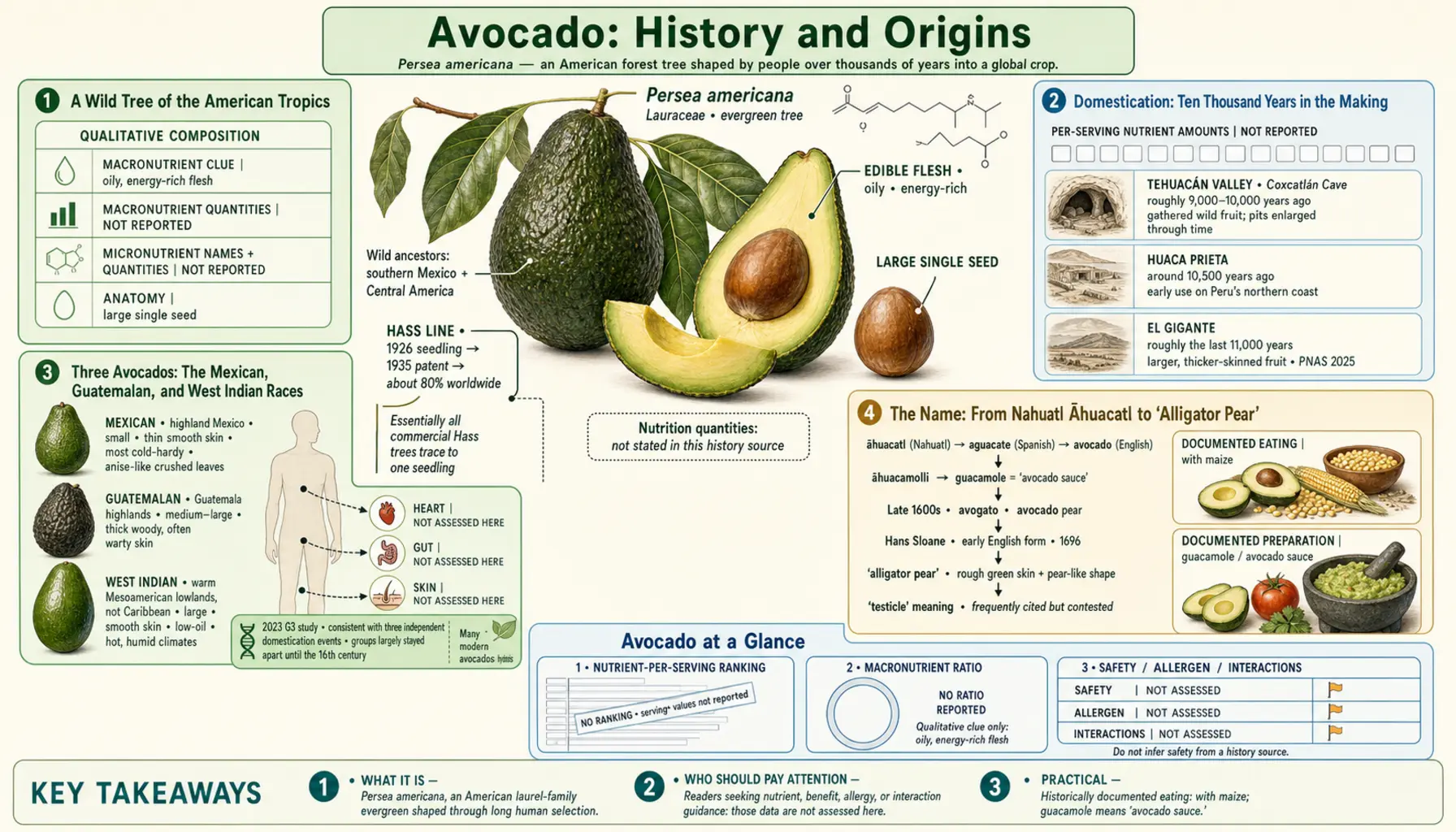
Long before the avocado became a fixture of brunch menus, it was a wild forest tree of the American tropics — one of the oldest foods in the human story of the New World. Charred and discarded avocado pits found in dry caves of Mexico's Tehuacán Valley are roughly nine to ten thousand years old, and remains from coastal Peru may be older still. No one "invented" the avocado; like every traditional food it is a natural species that human communities gathered, then slowly tamed over thousands of years, choosing the trees with the biggest, richest fruit. This article traces what the record actually supports: where the tree comes from and the three distinct kinds people bred from it, the Aztec word behind its name, how it was eaten and valued in Mesoamerica, how Spanish chroniclers first wrote it into European books in the early 1500s, how it travelled the world afterward, and how a single seedling planted by a California mail carrier in 1926 came to dominate the modern market. Where the record is firm we say so; where a detail is folklore or still argued among scholars, we name it as such.
Table of Contents
- A Wild Tree of the American Tropics
- Domestication: Ten Thousand Years in the Making
- Three Avocados: The Mexican, Guatemalan, and West Indian Races
- The Name: From Nahuatl Āhuacatl to "Alligator Pear"
- The Avocado in Mesoamerican Life
- The Columbian Exchange: First European Accounts and the Spread Worldwide
- The Hass Avocado: One Tree Behind a Global Crop (1926)
- From Forest Fruit to Global Commodity
- Research Papers and References
- Connections
- Featured Videos
A Wild Tree of the American Tropics
The avocado, Persea americana, is an evergreen tree of the laurel family (Lauraceae) — a relative of bay laurel, cinnamon, and sassafras rather than of any common fruit tree. It is entirely a plant of the Americas: its wild ancestors grew in the highland and lowland forests of southern Mexico and Central America, and the species was unknown anywhere else on Earth until Europeans carried it across the oceans after 1492. The large single seed and oily, energy-rich flesh are clues to its deep past. Botanists have long noted that such an outsized seed is built to be swallowed and carried by a large animal, and a popular hypothesis holds that the avocado evolved to be dispersed by the giant ground sloths and other huge mammals (megafauna) that roamed the Americas during the Ice Age and went extinct around the end of it. This megafaunal-dispersal idea is an attractive and widely repeated scientific hypothesis, not a proven fact, and we present it as such; what is not in doubt is that the wild avocado was a forest tree of tropical America for a very long time before any human ate one.
When the Ice Age dispersers disappeared, the avocado's wild range could have contracted — and this is exactly where people enter the story. Human foragers became the new carriers of the seed, gathering wild fruit, dropping pits near their camps, and eventually tending the trees that grew. The avocado is therefore one of the clearest cases of a food that humans and a tree shaped together over thousands of years.
Domestication: Ten Thousand Years in the Making
The avocado is among the oldest documented foods in the Americas. The classic evidence comes from the dry caves of the Tehuacán Valley in the modern Mexican state of Puebla, where mid-twentieth-century excavations — most famously at Coxcatlán Cave — recovered avocado pits preserved in the arid deposits. The oldest of these pits are generally dated to roughly 9,000 to 10,000 years ago, placing wild-avocado use at the very beginning of the Holocene, alongside the earliest farming experiments of the region. Importantly, the earliest finds represent gathered wild fruit, not yet a domesticated crop; researchers tracking the Tehuacán pits through time describe seeds that gradually grow larger over the millennia, the tell-tale signature of people selecting for bigger, fleshier fruit. By a few thousand years ago the avocados being eaten there were clearly a managed, increasingly domesticated tree rather than a wild one.
The Mexican caves are no longer the only chapter. Excavations on the northern coast of Peru, at sites such as Huaca Prieta, have reported avocado remains that some researchers date to around 10,500 years ago, suggesting very early use far to the south as well. More recently, a 2025 study of the El Gigante rockshelter in western Honduras — published in the Proceedings of the National Academy of Sciences — documented avocado seeds and rinds spanning roughly the last 11,000 years and found a clear long-term trend toward larger, thicker-skinned fruit, direct physical evidence of people managing and improving avocado trees over thousands of years. Taken together, these sites show that avocado use was old and widespread across tropical America, and that domestication was not a single event but a slow, repeated process in several regions.
A fair summary, then, is this: the avocado was first gathered from the wild by around ten thousand years ago in Mesoamerica (and probably independently in parts of South America), and was gradually domesticated — bred into a larger-fruited crop — over the following millennia. Anyone who pins the avocado's domestication to a single year or a single people is overstating a record that is genuinely deep, genuinely ancient, and genuinely spread across more than one homeland.
Three Avocados: The Mexican, Guatemalan, and West Indian Races
One of the most important facts in the avocado's history is that it was not domesticated just once. Botanists recognise three traditional horticultural races — long-established regional types — and genetic studies support the idea that they arose largely separately, in different homelands, before being brought together in later centuries:
- Mexican race (from highland Mexico) — small fruit with thin, smooth skin, the most cold-hardy of the three, and famous for the anise-like scent of its crushed leaves.
- Guatemalan race (from the highlands of Guatemala) — medium to large fruit with thick, woody, often warty skin.
- West Indian race (despite the name, a lowland tropical type native to the warm lowlands of Mesoamerica, not the Caribbean islands) — large, smooth-skinned, low-oil fruit suited to hot, humid climates.
Genomic research published in 2023 in the journal G3: Genes, Genomes, Genetics is consistent with three independent domestication events and concludes that the three groups largely stayed apart until the 16th century, when European movement of plants and people first brought them reliably into contact. That timing matters: many modern avocados, including the most familiar commercial one, are hybrids that could only have arisen once these once-separate races met. The everyday avocado in a grocery store is, in a real sense, a product of that post-Columbian mixing — a recent blend of lineages that had been developing on their own for thousands of years.
The Name: From Nahuatl Āhuacatl to "Alligator Pear"
The word avocado traces back to āhuacatl, the name for the fruit in Nahuatl, the language of the Aztecs (Mexica) and many other peoples of central Mexico. When the Spanish arrived, they rendered this word as aguacate, which remains the Spanish name today, and from that Spanish form the various European names — including English "avocado" — eventually descended. The three traditional races even carried distinct Nahuatl-derived names that reference type and origin: forms such as aoacatl (the Mexican type), quilaoacatl (the Guatemalan type), and tlacacolaocatl (the lowland West Indian type) appear in the historical and botanical literature.
It is widely repeated that āhuacatl also meant "testicle," supposedly because of the fruit's shape or the way it hangs in pairs. This is a genuinely common claim in reputable etymological discussions, but it is best treated with care: scholars debate whether "testicle" was the original meaning of the word or a secondary, slang use, so this page reports it as a frequently cited but contested piece of word-lore rather than settled fact. What is well established is the line from āhuacatl to aguacate to "avocado."
The English name took a winding road. The earliest English forms, from the late 1600s, were spellings such as avogato and later avocado pear; the naturalist Hans Sloane is often credited with using an early English form in a 1696 catalogue of Jamaican plants. English speakers soon corrupted "avocado pear" into the folk name "alligator pear," a nickname suggested by the fruit's rough green skin and pear-like shape, which stuck for centuries and can still be heard today. The Spanish aguacate also gave English the word guacamole (from Nahuatl āhuacamolli, literally "avocado sauce").
The Avocado in Mesoamerican Life
For the peoples of ancient Mesoamerica — the Olmec, Maya, Aztec, and many others — the avocado was a long-familiar food, not an exotic luxury. It appears in their record in several ways. The avocado is depicted in pre-Columbian art and writing: a glyph in the Maya script and a sign in the Aztec calendar of place-names point to its place in everyday and symbolic life, and the central-Mexican town now called Pueblo del Aguacate and similar place-names preserve the fruit's old importance. Spanish accounts written soon after contact describe avocados being sold in Mesoamerican markets and eaten with maize, much as they still are in Mexican cuisine.
The avocado also gathered a reputation as an aphrodisiac and a symbol of fertility and vitality in the region — a belief commonly attributed in popular and some scholarly retellings to the fruit's association with the "testicle" sense of its Nahuatl name and to the way the fruits hang in pairs. This reputation is a real part of the avocado's cultural history, and we report it as such: as a traditional belief held about the fruit, not as a medical or nutritional claim. As with many cherished foods, the avocado accumulated meaning precisely because it was woven so deeply into daily life, diet, and language across Mesoamerica long before any European set eyes on it.
The Columbian Exchange: First European Accounts and the Spread Worldwide
The avocado is a classic New World food whose global career began with the Columbian Exchange — the vast transfer of plants, animals, people, and diseases between the Americas and the rest of the world that followed Columbus's voyages of 1492. Like the tomato, the potato, maize, cacao, and the chili pepper, the avocado was completely unknown to Europe, Africa, and Asia until Spanish and Portuguese contact made it part of a worldwide food trade.
The earliest European written notice of the avocado is generally credited to the Spanish navigator and geographer Martín Fernández de Enciso, who mentioned the fruit in a book published in 1519. A fuller and more clearly recognisable description came a few years later from the chronicler Gonzalo Fernández de Oviedo y Valdés, whose Sumario de la natural historia de las Indias (1526) is often cited as the first detailed account that unmistakably describes the avocado, praising its buttery flesh. Later chroniclers of Spanish America, including Pedro Cieza de León around 1550, recorded the fruit and its names (both the Nahuatl-derived aguacate and the Quechua-derived palta used in the Andes) as Europeans encountered avocados from Mexico down to Peru.
From these first contacts the tree spread steadily along colonial and trade routes. Commonly cited milestones include its arrival in Spain around 1601, in Indonesia by about 1750, in Brazil by 1809, on the United States mainland by 1825, and in California by the mid-1850s, with introductions to South Africa and Australia following later in the nineteenth century. (Exact introduction dates vary somewhat between sources, so these are best read as well-attested approximations rather than precise anniversaries.) The avocado that today grows in Africa, the Mediterranean, Israel, Australia, and across the tropics is, in every case, a descendant of those American originals carried abroad after 1492.
The Hass Avocado: One Tree Behind a Global Crop (1926)
The single most consequential event in the avocado's modern history is well documented and refreshingly specific. In 1926, an amateur grower and mail carrier named Rudolph Hass, of La Habra Heights in Southern California, planted a batch of avocado seeds he had bought from a local nurseryman, A. R. Rideout of Whittier. One seedling proved stubborn — Hass reportedly tried and failed to graft a more fashionable variety onto it, gave up, and let it grow on its own roots. That tree turned out to bear an unusually good fruit: rich and nutty, with a thick, pebbly skin that conveniently darkened from green to near-black as it ripened, and that travelled and stored far better than the thin-skinned varieties then on the market.
Hass patented the tree in 1935 — one of the first U.S. patents ever granted on a plant — and named the variety after himself: the Hass avocado. Despite the patent, Hass is generally said to have earned very little from his discovery, as nurseries propagated the variety widely. The original "mother tree" in La Habra Heights lived for decades; it finally succumbed to root rot (the fungal disease Phytophthora) and was cut down in September 2002, at around 76 years old.
The remarkable part is genetic. Because avocados do not grow true to type from seed, every commercial Hass tree on Earth is propagated by grafting cuttings — which means that essentially all Hass avocados are clones tracing back to that one original seedling. The Hass now accounts for something on the order of 80 percent of the avocados eaten worldwide, an astonishing concentration for a crop that, a century ago, hung on a single tree in one California backyard. (Modern genetic studies indicate Hass arose mostly from the Guatemalan race with some Mexican-race ancestry — itself a product of the post-Columbian mixing of the once-separate avocado lineages described earlier.)
From Forest Fruit to Global Commodity
For most of its history the avocado was a regional food of tropical America, prized locally but barely known elsewhere. That changed dramatically in the twentieth and twenty-first centuries. The combination of a durable, shippable variety (the Hass), refrigerated long-distance transport, and a growing appetite for the fruit in North America, Europe, and Asia turned the avocado into a global commodity. Production has climbed steeply since the year 2000, with Mexico — and especially the state of Michoacán — emerging as by far the largest grower, followed by countries such as the Dominican Republic, Peru, Colombia, and Indonesia.
This rapid rise has a harder side that belongs in any honest history. Booming demand has been linked to real costs in the main growing regions: pressure on forests and water, and in parts of Mexico the involvement of organised crime in the lucrative trade. The avocado's journey — from a wild tree dispersed by Ice Age animals, to a food gathered and slowly bred over ten thousand years, to a worldwide crop riding container ships — is a vivid example of how the deep, local history of a plant and the global economy of the present are tied together. The nutritional details and the modern health research are taken up in the companion Avocado Benefits articles and on the main Avocado page; this history is concerned with how the fruit came to be eaten and grown in the first place.
Research Papers and References
The list below combines peer-reviewed studies on avocado domestication, genetics, and history with curated PubMed topic-search links. Historical primary sources (the 1519 account of Martín Fernández de Enciso and the 1526 Sumario of Gonzalo Fernández de Oviedo) are named in the article as historical sources rather than as modern citations. Author names, titles, and journals are given as plain text; only the stable DOI or PMID is hyperlinked, and each opens in a new tab.
- VanDerwarker AM, Scheffler TE, Scott Cummings L, et al. Early evidence of avocado domestication from El Gigante Rockshelter, Honduras. Proceedings of the National Academy of Sciences of the United States of America. 2025;122(10):e2417072122. — doi:10.1073/pnas.2417072122 Search PubMed
- Solares E, Morales-Cruz A, Figueroa-Balderas R, et al. Insights into the domestication of avocado and potential genetic contributors to heterodichogamy. G3: Genes, Genomes, Genetics. 2023;13(2):jkac323. — doi:10.1093/g3journal/jkac323
- Galindo-Tovar ME, Ogata-Aguilar N, Arzate-Fernández AM. Some aspects of avocado (Persea americana Mill.) diversity and domestication in Mesoamerica. Genetic Resources and Crop Evolution. 2008;55(3):441-450. — doi:10.1007/s10722-007-9250-5
- Dreher ML, Davenport AJ. Hass avocado composition and potential health effects. Critical Reviews in Food Science and Nutrition. 2013;53(7):738-750. — doi:10.1080/10408398.2011.556759 · PMID: 23638933
- Avocado (Persea americana) domestication and history PubMed: Persea americana domestication and history
- Avocado origin, diversity, and genetics PubMed: avocado origin and genetic diversity
External Authoritative Resources
- Wikipedia — Avocado (history and etymology)
- Wikipedia — Hass avocado (the mother tree)
- PNAS — Early evidence of avocado domestication, El Gigante, Honduras (2025)