Pale Stool


Table of Contents
Overview
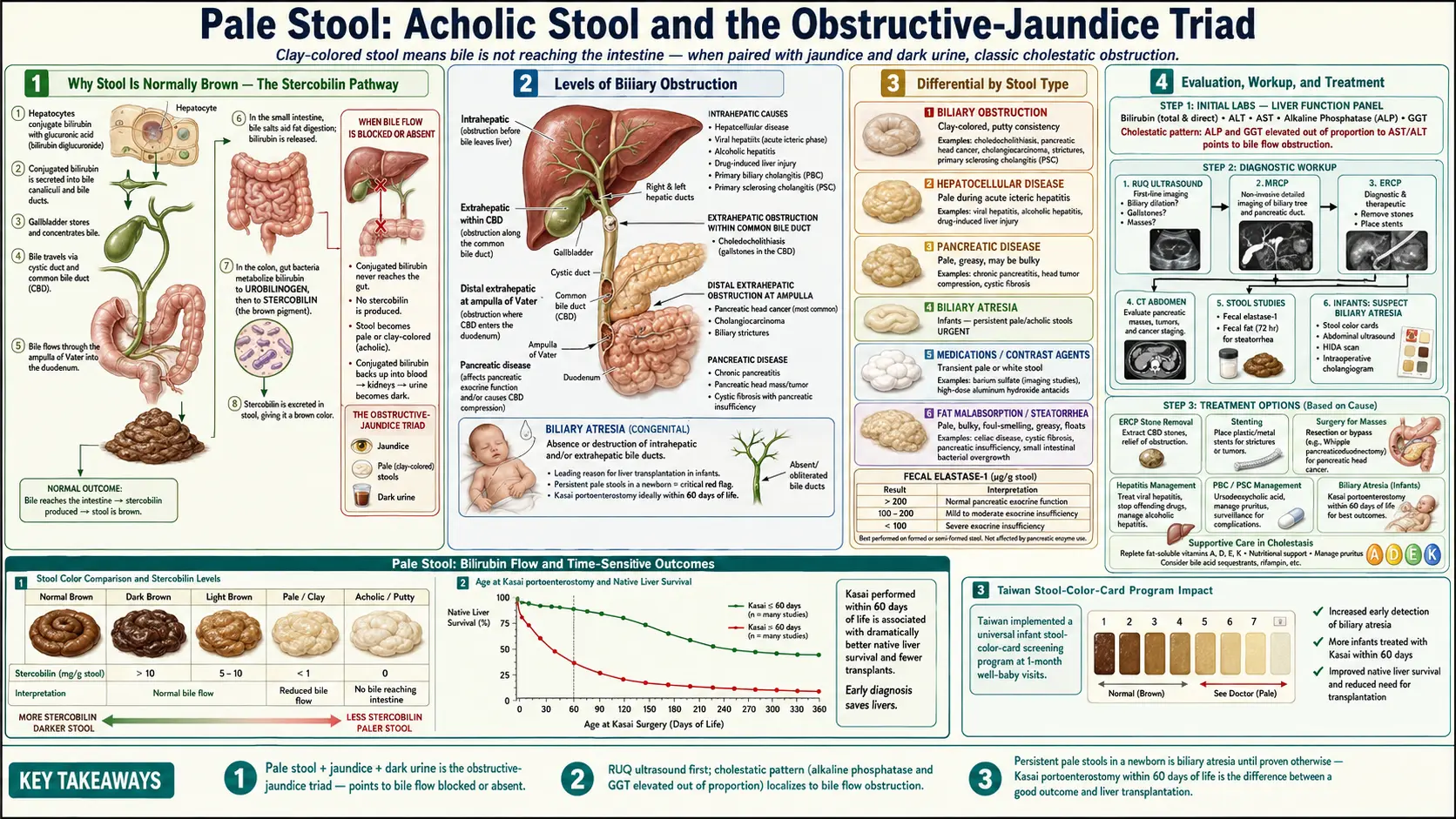
Pale stool — sometimes called acholic stool, clay-colored stool, or putty-colored stool — is a stool that lacks the normal brown pigment. It is a strong clue that bile is not reaching the intestine, which usually means there is a problem with the liver, bile ducts, or pancreas. When pale stools occur together with jaundice and dark urine, they form the classic triad of obstructive (cholestatic) jaundice.
Why Stool Is Normally Brown
The brown color of normal stool comes from stercobilin, a pigment formed when gut bacteria metabolize bilirubin in the intestine. Bile, produced by the liver and stored in the gallbladder, carries conjugated bilirubin into the small intestine through the bile ducts. If bile flow is blocked or absent, bilirubin never reaches the gut, no stercobilin is produced, and stool becomes pale or clay-colored. At the same time, the unused bilirubin backs up into the bloodstream and is excreted by the kidneys, darkening the urine.
Common Causes
- Biliary obstruction — gallstones in the common bile duct (choledocholithiasis), pancreatic head cancer, cholangiocarcinoma, biliary strictures, primary sclerosing cholangitis.
- Hepatocellular disease — viral hepatitis (especially during the acute icteric phase), alcoholic hepatitis, drug-induced liver injury, primary biliary cholangitis.
- Pancreatic disease — chronic pancreatitis, pancreatic head tumor compressing the bile duct, cystic fibrosis with pancreatic insufficiency.
- Biliary atresia — a congenital absence or destruction of bile ducts; the leading reason for liver transplantation in infants. Persistent pale stools in a newborn are a critical red flag.
- Medications and contrast agents — barium from imaging studies and high doses of antacids containing aluminum hydroxide can transiently lighten stool.
- Fat malabsorption — can produce pale, bulky, foul-smelling, greasy stools (steatorrhea), as in celiac disease, cystic fibrosis, or pancreatic insufficiency.
Evaluation
- Liver function panel — bilirubin (direct and total), ALT, AST, alkaline phosphatase, GGT. A "cholestatic pattern" — alkaline phosphatase and GGT disproportionately elevated — points to bile flow obstruction.
- Right upper quadrant ultrasound — first-line imaging to look for biliary dilation, gallstones, or masses.
- MRCP (magnetic resonance cholangiopancreatography) — non-invasive detailed imaging of the biliary tree.
- ERCP — diagnostic and therapeutic; can remove stones or place stents.
- CT scan — for pancreatic masses or staging cancer.
- Stool studies — fecal elastase for pancreatic insufficiency, fecal fat for steatorrhea.
- In infants — stool color cards, abdominal ultrasound, HIDA scan, and possibly intraoperative cholangiogram if biliary atresia is suspected.
Management
Treatment is directed at restoring bile flow or treating the underlying liver disease. Stones are removed via ERCP. Strictures and tumors may require stenting, surgical bypass, or resection. Hepatitis and primary biliary cholangitis are managed medically. Biliary atresia requires the Kasai portoenterostomy as early as possible, ideally within the first 60 days of life. Fat-soluble vitamin (A, D, E, K) deficiencies are common in prolonged cholestasis and should be replaced.
When to Seek Medical Care
- Persistent pale or clay-colored stool, especially with yellow skin or eyes, dark urine, or itching.
- Right upper quadrant pain, fever, or chills (concerning for cholangitis).
- Unexplained weight loss or back pain (concerning for pancreatic cancer).
- Pale stools in a newborn or infant — urgent evaluation for biliary atresia.
Connections
Key Research Papers
Historical Background
The link between pale stools and biliary obstruction was established in the 19th century with growing understanding of bile pigment metabolism. Morio Kasai's 1959 description of the hepatic portoenterostomy revolutionized the treatment of biliary atresia, transforming a once-fatal condition into one many infants survive with early intervention. Stool color cards distributed to parents of newborns in Taiwan and other countries have improved early detection of biliary atresia and outcomes.
Key Research Papers
- Hartley JL, Davenport M, Kelly DA. Biliary atresia. The Lancet. 2009;374(9702):1704-1713. — doi:10.1016/S0140-6736(09)60946-6
- Hsiao CH, Chang MH, Chen HL, et al. Universal screening for biliary atresia using an infant stool color card in Taiwan. Hepatology. 2008;47(4):1233-1240. — doi:10.1002/hep.22182
- European Association for the Study of the Liver. EASL Clinical Practice Guidelines: management of cholestatic liver diseases. Journal of Hepatology. 2009;51(2):237-267. — doi:10.1016/j.jhep.2009.04.009
- Lindor KD. Ursodeoxycholic acid for the treatment of primary biliary cirrhosis. New England Journal of Medicine. 2007;357(15):1524-1529. — doi:10.1056/nejmct074694
- Carey EJ, Ali AH, Lindor KD. Primary biliary cirrhosis. The Lancet. 2015;386(10003):1565-1575. — doi:10.1016/s0140-6736(15)00154-3
- Fawaz R, Baumann U, Ekong U, et al. Guideline for the evaluation of cholestatic jaundice in infants. Journal of Pediatric Gastroenterology and Nutrition. 2017;64(1):154-168. — doi:10.1097/MPG.0000000000001334
- Kasai M, Kimura S, Asakura Y, et al. Surgical treatment of biliary atresia. Journal of Pediatric Surgery. 1968;3(6):665-675. — doi:10.1016/0022-3468(68)90897-x
Featured Videos