Itching (Pruritus)
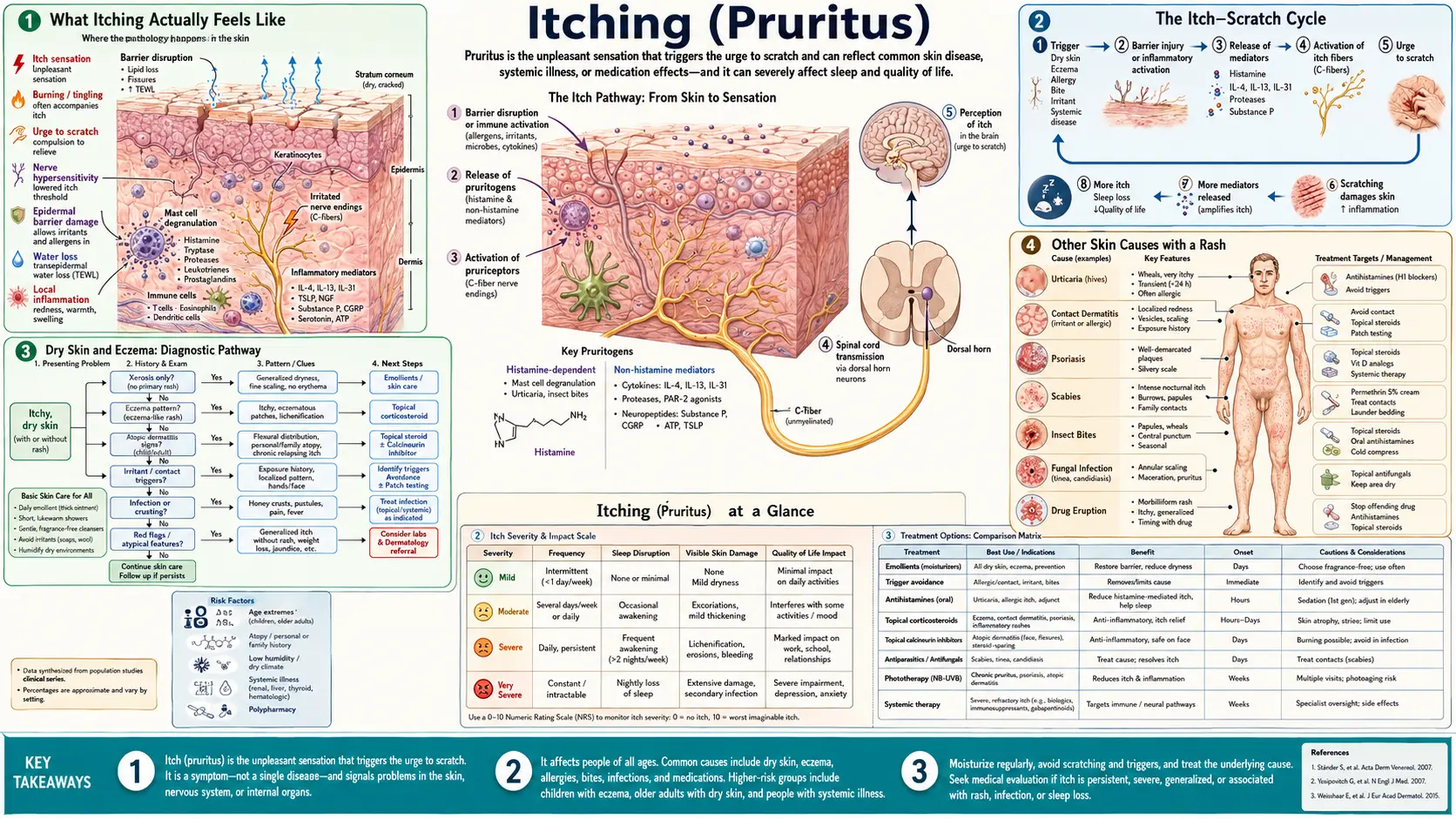
Table of Contents
- What Itching Actually Feels Like
- The Itch-Scratch Cycle
- Dry Skin and Eczema
- Other Skin Causes with a Rash
- Itching Without a Rash: A Systemic Clue
- Medications That Cause Itch
- Red Flags: When to Get Help Urgently
- How Itching Is Evaluated
- What Helps: Self-Care and Physical Measures
- When Medication Is Warranted
- What to Expect Over Time
- Connections
- Key Research Papers
- Featured Videos
What Itching Actually Feels Like
Itching — pruritus — is its own sensation with its own nerves, carried by thin unmyelinated C-fibers separate from the pain system. That is why painkillers do almost nothing for it, and why scratching, which is a mild pain signal, temporarily silences it.
How you describe your itch is a real diagnostic clue:
- Tight, papery, flaky, worse after a shower — dry skin.
- Deep, burning, unreachable, and scratching does not relieve it — points away from the skin toward an internal cause.
- Palms and soles, worse at night, no rash — a classic pattern in liver and bile-duct disease.
- Prickling within minutes of a warm shower, gone within the hour — aquagenic itch, which raises the question of a blood disorder.
- Hot, stinging, with welts that come and go in hours — hives.
European population studies find roughly 13–14% of adults have chronic itch at any moment, with a lifetime figure near 22–25%. Severe chronic itch scores comparably to chronic pain on quality-of-life measures. If you have been told your itch is "just dry skin" and it has taken over your nights, you are not being dramatic.
Itch lasting days to a couple of weeks usually has a findable external cause. Itch lasting more than six weeks is chronic by definition and deserves a systematic look, including blood work.
The Itch-Scratch Cycle
Almost every long-lasting itch, whatever started it, is kept alive by scratching — which is why the itch outlives its original cause.
- Something triggers the itch nerves — dryness, an allergen, an inflammatory chemical, a bile acid, a nerve injury.
- You scratch, and the pain and touch signal suppresses the itch pathway in the spinal cord. The relief is real and neurological, not psychological.
- The barrier breaks, and damaged skin releases inflammatory mediators — interleukin-31, interleukin-4 and interleukin-13, substance P, tryptase — several of which act directly on itch nerve endings.
- The itch returns stronger and wider, and the nerves sensitize so a waistband or a bedsheet now provokes itch (alloknesis).
- Repeated scratching thickens the skin into leathery plaques (lichenification) or firm itchy nodules (prurigo nodularis). Thickened skin itches more, and the loop is self-sustaining.
So breaking the mechanical loop is treatment, not just advice: short filed nails, cotton gloves at night, and cold or pressure instead of nails all measurably reduce damage. And night is the danger zone — skin blood flow rises in the evening, cortisol is at its daily low, and there is no distraction. Much scratching happens in light sleep with no memory of it, so damage appearing overnight is expected, not mysterious.
Dry Skin and Eczema
These two account for most of the itch that reaches a clinic, and both are worth addressing in nearly everyone — even when a systemic disease is present, because dry skin makes every other kind of itch worse.
Dry Skin (Xerosis)
The outer skin layer is held together by a lipid mortar of ceramides, cholesterol and fatty acids. Deplete it and water evaporates too fast, the layer cracks microscopically, and nerve endings sit closer to the surface — a fine, tight, flaky itch, worst on the shins, forearms and back. What depletes it: age (lipid and sweat output fall steadily after about 50, making xerosis by far the commonest cause of itch in older people); low humidity (indoor heating can drop relative humidity below 20%, producing "winter itch" and its cracked form, asteatotic eczema); hot water and foaming soap; and medical contributors — hypothyroidism, diabetes, kidney disease, statins, retinoids, diuretics.
Eczema (Atopic Dermatitis)
Eczema is dry skin plus immune inflammation, and the prototypical itch-first disease — "the itch that rashes," because in a flare the itch often precedes any visible change. It affects roughly 10–20% of children and 5–10% of adults.
Two things are broken at once. The barrier is genetically leaky — loss-of-function variants in the filaggrin gene are the strongest known risk factor. And the immune response is skewed toward type 2 inflammation dominated by interleukin-4, interleukin-13 and interleukin-31, the last of which acts directly on sensory nerves and is often called the "itch cytokine." That is why drugs blocking those signals relieve itch dramatically while antihistamines barely help: histamine is not the main driver of eczema itch — the commonest reason people conclude that "nothing works."
Typical appearance: red, or on darker skin violet-brown to grey, scaly patches — weeping when acute, thickened when chronic — behind the knees, inside the elbows, on the neck, wrists and ankles in adults, and on the cheeks in infants. Abrupt worsening with golden crusting means secondary Staphylococcus aureus infection. See Eczema and Contact Dermatitis.
Other Skin Causes with a Rash
When there is a visible rash the pattern usually names the diagnosis. A few deserve special mention because they are commonly missed or mistreated.
Scabies — the one missed most often
Suspect scabies in anyone with severe relentless itch that is dramatically worse at night and affects more than one person in the household. The itch is an allergic reaction to the burrowing mite Sarcoptes scabiei and its eggs and feces, which is why it takes four to six weeks to appear on a first infestation and can be brutal with only a dozen mites present. Look for short wavy burrows and papules in the finger webs, wrists, elbows, armpits, waistband and genitals; in adults the face and scalp are spared. It is often misdiagnosed as eczema and treated with steroids, which suppress the rash while the mites spread. Permethrin 5% cream or oral ivermectin works, with all household contacts treated at once, but the itch commonly continues two to four weeks afterwards. See Scabies.
Hives (Urticaria)
Raised, pale-centred welts that appear, migrate and vanish within 24 hours leaving no mark. This is the one itch that is genuinely histamine-driven, which is why non-sedating antihistamines work well. Acute hives usually follow an infection, food or drug; chronic hives lasting over six weeks are more often autoimmune than allergic, so hunting for a food trigger is usually a dead end. Welts lasting beyond 24 hours, or bruising, are not ordinary hives. See Hives and Flushing and Urticaria.
Psoriasis, contact dermatitis, fungal infection, blistering disease
Psoriasis gives thick plaques with silvery scale on elbows, knees, scalp and lower back; long taught to be non-itchy, but surveys find 60–90% of patients itch (see Psoriasis). Contact dermatitis is confined to where something touched the skin — nickel, fragrance, hair dye, poison ivy — so a geometric or one-sided rash is a strong hint. Fungal infection itches with a scaly advancing edge, and steroid creams make it spread. Bullous pemphigoid can begin with weeks to months of severe itch and only vague eczema-like patches before any blister appears, which is why unexplained intense itch over age 70 is a reason to biopsy (see Bullous Pemphigoid). Bed bugs give grouped or linear papules appearing overnight.
Itching Without a Rash: A Systemic Clue
This is the most important section on this page. Generalized itch with normal-looking skin — nothing beyond scratch marks — is a different problem from itchy dermatitis, and it can be the first sign of internal disease. In series of adults with generalized itch and no primary skin lesions, a systemic cause is found in a meaningful minority, commonly reported around 10–25%. That is high enough that unexplained chronic rashless itch always earns blood work. The giveaway: scratch marks and thickened patches within easy reach, while the middle of the back stays clear. The visible damage is all self-inflicted, and the itch is coming from somewhere else.
Liver and bile-duct disease (cholestatic itch)
Itch from impaired bile flow is among the most severe forms of pruritus in medicine, and the most under-recognized. Its pattern is distinctive: it often starts on the palms and soles, is worse at night, brings little relief from scratching, and can appear months or years before jaundice.
Conditions to consider: primary biliary cholangitis (autoimmune destruction of small bile ducts, overwhelmingly in women, with pruritus affecting a majority of patients at some point), primary sclerosing cholangitis, bile-duct obstruction from a stone or tumour, drug-induced cholestasis, chronic hepatitis B and C, cirrhosis, and intrahepatic cholestasis of pregnancy — which carries real fetal risk and is never "just pregnancy itch."
The old explanation — bile salts in the skin — does not fit, because itch severity correlates poorly with bile-acid levels. Evidence now points to lysophosphatidic acid and the enzyme that generates it, autotaxin, whose activity tracks itch intensity and falls when the itch is treated; opioid and serotonin signaling also contribute, which is why opioid antagonists and sertraline help some patients. Alkaline phosphatase and gamma-glutamyl transferase rise disproportionately, often with bilirubin still normal early, and anti-mitochondrial antibody is positive in most primary biliary cholangitis. Look also for dark urine, pale stool and jaundice. See Primary Biliary Cholangitis and Liver Disease.
Kidney failure (CKD-associated pruritus)
The international Dialysis Outcomes and Practice Patterns Study found roughly 40–45% of hemodialysis patients report moderate to extreme itch, with greater severity tracking worse sleep and higher mortality. It is typically generalized and symmetrical, worst on the back, abdomen and arms, often worse during or just after dialysis and at night, on dry skin. It is not simply "toxin buildup": contributors include shifted opioid-receptor signaling, low-grade inflammation, small-fiber neuropathy and secondary hyperparathyroidism with high phosphate. See Kidney Disease and Kidney Function Tests.
Thyroid disease
Both directions itch. Hypothyroidism gives dry, coarse, cool skin with reduced sweating — xerotic itch — plus fatigue, cold intolerance and hair thinning. Hyperthyroidism gives warm, moist, flushed skin, heat intolerance and generalized itch, and Graves' disease is also associated with chronic hives. Because the test is cheap and decisive, TSH belongs in the first round of blood work for any unexplained chronic itch. See Thyroid Disorders.
Iron deficiency
Iron deficiency can cause generalized itch with or without anemia, and the itch resolves once stores are restored — one of the most satisfying causes to find. It has no distinguishing features, so it is caught by testing, not pattern recognition. A ferritin below about 30 ng/mL indicates depleted stores in most laboratories, and 30–50 may still be inadequate when inflammation is present. Ask about heavy periods, vegetarian diets, celiac disease and gut blood loss — in an older adult, unexplained iron deficiency is itself a reason to investigate the bowel. See also Ferritin, Iron and Iron-Deficiency Anemia.
Lymphoma and other blood cancers
Itch is a recognized feature of Hodgkin lymphoma, reported in something like 10–30% of patients, and notable for sometimes preceding the diagnosis by months to years. Severe unexplained itch with night sweats, fever, weight loss, or painless rubbery nodes above the collarbone should not be treated in isolation. Cutaneous T-cell lymphoma (mycosis fungoides) can masquerade for years as an itchy, treatment-resistant "eczema": a rash that has failed multiple correct treatments deserves a biopsy.
Polycythemia vera and related myeloproliferative disorders cause aquagenic pruritus: intense prickling within minutes of water contact, typically a warm shower, with no rash, fading over the next hour. It is reported in a substantial minority, often before diagnosis, and dismissed for years. A complete blood count showing raised hemoglobin, hematocrit or platelets, especially with a low ferritin, points the way. See Lymphoma, Polycythemia Vera, Swollen Lymph Nodes and Night Sweats.
Other internal causes worth naming
Diabetes (dry skin, neuropathy, thrush in skin folds — new genital itch can be its presentation), HIV infection at any stage, and celiac disease, whose dermatitis herpetiformis gives itchy blisters on elbows and knees. Also neuropathic itch, where a damaged nerve rather than the skin generates the signal — notalgia paresthetica (upper back, one side), brachioradial pruritus (outer forearm, cervical spine disease), post-shingles itch. These ignore steroids and antihistamines and need gabapentin or capsaicin.
Medications That Cause Itch
Drug-induced itch is common, often rashless, and frequently overlooked because the drug was started weeks or months before the itch. Review every medication and supplement with its start date.
- Opioids, especially spinal or epidural morphine — itch through central mu-opioid receptor activation, classically on the face and nose. Not an allergy; switching agents is the usual answer.
- Statins (dry skin, occasionally cholestasis), ACE inhibitors, calcium channel blockers, hydrochlorothiazide (photosensitive eruptions), and estrogens or anabolic steroids (cholestasis with rashless itch).
- Allopurinol, penicillins, sulfonamides, anticonvulsants — drug eruptions, sometimes serious; amiodarone and hydroxychloroquine — intense, prolonged itch.
- Checkpoint inhibitors and EGFR-targeted cancer drugs — itch and eczema-like eruptions are among their commonest side effects. Alcohol and hot drinks are not causes but reliable amplifiers, through skin vasodilation.
Itch with a spreading rash, fever, facial swelling, or feeling systemically unwell within days to weeks of a new drug can be the start of a serious drug reaction and should be assessed the same day. See DRESS Syndrome.
Red Flags: When to Get Help Urgently
Most itch is not dangerous. These features change that.
Go to an emergency department now
- Itch with swelling of the lips, tongue, throat or face, difficulty breathing or swallowing, wheezing, vomiting or feeling faint — this is anaphylaxis. Use prescribed epinephrine and call emergency services; do not wait to see whether it settles.
- Itch with a rapidly spreading painful rash, blistering, peeling skin, or sores in the mouth, eyes or genitals, with fever — possible severe drug reaction. Also fever with a rash that does not blanch when pressed.
- New itch plus yellow eyes or skin, dark urine, pale stools, and abdominal pain or fever — possible bile-duct obstruction or biliary infection.
See a doctor within a few days
- Itch anywhere in pregnancy, especially third-trimester itch on palms and soles. Cholestasis of pregnancy carries fetal risk and is diagnosed with a bile-acid and liver blood test. Never wait this one out.
- Itch with unintended weight loss, drenching night sweats or fever, or with painless swollen lymph nodes in the neck, armpit, groin or above the collarbone.
- Any yellowing of the eyes or skin, even without pain.
- Severe itch that prevents sleep or is driving you to break the skin.
- Aquagenic itch — prickling within minutes of a shower, no rash — which warrants a complete blood count.
- A single itchy patch that is growing, changing colour, bleeding or ulcerating, or an itchy mole — skin cancers can itch.
- Severe generalized itch new after age 65 without an obvious dry-skin explanation, or any itch in someone with HIV, a history of cancer, or on immunosuppressive medication.
- Itch that started within weeks of a new medication, or lasting more than six weeks unexplained.
How Itching Is Evaluated
A good evaluation answers three questions in order: is there a primary rash, is there evidence of internal disease, and is a nerve or a drug responsible?
History and examination
Expect to be asked where it itches and where it does not; how long; timing — night-time predominance, season, relationship to showering, dialysis or heat; whether scratching relieves it (if not, think systemic or neuropathic); which came first, itch or rash; every drug and supplement with start dates; household itching, travel, new pets or bedding; and a review of weight, fevers, sweats, urine and stool colour and heat or cold intolerance. Say plainly how the itch affects sleep and mood — that gauges severity, and both are treatable in their own right.
The examination covers the whole skin surface including scalp, nails, finger webs, genitals and soles, separating a primary rash from pure scratch damage and looking for burrows, dermographism (a welt raised by stroking the skin, suggesting urticaria), lichenification, jaundice, pallor, an enlarged thyroid, lymph nodes, and an enlarged liver or spleen. A skin biopsy is taken when bullous pemphigoid or cutaneous lymphoma is a consideration.
First-round blood tests
A complete blood count with differential (anemia, raised hemoglobin or platelets, eosinophilia); a liver panel including alkaline phosphatase, gamma-glutamyl transferase, transaminases and bilirubin, hunting the cholestatic pattern; creatinine and eGFR, with calcium and phosphate in known kidney disease; TSH; ferritin, with full iron studies if low or borderline; fasting glucose or HbA1c; and CRP or ESR and lactate dehydrogenase — nonspecific, but redirecting when abnormal.
Targeted second-round testing
Anti-mitochondrial antibody and ultrasound if the liver panel is cholestatic, MR cholangiography for a suspected duct problem, serum bile acids in pregnancy, HIV testing offered broadly, and celiac serology with a suggestive rash or iron deficiency. CT of chest, abdomen and pelvis is for when lymphoma is a real consideration — red-flag features, not isolated itch with normal blood work. Otherwise: skin scrapings for fungus or mites, patch testing, spine imaging for a neuropathic pattern, and cancer screening up to date.
If a thorough first round is normal and there are no red flags, guidelines support treating the itch symptomatically and reassessing in a few months rather than escalating imaging indefinitely.
What Helps: Self-Care and Physical Measures
These are not filler before the "real" treatment. In dry-skin and eczema itch they often are the treatment, and in systemic itch they reduce how much medication is needed.
Washing and emollients
Lukewarm, not hot — hot water buys seconds of relief and hours of worse itch. Keep showers under 10 minutes, with a fragrance-free soap-free cleanser only where needed. Pat dry, do not rub, leaving the skin slightly damp, and moisturize within three minutes — the highest-yield habit on this page.
Apply emollient generously at least twice daily. For whole-body dryness adults typically need 250–500 g per week; a small tube lasting a month is a sign of under-treatment. Choose thick fragrance-free creams or ointments with ceramides, glycerin, urea (5–10%) or colloidal oatmeal, and keep one in the refrigerator — cold cream is itself an itch suppressant. Avoid topical diphenhydramine and "-caine" anaesthetics, which often cause contact allergy.
Cool the nerves, protect the skin from yourself
- Cold is the most reliable non-drug itch blocker: a cool damp cloth or wrapped gel pack, 10 minutes at a time. Menthol 1–2% gives a similar counter-sensation on intact skin. Wet wraps — damp cotton over emollient or prescribed steroid, an hour or overnight — can break a severe flare.
- Pressure, patting or a firm slap instead of nails; nails cut short and filed smooth; cotton gloves at night; loose cotton, no wool next to skin. Habit reversal — noticing the urge and substituting a competing action — has real evidence in eczema and prurigo and beats willpower alone.
The room, the night, and diet
Keep the bedroom around 18–20 °C (65–68 °F), add winter humidity toward 40–50%, and apply emollient right before bed. For most chronic itch there is no itch diet — the exceptions are strict gluten avoidance in dermatitis herpetiformis, and alcohol, which reliably worsens itch. Stress amplifies itch without causing it, so treating anxiety or depression reduces measured severity.
When Medication Is Warranted
Medication is appropriate when self-care has genuinely been tried and failed, when sleep is being destroyed, when the skin is being broken, or as soon as a specific cause is found — cause-directed treatment beats symptom-directed treatment every time.
The honest truth about antihistamines
Non-sedating antihistamines (cetirizine, loratadine, fexofenadine) are excellent for hives, and international urticaria guidelines support raising the dose up to four times standard under medical supervision before adding anything else. For eczema, dry-skin itch, kidney itch, liver itch and neuropathic itch they are largely ineffective, because histamine is not the driver. Sedating antihistamines such as hydroxyzine work there mainly by putting you to sleep, and in older adults they carry real risks of confusion and falls.
Topical prescription treatments
- Topical corticosteroids — the mainstay for inflammatory rashes, potency matched to site: low on face and groin, stronger on palms, soles and thick plaques. Safe for flares; thinning if used indefinitely. They do not help rashless systemic itch, and they worsen scabies and fungal infection.
- Topical calcineurin inhibitors (tacrolimus, pimecrolimus) and ruxolitinib cream — steroid-free, safe on the face and for maintenance. Capsaicin cream is for localized neuropathic itch; it burns before it helps.
Systemic and cause-directed treatments
- Gabapentin or pregabalin — the workhorses for neuropathic and kidney-related itch, with randomized evidence in hemodialysis patients. Start low, titrate slowly, reduce the dose in kidney impairment. Difelikefalin, a peripherally restricted kappa-opioid agonist, is approved for moderate-to-severe itch in adults on hemodialysis.
- Cholestyramine — first-line for cholestatic itch; take it before and after breakfast and keep other medicines four hours away, because it binds them too. Rifampicin, naltrexone and sertraline follow, reflecting the opioid and serotonin components, and bezafibrate reduced moderate-to-severe itch in a randomized placebo-controlled trial in fibrosing cholangiopathies.
- Dupilumab — blocks interleukin-4 and interleukin-13 signaling; it produced large, rapid falls in itch scores in the pivotal phase 3 eczema trials. Oral JAK inhibitors (upadacitinib, abrocitinib) work too, with a boxed-warning safety profile.
- Narrowband UVB phototherapy — useful across eczema, psoriasis and kidney-related itch. Low-dose mirtazapine, doxepin or an SSRI can be prescribed deliberately for the itch, not only for mood.
- Treating the disease — ursodeoxycholic acid, phosphate control and adequate dialysis, iron repletion, thyroid correction, treating the lymphoma. This is what ends the itch.
Systemic corticosteroids relieve almost any itch briefly but are a poor long-term choice: the itch rebounds on withdrawal.
What to Expect Over Time
The honest answer depends entirely on the cause.
- Dry-skin itch improves within one to three weeks of consistent emollient use, but returns whenever the routine lapses — maintenance, not failure. Eczema runs in flares and remissions; most childhood eczema improves markedly by adolescence, and adult eczema is more persistent but far more treatable than it used to be.
- Acute hives resolve in days to weeks, and chronic urticaria usually remits on its own — roughly half within a year, most within two to five years. Drug-induced itch resolves within weeks of stopping the drug. Scabies is cured by treatment, but the itch tails off over two to four weeks; beyond six weeks suspect re-infestation or an untreated contact.
- Cholestatic itch follows the liver disease, and not neatly — severity varies independently of laboratory numbers and can wax and wane for years. It usually responds stepwise to the treatment ladder, and intractable itch is itself an accepted reason to consider liver transplantation. Kidney-related itch likewise fluctuates with dialysis adequacy and mineral control, and improves greatly after a successful transplant.
- Thyroid and iron-deficiency itch resolve once the abnormality is corrected, over weeks to a few months — the best cases, and a reason to test rather than assume. Neuropathic itch is often long-lasting but controllable with the right drug class; it ignores anti-inflammatory creams, so getting the label right unlocks progress.
Chronic itch of unknown origin persists in a substantial minority even after a full evaluation. It is still treatable, and it does not mean something was missed if the workup was thorough. Two closing points: sensitized nerves take weeks to settle even after the cause is fixed, so do not abandon a treatment that seems to be working slowly; and severe itch deserves to be treated as a serious symptom, not a cosmetic complaint. If you have been dismissed, ask for a full skin examination, the first-round blood panel above, and a medication review.
Connections
Key Research Papers
Key Research Papers
- Yosipovitch G, Bernhard JD. Chronic pruritus. N Engl J Med. 2013;368(17):1625-1634. — Search PubMed
- Weisshaar E, Szépietowski JC, Dalgard FJ, et al. European S2k Guideline on Chronic Pruritus. Acta Derm Venereol. 2019;99(5):469-506. — Search PubMed
- Matterne U, Apfelbacher CJ, Loerbroks A, et al. Prevalence, correlates and characteristics of chronic pruritus: a population-based cross-sectional study. Acta Derm Venereol. 2011;91(6):674-679. — Search PubMed
- Kremer AE, Martens JJWW, Kulik W, et al. Lysophosphatidic acid is a potential mediator of cholestatic pruritus. Gastroenterology. 2010;139(3):1008-1018. — Search PubMed
- de Vries E, Bolier R, Goet J, et al. Fibrates for itch (FITCH) in fibrosing cholangiopathies: a double-blind, randomized, placebo-controlled trial. Gastroenterology. 2021;160(3):734-743. — Search PubMed
- Pisoni RL, Wikström B, Elder SJ, et al. Pruritus in haemodialysis patients: international results from the Dialysis Outcomes and Practice Patterns Study (DOPPS). Nephrol Dial Transplant. 2006;21(12):3495-3505. — Search PubMed
- Fishbane S, Jamal A, Munera C, et al. A phase 3 trial of difelikefalin in hemodialysis patients with pruritus. N Engl J Med. 2020;382(3):222-232. — Search PubMed
- Simpson EL, Bieber T, Guttman-Yassky E, et al. Two phase 3 trials of dupilumab versus placebo in atopic dermatitis. N Engl J Med. 2016;375(24):2335-2348. — Search PubMed