Swollen Lymph Nodes (Lymphadenopathy)
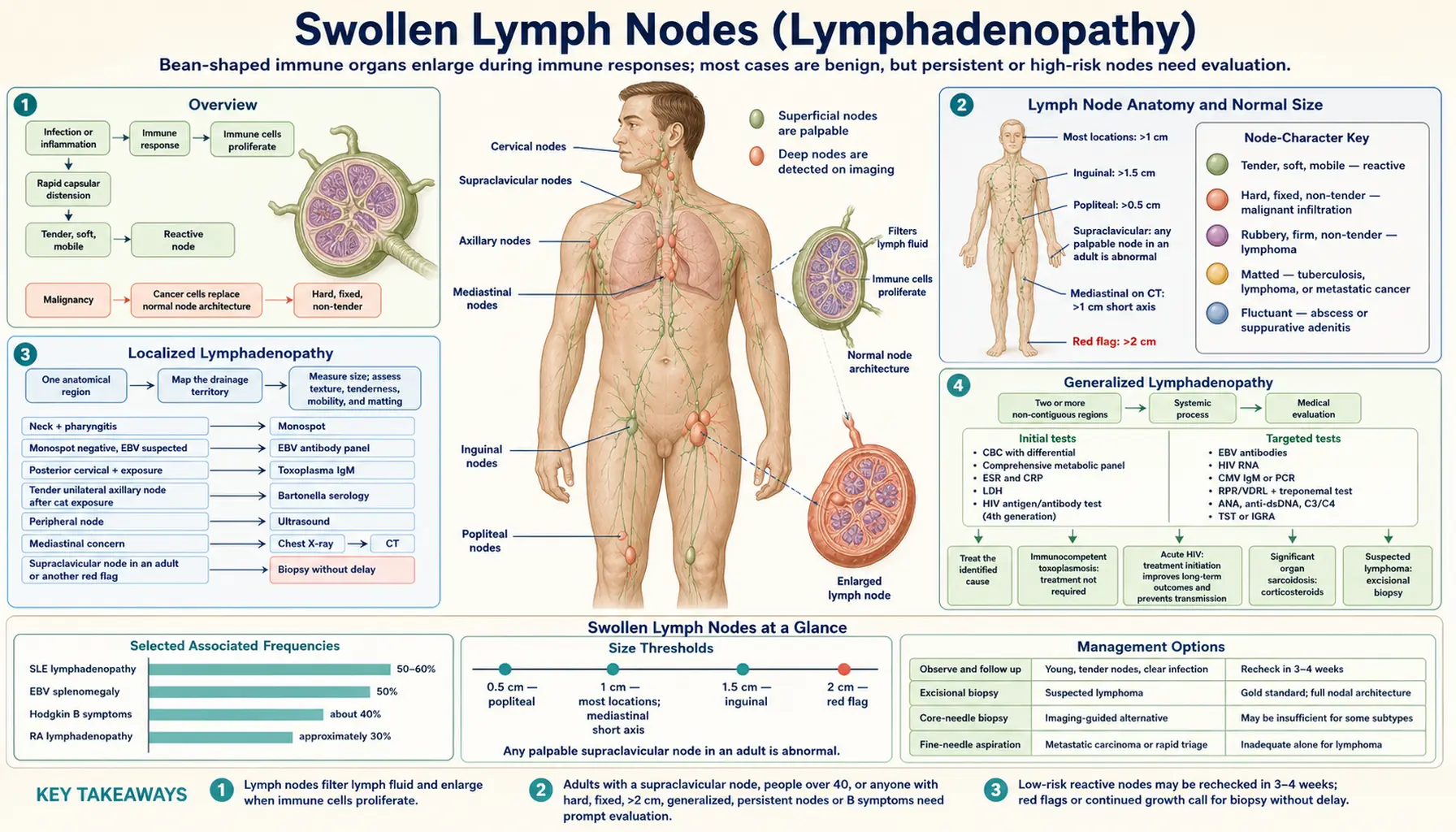
Table of Contents
Overview
Lymphadenopathy — swollen lymph nodes — is one of the most common physical findings in medicine. Lymph nodes are bean-shaped immune organs distributed throughout the body that filter lymph fluid and house the immune cells that respond to infection, inflammation, and malignancy. When the body mounts an immune response, lymph nodes enlarge as immune cells proliferate inside them.
Most cases of swollen lymph nodes are benign and self-limiting: a viral upper respiratory infection produces tender, swollen cervical nodes that resolve within two to four weeks as the infection clears. However, lymphadenopathy can also signal lymphoma, leukemia, metastatic cancer, HIV, mononucleosis, or serious systemic infections — and distinguishing these from benign reactive lymphadenopathy is one of the most important tasks in clinical medicine.
This page covers the full spectrum of causes, the anatomical clues that help narrow the differential, the red flags that should prompt urgent evaluation, and the diagnostic approach your doctor will use — including when a biopsy is needed.
Lymph Node Anatomy and Normal Size
The body contains approximately 600 to 700 lymph nodes, but only superficial nodes — cervical, axillary, and inguinal — are routinely palpable. Deep nodes (mediastinal, retroperitoneal, mesenteric) are not accessible to physical examination and are detected on imaging.
Normal Size Thresholds
A node is considered enlarged when it exceeds the following size thresholds on physical examination or imaging:
- Most body locations: greater than 1 cm in the shortest diameter.
- Inguinal nodes: greater than 1.5 cm (inguinal nodes are normally larger because they drain a large surface area with frequent minor trauma and infections).
- Popliteal nodes: greater than 0.5 cm (rarely palpated; enlargement is always abnormal).
- Supraclavicular nodes: any palpable supraclavicular node in an adult is abnormal and demands evaluation — these nodes drain the chest, abdomen, and lungs.
- Mediastinal nodes on CT: greater than 1 cm in short axis.
Character of Nodes
The texture and tenderness of a lymph node give important diagnostic clues:
- Tender, soft, mobile: Reactive (infection or inflammation). The node wall is intact and the tenderness reflects rapid capsular distension.
- Hard, fixed, non-tender: Malignant infiltration. Cancer cells replace the normal node architecture; the lack of tenderness reflects the absence of the acute inflammatory response.
- Rubbery, firm, non-tender: Characteristic of lymphoma. The nodes feel like a rubber eraser — distinct from the stony hardness of metastatic carcinoma.
- Matted (nodes fused together): Suggests tuberculosis, lymphoma, or metastatic cancer.
- Fluctuant: Abscess or suppurative (pus-forming) adenitis — most often bacterial.
Localized Lymphadenopathy
Localized (regional) lymphadenopathy involves nodes in a single anatomical region. Because each region drains specific tissues, the location of the enlarged nodes narrows the differential diagnosis considerably.
Cervical Lymph Nodes (Neck)
Cervical lymphadenopathy is the most common type seen in clinical practice. The neck is divided into anterior and posterior chains, with different significance:
- Anterior cervical nodes: Drain the teeth, gingiva, tongue, and pharynx. The most common causes are bacterial pharyngitis (Group A Streptococcus), viral upper respiratory infections, dental abscess, and peritonsillar abscess. In younger adults, EBV infectious mononucleosis classically produces bilateral anterior cervical lymphadenopathy with exudative pharyngitis, splenomegaly, and fatigue. Squamous cell carcinoma of the mouth, tongue, and oropharynx — particularly HPV-associated oropharyngeal cancer — presents with unilateral, non-tender, hard anterior cervical nodes in older patients or in younger patients with risk factors (tobacco, alcohol, HPV-16).
- Posterior cervical nodes: Less commonly enlarged; EBV mononucleosis characteristically involves posterior cervical nodes (a distinguishing feature from streptococcal pharyngitis, which tends to be anterior). Viral infections, toxoplasmosis, and rubella also involve posterior cervical chains.
- Submandibular and submental nodes: Drain the floor of the mouth, lips, and tongue. Dental infections (periapical abscess, periodontitis) and oral cavity cancers are the primary concerns.
- Occipital nodes: Drain the posterior scalp. Scalp infections (tinea capitis, impetigo, seborrheic dermatitis with secondary infection) and rubella are the leading causes.
- Supraclavicular nodes: Always abnormal in adults. Right supraclavicular lymphadenopathy drains the lungs and mediastinum — lung cancer and lymphoma are the most important causes. Left supraclavicular (Virchow's node) enlargement specifically suggests intra-abdominal malignancy (stomach, pancreas, ovary, colon) via the thoracic duct.
Axillary Lymph Nodes (Armpit)
Axillary lymphadenopathy in women demands immediate consideration of breast cancer — ipsilateral, hard, fixed, non-tender axillary nodes in a woman are a malignancy until proven otherwise. Other causes include:
- Cat scratch disease (Bartonella henselae): unilateral, tender axillary lymphadenopathy appearing three to four weeks after a cat scratch or bite, often in the ipsilateral arm or hand. Nodes can become fluctuant. The hallmark is the temporal link to cat exposure. Diagnosis is clinical; Bartonella serology confirms. Most cases resolve spontaneously in two to four months.
- Upper extremity infections: Cellulitis, paronychia, infected wounds of the arm or hand drain to ipsilateral axillary nodes.
- Lymphoma: Axillary nodes may be involved in both Hodgkin's and non-Hodgkin's lymphoma, though cervical and mediastinal involvement is more typical.
- Melanoma: Melanoma of the arm, shoulder, or upper back can metastasize to ipsilateral axillary nodes; sentinel lymph node biopsy guides staging.
- Silicone implant-associated changes: Breast implant illness and anaplastic large cell lymphoma (BIA-ALCL) are rare but recognized causes of axillary lymphadenopathy in women with breast implants.
Inguinal Lymph Nodes (Groin)
Inguinal nodes drain the lower extremities, external genitalia, perineum, and lower abdominal wall. Because they drain a large skin surface area exposed to frequent minor trauma and infections, small inguinal nodes (up to 1.5 cm) are often normally palpable and not clinically significant. Causes of pathological inguinal lymphadenopathy include:
- Sexually transmitted infections: Primary syphilis causes a painless unilateral inguinal node (the "bubo" of primary syphilis accompanying the chancre). Herpes simplex virus type 2 produces bilateral tender inguinal lymphadenopathy. Lymphogranuloma venereum (LGV, caused by Chlamydia trachomatis serovars L1-L3) causes large tender matted inguinal nodes — the classic "groove sign" (nodes above and below the inguinal ligament separated by the ligament itself). Gonorrhea and chancroid are additional STI causes.
- Lower extremity infections: Cellulitis, infected ulcers, and tinea pedis with secondary bacterial infection drain to inguinal nodes.
- Vulvar, penile, and anal cancer: Hard fixed inguinal nodes in the context of a lesion in the corresponding region signal squamous cell carcinoma.
- Lymphoma: Inguinal involvement is less common than cervical or axillary but occurs in widespread disease.
Generalized Lymphadenopathy
Generalized lymphadenopathy (GLA) involves lymph nodes in two or more non-contiguous regions. It signals a systemic process — infection, malignancy, or autoimmune disease — and almost always requires medical evaluation.
Infectious Mononucleosis (EBV)
Epstein-Barr virus (EBV) infectious mononucleosis is the most common cause of generalized lymphadenopathy in young adults and adolescents. The classic presentation is the triad of fever, exudative pharyngitis (often with a white tonsillar exudate that can mimic streptococcal pharyngitis), and bilateral cervical lymphadenopathy — often involving both anterior and posterior chains. Splenomegaly occurs in 50% of patients and is the most dangerous complication (splenic rupture risk, though rare, contraindicates contact sports for at least four weeks after diagnosis). Generalized lymphadenopathy, hepatitis (elevated transaminases), rash (particularly after amoxicillin administration — the classic maculopapular rash of mono), and fatigue rounding out the picture. The monospot (heterophile antibody) test is positive in about 85% of cases; EBV-specific antibodies (VCA IgM, EBNA) are needed when monospot is negative (young children, early disease).
HIV Primary Infection (Acute Retroviral Syndrome)
Acute HIV infection (primary HIV infection or acute retroviral syndrome, ARS) occurs two to four weeks after exposure and produces a mononucleosis-like illness: fever, pharyngitis, generalized lymphadenopathy, rash (often a maculopapular exanthem on the trunk), oral ulcers, arthralgias, and night sweats. The lymphadenopathy is typically generalized, involving cervical, axillary, and inguinal nodes. Diagnosis at this stage requires HIV RNA (viral load), as the standard HIV antigen/antibody test (4th generation) may be negative in the earliest days of infection. Identifying primary HIV infection is important: treatment initiation during acute infection improves long-term outcomes and prevents transmission. In chronic HIV disease, persistent generalized lymphadenopathy (PGL) — defined as enlarged nodes in two or more extra-inguinal sites for more than three months without another explanation — is a recognized clinical stage of HIV infection.
Cytomegalovirus (CMV)
CMV produces a syndrome clinically indistinguishable from EBV mononucleosis in immunocompetent hosts — fever, fatigue, pharyngitis, and lymphadenopathy — but the monospot test is negative ("heterophile-negative mononucleosis"). CMV mononucleosis tends to have less pharyngitis and fewer atypical lymphocytes than EBV but more prominent hepatitis. Diagnosis is by CMV IgM antibody or CMV PCR. In immunocompromised patients (transplant recipients, people with AIDS), CMV causes severe end-organ disease (retinitis, colitis, pneumonitis, encephalitis).
Toxoplasmosis
Toxoplasma gondii infection in immunocompetent adults characteristically causes posterior cervical lymphadenopathy — often the dominant finding — which may be generalized. The nodes are tender, discrete, and do not suppurate. Most patients have mild constitutional symptoms (fatigue, low-grade fever) or are asymptomatic. Exposure sources include undercooked meat (particularly pork and lamb) and cat feces (oocysts shed in cat stool). Diagnosis is by Toxoplasma IgM antibody. Treatment is not required in immunocompetent hosts; disease is self-limiting over weeks to months. In immunocompromised patients (HIV/AIDS), reactivation toxoplasmosis causes severe encephalitis.
Secondary Syphilis
Secondary syphilis — occurring six to eight weeks after the primary chancre — is a systemic illness characterized by a distinctive rash (classically a non-itchy maculopapular rash involving the palms and soles, which is highly specific for secondary syphilis), widespread lymphadenopathy (generalized, non-tender, "shotty"), fever, malaise, and mucous membrane lesions ("mucous patches"). The lymphadenopathy of secondary syphilis is one of the few causes of non-tender generalized lymphadenopathy and should be included in the differential of any unexplained generalized lymphadenopathy in a sexually active person. Diagnosis is by serology: non-treponemal tests (RPR, VDRL) plus confirmatory treponemal tests (FTA-ABS, TP-PA).
Other Infectious Causes of Generalized Lymphadenopathy
- Brucellosis: Gram-negative zoonosis transmitted through unpasteurized dairy or direct animal contact (livestock, veterinarians). Produces undulating (waves of) fever, profound night sweats, arthralgias, and generalized lymphadenopathy. Often underdiagnosed because of unusual exposure history and protean manifestations. Serology (Brucella agglutination) or blood culture confirms diagnosis.
- Leptospirosis: Spirochetal infection from contact with water or soil contaminated by infected animal urine. Presents with fever, headache, myalgia, conjunctival suffusion, and lymphadenopathy; can progress to Weil's disease (jaundice, acute kidney injury, hemorrhage).
- Disseminated tuberculosis: Reactivation or primary disseminated TB causes generalized lymphadenopathy in addition to constitutional symptoms. TB lymphadenitis most commonly involves cervical nodes, producing characteristic matted, soft, fluctuant nodes that can ulcerate and form sinuses (scrofula).
- Histoplasmosis and other fungal infections: Disseminated histoplasmosis (endemic to Ohio and Mississippi River valleys) causes fever, weight loss, hepatosplenomegaly, and generalized lymphadenopathy, particularly in immunocompromised hosts.
Malignancy-Related Lymphadenopathy
Malignancy must be excluded in any patient with unexplained, persistent, or progressive lymphadenopathy — particularly when nodes are non-tender, firm or rubbery, larger than 2 cm, and accompanied by constitutional symptoms.
Hodgkin's Lymphoma
Hodgkin's lymphoma has a bimodal age distribution, with peaks in young adults (15-35 years) and older adults (over 55 years). The hallmark presentation is painless, progressive, rubbery lymphadenopathy — most commonly cervical and mediastinal (a mediastinal mass on chest X-ray in a young adult should immediately raise suspicion). Nodes may wax and wane, and alcohol-induced pain in the enlarged nodes — though uncommon — is pathognomonic of Hodgkin's. B symptoms (fever above 38°C, drenching night sweats, weight loss greater than 10% in six months) occur in about 40% of patients and indicate a higher stage. The diagnostic hallmark is the Reed-Sternberg cell (a large binucleated cell with prominent "owl eye" nucleoli) on biopsy. Hodgkin's lymphoma is highly curable with modern chemotherapy and radiation therapy, even at advanced stages.
Non-Hodgkin's Lymphoma
Non-Hodgkin's lymphoma (NHL) is a heterogeneous group of more than 60 distinct subtypes. Unlike Hodgkin's, NHL tends to affect older adults, presents with more peripheral (rather than mediastinal) lymphadenopathy, and is more likely to involve extranodal sites (gastrointestinal tract, skin, CNS). "Waxing and waning" lymphadenopathy — nodes that enlarge and then transiently shrink without treatment — is a characteristic feature of follicular NHL. Diffuse large B-cell lymphoma (DLBCL), the most common NHL subtype, can present as rapidly enlarging nodes. Diagnosis requires excisional lymph node biopsy with immunophenotyping and cytogenetics — fine-needle aspiration is insufficient because architectural assessment is essential for subtype classification.
Leukemia
Chronic lymphocytic leukemia (CLL) is the most common adult leukemia. It produces diffuse, small (1-2 cm), non-tender, rubbery lymphadenopathy in older adults (median age at diagnosis 70 years), often discovered incidentally on routine blood work showing persistent lymphocytosis. The peripheral blood smear shows characteristic small, mature-appearing lymphocytes with "smudge cells" (fragile CLL cells that lyse during smearing). Acute lymphoblastic leukemia (ALL) is the most common malignancy in children and presents with lymphadenopathy, hepatosplenomegaly, bone pain, and cytopenias. Flow cytometry on peripheral blood or bone marrow aspirate is definitive.
Metastatic Carcinoma
Solid tumors commonly metastasize to regional lymph nodes before distant organs. Hard, fixed, non-tender nodes in the drainage territory of a primary tumor are the classic presentation. Key sites:
- Left supraclavicular node (Virchow's node): stomach, pancreas, ovary, colon carcinoma via thoracic duct.
- Axillary nodes: breast carcinoma, melanoma of arm/shoulder.
- Inguinal nodes: vulvar, penile, anal, and lower extremity melanoma.
- Cervical nodes: head and neck squamous cell carcinoma; thyroid carcinoma; nasopharyngeal carcinoma.
- Mediastinal/supraclavicular: lung carcinoma, particularly small cell lung cancer.
Autoimmune and Drug Causes
Several systemic autoimmune diseases and medications can cause lymphadenopathy as part of their presentation.
Systemic Lupus Erythematosus (SLE)
Lymphadenopathy occurs in 50-60% of patients with SLE over the course of their disease, most commonly during flares. The nodes are typically soft, tender, and generalized. SLE lymphadenopathy can be confused with lymphoma — both can produce mediastinal involvement and B-cell proliferation. The clinical context (malar rash, photosensitivity, arthritis, renal disease) and serology (ANA, anti-dsDNA, complement levels) establish the diagnosis. Rare but important: Kikuchi-Fujimoto disease (histiocytic necrotizing lymphadenitis) — a self-limiting cause of cervical lymphadenopathy with fever in young women, associated with SLE in some cases; biopsy is diagnostic.
Rheumatoid Arthritis
Lymphadenopathy occurs in approximately 30% of patients with rheumatoid arthritis, typically in nodes draining inflamed joints. Generalized lymphadenopathy may occur in Felty's syndrome (RA + splenomegaly + neutropenia). Patients with RA treated with methotrexate are at increased risk for lymphoma, particularly EBV-associated lymphoproliferative disorders — lymphadenopathy in this context should be biopsied. Patients on TNF inhibitors (adalimumab, etanercept, infliximab) also have an approximately 2-fold increased lymphoma risk.
Sarcoidosis
Sarcoidosis is a granulomatous disease of unknown etiology that most commonly presents with bilateral hilar lymphadenopathy (BHL) on chest imaging — a classic finding. Peripheral lymphadenopathy (cervical, axillary) and systemic features (skin lesions including erythema nodosum and lupus pernio, uveitis, hypercalcemia, fatigue) complete the picture. Serum ACE level is elevated in about 60% of cases. Biopsy demonstrates non-caseating granulomas (unlike TB, which shows caseating granulomas). The disease often remits spontaneously, but corticosteroids are used for significant organ involvement.
Drug-Induced Lymphadenopathy (Serum Sickness Reaction)
Certain medications cause lymphadenopathy as an adverse reaction, often as part of a drug hypersensitivity or serum sickness-like reaction:
- Phenytoin (Dilantin): The classic drug cause of lymphadenopathy; can mimic lymphoma (pseudolymphoma), with generalized lymphadenopathy, fever, rash, and hepatosplenomegaly. Resolves after discontinuation.
- Allopurinol: Causes DRESS syndrome (Drug Reaction with Eosinophilia and Systemic Symptoms) with lymphadenopathy, fever, rash, and organ involvement.
- Hydralazine and procainamide: Drug-induced lupus with lymphadenopathy.
- Carbamazepine and lamotrigine: Anticonvulsants associated with lymphadenopathy and hypersensitivity reactions.
- Vaccines: Transient lymphadenopathy, particularly axillary nodes on the side of injection, occurs after mRNA COVID-19 vaccines and can persist for weeks, leading to false-positive breast imaging findings.
Red Flags Requiring Urgent Evaluation
While most lymphadenopathy is benign and reactive, the following features demand prompt medical attention and should not be watched expectantly:
- Any palpable supraclavicular node in an adult — very high specificity for malignancy (intrathoracic or intra-abdominal). Always biopsy.
- Hard, fixed, non-tender nodes — the texture of malignant infiltration; stony hardness suggests carcinoma.
- Nodes larger than 2 cm — higher likelihood of malignancy or serious infection.
- B symptoms — fever above 38°C, drenching night sweats, and unintentional weight loss greater than 10% in six months; the hallmark of lymphoma.
- Mediastinal lymphadenopathy on imaging — always warrants thorough investigation; causes include lymphoma, sarcoidosis, lung cancer, and TB.
- Nodes that persist beyond four to six weeks or continue to grow — reactive lymphadenopathy from viral infections should resolve within this window.
- Absence of an obvious infectious cause — reactive lymphadenopathy should have an identifiable trigger (URI, pharyngitis, skin infection); unexplained nodes need investigation.
- Constitutional symptoms — significant fatigue, fever without an identifiable source, drenching night sweats.
- Age over 40 — malignant lymphadenopathy becomes progressively more likely with increasing age.
- Splenomegaly — generalized lymphadenopathy with splenomegaly markedly increases suspicion for lymphoma, CLL, EBV mononucleosis, or leukemia.
Evaluation and Workup
A systematic approach to lymphadenopathy guides efficient, cost-effective evaluation without missing serious diagnoses.
History
Key questions to ask:
- Duration: How long have the nodes been enlarged? Less than two weeks strongly favors infection; more than six weeks without a clear cause raises concern for malignancy.
- Tenderness: Tender nodes are typically reactive (infection); non-tender nodes are more concerning for malignancy.
- Systemic symptoms: Fever, night sweats, weight loss (B symptoms of lymphoma); fatigue; rash.
- Exposures: Recent upper respiratory infection, pharyngitis; animal contacts (cat scratch, livestock); sexual history and STI risk; travel to endemic areas (TB, histoplasmosis, leishmania); unpasteurized dairy (brucellosis); raw meat consumption (toxoplasmosis).
- Medications: Full medication list including over-the-counter drugs, supplements, and recent vaccinations.
- Cancer history: Prior malignancy, radiation therapy, immunosuppressive therapy.
- HIV risk factors: Recent testing, risk exposures.
Physical Examination
A thorough lymph node exam maps all node-bearing regions:
- Palpate cervical (anterior and posterior), submental, submandibular, occipital, pre-auricular, and supraclavicular nodes.
- Palpate axillary nodes bilaterally (anterior, posterior, lateral, central, apical groups).
- Palpate inguinal and popliteal nodes.
- Assess node size (measure in centimeters), texture (soft/rubbery/hard), tenderness, mobility (mobile vs. fixed), and matting.
- Examine the oropharynx, scalp, and skin for a primary infectious or malignant source.
- Assess for splenomegaly and hepatomegaly (important in EBV, CLL, lymphoma, sarcoidosis).
- Assess for rash: palms and soles (secondary syphilis); malar rash (SLE); erythema nodosum (sarcoidosis, infections).
Initial Laboratory Tests
- CBC with differential: Lymphocytosis with atypical lymphocytes (EBV, CMV, ARS); absolute lymphocytosis with mature small lymphocytes and smudge cells (CLL); cytopenias (leukemia, advanced lymphoma).
- Comprehensive metabolic panel: Liver function tests (hepatitis in EBV, CMV, drug reactions); creatinine; calcium (hypercalcemia in lymphoma, sarcoidosis).
- ESR and CRP: Non-specific markers of inflammation; highly elevated in lymphoma and serious infections.
- LDH: Elevated in lymphoma and leukemia; reflects cell turnover.
- Monospot (heterophile antibody): First-line test for EBV mononucleosis; 85-90% sensitivity in adolescents and adults; low sensitivity in children under 4 and in early disease.
- HIV antigen/antibody test (4th generation): Should be offered to all patients with unexplained generalized lymphadenopathy.
Targeted Tests Based on Clinical Suspicion
- EBV antibody panel (VCA IgM, VCA IgG, EBNA): When monospot is negative but EBV is still suspected.
- CMV IgM/IgG or CMV PCR: Heterophile-negative mononucleosis syndrome.
- Toxoplasma IgM: Posterior cervical lymphadenopathy with exposure history.
- RPR/VDRL with confirmatory treponemal test: Generalized lymphadenopathy with rash involving palms/soles or risk factors for syphilis.
- ANA, anti-dsDNA, complement (C3/C4): Suspected SLE.
- Serum ACE, calcium: Suspected sarcoidosis.
- TST or IGRA: TB screening with risk factors or upper lobe chest imaging abnormality.
- Bartonella serology: Suspected cat scratch disease (tender unilateral axillary node after cat exposure).
- Blood cultures: If fever is present or endocarditis or bacteremic seeding is suspected.
Imaging
- Chest X-ray: First-line imaging for mediastinal lymphadenopathy; bilateral hilar adenopathy on CXR is the classic finding of sarcoidosis; mediastinal widening raises concern for lymphoma or TB.
- CT of chest, abdomen, and pelvis: Maps the full extent of lymphadenopathy; identifies mediastinal, retroperitoneal, and mesenteric nodes not accessible to physical examination; characterizes node size and density; identifies splenomegaly and hepatomegaly.
- PET-CT: Used in lymphoma staging and response assessment; identifies metabolically active nodes that might be missed on CT.
- Ultrasound: Useful for characterizing peripheral nodes (cortical thickness, hilum preservation, vascularity); can guide fine-needle aspiration.
When to Biopsy
The decision to biopsy is one of the most important in the evaluation of lymphadenopathy. Biopsy too early and you subject the patient to unnecessary procedures; biopsy too late and you delay a lymphoma diagnosis.
General Approach
Reactive lymphadenopathy from a viral infection typically resolves within two to four weeks. A reasonable approach in low-risk patients (young, tender nodes, clear infectious cause) is to follow up in three to four weeks. If nodes are still enlarged or growing at follow-up — or if any red flag is present — proceed to biopsy without further delay.
Biopsy Technique
- Excisional biopsy (surgical removal of the entire node) is the gold standard for suspected lymphoma. It provides the full nodal architecture needed to classify the lymphoma subtype — flow cytometry, immunohistochemistry, cytogenetics, and molecular studies can all be performed. The largest, most accessible node should be selected; avoid inguinal nodes if possible because they often show reactive changes from chronic lower extremity inflammation.
- Core-needle biopsy (large-bore needle extracting a tissue core) is a reasonable alternative to excisional biopsy for lymphoma diagnosis when guided by imaging (CT or ultrasound). It can provide sufficient tissue for most lymphoma subtyping but may be insufficient for T-cell lymphomas and some rare subtypes.
- Fine-needle aspiration (FNA) samples individual cells, not tissue architecture. It can identify metastatic carcinoma (where cytology is sufficient) but is generally inadequate for lymphoma diagnosis because architectural features are essential for classification. FNA has a role in rapid triage (infection vs. tumor) but should not be the sole biopsy modality when lymphoma is suspected.
Always Biopsy Without Delay
- Any palpable supraclavicular node in an adult.
- Hard, fixed, non-tender nodes without an infectious explanation.
- Nodes with B symptoms (fever, night sweats, weight loss).
- Mediastinal lymphadenopathy with constitutional symptoms.
- Any node that has been enlarging for more than four to six weeks without a treatable cause identified.
- Generalized lymphadenopathy in a patient over age 40 without an obvious infectious etiology.
Connections
Key Research Papers
- Ferrer R. Lymphadenopathy: differential diagnosis and evaluation. Am Fam Physician. 1998;58(6):1313-1320. — PubMed PMID: 9803196
- Twist CJ, Link MP. Assessment of lymphadenopathy in children. Pediatr Clin North Am. 2002;49(5):1009-1025. — Search PubMed
- Habermann TM, Steensma DP. Lymphadenopathy. Mayo Clin Proc. 2000;75(7):723-732. — Search PubMed
- Gaddey HL, Riegel AM. Unexplained lymphadenopathy: evaluation and differential diagnosis. Am Fam Physician. 2016;94(11):896-903. — PubMed PMID: 27929264
- Macsween KF, Crawford DH. Epstein-Barr virus-recent advances. Lancet Infect Dis. 2003;3(3):131-140. — Search PubMed
- Schooley RT, Dolin R. Epstein-Barr virus infectious mononucleosis. In: Mandell, Douglas, and Bennett's Principles and Practice of Infectious Diseases. 8th ed. Philadelphia: Elsevier; 2015. PMID: Search PubMed: infectious mononucleosis EBV lymphadenopathy diagnosis. — Search PubMed
- Swerdlow SH, Campo E, Harris NL, et al., eds. WHO Classification of Tumours of Haematopoietic and Lymphoid Tissues. 4th ed. Lyon: IARC; 2008. — Search PubMed: WHO classification lymphoma lymphadenopathy
- Ioachim HL, Medeiros LJ. Ioachim's Lymph Node Pathology. 4th ed. Philadelphia: Lippincott Williams & Wilkins; 2008. — Search PubMed: lymph node pathology biopsy lymphadenopathy
- Pangalis GA, Vassilakopoulos TP, Boussiotis VA, Fessas P. Clinical approach to lymphadenopathy. Semin Oncol. 1993;20(6):570-582. — Search PubMed
- Slap GB, Brooks JS, Schwartz JS. When to perform biopsies of enlarged peripheral lymph nodes in young patients. JAMA. 1984;252(10):1321-1326. — Search PubMed
- Mohseni S, Shojaiefard A, Khorgami Z, Alinejad S, Ghorbani A, Ghafouri A. Peripheral lymphadenopathy: approach and diagnostic tools. Iran J Med Sci. 2014;39(2 Suppl):158-170. — Search PubMed
- Henry PH, Longo DL. Enlargement of lymph nodes and spleen. In: Kasper DL, et al., eds. Harrison's Principles of Internal Medicine. 19th ed. New York: McGraw-Hill; 2015. PMID: Search PubMed: lymphadenopathy splenomegaly differential diagnosis clinical. — Search PubMed