Abdominal Pain or Discomfort
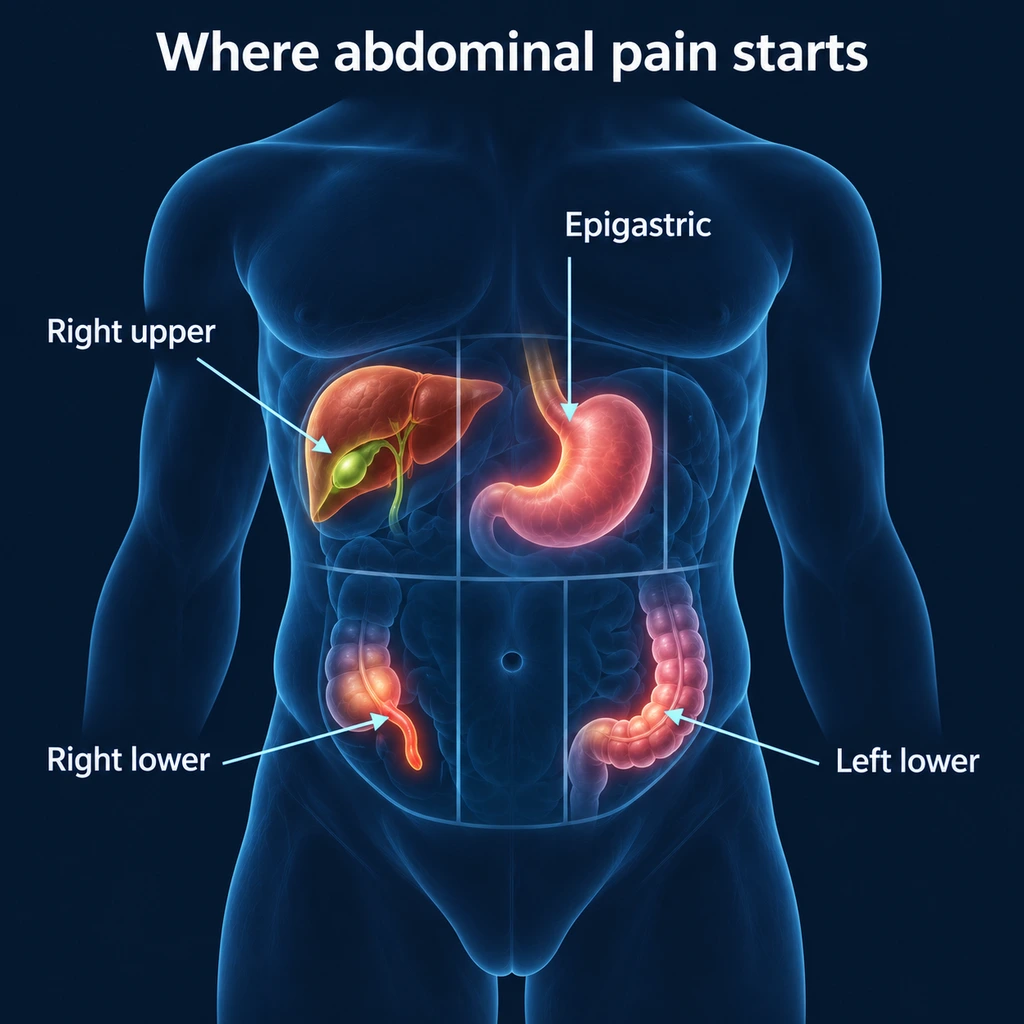
Table of Contents
Overview
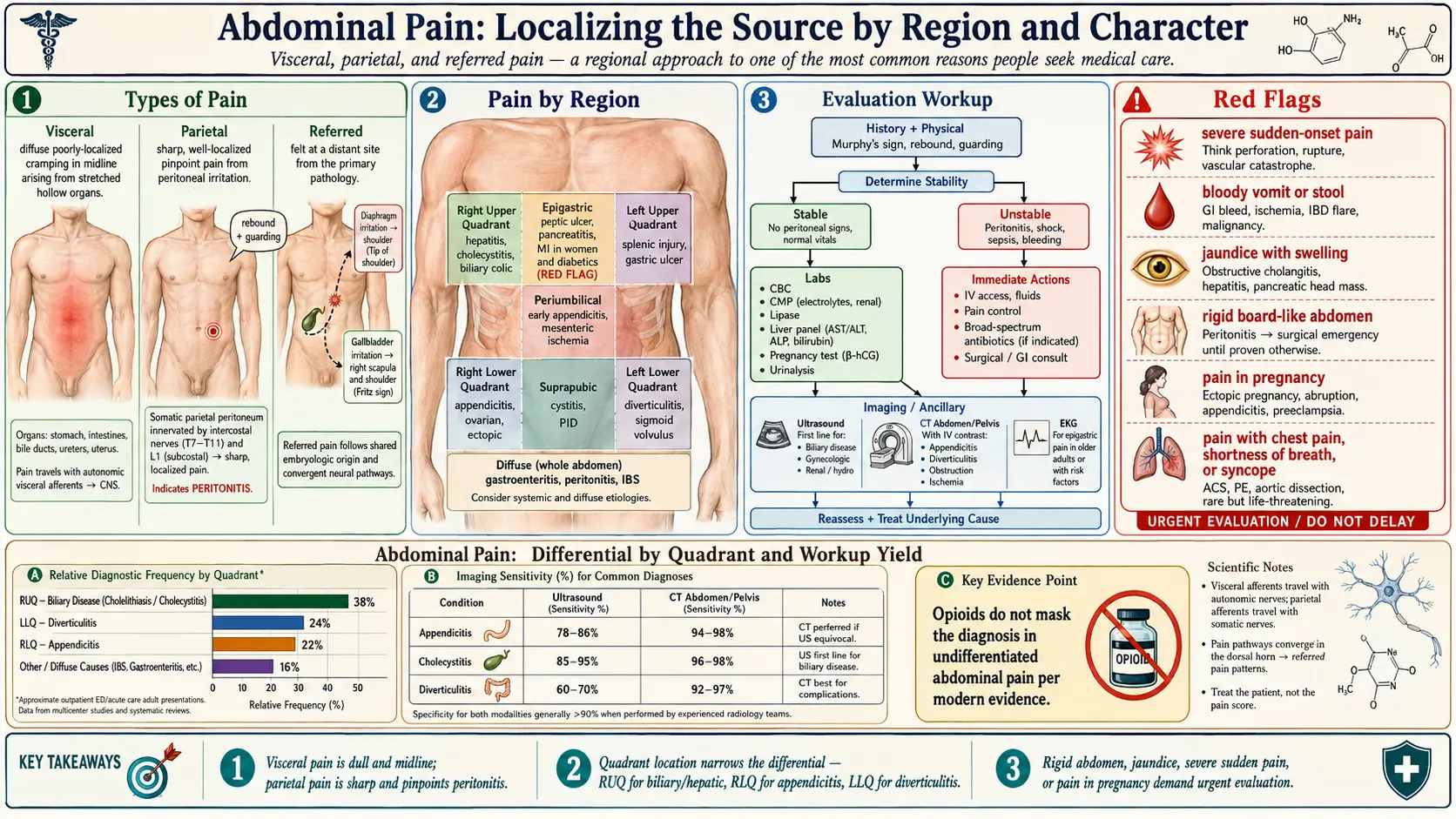
Abdominal pain is one of the most common reasons people seek medical care, ranging from mild discomfort that resolves on its own to a life-threatening surgical emergency. The location, character, timing, and accompanying symptoms guide the diagnosis. In viral hepatitis, abdominal pain is typically a dull or aching discomfort in the right upper quadrant, where the inflamed liver stretches its capsule.
Types of Abdominal Pain
- Visceral pain — diffuse, poorly localized, dull or crampy. Arises from stretching, distention, or inflammation of hollow or solid organs. Often midline because of bilateral autonomic innervation.
- Parietal (somatic) pain — sharp, well-localized, worsened by movement or coughing. Comes from irritation of the parietal peritoneum and is the hallmark of peritonitis.
- Referred pain — felt at a site distant from the source. Examples include diaphragmatic irritation referred to the shoulder or biliary pain referred to the right scapula.
Pain by Region
- Right upper quadrant — hepatitis, cholecystitis, biliary colic, hepatic abscess, right lower lobe pneumonia.
- Epigastric — peptic ulcer, gastritis, gastroesophageal reflux disease (GERD), pancreatitis, myocardial infarction (especially in women and diabetics).
- Left upper quadrant — splenic injury or infarction, gastric ulcer, pancreatitis.
- Periumbilical — early appendicitis, small bowel obstruction, mesenteric ischemia.
- Right lower quadrant — appendicitis, ovarian pathology, ectopic pregnancy, Crohn's disease.
- Left lower quadrant — diverticulitis, sigmoid volvulus, ovarian pathology.
- Suprapubic — cystitis, urinary retention, pelvic inflammatory disease.
- Diffuse — gastroenteritis, peritonitis, mesenteric ischemia, irritable bowel syndrome, sickle cell crisis.
Common Causes
- Hepatobiliary — viral hepatitis, gallstones, cholecystitis, cholangitis, hepatic congestion.
- Gastrointestinal — gastroenteritis, peptic ulcer, gastroesophageal reflux disease, irritable bowel syndrome (IBS), inflammatory bowel disease (IBD) (Crohn's, ulcerative colitis), constipation, bowel obstruction.
- Pancreatic — acute and chronic pancreatitis, pancreatic cancer.
- Vascular — mesenteric ischemia, abdominal aortic aneurysm.
- Genitourinary — kidney stones, pyelonephritis, urinary retention.
- Gynecologic — ovarian cyst, ectopic pregnancy, endometriosis, pelvic inflammatory disease.
- Functional — irritable bowel syndrome, functional dyspepsia.
Evaluation
- History and physical exam — onset, character, location, radiation, timing, and aggravating/relieving factors. Examine for tenderness, rebound, guarding, and Murphy's sign.
- Complete blood count (CBC), comprehensive metabolic panel (CMP), lipase, liver panel — to look for infection, electrolyte disturbance, pancreatitis, and hepatobiliary disease.
- Pregnancy test — in any woman of reproductive age.
- Urinalysis — for urinary tract infection (UTI), hematuria, ketones.
- Imaging — ultrasound for biliary, gynecologic, or renal causes; computed tomography (CT) for appendicitis, diverticulitis, obstruction, ischemia.
- Electrocardiogram (EKG) — for epigastric pain in older or at-risk adults to exclude cardiac ischemia.
For diverticulitis, a 2021 American Gastroenterological Association clinical practice update states that computed tomography is often necessary to make the diagnosis. The same update states that antibiotics can be used selectively rather than routinely in people with a healthy immune system who have mild, uncomplicated diverticulitis, and that antibiotic treatment is strongly advised for people whose immune system is weakened.
Management
Treatment depends on cause. Functional and self-limited causes resolve with supportive care. Surgical conditions (appendicitis, perforation, obstruction, ectopic pregnancy) require urgent intervention. Pain control, hydration, antiemetics, and treatment of the underlying disease are the mainstays. Opioids are not contraindicated in undifferentiated abdominal pain — modern trials found they can change some examination findings, without a significant increase in errors in diagnosis or in the decision to operate.
The numbers behind that point: a 2011 Cochrane review of eight trials concluded that opioid pain relief in acute abdominal pain does not increase the risk of a diagnosis error or of an error in treatment decisions. A 2006 analysis of placebo-controlled trials in JAMA found that opiates may alter the findings of the abdominal examination (risk ratio 2.13 in the trials where the drug clearly relieved pain), but that these changes caused no significant increase in management errors, meaning unnecessary surgery or necessary surgery delayed (+0.3% absolute increase; 95% confidence interval −4.1% to +4.7%). The authors noted that the existing literature does not rule out a small increase in errors.
For acute pancreatitis, the 2024 American College of Gastroenterology guideline notes that most patients have symptoms lasting a few days, but almost one-fifth go on to complications, including pancreatic necrosis (dead pancreatic tissue) and/or organ failure. It states that patients with biliary pancreatitis (pancreatitis linked to the bile system) typically will require surgery to prevent the disease from coming back, and it addresses the safety of early refeeding.
When to Seek Medical Care
- Severe or sudden-onset pain.
- Pain with fever, vomiting blood, bloody stool, or inability to keep down fluids.
- Pain with jaundice or marked abdominal swelling.
- Rigid, board-like abdomen (suggests peritonitis).
- Pain in pregnancy.
- Pain with chest pain, shortness of breath, or syncope.
Connections
- All Symptoms
- Pancreatitis
- Hepatitis
- Irritable Bowel Syndrome
- Diverticulitis
- Gallbladder Disease
- Inflammatory Bowel Disease
- Peptic Ulcer Disease
- Nausea and Vomiting
- Crohn's Disease
- Constipation
- Jaundice
- Small Intestinal Bacterial Overgrowth
- Ulcerative Colitis
- Inflammatory Markers
- Liver Disease
- Bloating
- Hepatitis B
- Hepatitis C
Key Research Papers
Historical Background
Surgeon Sir Zachary Cope's 1921 monograph The Early Diagnosis of the Acute Abdomen remains a foundational text for the bedside evaluation of abdominal pain, emphasizing careful history and physical examination over technology. The introduction of computed tomography in the 1970s and bedside ultrasound in the 1990s transformed the diagnostic workup, dramatically improving accuracy for appendicitis, diverticulitis, and biliary disease.
Key Research Papers
- Cartwright SL, Knudson MP. Evaluation of acute abdominal pain in adults. American Family Physician. 2008;77(7):971-978. PubMed PMID: 18441863
- Wagner JM, McKinney WP, Carpenter JL. Does this patient have appendicitis? JAMA. 1996;276(19):1589-1594. — doi:10.1001/jama.1996.03540190061030 (PubMed PMID: 8918857)
- Manterola C, Vial M, Moraga J, Astudillo P. Analgesia in patients with acute abdominal pain. Cochrane Database of Systematic Reviews. 2011;(1):CD005660. — doi:10.1002/14651858.CD005660.pub3 (PubMed PMID: 21249672)
- Ranji SR, Goldman LE, Simel DL, Shojania KG. Do opiates affect the clinical evaluation of patients with acute abdominal pain? JAMA. 2006;296(14):1764-1774. — doi:10.1001/jama.296.14.1764 (PubMed PMID: 17032990)
- Tenner S, Vege SS, Sheth SG, Sauer B, Yang A, Conwell DL, Yadlapati RH, Gardner TB. American College of Gastroenterology Guidelines: Management of Acute Pancreatitis. American Journal of Gastroenterology. 2024;119(3):419-437. — doi:10.14309/ajg.0000000000002645 (PubMed PMID: 38857482)
- Strate LL, Modi R, Cohen E, Spiegel BM. Diverticular disease as a chronic illness: evolving epidemiologic and clinical insights. American Journal of Gastroenterology. 2012;107(10):1486-1493. PubMed PMID: 22777341
- Peery AF, Shaukat A, Strate LL. AGA Clinical Practice Update on Medical Management of Colonic Diverticulitis: Expert Review. Gastroenterology. 2021;160(3):906-911.e1. — doi:10.1053/j.gastro.2020.09.059 (PubMed PMID: 33279517)
- Brown HF, Kelso L. Abdominal pain: an approach to a challenging diagnosis. AACN Advanced Critical Care. 2014;25(3):266-278. — doi:10.4037/nci.0000000000000042 (PubMed PMID: 25054532)
- Mayer EA. Clinical practice. Irritable bowel syndrome. New England Journal of Medicine. 2008;358(16):1692-1699. PubMed PMID: 18420501
Featured Videos