Postpartum Depression
If you are having thoughts of harming yourself or your baby, or you feel confused, panicked, or are hearing or seeing things others do not — get help right now. Call or text 988 (the Suicide & Crisis Lifeline) or call 911 / go to the nearest emergency room. You can also reach Postpartum Support International at 1-800-944-4773 (call or text "Help"). You are not a bad parent for needing help. This is a medical emergency that gets better with treatment.
Interactive Visualization Serotonin, Mood & SSRIs — build it, fire it, block reuptake Assemble serotonin from tryptophan, fire it across the synapse, then take an SSRI and watch the cleft flood — or starve the tryptophan and watch the signal fade. Launch →Table of Contents
- Overview
- Epidemiology
- Pathophysiology
- Etiology and Risk Factors
- Clinical Presentation
- Diagnosis
- Treatment
- Complications
- Prognosis
- Prevention
- Recent Research and Advances
- Research Papers
- Connections
- Featured Videos
1. Overview
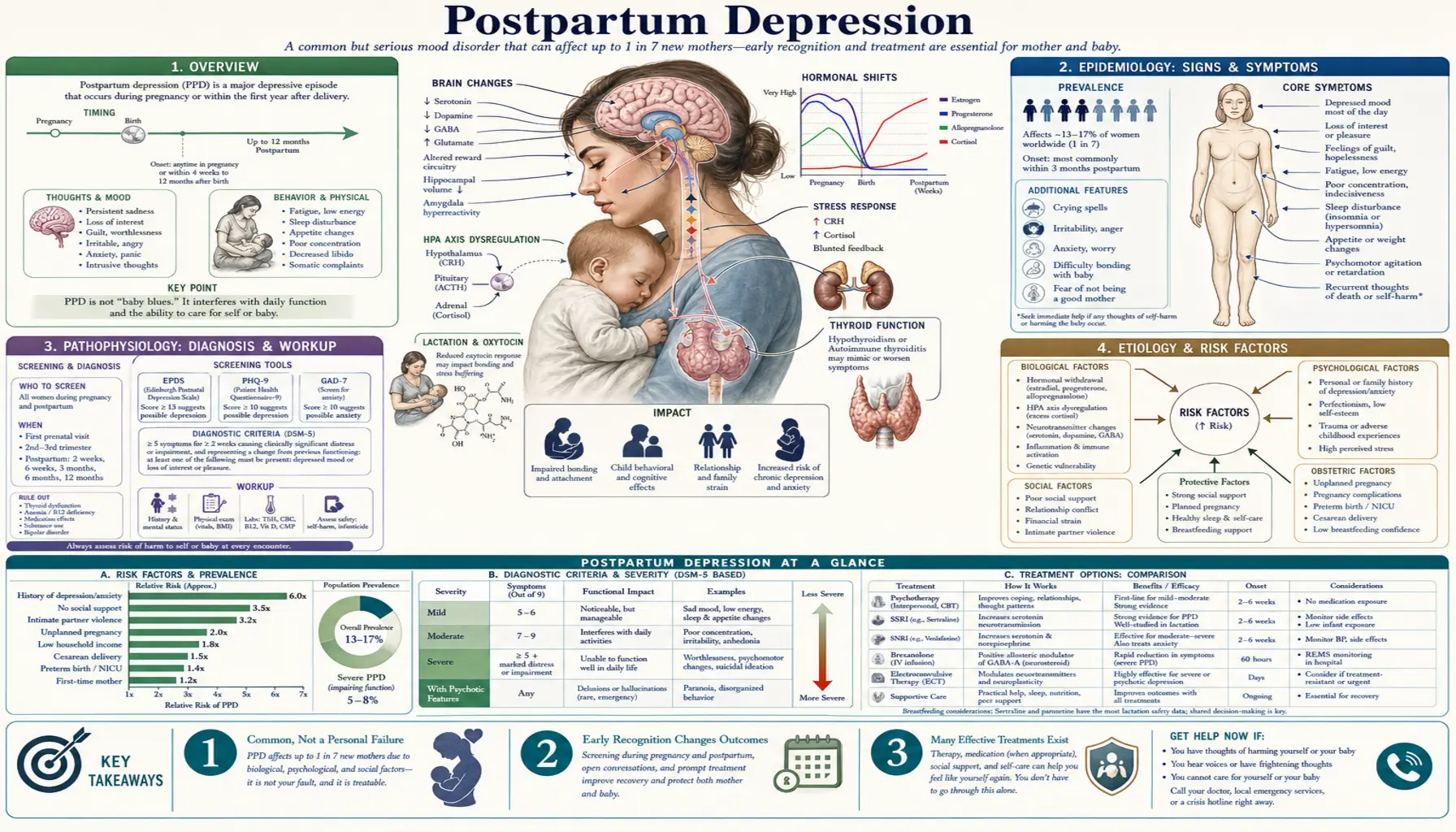
Postpartum depression (PPD) is a common, serious, and highly treatable mood disorder that affects roughly 1 in 7 birthing parents — and many partners too. It is not a character flaw, a sign of weakness, or evidence that you are a "bad mother." It is a medical condition, in the same way that diabetes or high blood pressure is a medical condition. Brain chemistry, hormones, sleep loss, genetics, and life stress collide in the weeks around birth, and depression can be the result. You did not cause it by doing something wrong, and you cannot fix it by simply "trying harder" or "being grateful." With the right care, the large majority of people recover fully.
One of the most important things to understand is that the postpartum period actually contains three distinct experiences that are often confused with one another. Telling them apart matters, because two of them usually resolve on their own and one — postpartum psychosis — is a true psychiatric emergency:
- The "baby blues" — very common (up to 80% of new parents), mild, and self-limiting. Tearfulness, mood swings, irritability, and feeling overwhelmed appear in the first few days after birth and usually fade on their own within about two weeks. The blues do not need medication; they need rest, food, and support.
- Postpartum depression — persistent low mood, anxiety, or loss of interest lasting two weeks or longer that interferes with daily life and your ability to care for yourself or your baby. It can begin during pregnancy (then often called peripartum or perinatal depression) and can appear any time in the first year after birth. PPD does not go away on its own the way the blues do — it deserves treatment.
- Postpartum psychosis — rare (about 1 to 2 per 1,000 births) but a medical emergency. See the red-flag box at the top of this page. If a new parent suddenly becomes confused, agitated, sleepless without feeling tired, paranoid, or begins hearing voices, seeing things, holding strange beliefs, or having thoughts of harming themselves or the baby — call 911 or go to the emergency room immediately. This is treatable, and getting help fast saves lives.
PPD is also broader than the stereotype. Depression after childbirth is not limited to people who gave birth: fathers and non-birthing partners develop postpartum depression too, at a rate of roughly 8–10%. And it does not require a healthy live birth — people who experience pregnancy loss, stillbirth, a NICU stay, or who become parents through adoption or surrogacy can all develop postpartum depression. If you are struggling after welcoming (or grieving) a child, your pain is real and you deserve support, regardless of how you became a parent.
2. Epidemiology
Postpartum depression is one of the most common complications of childbirth — more common than gestational diabetes or preeclampsia. Pooled estimates put the prevalence of postpartum depression at roughly 10–15% of birthing parents, which is the source of the familiar "about 1 in 7" figure. A large U.S. screening study of more than 10,000 postpartum women found that about 14% screened positive, and among those, a substantial fraction had onset of symptoms during pregnancy rather than only after delivery.
When pregnancy and the postpartum year are considered together (perinatal depression), point-prevalence estimates cluster around 11–13%, with the cumulative risk across the whole period higher still. Rates are even higher in some groups: in low- and middle-income countries, perinatal depression affects close to 1 in 5 mothers, driven by poverty, food insecurity, intimate-partner violence, and limited access to care. Adolescent parents, parents of multiples, and parents whose infants are in intensive care also carry elevated risk.
Despite how common it is, postpartum depression is widely underdiagnosed and undertreated. Stigma, the cultural expectation that new parents should feel only joy, short or rushed postpartum visits, and the very symptoms of depression (low energy, guilt, hopelessness) all make it hard to reach out. Many people who screen positive never receive treatment. This is exactly why routine screening — and removing the shame around the diagnosis — matters so much.
3. Pathophysiology
There is no single cause of postpartum depression. It is best understood as a "perfect storm" in which a sudden, dramatic biological shift meets sleep deprivation, individual sensitivity, and life stress. The leading biological players are:
- Abrupt hormone withdrawal. During pregnancy, levels of estrogen and progesterone rise to many times their normal values. After the placenta is delivered, these hormones crash within hours to days — one of the fastest, largest hormonal shifts the human body ever undergoes. For people who are biologically sensitive to these swings, that withdrawal appears to destabilize mood-regulating brain circuits.
- Allopregnanolone and the GABA system. Allopregnanolone is a neuroactive steroid made from progesterone that calms the brain by enhancing GABA-A receptor signaling (the brain's main "brakes"). Its levels soar in pregnancy and then plummet after birth. The brain's GABA receptors, which had adapted to high allopregnanolone, are left mismatched. This insight is the reason the newest PPD-specific medicines (brexanolone and zuranolone) were designed to replace allopregnanolone-like activity — and it represents a genuine breakthrough in understanding the disorder.
- Sleep deprivation. Newborn care fragments sleep severely. Disrupted sleep and circadian rhythm are powerful, independent triggers of mood disorders, and protecting sleep is one of the few interventions that helps almost everyone.
- Stress and inflammation. The stress-hormone (HPA-axis) system is reset by pregnancy and birth, and elevated inflammatory signaling has been associated with perinatal depression in some studies.
- Genetics and sensitivity. A personal or family history of depression, bipolar disorder, or premenstrual dysphoric disorder (PMDD) raises risk, pointing to an inherited sensitivity to hormonal change.
- Psychosocial context. Biology does not act in a vacuum. Lack of support, financial strain, relationship conflict, and a traumatic birth all shape whether vulnerability becomes illness.
The practical takeaway is reassuring: because PPD has real biological drivers, it responds to real biological and psychological treatments — and it is no more a "choice" than any other illness.
4. Etiology and Risk Factors
Knowing the risk factors helps you and your care team watch for trouble early. Having one or more of these does not mean you will develop PPD — and having none does not make you immune — but they shift the odds:
- A prior history of depression or anxiety — the single strongest predictor, especially depression in a previous pregnancy or postpartum period.
- A history of premenstrual dysphoric disorder (PMDD) or strong mood reactions to hormonal birth control — a marker of hormone sensitivity.
- Antenatal (during-pregnancy) depression or anxiety, which frequently carries straight through delivery.
- A personal or family history of bipolar disorder — important to disclose, because antidepressants alone can sometimes worsen an undiagnosed bipolar illness, and bipolar history greatly raises the risk of postpartum psychosis.
- Lack of social support — being isolated, far from family, or without a reliable partner.
- A traumatic or unexpected birth experience, emergency cesarean, severe pain, or feeling unheard during delivery.
- A NICU stay, prematurity, infant illness, or feeding difficulties.
- Financial stress, housing insecurity, or major recent life events.
- Unplanned or unwanted pregnancy, or ambivalence about parenting.
- Pregnancy loss or grief connected to the current pregnancy.
- Thyroid problems. Postpartum thyroiditis — inflammation of the thyroid that affects up to ~5% of people after birth — can cause fatigue, low mood, anxiety, and irritability that mimic or worsen depression. Because it is common and treatable, clinicians often check TSH (and sometimes free T4) when postpartum depression is suspected. Treating a thyroid problem will not "cure" true depression, but missing one means missing an important, fixable contributor. See Hypothyroidism and Hashimoto's Thyroiditis.
5. Clinical Presentation
Postpartum depression is much more than sadness, and for many people sadness is not even the main feeling. Symptoms can include:
- Persistent low mood, emptiness, or tearfulness that does not lift.
- Anxiety, dread, or panic — often the loudest symptom in PPD. Constant worry about the baby's health, racing thoughts, or physical symptoms like a pounding heart.
- Intrusive, scary thoughts about the baby. This deserves a careful, reassuring explanation, because it terrifies parents into silence. Many people with postpartum anxiety and depression experience sudden, unwanted, horrifying mental images — for example, of the baby being dropped, drowned, or hurt. In anxiety and depression, these thoughts are ego-dystonic: they are abhorrent to you, you do not want to act on them, and they make you check on or protect the baby more. Having these thoughts does not make you dangerous and does not mean your baby will be taken away. They are a recognized symptom that improves with treatment. This is fundamentally different from the disorganized, detached thinking of postpartum psychosis, where a person may actually believe a delusion and lose touch with reality. When in doubt, tell a clinician — they would far rather hear it than have you suffer alone.
- Irritability or rage — snapping, anger, and feeling "on edge" are common and under-recognized faces of PPD.
- Numbness or feeling disconnected — going through the motions, feeling like you are watching your life from outside.
- Guilt and worthlessness — feeling like a failure, like your baby deserves a better parent.
- Trouble bonding — not feeling the love or connection you expected. This is a symptom, not a verdict on you, and bonding usually returns as you recover.
- Sleep problems beyond newborn life — being unable to sleep even when the baby is sleeping, or sleeping far too much.
- Loss of interest, appetite changes, exhaustion, and trouble concentrating.
- Thoughts of death, of not wanting to be here, or of harming yourself. These must always be taken seriously — see the crisis resources at the top of this page.
6. Diagnosis
There is no blood test for postpartum depression. Diagnosis is clinical, made by talking with you about your symptoms, how long they have lasted, and how much they affect your life. Formally, PPD is diagnosed as a major depressive episode with a peripartum onset specifier (onset during pregnancy or in the weeks after delivery), with most clinicians and researchers applying the concept across the full first postpartum year.
The most widely used screening tool is the Edinburgh Postnatal Depression Scale (EPDS) — a brief, validated, 10-question self-report questionnaire developed by Cox and colleagues in 1987 specifically for new parents (it deliberately leaves out symptoms like fatigue and appetite change that overlap with normal newborn life). The Patient Health Questionnaire (PHQ-9) is also commonly used. Major bodies including the U.S. Preventive Services Task Force (USPSTF), the American College of Obstetricians and Gynecologists (ACOG), and the American Academy of Pediatrics recommend routine screening for depression during pregnancy and after birth — at obstetric visits and at well-baby pediatric visits, since the parent is in the room.
A complete evaluation also includes directly and gently asking about thoughts of self-harm or of harming the baby. Asking these questions does not plant the idea or "make things worse" — it opens the door to help and lets the clinician judge safety. A good evaluation also checks thyroid function (TSH) to catch postpartum thyroiditis, and screens for bipolar disorder (asking about past periods of unusually high energy, little need for sleep, or racing thoughts), because that changes treatment.
7. Treatment
Postpartum depression is very treatable, and there are more options now than ever. The right plan depends on how severe the symptoms are, whether you are breastfeeding, your preferences, and your safety. If at any point you have thoughts of harming yourself or your baby, treat it as an emergency — call or text 988, call 911, or go to the ER.
Psychotherapy (talk therapy) — first-line for mild to moderate PPD
For mild-to-moderate symptoms, structured talk therapy is a first-line treatment and works as well as medication for many people, without any exposure to your baby through milk. The two best-studied forms are cognitive behavioral therapy (CBT) — which helps you recognize and shift the harsh, distorted thoughts depression creates — and interpersonal therapy (IPT) — which focuses on the role transitions, relationship strains, and support needs that surround new parenthood. Both have strong evidence in the perinatal period.
Antidepressant medication
For moderate-to-severe depression, or when therapy alone is not enough, SSRIs (selective serotonin reuptake inhibitors) are the usual first choice. Sertraline (Zoloft) is often preferred because it is well studied and, importantly, compatible with breastfeeding.
About the breastfeeding worry — let's address it directly, because it stops many parents from getting help. It is completely understandable to fear that an antidepressant will reach your baby through breast milk. Here is what the data actually show: for sertraline (and similar SSRIs like paroxetine), the amount that passes into milk is very low, and infant blood levels are typically undetectable or extremely low. Reference resources for clinicians, including the NIH's LactMed database, classify sertraline as one of the preferred antidepressants during breastfeeding. Meanwhile, untreated depression carries real risks for both you and your baby. For most parents, the honest, evidence-based answer is that you usually do not have to choose between breastfeeding and getting treated. Talk it through with your clinician so the decision is yours and informed — not driven by fear.
Neuroactive steroid antidepressants — medicines made specifically for PPD
A genuinely new class of medicine targets the allopregnanolone/GABA mechanism described above — the first drugs ever developed specifically to treat postpartum depression:
- Brexanolone (Zulresso) — an intravenous (IV) form of allopregnanolone, FDA-approved in 2019. It is given as a continuous 60-hour IV infusion in a certified healthcare setting with monitoring (because it can cause excessive sedation). In phase 3 trials it produced rapid improvement in severe PPD, often within days. Its main drawbacks are the inpatient infusion requirement and cost.
- Zuranolone (Zurzuvae) — an oral neuroactive steroid, FDA-approved for PPD in 2023, taken once daily for a short 14-day course. Trials showed meaningful, relatively rapid reduction in depressive symptoms. As an oral, two-week treatment, it is far easier to access than an IV infusion. Common side effects include drowsiness and dizziness, so driving precautions apply, and breastfeeding decisions should be discussed individually.
These are not "miracle cures" or replacements for everything else, but for the right patient — particularly someone with severe PPD who needs fast relief — they are an important new option.
Support, practical help, and sleep protection
Treatment is not only medical. Concrete support changes outcomes: lining up help with feeds so you can get a protected block of sleep, sharing night duties, accepting meals and household help, peer support groups, and reducing isolation. Protecting sleep — even one longer stretch per night — is one of the most powerful, lowest-risk interventions available. Postpartum Support International (1-800-944-4773) connects parents to local resources, support groups, and trained volunteers.
8. Complications
Untreated postpartum depression carries real costs — which is precisely why getting help is an act of love, not failure. For the parent, untreated PPD can become longer and more severe, raise the risk of future depressive episodes, strain relationships, and, at its most dangerous, lead to suicidal thoughts; suicide is a leading cause of death in the year after birth, which is why screening and crisis access matter so much.
For the child, persistent untreated parental depression is associated with effects on bonding, and with differences in infant and child emotional, behavioral, and cognitive development — largely mediated by the strain depression places on responsive caregiving. This is not stated to add guilt (depression is not your fault), but to underline the opposite point: treating the parent helps the whole family. When a parent recovers, the bonding and the development risks improve. The most protective thing you can do for your baby is to take care of yourself.
The most serious complication, postpartum psychosis, is rare but can escalate quickly and is associated with the gravest risks to both parent and infant. It is the reason the red-flag warning sits at the top of this page: sudden confusion, not sleeping, paranoia, hallucinations, or thoughts of harm require an emergency response (911 / ER), not a wait-and-see approach.
9. Prognosis
Here is the most important message of this entire page: postpartum depression gets better, and most people recover with treatment. With appropriate therapy, medication, or both — plus support and sleep — the majority of parents experience substantial improvement, and many return fully to themselves. Recovery is often gradual rather than a switch flipping, and some people need more than one approach before finding what works, which is normal and not a sign of failure.
Having had PPD does raise the chance of depression in a future pregnancy, so it is worth telling your care team if you have another baby — that way a prevention and monitoring plan can be ready in advance. Postpartum psychosis, when treated promptly, also has a good prognosis for the acute episode, though it warrants close psychiatric follow-up. The single biggest factor that improves the outlook is simple: reaching out and getting care. Asking for help is the strong, healthy thing to do.
10. Prevention
Not every case of postpartum depression can be prevented, but the risk can genuinely be lowered, especially for people known to be at higher risk:
- Routine screening during pregnancy and after birth, so problems are caught early — when they are easiest to treat.
- Treating depression and anxiety during pregnancy. Antenatal depression often carries through to the postpartum period, so treating it early is one of the most effective forms of prevention.
- Building support in advance — arranging help, identifying who will cover night feeds, planning protected sleep, and lining up someone to talk to before the baby arrives.
- Counseling-based prevention for high-risk people. The USPSTF recommends counseling interventions — specifically CBT and interpersonal therapy — for pregnant and postpartum people at increased risk, because trials show they reduce the chance of developing perinatal depression. This is one of the clearest, evidence-based prevention strategies available.
- Addressing modifiable contributors — checking thyroid function, managing chronic insomnia, and reducing isolation and financial stress where possible.
For people with a history of severe PPD, clinicians may also discuss medication strategies or, in select cases, the newer neuroactive steroid treatments — but for most at-risk parents, the best-proven prevention is structured psychosocial support and therapy.
11. Recent Research and Advances
The science of postpartum depression has moved quickly, and the direction is hopeful. The standout advance is the arrival of neuroactive steroid antidepressants built on the allopregnanolone mechanism — brexanolone (IV, 2019) and zuranolone (oral, 2023) — the first medicines designed specifically for PPD rather than borrowed from general depression treatment. Their relatively rapid action is being studied to understand who benefits most and how to deploy them alongside therapy and SSRIs.
Other active areas include refining universal perinatal screening and closing the gap between screening positive and actually receiving care (a persistent real-world failure point); better characterizing paternal and partner postpartum depression, now recognized to affect roughly 8–10% of fathers and to track with maternal depression; investigating hormone sensitivity, allopregnanolone biology, and the GABA system as biomarkers and treatment targets; and studying digital and peer-delivered therapy to reach parents who cannot access traditional care. Across all of it runs a single practical thread: PPD is common, biological, and treatable — and the field is steadily building faster, more accessible ways to help.
12. References & Research
Historical Background
Although mood disturbances after childbirth were described in antiquity and again by 19th-century alienists, postpartum depression was for most of modern history under-recognized — frequently dismissed as ordinary "baby blues" or moral weakness. A turning point came in 1987, when Cox, Holden, and Sagovsky published the Edinburgh Postnatal Depression Scale, the first validated screening tool tailored to new mothers, which made systematic detection possible. The condition gained formal diagnostic clarity as a depressive episode with a peripartum-onset specifier in the DSM. The most recent chapter is therapeutic: the U.S. FDA approved brexanolone, the first medication developed specifically for postpartum depression, in 2019, followed by the first oral agent, zuranolone, in 2023.
Key Research Papers
- Cox JL, Holden JM, Sagovsky R. Detection of postnatal depression: development of the 10-item Edinburgh Postnatal Depression Scale. British Journal of Psychiatry. 1987;150:782–786.
- Gavin NI, Gaynes BN, Lohr KN, et al. Perinatal depression: a systematic review of prevalence and incidence. Obstetrics & Gynecology. 2005;106(5):1071–1083.
- Paulson JF, Bazemore SD. Prenatal and postpartum depression in fathers and its association with maternal depression: a meta-analysis. JAMA. 2010;303(19):1961–1969.
- Earls MF; Committee on Psychosocial Aspects of Child and Family Health. Incorporating recognition and management of perinatal and postpartum depression into pediatric practice. Pediatrics. 2010;126(5):1032–1039.
- Wisner KL, Sit DKY, McShea MC, et al. Onset timing, thoughts of self-harm, and diagnoses in postpartum women with screen-positive depression findings. JAMA Psychiatry. 2013;70(5):490–498.
- Grigoriadis S, VonderPorten EH, Mamisashvili L, et al. The impact of maternal depression during pregnancy on perinatal outcomes: a systematic review and meta-analysis. Journal of Clinical Psychiatry. 2013;74(4):e321–e341.
- Howard LM, Molyneaux E, Dennis CL, et al. Non-psychotic mental disorders in the perinatal period. The Lancet. 2014;384(9956):1775–1788.
- Stewart DE, Vigod S. Postpartum depression. New England Journal of Medicine. 2016;375(22):2177–2186.
- Gelaye B, Rondon MB, Araya R, Williams MA. Epidemiology of maternal depression, risk factors, and child outcomes in low-income and middle-income countries. The Lancet Psychiatry. 2016;3(10):973–982.
- Kanes S, Colquhoun H, Gunduz-Bruce H, et al. Brexanolone (SAGE-547 injection) in post-partum depression: a randomised controlled trial. The Lancet. 2017;390(10093):480–489.
- Woody CA, Ferrari AJ, Siskind DJ, et al. A systematic review and meta-regression of the prevalence and incidence of perinatal depression. Journal of Affective Disorders. 2017;219:86–92.
- Meltzer-Brody S, Colquhoun H, Riesenberg R, et al. Brexanolone injection in post-partum depression: two multicentre, double-blind, randomised, placebo-controlled, phase 3 trials. The Lancet. 2018;392(10152):1058–1070.
- ACOG Committee Opinion No. 757: Screening for perinatal depression. Obstetrics & Gynecology. 2018;132(5):e208–e212.
- O'Connor E, Senger CA, Henninger ML, et al. Interventions to prevent perinatal depression: US Preventive Services Task Force evidence report. JAMA. 2019;321(6):588–601.
- Deligiannidis KM, Meltzer-Brody S, Maximos B, et al. Zuranolone for the treatment of postpartum depression. American Journal of Psychiatry. 2023;180(9):668–675.
Research Papers
Explore the current peer-reviewed literature on postpartum depression and related perinatal mental health through these live PubMed searches. Each link opens a continually updated list of studies.
- Postpartum depression — overview
- Screening and the Edinburgh Postnatal Depression Scale
- Sertraline, SSRIs, and breastfeeding
- Brexanolone trials
- Zuranolone trials
- Allopregnanolone and neuroactive steroids
- Postpartum psychosis
- Paternal and partner postpartum depression
- CBT and IPT for perinatal depression
- Prevention interventions
- Postpartum thyroiditis and mood
- Child development and outcomes
Connections
- Psychiatry
- Serotonin, Mood & SSRIs — interactive animation
- Depression
- Anxiety
- Bipolar Disorder
- PTSD
- OCD
- Insomnia
- Grief
- Eating Disorders
- Infertility
- Preeclampsia
- Perimenopause
- Menopause & HRT
- Hypothyroidism
- Hashimoto's Thyroiditis