Lewy Body Dementia
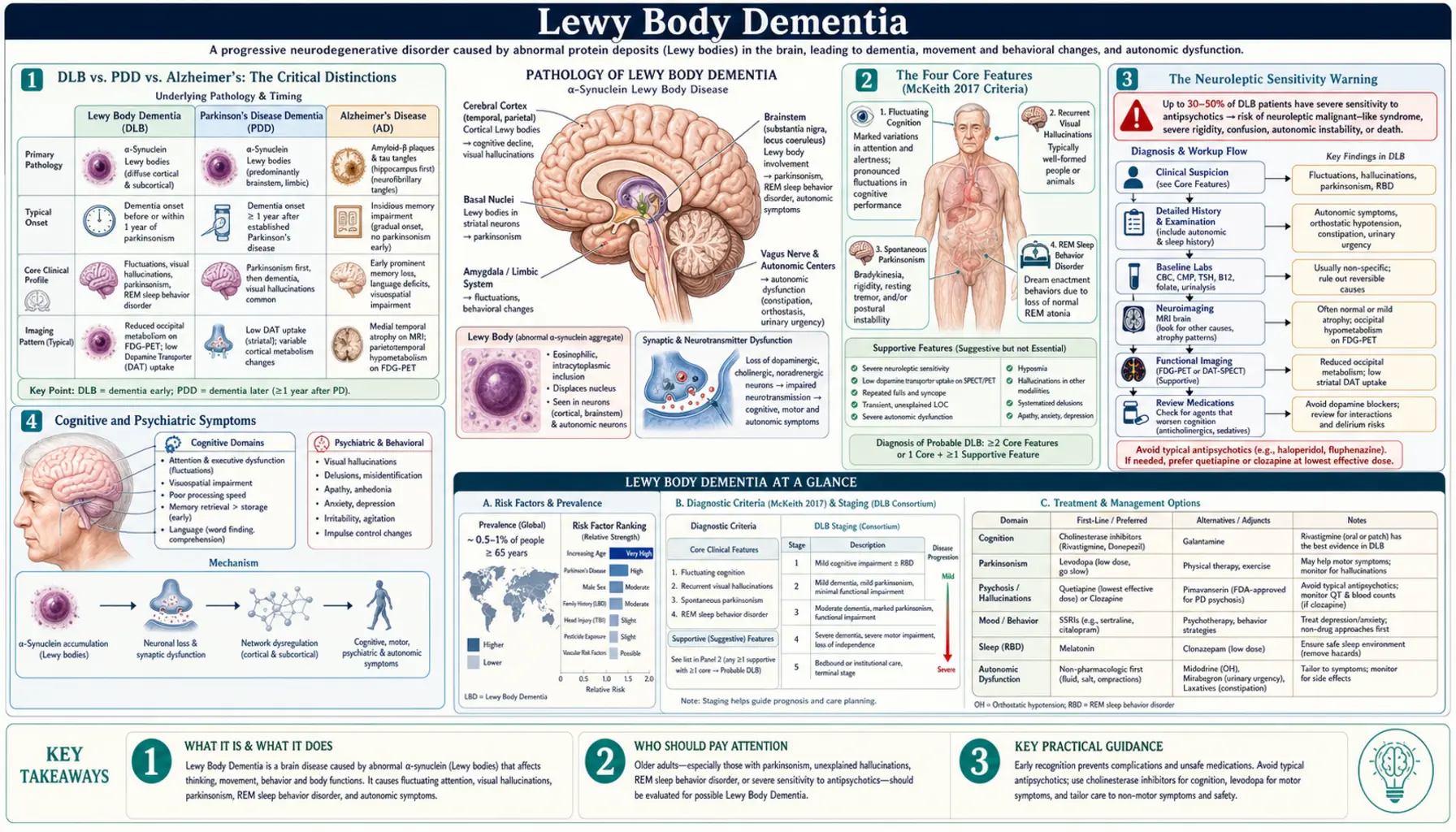
Lewy body dementia (LBD) is an umbrella term for two closely related diagnoses: dementia with Lewy bodies (DLB) and Parkinson's disease dementia (PDD). A 2014 review by Donaghy and McKeith places DLB, Parkinson's disease and Parkinson's disease dementia on one spectrum of Lewy body disease, and a 2015 review names alpha-synuclein as the protein responsible for DLB and Parkinson's disease. The 2014 review describes DLB as the second most common type of degenerative dementia after Alzheimer's disease. A 2014 systematic review found that DLB accounted for 4.2% of diagnosed dementia in the community and 7.5% in specialist care; its authors judged the true figure likely to be higher because the diagnosis is often missed. In a survey of 962 caregivers, the first diagnosis patients were given was Parkinson's disease or another movement disorder (39%), Alzheimer's disease or another cognitive disorder (36%), or a mental illness (24%). The 2017 consensus criteria list severe sensitivity to antipsychotic drugs among the features of DLB (see below).
Table of Contents
- DLB vs. PDD vs. Alzheimer's: The Critical Distinctions
- The Four Core Features (McKeith 2017 Criteria)
- Antipsychotic (Neuroleptic) Sensitivity
- Cognitive and Psychiatric Symptoms
- Diagnosis: Biomarkers and Imaging
- Management: Cholinesterase Inhibitors and Motor Symptoms
- Disease Course and Prognosis
- Information for Patients and Caregivers
- Key Research Papers
- Connections
- Featured Videos
DLB vs. PDD vs. Alzheimer's: The Critical Distinctions
Dementia with Lewy bodies and Parkinson's disease dementia sit on the same Lewy body disease spectrum. The DLB Consortium separates the two with a timing cutoff known as the 1-year rule. Its 2017 report describes the cutoff as arbitrary and based on expert opinion, but still useful, particularly in clinical practice, and notes that the time period may change once the genetics and mechanisms of these disorders are better understood.
The 2017 consensus report describes these features of DLB:
- Visual hallucinations: recurrent, complex visual hallucinations occur in up to 80% of patients with DLB and are a frequent signpost to the diagnosis. They are typically well formed, featuring people, children or animals, and are sometimes accompanied by a sense of presence, passage hallucinations or visual illusions. Patients are typically able to report them; their insight and emotional reaction vary.
- Fluctuating cognition: delirium-like, spontaneous changes in cognition, attention and arousal: waxing and waning episodes of inconsistent behavior, incoherent speech, variable attention, or altered consciousness with staring or "zoning out." Fluctuations can also occur in advanced stages of other dementias, so they point most strongly to DLB when they appear early.
- REM sleep behavior disorder (RBD): dream enactment with loss of the normal muscle relaxation of REM sleep. It was found in 76% of autopsy-confirmed DLB cases versus 4% of non-DLB cases, and often begins many years before other symptoms. In a multicentre study of 1,280 people with idiopathic RBD, 6.3% per year converted to an overt neurodegenerative syndrome and 73.5% had converted after 12 years of follow-up; the authors describe idiopathic RBD as a powerful early sign of Parkinson's disease, DLB and multiple system atrophy (PubMed PMID: 30789229).
- Parkinsonism: spontaneous parkinsonian features eventually occur in over 85% of people with DLB. Because many patients do not meet the full Parkinson's disease definition, the criteria require only one cardinal feature (bradykinesia, rest tremor or rigidity).
- Cognitive profile: deficits in attention, executive function and visual processing are typically out of proportion to problems with memory and naming. Spatial and perceptual difficulties often occur early, while memory and object naming tend to be less affected.
The Four Core Features (McKeith 2017 Criteria)
The fourth consensus report of the DLB Consortium, published in 2017 by McKeith and colleagues, revised the international diagnostic criteria for DLB. It separates clinical features from diagnostic biomarkers and gives more diagnostic weight to REM sleep behavior disorder and MIBG myocardial scintigraphy. Dementia, meaning progressive cognitive decline severe enough to interfere with normal social or occupational function or usual daily activities, is an essential requirement.
Core Clinical Features
- Fluctuating cognition: spontaneous alterations in cognition, attention and arousal.
- Recurrent visual hallucinations: typically well formed, featuring people, children or animals.
- REM sleep behavior disorder (RBD): recurrent dream enactment behavior.
- One or more cardinal features of parkinsonism: bradykinesia, rest tremor or rigidity.
Under the 2017 criteria, one or more indicative biomarkers together with one or more core features gives a diagnosis of probable DLB. Dementia with one or more indicative biomarkers but no core feature may be classified as possible DLB. Probable DLB is not diagnosed on the basis of biomarkers alone.
Indicative Biomarkers
- Reduced dopamine transporter (DAT) uptake in the basal ganglia on SPECT or PET imaging. The report gives a sensitivity of 78% and a specificity of 90% for separating DLB from Alzheimer's disease.
- Reduced uptake on MIBG myocardial scintigraphy, which reflects loss of the heart's sympathetic nerve supply. Sensitivity of 69% and specificity of 87% for separating probable DLB from probable Alzheimer's disease rise to 77% and 94% in milder cases. Heart disease, diabetes, peripheral neuropathies and some medicines can also reduce uptake.
- Polysomnographic confirmation of REM sleep without atonia. In a person with dementia and a history of RBD, this finding carries a 90% or greater likelihood of a synucleinopathy, which the report considers enough for a probable DLB diagnosis even without any other core feature or biomarker.
Supportive Biomarkers
- Relative preservation of medial temporal lobe structures on CT or MRI.
- Generally low uptake on SPECT or PET perfusion and metabolism scans, with reduced occipital activity, and the posterior cingulate island sign on FDG-PET.
- Prominent posterior slow-wave activity on EEG, with periodic fluctuations in the pre-alpha/theta range.
Amyloid PET is not among them: the report notes that more than 50% of patients with DLB show increased amyloid-beta deposition on PET, which limits its value for telling DLB and Alzheimer's disease apart.
Supportive Clinical Features (Not Core)
These are common, sometimes early, but lack diagnostic specificity. Those described in the report's text include severe sensitivity to antipsychotic drugs (moved to this category because reduced prescribing has limited its diagnostic usefulness), hypersomnia (excessive daytime sleepiness), hyposmia (reduced sense of smell, which occurs earlier in DLB than in Alzheimer's disease) and transient episodes of unresponsiveness. A 2014 review adds that constipation, RBD, hyposmia and postural dizziness can predate memory impairment by several years.
Antipsychotic (Neuroleptic) Sensitivity
The 2017 consensus report states that antipsychotics used for severe behavioral disturbance, delusions or visual hallucinations carry mortality risks in people with dementia, and that in DLB they should be avoided whenever possible because of the increased risk of a serious sensitivity reaction; it adds that caution about their use is unchanged. A 2015 review describes these reactions as potentially fatal.
The reaction was first reported in a 1992 study of 41 elderly patients whose diagnosis was confirmed at autopsy. Sixteen of the patients with Lewy body dementia had received neuroleptics; 13 of them (81%) reacted adversely, and in 7 (54%) the reaction was severe. Severe sensitivity was linked to higher mortality in the following year. Of 14 patients with Alzheimer's disease given neuroleptics, one (7%) had a severe reaction (PubMed PMID: 1356550).
Treatments Studied for Hallucinations and Psychosis
- Cholinesterase inhibitors (rivastigmine, donepezil): the 2017 report states that they may substantially reduce apathy and improve visual hallucinations and delusions in DLB. A 2015 meta-analysis found benefits of donepezil and rivastigmine for cognitive and psychiatric symptoms.
- Quetiapine: the 2017 report describes low-dose quetiapine as possibly safer than other antipsychotics and widely used, but notes that a small placebo-controlled trial in DLB was negative. The 2015 meta-analysis found that quetiapine, olanzapine and risperidone do not appear to be effective in Lewy body dementia.
- Clozapine: the 2017 report cites a positive evidence base in Parkinson's disease psychosis, but states that efficacy and tolerability in DLB have not been established.
- Pimavanserin: FDA-approved in 2016 for hallucinations and delusions associated with Parkinson's disease psychosis. Its label describes it as an atypical antipsychotic that acts at serotonin 5-HT2A (and, less strongly, 5-HT2C) receptors and has no appreciable affinity for dopamine receptors, including D2. The label carries a boxed warning that elderly patients with dementia-related psychosis treated with antipsychotic drugs are at increased risk of death, and states that the drug is not approved for dementia-related psychosis unrelated to the hallucinations and delusions of Parkinson's disease psychosis. In the 6-week phase 3 trial in Parkinson's disease psychosis (199 patients), psychosis scores fell more than with placebo and motor function did not worsen (PubMed PMID: 24183563). The HARMONY trial, which included patients with DLB and Parkinson's disease dementia among other dementias, randomized responders to continue the drug or switch to placebo; relapse occurred in 13% versus 28% (hazard ratio 0.35). The trial was stopped early for efficacy, and its authors state that longer and larger trials are required (PubMed PMID: 34289275). The 2017 report states that controlled trial data in DLB are needed.
Cognitive and Psychiatric Symptoms
The cognitive and psychiatric profile of DLB differs from that of Alzheimer's disease, especially early on.
Cognitive Domains Affected
- Visuospatial and perceptual processing: often affected early. The 2017 report lists the kinds of tasks used to probe it: copying figures (such as intersecting pentagons), visual assembly (block design, puzzles), spatial matching (line orientation) and perceptual discrimination (incomplete figures or letters).
- Attention and executive function: tests of processing speed and divided or alternating attention help separate DLB from Alzheimer's disease and normal aging, and predict progression from mild cognitive impairment to DLB.
- Fluctuating alertness: questions about daytime drowsiness, lethargy, staring into space or episodes of disorganized speech separate DLB from Alzheimer's disease better than general questions about fluctuation. These items have been built into clinician-interview and informant-questionnaire rating scales, and the report states that at least one measure of fluctuation should be documented when the criteria are applied. Transient episodes of unresponsiveness may be an extreme form of fluctuation and can be hard to distinguish from true fainting (syncope).
- Memory and naming: tend to be less affected in DLB than attention, executive and visual functions.
Psychiatric Symptoms
- Visual hallucinations: described above.
- Depression: the 2017 report describes depressive symptoms as common in DLB, with scant trial data.
- Delusions and misidentification: in a study of 55 consecutive DLB patients, 11 had Capgras syndrome (the belief that a familiar person has been replaced by an impostor); it was associated with visual hallucinations and anxiety, and their caregivers reported higher burden (PubMed PMID: 23211760). In a memory-clinic study, at least one misidentification delusion was present in 52.4% of 21 patients with Lewy body dementia and 34.2% of 146 with Alzheimer's disease (PubMed PMID: 26859554).
- Apathy and anxiety: the 2017 report states that cholinesterase inhibitors may substantially reduce apathy, and that anxiety and agitation are sometimes driven by psychosis.
Diagnosis: Biomarkers and Imaging
At the time of the 2017 report, direct biomarker evidence of Lewy body pathology was not yet available for clinical diagnosis, and diagnosis rested on clinical features plus the indirect tests below. Newer tissue and spinal-fluid tests for alpha-synuclein are described at the end of this section.
Dopamine Transporter Imaging (FP-CIT SPECT)
This scan uses an injected radiotracer to image dopamine transporters in the basal ganglia. The 2017 report gives a sensitivity of 78% and a specificity of 90% for distinguishing DLB from Alzheimer's disease. Reduced uptake also occurs in other disorders, including progressive supranuclear palsy, multiple system atrophy, corticobasal degeneration and frontotemporal dementia, and normal uptake has been reported in autopsy-confirmed DLB. In a 10-year series of 20 patients followed to autopsy, an initial clinical diagnosis of DLB had a sensitivity of 75% and a specificity of 42%, while the FP-CIT scan had a sensitivity of 88% and a specificity of 100% (PubMed PMID: 17353255).
MIBG Myocardial Scintigraphy
Meta-iodobenzylguanidine (MIBG) scintigraphy measures the heart's sympathetic nerve supply, which is reduced in Lewy body disease. It is an indicative biomarker in the 2017 criteria (figures in the section above). The report lists ischemic heart disease, heart failure, diabetes, peripheral neuropathies and some medicines as possible causes of falsely abnormal results.
Polysomnography (PSG)
An overnight sleep study can show REM sleep without atonia, which the 2017 report describes as a highly specific predictor of Lewy-related pathology. The report also notes that conditions resembling RBD (confusional awakenings, severe obstructive sleep apnea, periodic limb movements) are common in people with dementia and have to be ruled out.
MRI Brain
People with Alzheimer's disease show more atrophy of the medial temporal lobe, particularly the hippocampus, than people with DLB. In a multisite study with autopsy confirmation, this feature had a sensitivity of 64% and a specificity of 68% for separating the two. Medial temporal atrophy in DLB may signal substantial additional Alzheimer's pathology and a faster clinical course.
FDG-PET
Fluorodeoxyglucose PET measures brain glucose metabolism. Reduced occipital metabolism in DLB correlates with visual-cortex pathology; in larger, earlier-stage studies it had a sensitivity of about 70% and a specificity of 74%. The cingulate island sign is relative preservation of posterior or mid-cingulate metabolism compared with the surrounding occipital cortex. It has been described in DLB and is associated with less concurrent neurofibrillary pathology.
Alpha-Synuclein Skin Biopsy
In a blinded 30-site study, skin biopsy detected phosphorylated alpha-synuclein in 96.0% (48 of 50) of people meeting clinical criteria for DLB, 92.7% with Parkinson's disease, 98.2% with multiple system atrophy, 100% with pure autonomic failure and 3.3% of controls. The authors state that further research in unselected clinical populations is needed to validate the findings (PubMed PMID: 38506839).
CSF Biomarkers
The 2017 report states that CSF alpha-synuclein levels were not yet proven as a biomarker, while amyloid-beta, tau and phospho-tau may help detect coexisting Alzheimer's pathology or predict cognitive decline. Since then, alpha-synuclein seed amplification assays (SAAs) have been developed to detect abnormal alpha-synuclein seeds in spinal fluid. In 191 clinically diagnosed DLB participants, 72% had a positive CSF SAA versus 4% of controls. A reduced sense of smell was the strongest clinical predictor of a positive result, and the authors note that a substantial proportion of clinically diagnosed participants tested negative (PubMed PMID: 39013126).
Management: Cholinesterase Inhibitors and Motor Symptoms
The 2017 consensus report states that its management recommendations rest largely on expert opinion because randomized trials in DLB are few, and it calls for trials of both symptomatic and disease-modifying treatments. A 2015 treatment review describes a comprehensive program as able to improve quality of life without altering the course of the disease. The 2017 report notes that people with DLB are prone to worsening mental status, including delirium, during other medical illness, and that dopaminergic and anticholinergic medicines can worsen cognition and behavior, leading to confusion and psychosis.
Cholinesterase Inhibitors (Cognitive Symptoms and Hallucinations)
The 2017 report states that meta-analyses of Class I trials of rivastigmine and donepezil support cholinesterase inhibitors in DLB for cognition, global function and daily activities, and that patients who do not improve on them are less likely to deteriorate while taking them. The 2015 meta-analysis found that rivastigmine, but not donepezil, was associated with a greater risk of adverse events, and it found some descriptive evidence of benefit for galantamine. Rivastigmine's FDA label lists mild-to-moderate dementia associated with Parkinson's disease among its indications. In a 24-week placebo-controlled trial (541 patients with Parkinson's disease dementia, 3 to 12 mg per day), rivastigmine produced moderate improvements: the cognitive score improved by 2.1 points versus a 0.7-point worsening on placebo. Nausea (29.0% vs 11.2%), vomiting (16.6% vs 1.7%) and tremor (10.2% vs 3.9%) were more frequent on rivastigmine (PubMed PMID: 15590953).
Levodopa (Motor Symptoms)
The 2017 report states that parkinsonism in DLB often responds less to dopaminergic treatment than in Parkinson's disease and that this treatment may raise the risk of psychosis. It adds that some patients may benefit from levodopa started at a low dose and increased slowly to the minimum needed. The 2015 review describes levodopa/carbidopa treatment as often limited by worsening of psychiatric and cognitive symptoms.
Memantine
The 2017 report describes the efficacy of memantine in DLB as less clear, but notes that it is well tolerated and may have benefits, alone or added to a cholinesterase inhibitor. The 2015 meta-analysis found memantine well tolerated but with few benefits.
REM Sleep Behavior Disorder
The 2017 report states that cautious bedtime use of clonazepam may reduce the risk of sleep-related injuries in DLB with RBD but carries a risk of worsening cognition and gait, and describes melatonin as possibly safer. The 2015 review describes non-drug measures, melatonin and clonazepam as all effective.
Autonomic Symptoms, Mood and Falls
The 2015 review describes autonomic symptoms as under-recognized and reports that constipation, urinary symptoms and low blood pressure on standing respond to standard medications. The 2015 meta-analysis found that treatments for autonomic symptoms had not been investigated in Lewy body dementia. The 2017 report notes that, without DLB-specific trial data for these symptoms, clinicians base decisions on clinical experience, expert opinion or evidence from other diseases. For depression it lists selective serotonin reuptake inhibitors, serotonin-norepinephrine reuptake inhibitors and mirtazapine as options. For people at risk of falling it describes safety assessments, bone-density screening and checks of vitamin D status as ways to manage fracture risk.
Caregiver Burden and Multidisciplinary Care
The 2017 report describes a multidisciplinary team approach and cites preliminary evidence for exercise, cognitive training, and caregiver education and training in managing psychiatric symptoms. Studies comparing caregiver burden disagree. In a Japanese registry of 93 DLB and 500 Alzheimer's patients, burden scores were higher for DLB at the same level of cognitive decline (PubMed PMID: 37271219). A survey of 515 caregivers found no difference in burden, grief or quality of life between DLB, Alzheimer's disease and Parkinson's disease dementia, with the patient's current symptoms mattering more than the diagnosis (PubMed PMID: 33554912). Among 611 LBD caregivers, behavioral and emotional problems, disability in daily activities and isolation predicted burden (PubMed PMID: 20667944).
Disease Course and Prognosis
A 2019 meta-analysis of 11 longitudinal studies (2,029 people with DLB and 20,923 with Alzheimer's disease) found an average survival from diagnosis of 4.11 years in DLB versus 5.66 years in Alzheimer's disease, 1.6 years shorter, with a 1.35-fold higher relative risk of death. The difference was not explained by follow-up time, age at diagnosis, sex or cognitive score (PubMed PMID: 30625375). In a population study in Olmsted County, Minnesota (1991–2005), the incidence of DLB was 3.5 per 100,000 person-years. It rose steeply with age and was markedly higher in men than in women (PubMed PMID: 24042491).
Causes of Death
A study of secondary-care mental health records found higher death rates in DLB and Parkinson's disease dementia than in Alzheimer's disease, for both men and women. Compared with Alzheimer's disease, "nervous system" causes of death were significantly more common in every Lewy body group. Aspiration pneumonia was also elevated in men with Parkinson's disease dementia and in women with DLB, and other respiratory causes in men with DLB (PubMed PMID: 37208979).
Lewy-AD Overlap
Lewy body and Alzheimer's pathology often occur together. Pooled data from nine community-based brain autopsy cohorts (7,309 people, mean age at death 84.2 years) found Lewy body pathology in 27.3% of participants, neocortical in 8.4%. Neocortical Lewy body pathology was associated with dementia (odds ratio 4.06) and with higher odds of Alzheimer's disease neuropathologic change (odds ratio 2.30) (PubMed PMID: 41885166). The 2017 consensus report notes that such mixed cases are common, which explains why up to half of carefully research-diagnosed Alzheimer's patients may have unsuspected Lewy-related pathology at autopsy. It also notes that abundant Alzheimer's pathology can make the clinical picture resemble Alzheimer's disease more than DLB.
Information for Patients and Caregivers
The Diagnostic Journey
In the survey of 962 caregivers, half of patients saw more than three doctors over more than ten visits in the year before an LBD diagnosis was made. Neurologists made 62% of diagnoses and primary care providers 6%. Caregivers rated physicians as knowledgeable about symptoms and treatment options, but not about disease course, prognosis or community resources (PubMed PMID: 20434939). The 2017 consensus report notes that detection rates in clinical practice remain suboptimal, with many cases missed or misdiagnosed, usually as Alzheimer's disease.
Medication Sensitivity
The sources on this page describe three groups of medicines that raise concerns in DLB: antipsychotics (the sensitivity reactions described above), and dopaminergic and anticholinergic medicines, which the 2017 report states can worsen cognition and behavior. Decisions about medicines belong with a clinician who knows the diagnosis.
The Lewy Body Dementia Association (LBDA.org), a patient and caregiver organization, conducted the caregiver surveys cited on this page.
Non-Drug Approaches
The 2017 report cites preliminary evidence for exercise (with motor and cognitive benefits), cognitive training, and caregiver education and training to manage psychiatric symptoms, including agitation and psychosis. It notes that RBD is particularly likely when dreams involve being chased or attacked and when the patient or bed partner has been injured by limb movements.
Key Resources
- Lewy Body Dementia Association (LBDA.org): a patient and caregiver organization.
- National Institute on Aging — Lewy Body Dementia: health information from the U.S. National Institutes of Health.
- Mayo Clinic — Lewy Body Dementia: a clinical overview for patients.
Key Research Papers
- McKeith IG, et al. "Diagnosis and management of dementia with Lewy bodies: Fourth consensus report of the DLB Consortium." Neurology. 2017 Jul 4;89(1):88–100. — PubMed PMID: 28592453
- McKeith IG, et al. "Dementia with Lewy bodies." Lancet Neurol. 2004 Jan;3(1):19–28. — PubMed PMID: 14693108
- Donaghy PC, McKeith IG. "The clinical characteristics of dementia with Lewy bodies and a consideration of prodromal diagnosis." Alzheimers Res Ther. 2014 Jul 21;6(4):46. — PubMed PMID: 25484925
- Walker Z, et al. "Dementia with Lewy bodies: a comparison of clinical diagnosis, FP-CIT single photon emission computed tomography imaging and autopsy." J Neurol Neurosurg Psychiatry. 2007 Nov;78(11):1176–81. — PubMed PMID: 17353255
- Emre M, et al. "Rivastigmine for dementia associated with Parkinson's disease." N Engl J Med. 2004 Dec 9;351(24):2509–18. — PubMed PMID: 15590953
- Ferman TJ, et al. "Dementia with Lewy bodies may present as dementia and REM sleep behavior disorder without parkinsonism or hallucinations." J Int Neuropsychol Soc. 2002 Nov;8(7):907–14. — PubMed PMID: 12405541
- Stinton C, et al. "Pharmacological Management of Lewy Body Dementia: A Systematic Review and Meta-Analysis." Am J Psychiatry. 2015 Aug;172(8):731–42. — PubMed PMID: 26085043
- Tiraboschi P, et al. "The importance of neuritic plaques and tangles to the development and evolution of AD." Neurology. 2004 Jun 8;62(11):1984–9. — PubMed PMID: 15184601
- Molano J, et al. "Mild cognitive impairment associated with limbic and neocortical Lewy body disease: a clinicopathological study." Brain. 2010;133(Pt 2):540–56. — PubMed PMID: 19889717
- Bonanni L, et al. "EEG comparisons in early Alzheimer's disease, dementia with Lewy bodies and Parkinson's disease with dementia patients with a 2-year follow-up." Brain. 2008 Mar;131(Pt 3):690–705. — PubMed PMID: 18202105
- Boot BP. "Comprehensive treatment of dementia with Lewy bodies." Alzheimers Res Ther. 2015 May 29;7(1):45. — PubMed PMID: 26029267
- Savica R, et al. "Incidence of dementia with Lewy bodies and Parkinson disease dementia." JAMA Neurol. 2013 Nov;70(11):1396–402. — PubMed PMID: 24042491
- McKeith I, et al. "Neuroleptic sensitivity in patients with senile dementia of Lewy body type." BMJ. 1992 Sep 19;305(6855):673–8. — PubMed PMID: 1356550
- Vann Jones SA, O'Brien JT. "The prevalence and incidence of dementia with Lewy bodies: a systematic review of population and clinical studies." Psychol Med. 2014 Mar;44(4):673–83. — PubMed PMID: 23521899
- Postuma RB, et al. "Risk and predictors of dementia and parkinsonism in idiopathic REM sleep behaviour disorder: a multicentre study." Brain. 2019 Mar 1;142(3):744–759. — PubMed PMID: 30789229
- Mueller C, et al. "Survival time and differences between dementia with Lewy bodies and Alzheimer's disease following diagnosis: A meta-analysis of longitudinal studies." Ageing Res Rev. 2019 Mar;50:72–80. — PubMed PMID: 30625375
- Gibson LL, et al. "The prevalence of Lewy body pathology across nine international community-based cohorts." Brain. 2026 Mar 26 (online ahead of print). — PubMed PMID: 41885166
- Kershenbaum AD, et al. "Mortality rates and proximal causes of death in patients with Lewy body dementia versus Alzheimer's disease: A longitudinal study using secondary care mental health records." Int J Geriatr Psychiatry. 2023 May;38(5):e5937. — PubMed PMID: 37208979
- Gibbons CH, et al. "Skin Biopsy Detection of Phosphorylated α-Synuclein in Patients With Synucleinopathies." JAMA. 2024 Apr 16;331(15):1298–1306. — PubMed PMID: 38506839
- Coughlin DG, et al. "Association of CSF α-Synuclein Seeding Amplification Assay Results With Clinical Features of Possible and Probable Dementia With Lewy Bodies." Neurology. 2024 Aug 13;103(3):e209656. — PubMed PMID: 39013126
- Cummings J, et al. "Pimavanserin for patients with Parkinson's disease psychosis: a randomised, placebo-controlled phase 3 trial." Lancet. 2014 Feb 8;383(9916):533–40. — PubMed PMID: 24183563
- Tariot PN, et al. "Trial of Pimavanserin in Dementia-Related Psychosis." N Engl J Med. 2021 Jul 22;385(4):309–319. — PubMed PMID: 34289275
- Galvin JE, et al. "Lewy body dementia: the caregiver experience of clinical care." Parkinsonism Relat Disord. 2010 Jul;16(6):388–92. — PubMed PMID: 20434939
- Thaipisuttikul P, et al. "Capgras syndrome in Dementia with Lewy Bodies." Int Psychogeriatr. 2013 May;25(5):843–9. — PubMed PMID: 23211760
- Perini G, et al. "Misidentification Delusions: Prevalence in Different Types of Dementia and Validation of a Structured Questionnaire." Alzheimer Dis Assoc Disord. 2016 Oct-Dec;30(4):331–337. — PubMed PMID: 26859554
- Yuuki S, et al. "Comparison of caregiver burden between dementia with Lewy bodies and Alzheimer's disease." Psychogeriatrics. 2023 Jul;23(4):682–689. — PubMed PMID: 37271219
- Rigby T, et al. "Comparison of the Caregiving Experience of Grief, Burden, and Quality of Life in Dementia with Lewy Bodies, Alzheimer's Disease, and Parkinson's Disease Dementia." J Alzheimers Dis. 2021;80(1):421–432. — PubMed PMID: 33554912
- Leggett AN, et al. "Stress and burden among caregivers of patients with Lewy body dementia." Gerontologist. 2011 Feb;51(1):76–85. — PubMed PMID: 20667944
- U.S. Food and Drug Administration. Pimavanserin tablets, prescribing information (initial U.S. approval 2016; label revised 04/2016). — FDA label (PDF)
- U.S. Food and Drug Administration. Rivastigmine tartrate, prescribing information (2006), indications including mild-to-moderate dementia associated with Parkinson's disease. — FDA label (PDF)
PubMed Topic Searches
Connections
- Neurology
- Alzheimer's Disease — differential diagnosis and Lewy-AD overlap
- Parkinson's Disease — PDD overlap and shared synuclein pathology
- Frontotemporal Dementia — dementia differential
- Vascular Dementia — dementia differential
- Normal Pressure Hydrocephalus — treatable dementia differential
- Multiple System Atrophy — synucleinopathy overlap
- Restless Legs Syndrome — related neurology page
- Magnesium — mineral overview
- Thiamine (Vitamin B1) — vitamin overview
- Dementia — the umbrella syndrome LBD belongs to, and the baseline for comparing subtypes.