Anisakis (Herring Worm / Sushi Worm)
Anisakis is a small marine roundworm whose larvae live in the flesh and guts of saltwater fish and squid. People become infected — a condition called anisakiasis — by eating those fish raw or undercooked, so the parasite has grown far more visible as sushi, sashimi, and ceviche have become popular around the world. Once swallowed, the larva can burrow into the wall of the stomach or intestine, causing sudden, severe belly pain within hours. Anisakis also has a second, less familiar trick: it is a genuine food allergen, and in sensitized people it can set off hives or even anaphylaxis — sometimes from fish that was thoroughly cooked. The reassuring part is that anisakiasis is almost entirely preventable: freezing and proper cooking both kill the larvae, which is the whole idea behind "sushi-grade" fish. This page explains what Anisakis is, how it reaches your plate, what it does to the body, the allergy angle that is so often missed, and exactly how to enjoy fish safely.
Table of Contents
1. What Is Anisakis?
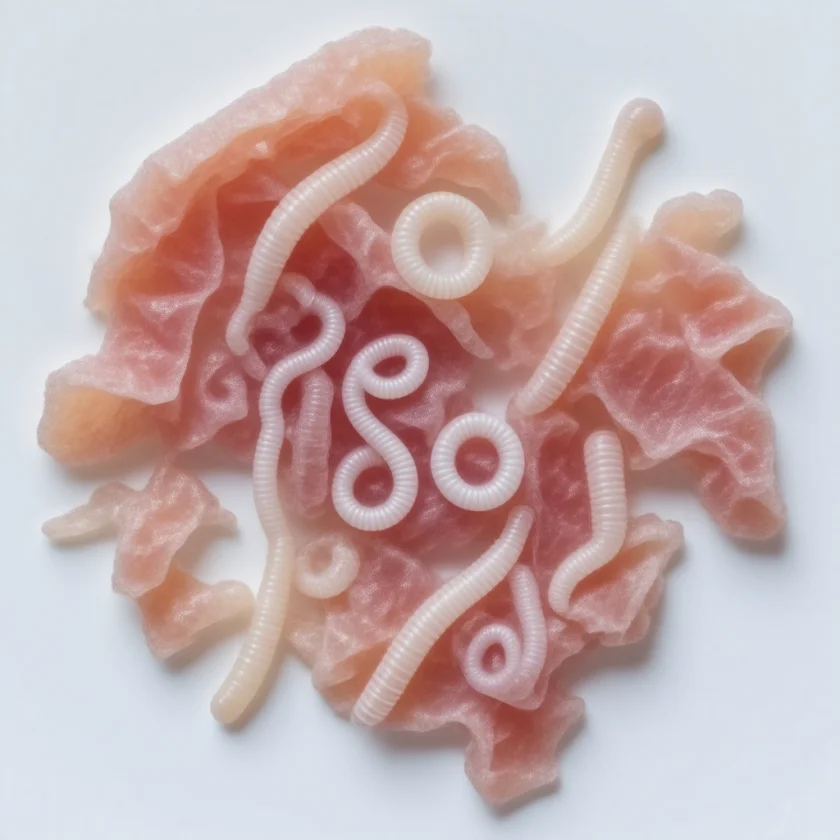
Anisakis is a genus of parasitic roundworm (nematode) that spends its life in the sea. Its larvae are the part that matters to us: pale, coiled, thread-like worms roughly one to two centimeters long — about the length of a staple — that live inside the body cavity and muscle of many common saltwater fish and squid. The most familiar species is Anisakis simplex, long nicknamed the "herring worm" because it is so often found in herring; a close relative, Pseudoterranova decipiens, is called the "cod worm" or "seal worm." Because these larvae ride to the table inside raw fish, the popular press has taken to calling Anisakis the "sushi worm."
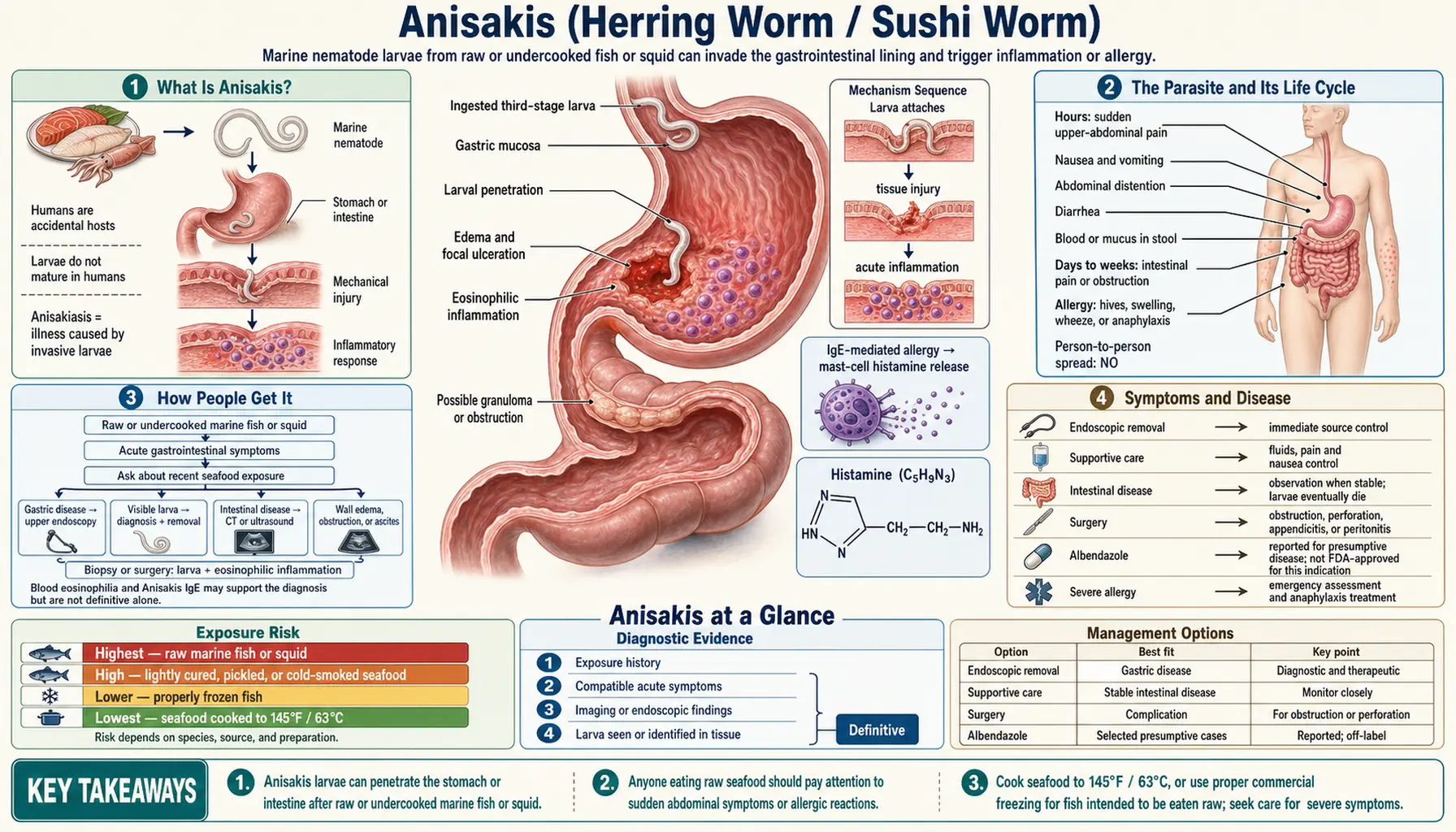
The disease it causes when a live larva is swallowed is called anisakiasis (the broader term anisakidosis covers the whole family of related worms). Humans are not the parasite's intended destination — we are an accidental, dead-end host. The larva cannot grow up or reproduce inside a person, and it eventually dies. But in the meantime it can cause real trouble, either by physically burrowing into the gut wall or, quite separately, by provoking a powerful allergic reaction.
Two things make Anisakis increasingly relevant. First, our taste for raw and lightly cured fish — sushi, sashimi, ceviche, poke, marinated anchovies, cold-smoked salmon — has spread far beyond the coastal cultures where it began. Second, surveys keep finding that infection rates in wild fish are high and, in many seas, rising. The parasite was once an obscure curiosity of fishery science; today it is a recognized food-safety and allergy concern worldwide.
2. The Parasite and Its Life Cycle
Anisakis completes its life cycle entirely at sea, passing through several hosts before reaching an adult worm. Understanding that chain explains both why the larvae end up in fish flesh and why cooked, farmed, or freshwater fish are far safer.
The adult worms live in the stomachs of marine mammals — whales, dolphins, seals, and sea lions, which are the parasite's true (definitive) hosts. The adults produce eggs, which pass out with the animal's feces into the seawater. In the water the eggs develop and hatch into tiny swimming larvae.
These larvae are eaten by small crustaceans — krill and other planktonic shrimp-like animals — which act as the first hosts. When fish and squid feed on those infected crustaceans, the larvae are passed up the food chain. Inside the fish, the worms settle as third-stage larvae (L3), coiling up in the belly cavity, around the guts, and — importantly — migrating into the muscle (the flesh we eat). Larger predatory fish that eat smaller infected fish can accumulate many worms, so the parasite concentrates as it moves up toward the top of the food web.
The cycle closes when a marine mammal eats an infected fish and the larvae finally mature into adults in its stomach. Humans break into this loop by accident, simply by eating the same raw fish a seal or whale would. Our stomach is the wrong environment, so the larva never matures — but it can still attach to and burrow into our stomach or intestinal wall before it dies, and that is where the illness comes from.
One practical detail from this biology matters at the dock and in the kitchen: while a fish is alive the worms tend to stay in its guts, but after the fish dies they can migrate out of the viscera into the surrounding flesh if the catch is not gutted and chilled promptly. Prompt evisceration of caught fish is one reason commercial handling reduces — though it does not eliminate — the number of larvae in the fillet.
3. How People Get It
Anisakiasis comes from eating raw or undercooked marine fish and squid that still contain a living larva. It is essentially a disease of preparation: the same fish is completely safe once it has been properly cooked or frozen. The dishes most often implicated are exactly the ones we prize for being raw or barely cured:
- Sushi and sashimi — raw fish over rice or served plain.
- Ceviche and tiradito — raw fish "cooked" only in citrus juice. The acid changes the texture but does not reliably kill the worm.
- Pickled, salted, or "green" herring — lightly cured herring such as Dutch maatjes or Scandinavian pickled herring.
- Marinated fresh anchovies — the Spanish boquerones en vinagre are a leading cause of anisakiasis in Spain.
- Cold-smoked or lightly salted salmon and gravlax — "cold" smoking never reaches a temperature that kills larvae.
- Lightly seared fish (browned outside, raw inside) and raw squid.
A crucial point that surprises many people: the ordinary kitchen tricks we associate with "curing" fish — salt, vinegar, lemon or lime juice, and cold smoke — do not reliably kill Anisakis larvae. Only sufficient heat or sufficient freezing does. That is why marinated and cold-cured preparations carry the risk while a fully cooked fillet does not.
Just as important is what does not transmit it. Anisakis is a strictly marine (saltwater) parasite, so purely freshwater fish are not a source. (Freshwater fish carry their own, different parasites, but not this one.) Anisakiasis is also not contagious from person to person — you can only get it from the fish, never from someone who has it.
Geography follows the plate. Japan reports the most cases in the world because of its deep sashimi tradition, and Spain has high rates driven by marinated anchovies. As raw-fish dining has spread, cases are being recognized more often across the rest of Europe and the Americas.
4. Symptoms and Disease
When someone swallows a live larva, the illness usually announces itself quickly and dramatically. The most common form is gastric anisakiasis, in which the worm attacks the wall of the stomach. Symptoms typically begin within hours of the meal — often within the first several hours — and include:
- Sudden, severe pain in the upper abdomen (the pit of the stomach).
- Nausea and vomiting.
- Sometimes a tingling or "tickling" sensation in the throat, occasionally with the urge to cough — when a larva lodges high up.
The pain is caused by the larva physically burrowing into the stomach lining, which sets off intense local inflammation. The symptoms can be sharp enough to send people to the emergency room, and they are easily mistaken for a stomach ulcer, gallbladder attack, or food poisoning — which is exactly why the recent-raw-fish history is such an important clue.
A second, later pattern is intestinal anisakiasis, in which the larva passes beyond the stomach and burrows into the wall of the small or large intestine. This form tends to appear a day or more after the meal, with lower abdominal pain, cramping, bloating, and sometimes signs of partial bowel obstruction. Because it can produce a tender mass or mimic appendicitis, intestinal cases are sometimes discovered only during surgery for a suspected surgical emergency. Serious complications such as bowel perforation are possible but uncommon.
There is a natural limit to the infection. Because a human is the wrong host, the larva cannot survive indefinitely and generally dies within days to a few weeks. As it dies, the body may wall it off in a small inflammatory nodule (an eosinophilic granuloma). So even without treatment many cases eventually settle on their own — but the intervening symptoms can be miserable, and removing the worm brings much faster relief.
5. The Allergy Angle
Here is the part of the Anisakis story that is genuinely under-recognized, even by many doctors: beyond being an infection, Anisakis is a potent food allergen. Its body contains proteins that the human immune system can learn to react to, and in a sensitized person, eating fish that harbored the worm can trigger a classic, IgE-mediated allergic reaction.
These reactions run the full range of food allergy. Milder cases cause hives (urticaria) and swelling (angioedema); severe cases can produce anaphylaxis — a rapid, whole-body reaction with trouble breathing and a drop in blood pressure that is a medical emergency. When acute allergic symptoms occur together with an active worm in the gut, the picture is sometimes called gastro-allergic anisakiasis.
The unsettling twist is that the fish does not have to be raw, or even contain a living worm, for a sensitized person to react. Several of the Anisakis allergens are remarkably tough — stable to heat and to freezing — so they can survive cooking. That means a person who has become allergic can, in principle, react to a piece of fish that was thoroughly cooked but had contained a (now dead) larva. This is a major reason Anisakis is thought to be an overlooked cause of apparent "fish allergy" and of some cases of unexplained anaphylaxis in populations that eat a lot of fish. Someone told they are "allergic to fish" may in fact be allergic to the worm that was in it.
Sensitization generally requires a prior exposure — usually at least one earlier infection with a live larva. There is also an occupational side: workers in fish-processing and fishmongering can develop skin and respiratory allergy from handling parasitized fish. The honest and important implication for care is that for a person with a confirmed Anisakis allergy, freezing and cooking — which reliably prevent infection — may not prevent an allergic reaction, because the offending proteins can persist. Those individuals need an allergist's guidance and may have to avoid the fish species most likely to carry the parasite.
6. Diagnosis
The single most useful clue is the story: severe stomach pain, nausea, or vomiting that started within hours of eating raw or lightly cured marine fish. With that history in mind, the diagnosis of gastric anisakiasis can often be both confirmed and cured in one step.
That step is upper endoscopy (gastroscopy). A thin, flexible camera is passed into the stomach, and in gastric cases the clinician can frequently see the pale larva half-buried in the stomach lining — and then grasp and remove it with forceps. Endoscopy is therefore the gold standard: it is diagnostic and therapeutic at the same time, and pulling the worm out usually relieves the pain quickly.
Intestinal cases are harder to catch, because an endoscope cannot easily reach the affected stretch of bowel. There, doctors rely on imaging — ultrasound or CT scans that show a thickened, swollen segment of intestinal wall — together with the dietary history; some are diagnosed only at surgery undertaken for a suspected obstruction or appendicitis.
For the allergy side, the tools are different. Blood tests for specific IgE antibodies to Anisakis simplex and skin-prick testing can show that a person has been sensitized. These tests have a limitation worth understanding: a positive result proves past exposure and sensitization, but does not by itself prove that Anisakis caused a particular recent reaction, so results are interpreted alongside the clinical story. Blood eosinophil counts may rise, but often only later in the illness, so a normal count early on does not rule anisakiasis out.
7. Treatment
For gastric anisakiasis, the best treatment is refreshingly direct: take the worm out. Endoscopic removal of the larva is often immediately curative — once the parasite is gone, the inflammation subsides and the severe pain typically eases within a short time. Because endoscopy both finds and fixes the problem, it is the preferred approach whenever the worm can be reached.
When the larva is not or cannot be removed — as in many intestinal cases — the illness is usually managed with supportive care and time. Since a human is a dead-end host, the larva dies on its own within days to a few weeks, and symptoms fade as it does. Supportive care means relief measures: pain control, anti-nausea medicine, and fluids. Most intestinal cases resolve without an operation; surgery is reserved for genuine complications such as bowel obstruction, perforation, or when the diagnosis was uncertain and a possible appendicitis or tumor had to be explored.
It is worth being honest about drug treatment: there is no antiparasitic pill reliably proven to cure anisakiasis. The deworming drug albendazole has been reported in some cases and is sometimes tried when the worm cannot be located, but the evidence is limited and it is not a substitute for removal or for supportive care. The mainstays remain endoscopic removal when possible, and watchful supportive treatment otherwise.
The allergic reactions are treated as any serious allergy would be — antihistamines for milder symptoms and epinephrine for anaphylaxis, followed by referral to an allergist for longer-term guidance and avoidance planning.
8. Prevention
This is the practical heart of the matter, and the news is good: Anisakis larvae are killed by freezing and by cooking. Get either one right and the fish is safe to eat, raw preparations included. Two numbers do most of the work.
Freezing. Deep-freezing is what makes raw fish safe, and it is the real meaning behind the marketing term "sushi-grade." In the United States, the FDA recommends freezing fish intended to be eaten raw at −20°C (−4°F) or below for 7 days, or at a colder −35°C (−31°F) until solid and then held for about 15 hours, to kill parasites. European rules similarly require freezing fishery products meant to be eaten raw, marinated, salted, or cold-smoked to −20°C throughout the product for at least 24 hours. Reputable sushi restaurants and fish suppliers freeze to these standards; an ordinary home freezer, which is often warmer and slower, may not reliably reach or hold them.
Cooking. Heat is just as effective. Cooking fish to an internal temperature of 63°C (145°F) — until the flesh is opaque and flakes easily — kills the larvae. This is why a properly cooked fillet, however heavily parasitized the raw fish might have been, does not cause anisakiasis.
Other measures help but should not be relied on alone. Visual inspection and candling — examining fillets over a bright light to spot and pick out visible worms — removes many larvae and is used commercially, but it is not perfect. And to repeat the single most common mistake: salting, vinegar or citrus marinades, and cold smoking do not reliably kill the parasite. The riskiest home preparations are exactly these lightly cured ones made from fresh, never-frozen fish — homemade marinated anchovies or fresh pickled herring being classic examples.
A few plain-language takeaways:
- If you love raw fish, buy from suppliers who freeze to the standards above, or freeze suitable fish yourself in a freezer cold enough to do the job — and be wary of home-cured fresh anchovies and herring.
- When in doubt, cook it to 63°C (145°F). Cooking removes the risk entirely.
- Freshwater fish do not carry Anisakis (though they carry other parasites, so the cook-or-freeze logic still applies broadly).
- Pregnant people and anyone who prefers to be cautious can enjoy fish freely as long as it is thoroughly cooked or has been properly frozen before being served raw.
- If you have had an allergic reaction that might be linked to Anisakis, see an allergist — for you, freezing and cooking may not be enough, and specific avoidance advice is important.
Key Research Papers
Peer-reviewed reviews and studies on Anisakis and anisakiasis — covering the worm's biology and life cycle, how the infection presents and is managed, the parasite as a food allergen, and the food-safety measures that prevent it. Journal names appear as plain text; the year/volume/pages link opens the full citation via DOI.
- Audicana MT, Kennedy MW. Anisakis simplex: from obscure infectious worm to inducer of immune hypersensitivity. Clinical Microbiology Reviews. 2008;21(2):360–379. — The definitive review linking the infection and the allergy. — doi:10.1128/CMR.00012-07
- Sakanari JA, McKerrow JH. Anisakiasis. Clinical Microbiology Reviews. 1989;2(3):278–284. — A classic early overview of the disease and its cause. — doi:10.1128/CMR.2.3.278
- Hochberg NS, Hamer DH. Anisakidosis: perils of the deep. Clinical Infectious Diseases. 2010;51(7):806–812. — A clinician-focused review of diagnosis and management. — doi:10.1086/656238
- EFSA Panel on Biological Hazards (BIOHAZ). Scientific opinion on risk assessment of parasites in fishery products. EFSA Journal. 2010;8(4):1543. — The European risk assessment underpinning freezing rules for raw fish. — doi:10.2903/j.efsa.2010.1543
- Baird FJ, Gasser RB, Jabbar A, Lopata AL. Foodborne anisakiasis and allergy. Molecular and Cellular Probes. 2014;28(4):167–174. — Reviews the twin problem of infection and allergy in the food chain. — doi:10.1016/j.mcp.2014.02.003
- Nieuwenhuizen NE, Lopata AL. Anisakis — a food-borne parasite that triggers allergic host defences. International Journal for Parasitology. 2013;43(12–13):1047–1057. — How the worm drives allergic sensitization. — doi:10.1016/j.ijpara.2013.08.001
- Nieuwenhuizen NE. Anisakis — immunology of a foodborne parasitosis. Parasite Immunology. 2016;38(9):548–557. — Reviews the allergens and the immune response to them. — doi:10.1111/pim.12349
- Audicana MT, Ansotegui IJ, Fernández de Corres L, Kennedy MW. Anisakis simplex: dangerous — dead and alive? Trends in Parasitology. 2002;18(1):20–25. — Argues that even killed larvae can cause allergic disease. — doi:10.1016/s1471-4922(01)02152-3
- Daschner A, Cuéllar C, Rodero M. The Anisakis allergy debate: does an evolutionary approach help? Trends in Parasitology. 2012;28(1):9–15. — A thoughtful look at why sensitization happens. — doi:10.1016/j.pt.2011.10.001
- Mattiucci S, Fazii P, De Rosa A, et al. Anisakiasis and gastroallergic reactions associated with Anisakis pegreffii infection, Italy. Emerging Infectious Diseases. 2013;19(3):496–499. — Ties a specific species to combined infection-and-allergy cases. — doi:10.3201/eid1903.121017
- Bao M, Pierce GJ, Pascual S, et al. Assessing the risk of an emerging zoonosis of worldwide concern: anisakiasis. Scientific Reports. 2017;7:43699. — Quantifies the growing global burden. — doi:10.1038/srep43699
- Aibinu IE, Smooker PM, Lopata AL. Anisakis nematodes in fish and shellfish — from infection to allergies. International Journal for Parasitology: Parasites and Wildlife. 2019;9:384–393. — An up-to-date synthesis across the food chain. — doi:10.1016/j.ijppaw.2019.04.007
PubMed Topic Searches
Each link opens a live PubMed query so results stay current as new papers are indexed.
- PubMed: Anisakis simplex anisakiasis
- PubMed: Gastric anisakiasis endoscopy
- PubMed: Anisakis allergy and anaphylaxis
- PubMed: Anisakis heat-stable allergens
- PubMed: Anisakis raw fish, sushi, ceviche
- PubMed: Anisakis freezing and cooking prevention
- PubMed: Anisakis pegreffii gastro-allergic
- PubMed: Intestinal anisakiasis and obstruction