Sarcoma
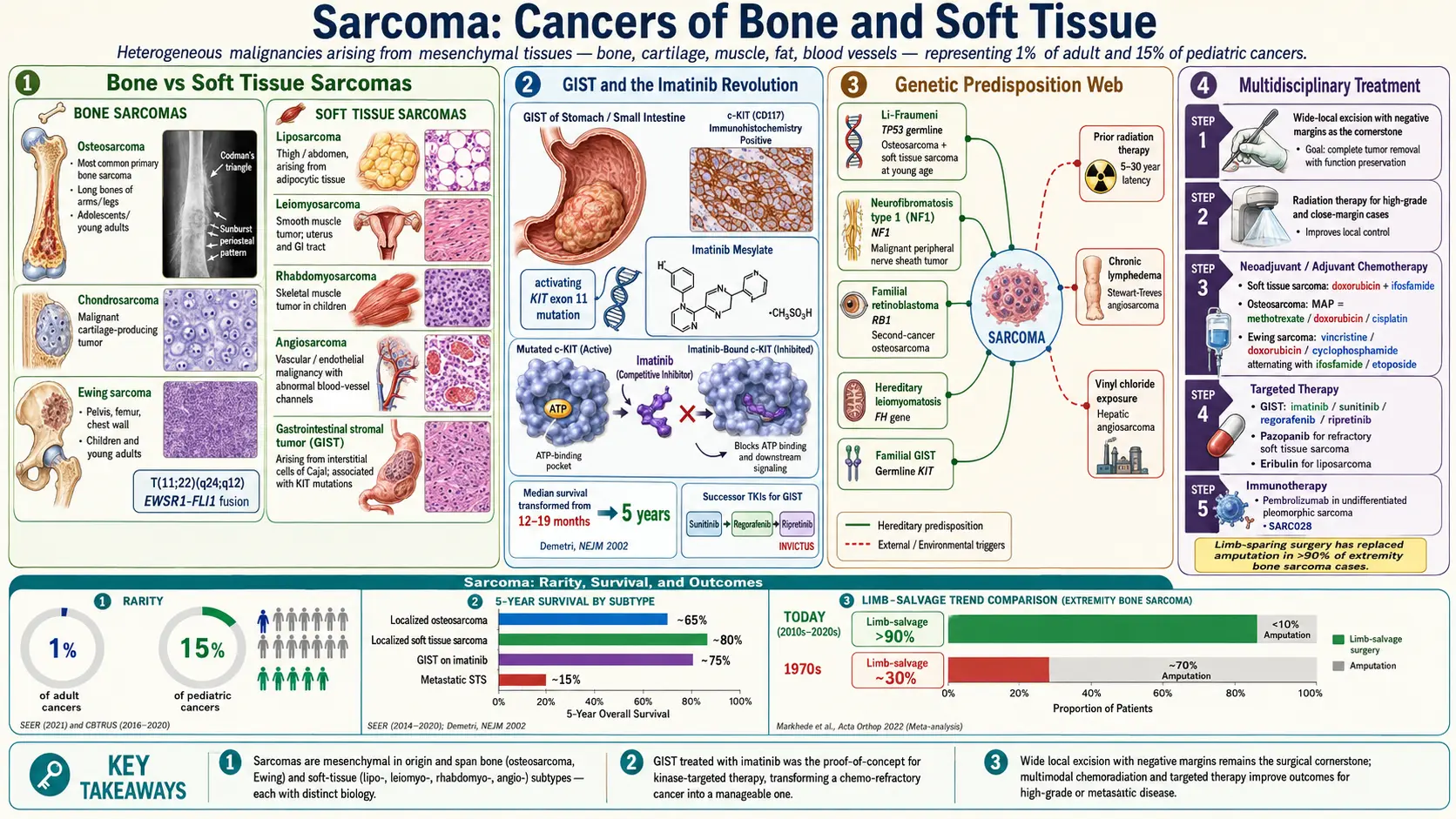
Table of Contents
What Sarcoma Is
Sarcoma is a type of cancer that originates in the body's connective tissues, such as bones, muscles, fat, cartilage, and blood vessels. It can occur in any part of the body but is most commonly found in the arms, legs, and abdomen.
Sarcomas are rare in adults and much more common, relatively, in children: a 2012 review of sarcoma epidemiology reports that they make up over 20% of solid cancers in children but under 1% of solid cancers in adults. The great majority are soft tissue sarcomas; cancers of the bone make up just over 10% of sarcomas.
Types of Sarcoma
1. Bone Sarcoma
- Osteosarcoma: The most common type of bone cancer, usually occurring in the long bones of the arms and legs.
- Ewing Sarcoma: Often found in the pelvis, legs, or chest wall, more common in children and young adults.
2. Soft Tissue Sarcoma
- Liposarcoma: Develops in fat tissues, often in the thigh or abdomen.
- Leiomyosarcoma: Originates in smooth muscles, such as those in the uterus or digestive tract.
- Rhabdomyosarcoma: Affects skeletal muscle tissues and is more common in children.
- Angiosarcoma: Develops in the lining of blood or lymph vessels.
Causes and Risk Factors
The exact cause of sarcoma is unknown, but there are several risk factors:
- Genetic disorders: Conditions like Li-Fraumeni syndrome, neurofibromatosis, and retinoblastoma increase the risk.
- Radiation exposure: Previous radiation therapy for cancer can increase the risk of developing sarcoma. The 2012 epidemiology review reports that the risk of bone sarcoma rises as the total (cumulative) radiation dose to the bone rises (p for trend <0.001).
- HIV infection: People with HIV have a higher risk of Kaposi sarcoma, which is caused by human herpesvirus 8 (HHV8).
- Chronic lymphedema: Prolonged swelling due to lymph fluid buildup may increase the risk of angiosarcoma.
- Chemical exposure: Contact with certain chemicals, such as dioxins or herbicides, may increase the risk. The 2012 review describes work exposure to herbicides and chlorophenols as "suggested" risk factors, and one case-control study it cites found a higher soft tissue sarcoma risk among gardeners (adjusted odds ratio 4.1), but not among people working strictly in farming; the review notes that many of these links still need confirmation in larger studies.
- Age: Although sarcomas can occur at any age, certain types are more common in children, while others occur more frequently in adults.
Symptoms of Sarcoma
Symptoms of sarcoma vary depending on the location and type, but common signs include:
- Noticeable lump under the skin, which may or may not be painful
- Swelling and tenderness in the affected area
- Bone pain, particularly at night or during activity
- Unexplained weight loss
- Limited range of motion if near joints
Diagnosis and Staging
Diagnostic Tests
To diagnose sarcoma, doctors may use the following tests:
- Physical examination: To identify lumps and swelling.
- Imaging tests: Such as X-rays, magnetic resonance imaging (MRI), computed tomography (CT) scans, or positron emission tomography (PET) scans to visualize the tumor.
- Biopsy: A sample of tissue is taken to confirm the diagnosis and identify the type of sarcoma.
Staging
The staging of sarcoma depends on the size, grade, location, and spread of the tumor. The list below is a simplified summary of the American Joint Committee on Cancer (AJCC) staging for soft tissue sarcoma of the arms, legs and trunk; bone sarcomas and sarcomas in other body sites are staged differently:
- Stage I: Low-grade tumor, confined to the original site.
- Stage II: High-grade tumor, confined but more aggressive.
- Stage III: Larger high-grade tumor that has not spread to lymph nodes or distant sites.
- Stage IV: Tumor that has spread to distant parts of the body (metastasis). In the current AJCC 8th edition, spread to nearby lymph nodes is also grouped with distant spread as stage IV for sarcomas of the arms, legs and trunk.
Treatment Options
Treatment depends on the type, location, and stage of the sarcoma:
- Surgery: The primary treatment to remove the tumor, often with some surrounding healthy tissue to ensure complete removal.
- Radiation therapy: Used before or after surgery to shrink the tumor or kill remaining cancer cells.
- Chemotherapy: May be used for certain types of sarcoma, such as Ewing sarcoma or high-grade soft tissue sarcomas.
- Targeted therapy: Drugs that specifically target cancer cell mutations. In gastrointestinal stromal tumours (GIST), a sarcoma of the digestive tract, imatinib produced a partial response in 79 of 147 patients (53.7%) with advanced disease in a 2002 trial. For GIST that has progressed on imatinib, sunitinib and regorafenib, the 2020 INVICTUS trial found ripretinib kept the disease from progressing for a median of 6.3 months versus 1.0 month on placebo.
- Immunotherapy: Stimulates the body’s immune system to fight cancer cells. In the SARC028 trial (2017) of the checkpoint drug pembrolizumab, 7 of 40 patients with advanced soft tissue sarcoma responded, including 4 of 10 with undifferentiated pleomorphic sarcoma and 2 of 10 with liposarcoma, but none of 10 with leiomyosarcoma; 2 of 40 with bone sarcoma responded and none of 13 with Ewing sarcoma.
- Engineered T-cell therapy: On 1 August 2024 the U.S. Food and Drug Administration gave accelerated approval to afamitresgene autoleucel, a one-time treatment made from the patient's own T cells (immune cells) that are genetically modified to attack the MAGE-A4 protein. It is approved for adults with synovial sarcoma that cannot be removed by surgery or has spread, who have already had chemotherapy, whose tumours express MAGE-A4 and who carry certain HLA-A*02 tissue types. In the trial behind the approval, 43.2% of 44 patients responded (2 completely), with a median response length of 6.0 months; cytokine release syndrome (a body-wide inflammatory reaction) occurred in 75%, which carries a boxed warning. The FDA reports that data-quality issues led it to order an independent re-review of the scans. It was the first FDA approval of a T-cell receptor gene therapy and the first approval specifically for synovial sarcoma.
Other chemotherapy results reported in trials: in previously treated advanced liposarcoma or leiomyosarcoma, eribulin gave a median overall survival of 13.5 months versus 11.5 months with dacarbazine (2016 phase 3 trial), with more grade 3 or higher side effects (67% versus 56%). A 2016 phase 2 trial had reported longer survival when olaratumab was added to doxorubicin, but the 509-patient ANNOUNCE phase 3 trial (2020) found no survival difference (median 20.4 versus 19.7 months), and the authors state it "did not confirm the overall survival benefit observed in the phase 2 trial".
Prognosis
The prognosis for sarcoma depends on various factors, including the type, stage at diagnosis, and response to treatment. Early detection and treatment can improve the chances of a positive outcome, especially for low-grade and localized sarcomas.
Key Research Papers
Historical Background
The term "sarcoma" was coined by English surgeon John Abernethy in 1804, deriving from the Greek "sarx" (flesh). James Ewing described Ewing sarcoma in 1921, distinguishing it from other bone tumors. Major advances in sarcoma treatment came in the 1970s when Norman Jaffe and Gerald Rosen demonstrated that adjuvant chemotherapy dramatically improved survival in osteosarcoma, transforming it from a nearly uniformly fatal disease to one with a majority survival rate.
- Gronchi A, Miah AB, Dei Tos AP, et al. Soft tissue and visceral sarcomas: ESMO-EURACAN-GENTURIS Clinical Practice Guidelines. Ann Oncol. 2021;32(11):1348-1365. — doi:10.1016/j.annonc.2021.07.006
- Tap WD, Jones RL, Van Tine BA, et al. Olaratumab and doxorubicin versus doxorubicin alone for treatment of soft-tissue sarcoma. The Lancet. 2016;388(10043):488-497. — doi:10.1016/S0140-6736(16)30587-6
- Tap WD, Wagner AJ, Schöffski P, et al. Effect of Doxorubicin Plus Olaratumab vs Doxorubicin Plus Placebo on Survival in Patients With Advanced Soft Tissue Sarcomas: The ANNOUNCE Randomized Clinical Trial. JAMA. 2020;323(13):1266-1276. — PubMed PMID: 32259228
- Casali PG, Abecassis N, Aro HT, et al. Soft tissue and visceral sarcomas: ESMO Clinical Practice Guidelines. Ann Oncol. 2018;29(Suppl 4):iv51-iv67. — doi:10.1093/annonc/mdy096
- Demetri GD, von Mehren M, Blanke CD, et al. Efficacy and safety of imatinib mesylate in advanced gastrointestinal stromal tumours. N Engl J Med. 2002;347(7):472-480. — doi:10.1056/NEJMoa020461
- Fletcher CDM, Bridge JA, Hogendoorn PCW, Mertens F (eds). WHO Classification of Tumours of Soft Tissue and Bone (4th edition). Lyon: IARC Press. 2013.
- Gaspar N, Hawkins DS, Dirksen U, et al. Ewing sarcoma: current management and future approaches. J Clin Oncol. 2015;33(27):3036-3046. — doi:10.1200/JCO.2014.59.5256
- Pisters PW, Leung DH, Woodruff J, et al. Analysis of prognostic factors in 1,041 patients with localized soft tissue sarcomas of the extremities. J Clin Oncol. 1996;14(5):1679-1689. — PubMed PMID: 8622088
- Stacchiotti S, Sommer J. Building a global consensus approach to chordoma: a position paper. Lancet Oncol. 2015;16(2):e71-e83. — doi:10.1016/S1470-2045(14)71190-8
- Tawbi HA, Burgess M, Bolejack V, et al. Pembrolizumab in advanced soft-tissue sarcoma and bone sarcoma (SARC028). Lancet Oncol. 2017;18(11):1493-1501. — doi:10.1016/S1470-2045(17)30624-1
- Schöffski P, Chawla S, Maki RG, et al. Eribulin versus dacarbazine in previously treated patients with advanced liposarcoma or leiomyosarcoma. The Lancet. 2016;387(10028):1629-1637. — doi:10.1016/S0140-6736(15)01283-0
- Blay JY, Serrano C, Heinrich MC, et al. Ripretinib in patients with advanced gastrointestinal stromal tumours (INVICTUS). Lancet Oncol. 2020;21(7):923-934. — doi:10.1016/S1470-2045(20)30168-6
- Cates JMM. The AJCC 8th Edition Staging System for Soft Tissue Sarcoma of the Extremities or Trunk: A Cohort Study of the SEER Database. J Natl Compr Canc Netw. 2018;16(2):144-152. — PubMed PMID: 29439175
- Barnett KK, Johnson AR, Das A, et al. FDA Approval Summary: Afamitresgene Autoleucel for Adults with HLA-Restricted, MAGE-A4-Positive Unresectable or Metastatic Synovial Sarcoma after Prior Chemotherapy. Clin Cancer Res. 2025;31(15):3112-3117. — PubMed PMID: 40423661
- Burningham Z, Hashibe M, Spector L, Schiffman JD. The epidemiology of sarcoma. Clin Sarcoma Res. 2012;2(1):14. — doi:10.1186/2045-3329-2-14
PubMed Topic Searches
The following PubMed topic searches surface the current peer-reviewed literature on Sarcoma. Each link opens a live PubMed query; results update as new papers are indexed.
- PubMed: Search: sarcoma
- PubMed: Search: soft tissue sarcoma
- PubMed: Search: osteosarcoma
- PubMed: Search: Ewing sarcoma
- PubMed: Search: leiomyosarcoma
- PubMed: Search: liposarcoma
- PubMed: Search: gastrointestinal stromal tumor GIST imatinib
- PubMed: Search: sarcoma chemotherapy doxorubicin
- PubMed: Search: sarcoma surgical resection margins
- PubMed: Search: sarcoma radiation therapy
- PubMed: Search: rhabdomyosarcoma pediatric
- PubMed: Search: sarcoma pazopanib