Thyroid Cancer
- Overview
- Epidemiology
- Types of Thyroid Cancer
- Pathophysiology
- Risk Factors
- Clinical Presentation
- Diagnosis and Staging
- Treatment
- Prognosis
- Research Papers
- Connections
- Featured Videos
Overview
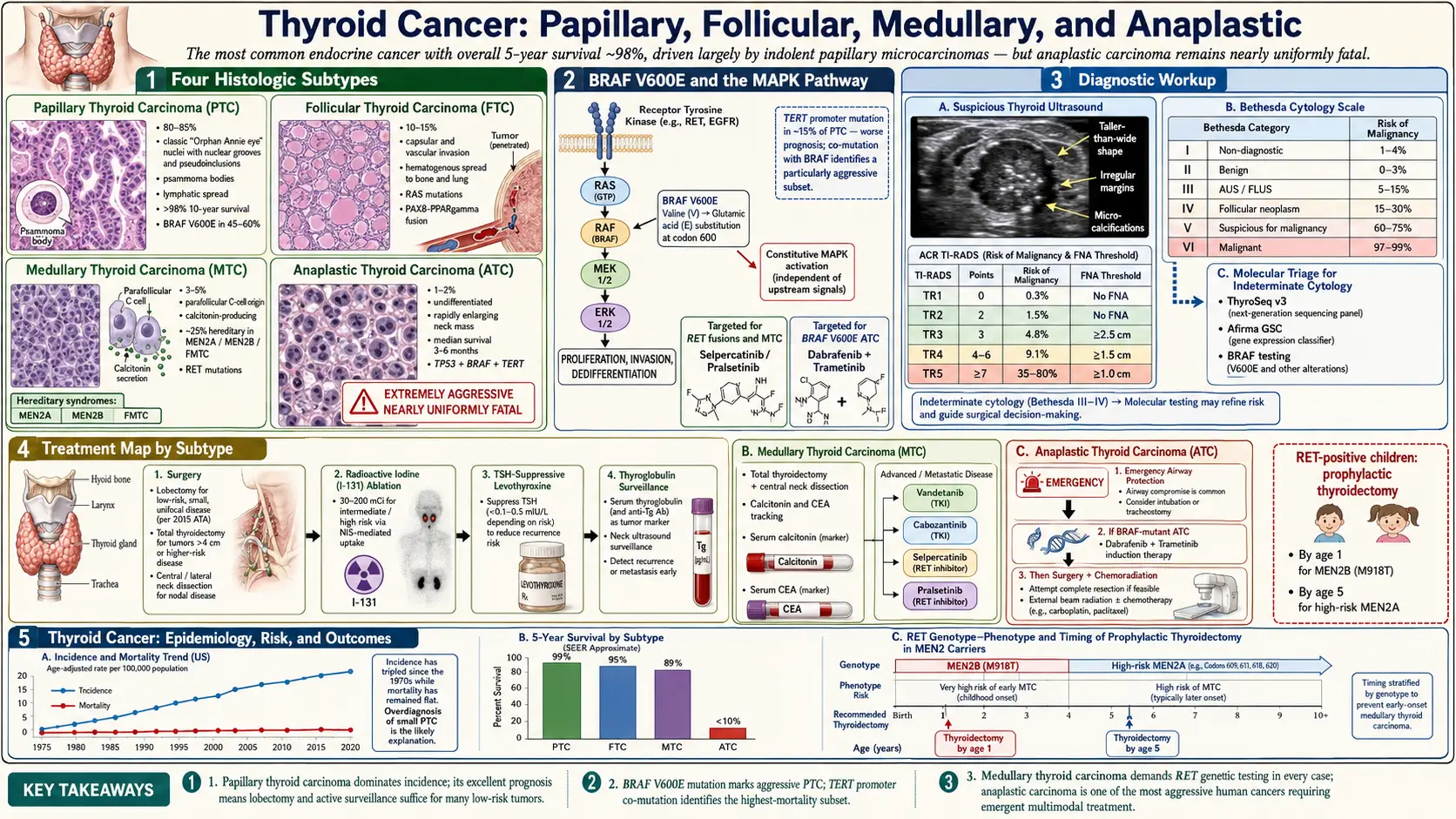
Thyroid cancer arises in the thyroid gland. Most thyroid cancers start in the follicular cells that make thyroid hormone; medullary thyroid cancer starts instead in the parafollicular C cells, which secrete calcitonin (Fagin and Wells 2016). Differentiated thyroid cancer (DTC) — the papillary and follicular types — makes up the vast majority (more than 90 percent) of all thyroid cancers, according to the 2015 American Thyroid Association (ATA) guideline (Haugen 2016).
Outcomes differ enormously by type. For differentiated thyroid cancer the 10-year disease-specific mortality is less than 5 percent (Fagin and Wells 2016), and U.S. cancer-registry (SEER) data put 5-year relative survival for all thyroid cancers at 98.3 percent. Anaplastic thyroid cancer is the opposite extreme: the 2021 ATA anaplastic guideline describes a historical median survival of about 5 months and a 1-year survival of about 20 percent (Bible 2021).
Thyroid cancer is also a central example of overdiagnosis. U.S. incidence nearly tripled between 1975 and 2009, almost entirely from papillary cancer, with a growing share of tumors 1 cm or smaller that the guideline links to increasing use of neck imaging (Haugen 2016). In South Korea, regional screening rates tracked thyroid cancer incidence closely, the rise was confined to papillary cancer, and screening was not associated with thyroid cancer mortality (Ahn 2016). These findings underlie the active-surveillance option for very low-risk papillary microcarcinomas that the ATA guideline describes (Haugen 2016).
Epidemiology
The U.S. National Cancer Institute’s SEER program estimates 45,240 new cases of thyroid cancer and 2,320 deaths in the United States in 2026 — 2.1 percent of all new cancer cases and 0.4 percent of cancer deaths. The age-adjusted rate of new cases is 13.7 per 100,000 per year (2019–2023), the death rate is 0.5 per 100,000, and about 1.1 percent of people will be diagnosed with thyroid cancer during their lifetime. The median age at diagnosis is 51 (SEER Cancer Stat Facts: Thyroid Cancer).
Women are affected far more often than men: SEER reports age-adjusted rates of 20.0 new cases per 100,000 women and 7.4 per 100,000 men, while the death rate is 0.5 per 100,000 in both sexes. Among women, rates range from 12.1 per 100,000 in non-Hispanic Black women to 22.3 per 100,000 in non-Hispanic Asian/Pacific Islander women (SEER).
Incidence rose from 4.9 per 100,000 in 1975 to 14.3 per 100,000 in 2009, a change attributed almost entirely to papillary thyroid cancer; 25 percent of new thyroid cancers diagnosed in 1988–1989 were 1 cm or smaller, compared with 39 percent in 2008–2009. A population-based study from Olmsted County attributed the doubling of incidence from 2000 to 2012 entirely to clinically occult cancers found incidentally on imaging or pathology (both as summarized in Haugen 2016). Papillary microcarcinomas smaller than 1 cm occur in up to 30 percent of adults in the general population, yet rarely become clinically significant (Fagin and Wells 2016).
In South Korea, where incidence rose the most, the 2008–2010 incidence was 64.1 per 100,000 (107.3 in women, 21.1 in men). Regional screening rates correlated strongly with regional incidence (r = 0.77), screening was associated only with more papillary cancer, and it showed no association with thyroid cancer mortality (Ahn 2016; see also Ahn, Kim and Welch 2014).
Types of Thyroid Cancer
Thyroid cancers are grouped by the cell they arise from and how closely they still resemble normal thyroid tissue. The figures below come from the 2016 NEJM review by Fagin and Wells unless another source is named.
Papillary Thyroid Cancer (PTC)
Papillary thyroid carcinoma accounts for approximately 85 percent of thyroid cancers. Most papillary cancers behave indolently, consistent with a simple genome: papillary thyroid carcinoma has one of the lowest mutation densities of any cancer studied by whole-exome sequencing. Its driver mutations are mutually exclusive and all signal through the MAPK pathway — BRAF V600E accounts for 60 percent of them, RAS mutations for 15 percent, and chromosomal rearrangements activating BRAF or receptor tyrosine kinases such as RET, NTRK and ALK for 12 percent; the remaining 13 percent mostly have no known driver.
BRAF-mutated classical and tall-cell-variant papillary cancers have a high frequency of lymph-node metastases and recurrence after thyroidectomy and respond poorly to radioiodine. RAS-mutated tumors are associated with the follicular variant, which spreads infrequently to lymph nodes and usually remains radioiodine-avid.
In 2016 an international pathology panel renamed noninvasive encapsulated follicular variant papillary carcinoma “noninvasive follicular thyroid neoplasm with papillary-like nuclear features” (NIFTP). All 109 patients with the noninvasive form, 67 of them treated with lobectomy alone and none with radioiodine, were alive with no evidence of disease after a median of 13 years (range 10–26), whereas adverse events occurred in 12 of 101 patients with the invasive form, including 5 with distant metastases, 2 of whom died (Nikiforov 2016).
Follicular Thyroid Cancer (FTC)
Follicular thyroid carcinomas represent 2 to 5 percent of thyroid cancers. They carry mutually exclusive RAS mutations or a PAX8–PPARG fusion oncogene, and prognosis depends on tumor size, the patient’s age and the degree of angioinvasion, which predicts the risk of distant metastases. Hürthle-cell carcinomas are genetically distinct; widely invasive forms often metastasize to lung and bone and are particularly refractory to radioiodine. The ATA guideline reports recurrence rates of 0–7 percent for well-differentiated follicular cancers with capsular invasion only (Haugen 2016).
Medullary Thyroid Cancer (MTC)
Medullary thyroid carcinoma accounts for 3 to 5 percent of thyroid cancers. In 75 percent of patients it is sporadic, usually developing in the fourth to sixth decade of life; the rest is part of the hereditary multiple endocrine neoplasia type 2 syndromes, MEN2A (95 percent of MEN2 cases) and MEN2B. RET is the dominant oncogene: more than 100 gain-of-function RET mutations have been reported, germline in hereditary disease and somatic in sporadic disease, and the clinical aggressiveness of the cancer is related to the specific RET mutation. In MEN2B, a RET M918T mutation is present in more than 95 percent of patients. Medullary cancer cells secrete calcitonin and carcinoembryonic antigen (CEA), whose serum levels track C-cell mass.
About 7 percent of patients with apparently sporadic medullary cancer turn out to have MEN2A (Fagin and Wells 2016); the revised ATA medullary guideline gives a range of 1–7 percent and states that patients with sporadic medullary cancer should have genetic counseling and RET germline testing, with first-degree relatives of carriers offered testing in turn (Wells 2015).
Anaplastic Thyroid Cancer (ATC)
Anaplastic thyroid carcinoma accounts for 1.7 percent of U.S. thyroid cancers (1.3 to 9.8 percent worldwide) and carries the highest mortality risk of any thyroid tumor (Bible 2021). It probably arises from pre-existing differentiated or poorly differentiated thyroid cancer and has a high mutation burden; besides BRAF and RAS drivers it frequently carries mutations in TP53, the TERT promoter, PI3K–AKT–mTOR pathway genes and epigenetic regulators. TP53 mutations occur in more than 70 percent of anaplastic cancers but are infrequent in other thyroid cancers (Fagin and Wells 2016). BRAF V600E is found in 50–70 percent of anaplastic cancers, and in over 90 percent when papillary cancer coexists in the specimen (Bible 2021).
Every anaplastic thyroid cancer is classified as AJCC stage IV because of its historically poor prognosis (Bible 2021): intrathyroidal disease is stage IVA, gross extrathyroidal extension or cervical lymph-node metastases stage IVB, and distant metastases stage IVC (Tuttle 2017). Poorly differentiated thyroid carcinoma, an intermediate form, makes up approximately 6 percent of thyroid cancers and has a reported mean survival of 3.2 years (Fagin and Wells 2016).
Pathophysiology
The driver mutations of papillary cancer (BRAF, RAS, and fused receptor tyrosine kinases) all activate MAPK signaling, but to different degrees: BRAF V600E produces the highest output because it signals as a monomer and does not respond to the pathway’s negative feedback. MAPK signaling suppresses the genes needed for iodide uptake and metabolism, which are the hallmarks of differentiated thyroid cells. That matters clinically, because response to radioiodine requires those genes to remain active (Fagin and Wells 2016).
Radioiodine therapy relies on the ability of thyroid follicular cells to take up iodide and incorporate it into thyroglobulin, a feature retained in a subgroup of differentiated thyroid cancers. BRAF-mutated cancers and those positive on FDG-PET scans are often refractory to radioiodine, while iodine-handling genes are comparatively preserved in RAS-mutated papillary cancers. In mouse models, MEK or RAF inhibitors partially restore radioiodine uptake that BRAF V600E has suppressed (Fagin and Wells 2016) — the basis of the human “redifferentiation” studies described under Treatment.
Most patients with differentiated thyroid cancer receive thyroid hormone in doses sufficient to suppress thyrotropin (TSH); Fagin and Wells note it is unclear whether this benefits BRAF-mutated papillary cancers, because most of them express low levels of the TSH receptor. Serum thyroglobulin is used with neck ultrasound to follow patients after treatment; antithyroglobulin antibodies, present in people with autoimmune thyroiditis, can interfere with thyroglobulin assays, but persistent or rising antibody levels also indicate disease activity (Fagin and Wells 2016).
In anaplastic cancer, TERT promoter mutations appear to be key transitional steps: they are infrequent and subclonal in papillary cancer (about 10 percent of tumors) but substantially more common, and uniformly clonal, in poorly differentiated and anaplastic cancers (Fagin and Wells 2016).
Risk Factors
Ionizing radiation: Exposure to ionizing radiation is a risk factor for papillary thyroid carcinoma. After the 1986 Chernobyl accident there was a sharp increase in papillary cancers, primarily in very young children in iodine-deficient regions; similar age-dependent trends followed the 1945 atomic bombings and external radiotherapy for benign or malignant head and neck conditions. Radiation-induced papillary cancers have a high prevalence of fusion oncogenes, usually activating RET or, less often, NTRK (Fagin and Wells 2016). The ATA guideline lists childhood head and neck radiation, total-body radiation for bone marrow transplantation and childhood or adolescent exposure to fallout among the history factors that raise the probability that a nodule is malignant (Haugen 2016).
Iodine status: A 2015 review of animal and human studies concluded that iodine deficiency is a risk factor for thyroid cancer, particularly follicular and possibly anaplastic cancer, and that iodine prophylaxis has been followed by declines in those types (Zimmermann and Galetti 2015). The 2021 ATA anaplastic guideline also notes data linking falling anaplastic incidence to food iodization, while cautioning that such data are confounded (Bible 2021). The site’s Iodine page covers what is known about excess intake.
Sex: SEER rates of new cases are about 20 per 100,000 women versus 7.4 per 100,000 men (see Epidemiology). On pregnancy, the ATA guideline reports that papillary cancer discovered during pregnancy does not behave more aggressively than in similar-aged women who are not pregnant (Haugen 2016).
Family history and genetics: 3 to 9 percent of differentiated thyroid cancers are familial. They can occur within cancer syndromes — Cowden disease (PTEN), familial adenomatous polyposis (APC) and Werner syndrome (WRN) — but more commonly as an isolated familial disease in first-degree relatives; germline variants near FOXE1 (9q22.33) and NKX2-1 (14q13.3) are associated with higher risk (Fagin and Wells 2016). The ATA guideline adds Carney complex and MEN2 (for medullary cancer) to the list of syndromes in a first-degree relative that raise suspicion (Haugen 2016).
Body weight: Two meta-analyses and a pooled analysis of prospective studies have reported a positive association between adiposity and thyroid cancer risk, including small subgroup analyses for anaplastic cancer, in which two meta-analyses each reported a relative risk of 1.93 for obesity compared with lean body weight; the ATA anaplastic guideline states that more and larger studies are needed (Bible 2021).
Goiter and anaplastic cancer: In one case-control study, goiter was strongly associated with anaplastic thyroid cancer; the ATA panel lists iodine deficiency and long-neglected goiter as possible explanations, without a settled answer (Bible 2021).
Clinical Presentation
Thyroid nodules are common. In iodine-sufficient parts of the world about 5 percent of women and 1 percent of men have a palpable nodule, while high-resolution ultrasound finds nodules in 19–68 percent of randomly selected people, more often in women and older people. Thyroid cancer is found in 7–15 percent of nodules, depending on age, sex, radiation history, family history and other factors (Haugen 2016).
Signs that raise the probability of cancer, as listed by the ATA guideline, include rapid nodule growth, hoarseness, vocal cord paralysis, enlarged cervical lymph nodes and fixation of the nodule to surrounding tissue. Locally invasive tumors may cause progressive difficulty swallowing, breathing problems, coughing up blood, rapid enlargement, significant voice change and fixation to the airway or neck structures (Haugen 2016).
Anaplastic presentation: The diagnosis of anaplastic cancer is often suspected in older patients with large, symptomatic, rapidly growing neck masses, and the ATA panel notes that most rapidly growing thyroid masses turn out to be anaplastic cancer or primary thyroid lymphoma; the diagnosis rests on tissue examination (Bible 2021). About 10 percent of patients present with a tumor confined to the thyroid, 40 percent with extrathyroidal invasion and/or lymph-node spread, and the remainder with widespread metastases (Bible 2021).
Medullary presentation: According to the revised ATA medullary guideline, 70 percent of patients who present with a palpable medullary thyroid nodule already have cervical lymph-node metastases and 10 percent have distant metastases. Diarrhea occurs most often in advanced disease with liver metastases. About 50 percent of patients with MEN2B develop pheochromocytomas, and MEN2B carries a characteristic appearance that includes a marfanoid body habitus (Wells 2015).
Diagnosis and Staging
Evaluation of a thyroid nodule combines clinical history, ultrasound, fine-needle aspiration (FNA) cytology and, for some nodules, molecular testing (Haugen 2016).
Ultrasound Risk Stratification
The 2015 ATA guideline sorts nodules into ultrasound patterns with estimated malignancy risks: high suspicion (a solid hypoechoic nodule with irregular margins, microcalcifications, a taller-than-wide shape, disrupted rim calcifications or extrathyroidal extension; risk above 70–90 percent), intermediate suspicion (hypoechoic and solid with smooth margins; 10–20 percent), low suspicion (isoechoic or hyperechoic solid, or partially cystic with eccentric solid areas; 5–10 percent), very low suspicion (spongiform or partially cystic without those features; below 3 percent) and benign (purely cystic; below 1 percent). The guideline ties FNA to size cut-offs for each pattern: 1 cm for high and intermediate suspicion, 1.5 cm for low suspicion, and consideration at 2 cm (or observation) for very low suspicion (Haugen 2016).
The American College of Radiology’s TI-RADS, published in 2017, is a parallel system that bases management recommendations on a standard ultrasound lexicon (Tessler 2017).
Fine-Needle Aspiration Cytology and the Bethesda System
The Bethesda System for Reporting Thyroid Cytopathology places every thyroid FNA in one of six categories (Cibas 2017). The ATA guideline reproduces the risk of malignancy originally estimated by the Bethesda system for each category:
- Bethesda I (Nondiagnostic or unsatisfactory): 1–4 percent.
- Bethesda II (Benign): 0–3 percent.
- Bethesda III (Atypia or follicular lesion of undetermined significance): 5–15 percent.
- Bethesda IV (Follicular neoplasm or suspicious for a follicular neoplasm): 15–30 percent.
- Bethesda V (Suspicious for malignancy): 60–75 percent.
- Bethesda VI (Malignant): 97–99 percent.
In a meta-analysis of surgically removed nodules cited in the same table, the observed median risks were higher for several categories (for example 14 percent for category III and 25 percent for category IV), figures the ATA notes are likely not representative of all nodules, because only some nodules in each category are removed (Haugen 2016). The 2017 and 2023 Bethesda revisions updated each category’s malignancy risk using newer data, took the NIFTP reclassification into account, and the 2023 edition gave each category a single name (Cibas 2017; Ali 2023).
Molecular Testing for Indeterminate Nodules
Cytology is inconclusive in 20 to 30 percent of cases (Fagin and Wells 2016). Two kinds of molecular test are used on these indeterminate nodules: gene-expression classifiers, designed to identify benign nodules, and next-generation sequencing panels of oncogenes and tumor-suppressor genes (Fagin and Wells 2016). In a multi-institutional study of 129 nodules with category III cytology summarized by the ATA, a 167-gene expression classifier had 90 percent sensitivity and a 95 percent negative predictive value but only 53 percent specificity (Haugen 2016). In a prospective, blinded study at 10 centers, a multigene sequencing classifier tested on Bethesda III and IV nodules had 94 percent sensitivity, 82 percent specificity and a 97 percent negative predictive value at a cancer/NIFTP prevalence of 28 percent; the authors estimated it could avoid diagnostic surgery in up to 61 percent of such patients (Steward 2019).
Staging and Advanced Imaging
The ATA guideline notes that radioiodine can be given 4–8 weeks after an injection of iodinated contrast, when most of the iodine load has cleared, and that a history of high-dose iodine exposure (such as IV contrast or amiodarone) bears on the timing of radioiodine treatment or imaging (Haugen 2016).
The eighth edition of the AJCC/TNM staging system for differentiated thyroid cancer raised the age cut-off from 45 to 55 years at diagnosis and removed regional lymph-node metastases and microscopic extrathyroidal extension from the definition of T3 disease. Under it, lymph-node spread (N1) is stage I in patients younger than 55 and stage II in those 55 or older (Tuttle 2017). All anaplastic cancers are stage IV (Bible 2021).
For hereditary medullary cancer, the revised ATA medullary guideline states that pheochromocytoma must be excluded before thyroidectomy, by measuring free plasma or fractionated urinary metanephrines, because an undiagnosed pheochromocytoma during thyroid surgery can cause substantial morbidity and even death (Wells 2015).
Treatment
Treatment depends on the type and extent of the cancer. What follows reports what the main guidelines state and what the key trials found; decisions about an individual’s treatment belong with their care team.
Surgery
For differentiated thyroid cancers larger than 1 cm and smaller than 4 cm, without extrathyroidal extension or clinically evident lymph-node metastases, the 2015 ATA guideline states that the initial operation can be either total (or near-total) thyroidectomy or lobectomy, and that lobectomy alone may be sufficient for low-risk papillary and follicular cancers; the treatment team may choose total thyroidectomy to enable radioiodine therapy or to enhance follow-up, based on disease features and patient preferences (Haugen 2016). With proper patient selection, the guideline reports loco-regional recurrence rates below 1–4 percent after lobectomy. Lobectomy is followed by biochemical hypothyroidism in an estimated 22 percent of patients and overt hypothyroidism in 4 percent (Haugen 2016). Total thyroidectomy with resection of involved lymph-node compartments is the treatment described for tumors larger than 4 cm (Fagin and Wells 2016).
The ATA guideline states that prophylactic central neck dissection should be considered for papillary cancer with clinically uninvolved central nodes when the primary tumor is advanced (T3 or T4), when lateral neck nodes are involved, or when the information will guide further treatment, and that therapeutic lateral neck dissection should be performed for biopsy-proven lateral neck metastases (Haugen 2016).
Active surveillance: The ATA guideline lists active surveillance as an alternative to immediate surgery for very low-risk papillary microcarcinomas, patients at high surgical risk, and patients with a short expected life span. It reports that, in the Japanese observation study it cites, 5 percent of microcarcinomas enlarged by more than 3 mm at 5 years and 8 percent at 10 years, while 1.7 percent and 3.8 percent showed lymph-node metastases (Haugen 2016). A 2024 review of 30 years of experience at Kuma Hospital, Japan, found no reports of patients dying of thyroid cancer during or after active surveillance, and reported that immediate surgery was associated with significantly more permanent vocal-cord paralysis and hypoparathyroidism than active surveillance as the initial approach (Ito 2024).
For medullary cancer, the type of operation depends on the patient’s age and the extent of disease judged by examination, neck imaging and serum calcitonin (Fagin and Wells 2016). In children who inherit MEN2B with a RET M918T mutation, the revised ATA medullary guideline states that thyroidectomy should be done in the first year of life, perhaps in the first months (Wells 2015).
Radioiodine (RAI) Therapy
The 2015 ATA guideline states that radioiodine remnant ablation is not routinely recommended after thyroidectomy for ATA low-risk patients, that adjuvant radioiodine should be considered for intermediate-risk patients, and that it is routinely recommended for high-risk patients (Haugen 2016). Four randomized trials in low-risk disease shape this picture:
- HiLo (UK, 438 patients): a low dose (1.1 GBq) ablated the remnant about as often as a high dose (3.7 GBq) — 85.0 versus 88.9 percent — with fewer adverse events (21 versus 33 percent) and fewer hospital stays of 3 days or more (Mallick 2012).
- ESTIMABL (France, 752 patients): ablation rates were equivalent between the two doses and between the two ways of raising TSH (Schlumberger 2012).
- ESTIMABL2 (France, 730 evaluable patients): at 3 years, 95.6 percent of patients given no radioiodine and 95.9 percent of those given radioiodine were free of events, meeting the trial’s non-inferiority criterion (Leboulleux 2022).
- IoN (UK, 504 patients): 5-year recurrence-free rates were 97.9 percent without ablation and 96.3 percent with it, again meeting non-inferiority (Mallick 2025).
Before radioiodine, TSH is raised either by withdrawing thyroid hormone or by injecting recombinant human TSH. The ATA guideline notes that early observational research suggested a TSH above 30 mIU/L was needed for tumors to concentrate iodine-131, that withdrawal is described as lasting 3–4 weeks, and that recombinant TSH is an acceptable alternative for remnant ablation in low- and intermediate-risk disease, for patients without extensive lymph-node involvement, based on better short-term quality of life and similar ablation success (Haugen 2016). In HiLo, ablation success was 87.1 percent with recombinant TSH and 86.7 percent with withdrawal (Mallick 2012).
The ATA guideline classifies disease as radioiodine-refractory when tumor tissue never concentrates radioiodine, loses that ability, concentrates it in some lesions but not others, or progresses despite concentrating it (Haugen 2016).
TSH Suppression Therapy
The 2015 ATA guideline gives initial TSH targets by risk: below 0.1 mU/L for high-risk patients and 0.1–0.5 mU/L for intermediate-risk patients. For low-risk patients with undetectable thyroglobulin, and for low-risk patients after lobectomy, it describes keeping TSH in the low-to-mid reference range (0.5–2 mU/L). The guideline reports that suppression below 0.1 mU/L may improve outcomes in high-risk patients, while no such benefit has been documented in low-risk patients (Haugen 2016).
Systemic Therapy for Advanced and RAI-Refractory DTC
Two multikinase inhibitors were approved for radioiodine-refractory differentiated thyroid cancer on the basis of placebo-controlled phase 3 trials (Fagin and Wells 2016). In the SELECT trial (261 patients on lenvatinib, 131 on placebo), lenvatinib produced a median progression-free survival of 18.3 months versus 3.6 months with placebo and a response rate of 64.8 percent versus 1.5 percent; hypertension occurred in 67.8 percent of lenvatinib-treated patients and 14.2 percent stopped the drug because of adverse effects (Schlumberger 2015). In the DECISION trial (417 patients), sorafenib produced a median progression-free survival of 10.8 months versus 5.8 months with placebo, with hand-foot skin reaction in 76.3 percent (Brose 2014). The two drugs have not been compared directly; Fagin and Wells write that lenvatinib appears to have greater efficacy.
“Redifferentiation”: In a pilot study, the MEK inhibitor selumetinib increased iodine uptake in 12 of 20 patients with radioiodine-refractory metastatic thyroid cancer, including all 5 with NRAS mutations and 4 of 9 with BRAF mutations; 8 reached the threshold for radioiodine therapy, of whom 5 had confirmed partial responses and 3 stable disease (Ho 2013). Fagin and Wells report similar results with the BRAF inhibitor dabrafenib.
RET-Targeted Therapy for MTC
RET mutations occur in 70 percent of medullary thyroid cancers (Wirth 2020). The multikinase inhibitors vandetanib and cabozantinib were approved for advanced medullary cancer after phase 3 trials showed longer progression-free survival than placebo; responses were partial and no survival advantage was shown (Fagin and Wells 2016). Two selective RET inhibitors followed:
- Selpercatinib (LIBRETTO-001): responses in 69 percent of 55 patients with RET-mutant medullary cancer previously treated with vandetanib and/or cabozantinib, 73 percent of 88 patients not previously treated with them, and 79 percent of 19 patients with previously treated RET fusion-positive thyroid cancer; 2 percent of all 531 patients treated stopped the drug for drug-related adverse events (Wirth 2020). Longer follow-up reported a response rate of 82.5 percent in medullary cancer not previously treated with cabozantinib or vandetanib, with a 3-year progression-free survival of 75.2 percent in that group (Wirth 2024).
- Pralsetinib (ARROW): responses in 71 percent of 21 patients with treatment-naive RET-mutant medullary cancer, 60 percent of 55 previously treated with cabozantinib and/or vandetanib, and 89 percent of 9 with RET fusion-positive thyroid cancer; grade 3 or higher treatment-related hypertension occurred in 17 percent (Subbiah 2021).
Standard chemotherapy has low response rates of short duration in medullary cancer and is seldom used first (Fagin and Wells 2016). The revised ATA medullary guideline states that systemic therapy should not be given to patients whose markers are rising without documented metastases, or who have stable low-volume metastases with calcitonin and CEA doubling times greater than 2 years (Wells 2015).
Treatment of Anaplastic Thyroid Cancer
Because of the sudden onset and aggressive course, the 2021 ATA anaplastic guideline describes immediate, coordinated involvement of surgeons, radiation and medical oncologists or oncologic endocrinologists, and palliative care teams, with counseling and goals of care established quickly. The panel reports a consensus that at least BRAF V600E testing be done early and urgently, noting that immunohistochemistry gives a rapid result (Bible 2021).
Dabrafenib (a BRAF inhibitor) plus trametinib (a MEK inhibitor) was approved by the U.S. FDA in May 2018 for BRAF V600E-mutated anaplastic cancer (Bible 2021). In the first report of the phase 2 trial, the confirmed response rate was 69 percent in 16 evaluable patients, with 12-month estimates of 90 percent for duration of response, 79 percent for progression-free survival and 80 percent for overall survival (Subbiah 2018). The updated analysis of the full cohort of 36 patients reported a response rate of 56 percent, including three complete responses, a median overall survival of 14.5 months, and 1- and 2-year overall survival of 51.7 and 31.5 percent (Subbiah 2022). The 2021 ATA guideline recommends dabrafenib plus trametinib over other systemic therapies, where available, for BRAF V600E-mutated stage IVC disease and for unresectable stage IVB disease when radiation is declined (a strong recommendation based on low-quality evidence) (Bible 2021).
For tumors without a BRAF V600E mutation, the ATA panel writes that there are few data to support any one class of drug. In a phase 2 trial of the anti-PD-1 antibody spartalizumab, the response rate was 19 percent overall, 8 percent among BRAF V600E-mutated tumors, and median overall survival 5.9 months; at the time of the guideline spartalizumab was not FDA-approved (Bible 2021). The guideline also reports that patients who had surgery had a longer median overall survival (8 months) than those who did not (3 months) (Bible 2021).
Prognosis
Prognosis varies more by type than in almost any other cancer. SEER reports 5-year relative survival of 99.9 percent when thyroid cancer is localized (63 percent of cases), 98.1 percent when it has spread to regional lymph nodes (31 percent), and 48.3 percent when it has metastasized to distant sites (3 percent).
Differentiated Thyroid Cancer
The 10-year disease-specific mortality of differentiated thyroid cancer is less than 5 percent. Because the AJCC system predicts death rather than recurrence, guidelines use separate low, intermediate and high recurrence-risk groups to guide surveillance and treatment intensity (Fagin and Wells 2016).
The 2015 ATA guideline presents recurrence risk as a continuum ranging from below 1 percent in very low-risk patients to above 50 percent in high-risk patients. Within the low-risk group, structural recurrence ranges from 1–2 percent for unifocal papillary microcarcinomas to 8–10 percent for intrathyroidal papillary cancers larger than 4 cm. Validation studies after total thyroidectomy and remnant ablation found no evidence of disease at follow-up in 78–91 percent of low-risk, 52–64 percent of intermediate-risk and 31–32 percent of high-risk patients (Haugen 2016).
The guideline describes “dynamic” reassessment of risk according to the response to initial therapy: about two-thirds of intermediate-risk patients have an excellent response, which lowers their estimated risk of recurrent or persistent disease from 36–43 percent to 1–2 percent. Among mortality staging systems, the AJCC/TNM and MACIS systems consistently explain the most variation in outcome (Haugen 2016). In the eighth AJCC edition, patients younger than 55 are stage I without distant metastases (expected 10-year disease-specific survival 98–100 percent) and stage II with them (85–95 percent) (Tuttle 2017).
Medullary Thyroid Cancer
On multivariate analysis, only age and stage at diagnosis independently predict medullary cancer outcome. The revised ATA medullary guideline cites 10-year survival rates of 100, 93, 71 and 21 percent for stages I, II, III and IV, and notes that just under half of patients present with stage III or IV disease (Wells 2015).
Calcitonin doubling time is the strongest biochemical predictor. In a retrospective study of 65 patients cited by the guideline, 5- and 10-year survival were 25 and 8 percent when the calcitonin doubling time was less than 6 months and 92 and 37 percent for doubling times of 6–24 months; all patients with doubling times greater than 24 months were alive at the end of the study, and doubling time was the only independent predictor of survival (Wells 2015). In children who inherit a RET mutation, Fagin and Wells note that the serum calcitonin level, rather than the specific mutation, is the reliable indicator for timing thyroidectomy, and that a calcitonin level undetectable for 5 years after surgery suggests cure.
Anaplastic Thyroid Cancer
The 2021 ATA anaplastic guideline gives a median survival of 5–6 months and a 1-year survival of about 20 percent; patients rarely survive more than 2 years, and reports suggest 3–10 percent survive more than 10 years (Bible 2021). In the updated BRAF V600E cohort treated with dabrafenib plus trametinib, median overall survival was 14.5 months and 2-year survival 31.5 percent (Subbiah 2022). Among patients whose tumors shrank enough on BRAF-directed therapy to be removed surgically, the guideline cites a 1-year overall survival of 94 percent in 20 patients (Bible 2021).
Key Research Papers
- Haugen BR, Alexander EK, Bible KC, et al. 2015 American Thyroid Association Management Guidelines for Adult Patients with Thyroid Nodules and Differentiated Thyroid Cancer. Thyroid. 2016;26(1):1–133. — PubMed PMID: 26462967
- Schlumberger M, Tahara M, Wirth LJ, et al. Lenvatinib versus Placebo in Radioiodine-Refractory Thyroid Cancer (SELECT Trial). N Engl J Med. 2015;372(7):621–630. — PubMed PMID: 25671254
- Brose MS, Nutting CM, Jarzab B, et al. Sorafenib in Radioactive Iodine-Refractory, Locally Advanced or Metastatic Differentiated Thyroid Cancer (DECISION): a randomised, double-blind, phase 3 trial. Lancet. 2014;384(9940):319–328. — PubMed PMID: 24768112
- Wirth LJ, Sherman E, Robinson B, et al. Efficacy of Selpercatinib in RET-Altered Thyroid Cancers (LIBRETTO-001). N Engl J Med. 2020;383(9):825–835. — PubMed PMID: 32846061
- Wirth LJ, Brose MS, Subbiah V, et al. Durability of Response With Selpercatinib in Patients With RET-Activated Thyroid Cancer: Long-Term Safety and Efficacy From LIBRETTO-001. J Clin Oncol. 2024;42(27):3187–3195. — PubMed PMID: 39094065
- Subbiah V, Kreitman RJ, Wainberg ZA, et al. Dabrafenib and Trametinib Treatment in Patients With Locally Advanced or Metastatic BRAF V600-Mutant Anaplastic Thyroid Cancer. J Clin Oncol. 2018;36(1):7–13. — PubMed PMID: 29072975
- Fagin JA, Wells SA Jr. Biologic and Clinical Perspectives on Thyroid Cancer. N Engl J Med. 2016;375(11):1054–1067. — PubMed PMID: 27626519
- Sipos JA, Mazzaferri EL. Thyroid Cancer Epidemiology and Prognostic Variables. Clin Oncol (R Coll Radiol). 2010;22(6):395–404. — PubMed PMID: 20627675
- Tessler FN, Middleton WD, Grant EG, et al. ACR Thyroid Imaging, Reporting and Data System (TI-RADS): White Paper of the ACR TI-RADS Committee. J Am Coll Radiol. 2017;14(5):587–595. — PubMed PMID: 28372962
- Cibas ES, Ali SZ. The 2017 Bethesda System for Reporting Thyroid Cytopathology. Thyroid. 2017;27(11):1341–1346. — PubMed PMID: 29091573
- Wells SA Jr, Asa SL, Dralle H, et al. Revised American Thyroid Association Guidelines for the Management of Medullary Thyroid Carcinoma. Thyroid. 2015;25(6):567–610. — PubMed PMID: 25810047
- Smallridge RC, Ain KB, Asa SL, et al. American Thyroid Association Guidelines for Management of Patients with Anaplastic Thyroid Cancer. Thyroid. 2012;22(11):1104–1139. — PubMed PMID: 23130564
- Bible KC, Kebebew E, Brierley J, et al. 2021 American Thyroid Association Guidelines for Management of Patients with Anaplastic Thyroid Cancer. Thyroid. 2021;31(3):337–386. — PubMed PMID: 33728999
- Subbiah V, Kreitman RJ, Wainberg ZA, et al. Dabrafenib plus trametinib in patients with BRAF V600E-mutant anaplastic thyroid cancer: updated analysis from the phase II ROAR basket study. Ann Oncol. 2022;33(4):406–415. — PubMed PMID: 35026411
- Subbiah V, Hu MI, Wirth LJ, et al. Pralsetinib for patients with advanced or metastatic RET-altered thyroid cancer (ARROW): a multi-cohort, open-label, registrational, phase 1/2 study. Lancet Diabetes Endocrinol. 2021;9(8):491–501. — PubMed PMID: 34118198
- Ho AL, Grewal RK, Leboeuf R, et al. Selumetinib-enhanced radioiodine uptake in advanced thyroid cancer. N Engl J Med. 2013;368(7):623–632. — PubMed PMID: 23406027
- Mallick U, Harmer C, Yap B, et al. Ablation with low-dose radioiodine and thyrotropin alfa in thyroid cancer (HiLo). N Engl J Med. 2012;366(18):1674–1685. — PubMed PMID: 22551128
- Schlumberger M, Catargi B, Borget I, et al. Strategies of radioiodine ablation in patients with low-risk thyroid cancer (ESTIMABL). N Engl J Med. 2012;366(18):1663–1673. — PubMed PMID: 22551127
- Leboulleux S, Bournaud C, Chougnet CN, et al. Thyroidectomy without Radioiodine in Patients with Low-Risk Thyroid Cancer (ESTIMABL2). N Engl J Med. 2022;386(10):923–932. — PubMed PMID: 35263518
- Mallick U, Newbold K, Beasley M, et al. Thyroidectomy with or without postoperative radioiodine for patients with low-risk differentiated thyroid cancer in the UK (IoN): a randomised, multicentre, non-inferiority trial. Lancet. 2025;406(10498):52–62. — PubMed PMID: 40543520
- Nikiforov YE, Seethala RR, Tallini G, et al. Nomenclature Revision for Encapsulated Follicular Variant of Papillary Thyroid Carcinoma: A Paradigm Shift to Reduce Overtreatment of Indolent Tumors. JAMA Oncol. 2016;2(8):1023–1029. — PubMed PMID: 27078145
- Steward DL, Carty SE, Sippel RS, et al. Performance of a Multigene Genomic Classifier in Thyroid Nodules With Indeterminate Cytology: A Prospective Blinded Multicenter Study. JAMA Oncol. 2019;5(2):204–212. — PubMed PMID: 30419129
- Ali SZ, Baloch ZW, Cochand-Priollet B, et al. The 2023 Bethesda System for Reporting Thyroid Cytopathology. Thyroid. 2023;33(9):1039–1044. — PubMed PMID: 37427847
- Tuttle RM, Haugen B, Perrier ND. Updated American Joint Committee on Cancer/Tumor-Node-Metastasis Staging System for Differentiated and Anaplastic Thyroid Cancer (Eighth Edition): What Changed and Why? Thyroid. 2017;27(6):751–756. — PubMed PMID: 28463585
- Ahn HS, Kim HJ, Welch HG. Korea’s thyroid-cancer “epidemic” — screening and overdiagnosis. N Engl J Med. 2014;371(19):1765–1767. — PubMed PMID: 25372084
- Ahn HS, Kim HJ, Kim KH, et al. Thyroid Cancer Screening in South Korea Increases Detection of Papillary Cancers with No Impact on Other Subtypes or Thyroid Cancer Mortality. Thyroid. 2016;26(11):1535–1540. — PubMed PMID: 27627550
- Ito Y, Miyauchi A, Fujishima M, et al. Active surveillance for adult low-risk papillary thyroid microcarcinoma — a review focused on the 30-year experience of Kuma Hospital. Endocr J. 2024;71(1):7–21. — PubMed PMID: 37793883
- Zimmermann MB, Galetti V. Iodine intake as a risk factor for thyroid cancer: a comprehensive review of animal and human studies. Thyroid Res. 2015;8:8. — PubMed PMID: 26146517
Connections
- Oncology
- Cancer (Overview)
- Head and Neck Cancer
- Endocrinology
- Parathyroid Disorders
- Hyperthyroidism
- Hypothyroidism
- Multiple Endocrine Neoplasia (MEN2)
- Iodine
- Lab Tests (TSH, Thyroglobulin)
- Hermann Joseph Muller — the childhood-irradiation cohorts, and what they taught about radiation risk