Alzheimer's Disease: History and Discovery
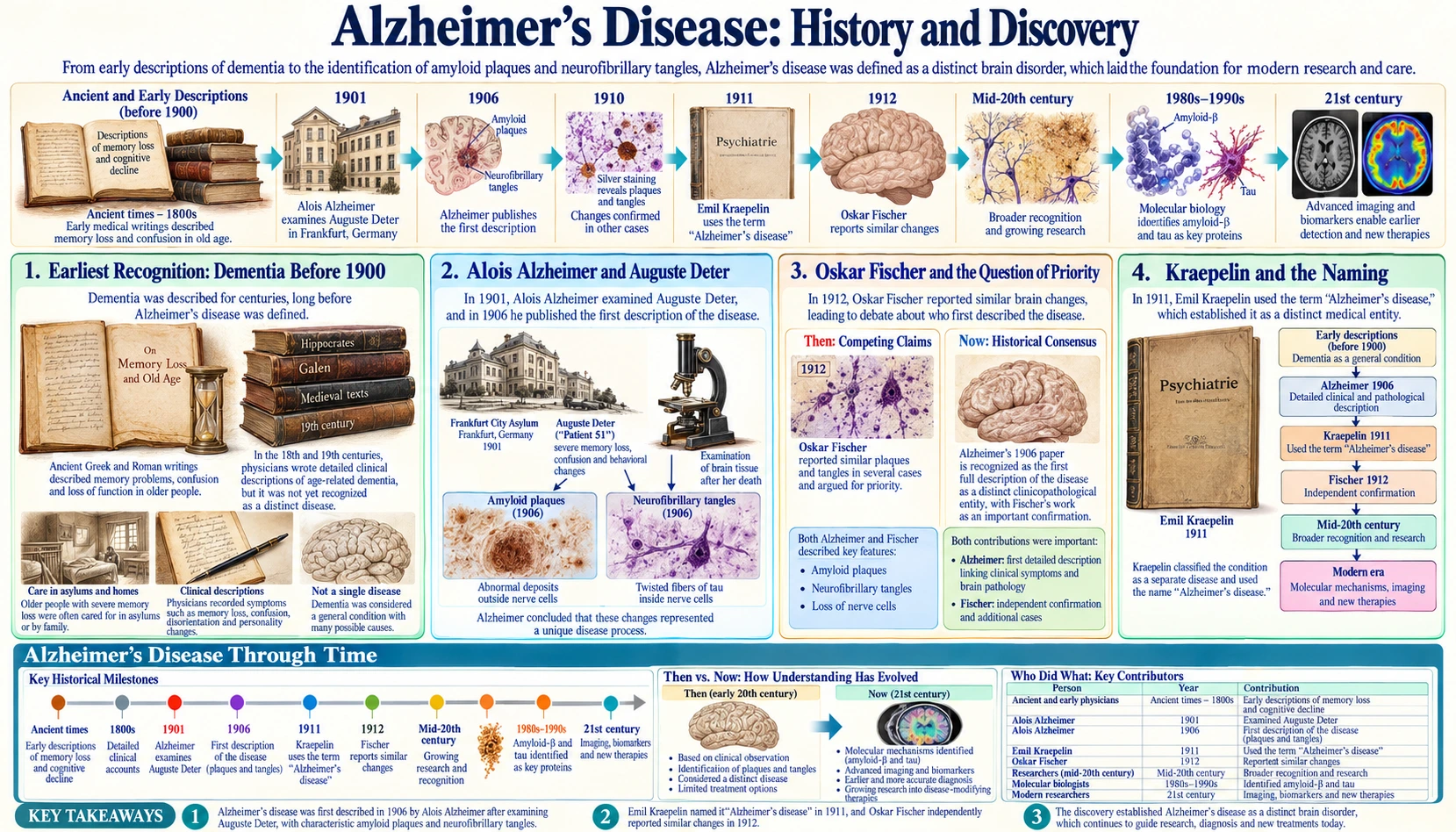
The disease is named after Alois Alzheimer, a German psychiatrist and neuropathologist who, on 3 November 1906, presented the case of a 50-year-old woman, Auguste Deter, and described the abnormal protein deposits (plaques) and twisted fibers (neurofibrillary tangles) he had found in her brain; he published the case in 1907. The name “Alzheimer's disease,” however, was coined by Alzheimer's mentor, Emil Kraepelin, who introduced it in the eighth edition of his psychiatry textbook in 1910. Crucially, dementia of old age (“senile dementia”) had been recognized and described long before — and the actual molecular causes were not unravelled until decades later, beginning in the 1980s.
Table of Contents
- Earliest Recognition: Dementia Before 1900
- Alois Alzheimer and Auguste Deter (1906)
- Oskar Fischer and the Question of Priority
- Kraepelin and the Naming (1910)
- The Plaques and the Tangles
- Discovering the Cause: Amyloid, Tau, Genes, and ApoE
- Diagnosis and Classification Over Time
- Treatment Through the Eras
- Modern Understanding
- Key Research Papers
- Connections
- Featured Videos
Earliest Recognition: Dementia Before 1900
People have always grown old, and some have always lost their memory and reason as they aged. The idea that severe forgetfulness and confusion could accompany old age is ancient: Greek and Roman writers, including the physician Galen and the statesman Cicero, noted that the mind could decline with the years, though they tended to treat it as an unavoidable part of aging rather than as a specific disease. The word we still use — dementia — comes from the Latin for “out of one's mind” (roughly, de “without” + mens “mind”) and entered formal medical usage only in the modern era.
The modern medical concept took shape in early-nineteenth-century France. Building on the reforms of Philippe Pinel (1745–1826), his student Jean-Étienne Dominique Esquirol (1772–1840) gave dementia a careful clinical definition and distinguished a senile form — the dementia of old age — from acute and chronic forms. By the later nineteenth century, “senile dementia” was an accepted, if poorly understood, diagnosis across European medicine. It was generally blamed on hardening of the brain's arteries and the simple wearing-out of the aging brain.
This is the essential backdrop for understanding Alzheimer's contribution. Dementia in the elderly was already a familiar idea. What had not been done was to link a specific pattern of microscopic brain changes to a specific clinical picture — and, strikingly, to find that disease in a patient who was not yet old. That is what made the case Alzheimer described in 1906 different.
Alois Alzheimer and Auguste Deter (1906)
Alois Alzheimer (1864–1915) was a German physician trained in both clinical psychiatry and the microscopic study of brain tissue. In 1901, while working at the asylum in Frankfurt am Main, he admitted a 50-year-old woman named Auguste Deter. She had developed rapidly worsening memory loss, disorientation, paranoia (she believed her husband was unfaithful), language difficulty, and unpredictable behavior — symptoms that, at her relatively young age, did not fit the usual picture of “senile” decline. Alzheimer interviewed her at length; his notes preserve her now-famous reply when asked to write her name: “Ich habe mich verloren” “I have lost myself.”
Auguste Deter died in April 1906. Alzheimer, who had by then moved to Munich to work under Emil Kraepelin, had her brain sent to him and examined it using a newly available silver-staining technique (the Bielschowsky stain). Under the microscope he saw two abnormalities: dense clumps between the nerve cells (which we now call amyloid plaques or senile plaques) and tangled, twisted fibers inside dying nerve cells (neurofibrillary tangles). The cortex was also thinned. Finding these changes together, in a patient who had become demented in her early fifties, was the novel observation.
On 3 November 1906, Alzheimer presented the case at a meeting of southwest German psychiatrists in Tübingen. The talk drew little interest — by several accounts the audience was more eager for the next speaker's topic, and Alzheimer received no questions. He published a brief account of the case in 1907 (often cited as “Über eine eigenartige Erkrankung der Hirnrinde” “On a peculiar disease of the cerebral cortex”). At the time, neither Alzheimer nor anyone else realized how common this “peculiar” disease would turn out to be.
Oskar Fischer and the Question of Priority
History rarely belongs to a single person, and the discovery of Alzheimer's disease is a good example. In the same year that Alzheimer described Auguste Deter, a physician in Prague named Oskar Fischer (1876–1942) published a much larger study — a clinicopathological series of sixteen cases of senile dementia in which he gave a detailed description of what he called “neuritic plaques.” Where Alzheimer's 1907 paper rested on a single, atypically young case and emphasized the tangles, Fischer documented plaques across many older patients and argued they were central to senile dementia.
Modern historians of medicine increasingly describe Fischer as a co-discoverer of the disease's pathology. His name faded for several reasons: he wrote in a less dominant academic center than Kraepelin's Munich institute, his particular interpretations later fell out of favor, and — tragically — as a Jewish physician he was arrested by the Gestapo and died in the Theresienstadt concentration camp in 1942, his career and reputation cut short. The honest summary is that Alzheimer and Fischer, working independently and in the same period, both helped establish that specific microscopic lesions accompany dementia; the disease bears one man's name largely because of how the naming happened next.
Kraepelin and the Naming (1910)
The eponym “Alzheimer's disease” was not chosen by Alzheimer himself. It was bestowed by Emil Kraepelin (1856–1926), the towering German psychiatrist who ran the Munich clinic where Alzheimer worked and who is often called the founder of modern scientific psychiatry. In 1910, in the eighth edition of his influential textbook Psychiatrie: Ein Lehrbuch für Studierende und Ärzte, Kraepelin introduced “Alzheimer's disease” (Alzheimersche Krankheit) as a named condition — using it for the kind of presenile dementia, beginning before old age, that Alzheimer had described.
Why Kraepelin singled out this entity has been debated ever since. Some historians suggest scientific reasons — the unusually early onset and the striking pathology seemed to mark out a distinct disease; others have suggested institutional or even competitive motives within German psychiatry of the day. Whatever the reason, the label stuck, and an important and somewhat artificial distinction was baked into medicine for most of the twentieth century: “Alzheimer's disease” came to mean the rarer presenile (early-onset) form, while the far more common dementia of old age was still called “senile dementia,” as if they were different diseases. Untangling that distinction would take another sixty years.
The Plaques and the Tangles
For most of the twentieth century, the two lesions Alzheimer had drawn — the plaques and the tangles — remained the disease's defining microscopic fingerprint, but what they were made of was unknown. They could be seen and counted under the microscope, and pathologists used them to confirm the diagnosis after death, yet their chemical identity stayed a mystery for roughly seventy-five years. Without knowing the molecules involved, researchers could not say whether the plaques and tangles caused the disease or were merely its tombstones.
That changed in the 1980s, when biochemistry finally caught up with neuropathology. In 1984, George Glenner and Caine Wong at the University of California, San Diego, isolated and partially sequenced the protein that makes up the plaques — the amyloid-beta (Aβ) peptide. Two years later, in 1986, several laboratories (including those of Inge Grundke-Iqbal and Khalid Iqbal, and of Kosik and colleagues) identified the chief component of the tangles as an abnormally modified, “hyperphosphorylated” form of a normal brain protein called tau. For the first time, Alzheimer's two lesions had names at the molecular level: amyloid in the plaques, tau in the tangles.
This was the turning point that converted Alzheimer's disease from a purely descriptive diagnosis into a problem that molecular biology and genetics could attack. The question now sharpened into one of cause and sequence: which came first, and which did the damage?
Discovering the Cause: Amyloid, Tau, Genes, and ApoE
Once the plaque and tangle proteins were identified, genetics rapidly illuminated the rare families in which Alzheimer's strikes early and runs strongly through the generations. In 1991, John Hardy's group (Goate and colleagues) found that a mutation in the gene for the amyloid precursor protein (APP) — the parent molecule from which amyloid-beta is cut — could cause inherited early-onset Alzheimer's. In 1995, two more genes, presenilin 1 and presenilin 2, were discovered to cause early-onset familial disease; these turned out to be part of the machinery that snips APP into amyloid-beta. Each of these genetic findings pointed back toward amyloid.
Drawing these threads together, in 1992 John Hardy and Gerald Higgins published a short, enormously influential paper in Science proposing the amyloid cascade hypothesis: the idea that the accumulation of amyloid-beta is the initiating event, and that the tangles, nerve-cell death, and dementia all follow downstream from it. It is essential to be clear that this is a hypothesis, not a proven fact. It has dominated research for over thirty years and is supported by the genetics, but it remains debated — critics note that plaque burden correlates poorly with symptoms, that tangle spread tracks the dementia more closely, and that, until recently, amyloid-lowering drugs failed to help patients. The relationship between amyloid and tau is still being worked out.
The most common, late-onset form of Alzheimer's is not caused by a single mutation but is shaped by risk genes. The major one was identified by Allen Roses and colleagues (Strittmatter and others) in 1993: a variant of the apolipoprotein E gene called ApoE4. Carrying one copy raises lifetime risk; carrying two raises it substantially — but ApoE4 is a risk factor, not destiny: many carriers never develop the disease, and many patients carry no copies at all. Alongside genetics, age remains the single largest risk factor, with cardiovascular health, head injury, and other influences contributing. The full causal story — why amyloid and tau accumulate in ordinary aging brains in the first place — is still not completely understood.
Diagnosis and Classification Over Time
For decades, a definite diagnosis of Alzheimer's disease could be made only after death, by examining brain tissue for plaques and tangles. During life, doctors made a “probable Alzheimer's” diagnosis by ruling out other causes of dementia — a useful but imperfect approach that was wrong in a meaningful fraction of cases.
A conceptual breakthrough came in 1968, when British researchers Gary Blessed, Bernard Tomlinson, and Martin Roth showed that the same plaque-and-tangle pathology Alzheimer had described in his young patient was also present, and correlated with the severity of dementia, in elderly people previously labeled with “senile dementia.” This evidence collapsed the artificial wall between early-onset “Alzheimer's disease” and late-onset “senile dementia”: they were recognized as one and the same disease, differing mainly in the age at which they appear. From the 1970s onward, “Alzheimer's disease” became the name for the whole spectrum — which is why it went from a rare curiosity to one of the most common diseases of aging almost overnight, simply by being correctly defined.
Formal diagnostic criteria followed in 1984 (the widely used NINCDS-ADRDA criteria) and were substantially revised in 2011 and again in the years since. The newer frameworks increasingly define the disease biologically — through biomarkers such as amyloid and tau measured in spinal fluid or, since the 2010s, seen directly in the living brain by positron emission tomography (PET) imaging, and more recently through blood tests. This shift lets clinicians detect Alzheimer's changes years before severe symptoms appear, and it is steadily moving the diagnosis away from Alzheimer's original microscope and toward measurable molecules in living patients.
Treatment Through the Eras
For most of the twentieth century there was no specific treatment at all. Care meant managing symptoms, ensuring safety, and supporting families — much as it had in the era of “senile dementia.” The first drug specifically approved for Alzheimer's did not arrive until 1993: tacrine, a cholinesterase inhibitor. The rationale came from research in the 1970s showing that Alzheimer's brains lose nerve cells using the chemical messenger acetylcholine; cholinesterase inhibitors block the enzyme that breaks acetylcholine down, leaving more of it available. Tacrine offered only modest, temporary benefit and could harm the liver, and it was eventually withdrawn.
Better-tolerated cholinesterase inhibitors followed and remain in use: donepezil (1996), rivastigmine, and galantamine. In 2003, memantine, which works on a different system (the glutamate/N-methyl-D-aspartate (NMDA) receptor), was approved. All of these treat symptoms — they can modestly slow the apparent decline or ease certain features for a time — but none halt the underlying disease or reverse it.
The long-sought goal has been a disease-modifying drug, and the amyloid hypothesis drove the search. After many high-profile failures of anti-amyloid drugs, the first anti-amyloid monoclonal antibodies reached patients: aducanumab received a controversial accelerated U.S. Food and Drug Administration (FDA) approval in 2021 (and was later discontinued commercially), and lecanemab received accelerated approval in early 2023 and traditional approval in mid-2023, followed by donanemab in 2024. These antibodies clear amyloid from the brain and modestly slow decline in early disease, but their benefits are limited, they carry real risks (including brain swelling and bleeding visible on magnetic resonance imaging (MRI)), and they are not cures. They do, however, represent the first treatments aimed at the disease process Alzheimer first glimpsed under his microscope — a milestone, even if a contested one.
Modern Understanding
More than a century after Alzheimer drew Auguste Deter's plaques and tangles, his core observation still stands: Alzheimer's disease is defined by the buildup of amyloid plaques and tau tangles, the loss of nerve cells and their connections, and the progressive erosion of memory and thinking. What has changed is the depth beneath that picture — the molecular identities, the genes, the biomarkers, and the slow, hard-won shift from a diagnosis made only at autopsy to one detectable in living people years before symptoms become severe.
The field is also broadening beyond the amyloid-versus-tau debate. Researchers now study the roles of brain inflammation and the immune cells called microglia, of vascular and metabolic health, of sleep and the brain's overnight “clearance” systems, and of how Alzheimer's pathology overlaps with other causes of dementia in the same aging brain. The honest scientific position is that Alzheimer's is almost certainly not one simple thing with one simple cause, and that the most effective approaches may ultimately combine several targets and emphasize prevention and risk reduction across a lifetime.
The throughline of this history is humbling. A single careful case in 1906, a name granted by a powerful mentor in 1910, a forgotten co-discoverer in Prague, seventy-five years of seeing the lesions without knowing them, a burst of molecular and genetic discovery from the 1980s onward, and a still-unfinished search for cause and cure — together they show how slowly and unevenly medicine comes to understand a common disease, and how much remains to be learned.
Key Research Papers
The references below combine landmark peer-reviewed papers with reputable historical reviews and curated PubMed topic searches. Where a specific historical primary source is named in the text (Alzheimer's 1907 case report, Kraepelin's 1910 textbook, Esquirol's nineteenth-century writings), it is identified in the article itself as a historical source. Each link opens in a new tab at the publisher, PubMed, or the National Library of Medicine.
- Hardy JA, Higgins GA. Alzheimer's disease: the amyloid cascade hypothesis. Science. 1992;256(5054):184–185. — doi:10.1126/science.1566067
- Goate A, Chartier-Harlin MC, Mullan M, et al. Segregation of a missense mutation in the amyloid precursor protein gene with familial Alzheimer's disease. Nature. 1991;349(6311):704–706. — doi:10.1038/349704a0
- Strittmatter WJ, Saunders AM, Schmechel D, et al. Apolipoprotein E: high-avidity binding to beta-amyloid and increased frequency of type 4 allele in late-onset familial Alzheimer disease. PNAS. 1993;90(5):1977–1981. — doi:10.1073/pnas.90.5.1977
- Glenner GG, Wong CW. Alzheimer's disease: initial report of the purification and characterization of a novel cerebrovascular amyloid protein. Biochem Biophys Res Commun. 1984;120(3):885–890. — PubMed PMID: 6375662
- Grundke-Iqbal I, Iqbal K, Tung YC, et al. Abnormal phosphorylation of the microtubule-associated protein tau in Alzheimer cytoskeletal pathology. PNAS. 1986;83(13):4913–4917. — doi:10.1073/pnas.83.13.4913
- Berrios GE. Alzheimer's disease: a conceptual history. International Journal of Geriatric Psychiatry. 1990;5(6):355–365. — doi:10.1002/gps.930050603
- Hippius H, Neundörfer G. The discovery of Alzheimer's disease. Dialogues in Clinical Neuroscience. 2003;5(1):101–108. — PubMed PMID: 22034141
- Goedert M. Oskar Fischer and the study of dementia. Brain. 2009;132(Pt 4):1102–1111. — doi:10.1093/brain/awn256
- Blessed G, Tomlinson BE, Roth M. The association between quantitative measures of dementia and of senile change in the cerebral grey matter of elderly subjects. British Journal of Psychiatry. 1968;114(512):797–811. — doi:10.1192/bjp.114.512.797
- McKhann G, Drachman D, Folstein M, et al. Clinical diagnosis of Alzheimer's disease (NINCDS-ADRDA criteria). Neurology. 1984;34(7):939–944. — doi:10.1212/wnl.34.7.939
- van Dyck CH, Swanson CJ, Aisen P, et al. Lecanemab in early Alzheimer's disease. New England Journal of Medicine. 2023;388(1):9–21. — doi:10.1056/NEJMoa2212948
- History of Alzheimer's disease research — PubMed: Alzheimer disease history
- Amyloid cascade hypothesis — debate and evidence — PubMed: amyloid cascade hypothesis review
- Anti-amyloid antibodies (aducanumab, lecanemab, donanemab) — PubMed PMID: 42784125
External Authoritative Resources
Connections
- Neurology
- Alzheimer's Disease (main page)
- Dementia
- Parkinson's Disease
- Huntington's Disease
- Vitamin B12
- Vitamin E
- Vitamin D
- Magnesium
- Zinc
- All Conditions