Oregano for Antiparasitic Use and SIBO — Force 2000, Chedid 2014, and Gut Dysbiosis
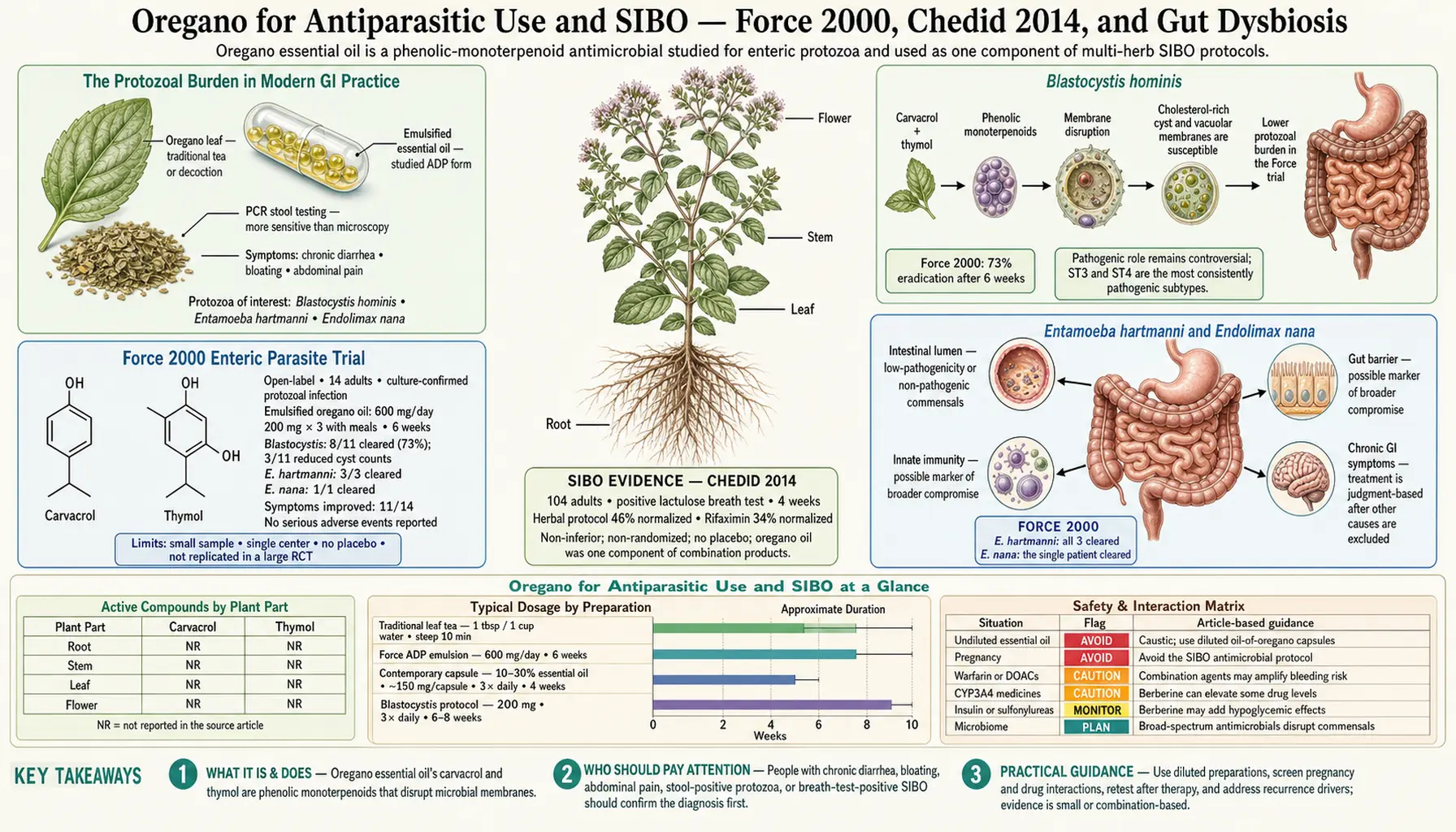
Two small human studies are the clinical evidence most often cited for oregano oil in the gut. Force and colleagues (2000) gave 600 mg a day of emulsified oregano oil for 6 weeks to 14 adults whose stools tested positive for Blastocystis hominis, Entamoeba hartmanni or Endolimax nana, with no comparison group; afterward Blastocystis was no longer found in 8 of 11 cases, and E. hartmanni and E. nana were no longer found in any case. Chedid and colleagues (2014) at Johns Hopkins reviewed the charts of 104 people with SIBO (small intestinal bacterial overgrowth) who had chosen either the antibiotic rifaximin or commercial multi-herb blends, one ingredient of which was oregano oil, for 4 weeks: the follow-up breath test was negative in 46% of the herbal group and 34% of the rifaximin group, a difference that was not statistically significant. Neither study had a placebo arm, and neither shows that oregano oil cures a parasitic infection or SIBO. This deep-dive sets out what each study did and found, what the 2020 American College of Gastroenterology (ACG) guideline says about SIBO treatment, and the laboratory and animal data on carvacrol and thymol, the main phenols in oregano oil.
Table of Contents
- The Protozoal Burden in Modern GI Practice
- Force 2000 Enteric Parasite Study
- Blastocystis hominis
- Entamoeba hartmanni and Endolimax nana
- SIBO — Background and Diagnosis
- Chedid 2014 Johns Hopkins Chart Review
- Methane-Dominant SIBO / IMO
- Traditional Mediterranean Gut Use
- What the Studies Gave, and for How Long
- Combinations with Berberine, Allicin, Neem
- Cautions and Microbiome Disruption
- Key Research Papers
- Connections
- Featured Videos
The Protozoal Burden in Modern GI Practice
Blastocystis is one of the most widespread single-celled organisms found in human stool, and its role in health and disease is still unsettled. A 2016 review notes that DNA-based tests have shown it to be much more common than previously thought, and that the large genetic differences between isolates may be where differences in clinical outcome lie (Stensvold 2016). Other protozoa found on stool testing, such as Endolimax nana and Entamoeba hartmanni, have traditionally been classed as non-pathogenic.
Reports differ on whether Blastocystis causes symptoms. A 2008 review describes infections linked with abdominal pain, diarrhea, constipation, fatigue and skin rash, as well as asymptomatic infection, and discusses a possible role in irritable bowel syndrome (IBS) (Boorom 2008). In a 2016 French study comparing 48 people colonized with Blastocystis with 48 who were not, the colonized group had a more diverse gut bacterial community, which the authors read as suggesting that colonization usually goes with a healthy gut microbiota rather than with dysbiosis (Audebert 2016).
A 2013 review of Blastocystis treatment reports that metronidazole appears to be the most effective drug, while noting widely variable cure and eradication rates, differing doses and regimens, and subtypes resistant to metronidazole; trimethoprim-sulfamethoxazole and nitazoxanide are also used (Sekar 2013).
Oregano essential oil has been tested against protozoa in the laboratory on the reasoning that the membrane-disrupting action described on the antibacterial and antifungal pages might also apply to protozoal cells. The Force 2000 study below is the human study of this use.
Force 2000 Enteric Parasite Study
Force M, Sparks WS and Ronzio RA (2000), "Inhibition of enteric parasites by emulsified oil of oregano in vivo," published in Phytotherapy Research, is a two-page report of an uncontrolled study. According to its abstract, oil of Mediterranean oregano (Origanum vulgare) was given by mouth to 14 adults whose stools tested positive for enteric parasites. The parasites named were:
- Blastocystis hominis — 11 cases
- Entamoeba hartmanni — 4 cases
- Endolimax nana — 1 case
The per-parasite case counts add up to more than 14, so some patients carried more than one parasite; the abstract does not say how many. Treatment was 600 mg of emulsified oregano oil a day for 6 weeks. There was no placebo or comparison group, and no blinding is reported. The paper lists a supplement manufacturer, the maker of an emulsified oregano oil product, among the authors' affiliations.
Results reported in the abstract after 6 weeks:
- Entamoeba hartmanni disappeared in all 4 cases.
- Endolimax nana disappeared in the 1 case.
- Blastocystis hominis disappeared in 8 cases, and its scores declined in 3 more.
- Gastrointestinal symptoms improved in 7 of the 11 patients who had tested positive for Blastocystis hominis.
The abstract does not report stool testing after treatment ended or adverse effects, and the full text was not available to check. With 14 patients and no control group, the study cannot separate an effect of the oil from clearance that would have happened anyway; a 2013 treatment review notes that patients with Blastocystis have recovered even without treatment (Sekar 2013). A PubMed search for this page (October 2026) found no randomized controlled trial in people testing oregano oil or carvacrol against intestinal parasites.
Blastocystis hominis
Blastocystis hominis is described in a 2016 review as one of the most widespread and prevalent intestinal eukaryotes, whose role in health and disease remains elusive (Stensvold 2016). Whether it is a pathogen or a commensal has been debated for decades. A 2013 review notes that patients have improved without any treatment, and adds that treatment is warranted in many patients because symptoms persist, particularly in children and in adults who are immunocompromised (Sekar 2013). DNA-based methods have begun to sort its genetic variety into types, and the 2016 review suggests that differences in clinical outcome may lie there (Stensvold 2016).
Laboratory data on oregano-type compounds and Blastocystis are limited. In a 2007 Austrian laboratory study, carvacrol and an essential-oil mixture containing thyme oil were tested against cultured Blastocystis isolates alongside two poultry parasites; the minimal lethal concentrations differed from one Blastocystis isolate to another (Grabensteiner 2007, in vitro). In a 2018 Egyptian laboratory study, a water extract of marjoram (Origanum majorana, a related species, not oregano oil) at 400 µg/ml showed efficacy rates of 96% at 48 hours and 100% at 72 hours against Blastocystis cysts from patients' stool samples, which the authors describe as nearly equivalent to nitazoxanide at 500 µg/ml (Méabed 2018, in vitro). These are test-tube results; they do not show what concentration reaches the gut after an oral dose.
The Force 2000 result for Blastocystis (8 of 11 cases no longer found on stool testing) comes from an uncontrolled study and has not been compared with metronidazole or any other drug in a trial. Regimens combining oregano oil with other herbs for Blastocystis are described by integrative practitioners; their doses and durations come from practitioners rather than from trials.
Entamoeba hartmanni and Endolimax nana
Entamoeba hartmanni and Endolimax nana are intestinal amoebae traditionally regarded as non-pathogenic or of low pathogenicity, and distinguished by microscopy from the disease-causing Entamoeba histolytica. Conventional teaching reports them as incidental findings that are not treated. Some integrative practitioners treat them in people with chronic gut symptoms after other causes are excluded; that approach has not been tested in trials.
In the Force 2000 study, E. hartmanni (4 cases) and E. nana (1 case) were no longer found after 6 weeks. With so few cases and no comparison group, the result does not show whether these organisms would have cleared without treatment.
SIBO — Background and Diagnosis
The 2020 ACG guideline defines small intestinal bacterial overgrowth (SIBO) as the presence of excessive numbers of bacteria in the small bowel, causing gastrointestinal symptoms, and lists abdominal pain, bloating, gas, distension, flatulence and diarrhea as the most common symptoms. The guideline suggests glucose or lactulose breath testing to diagnose SIBO, and methane testing to diagnose intestinal methanogen overgrowth (IMO) in people with constipation; both are conditional recommendations based on very low-quality evidence.
Rifaximin is a minimally absorbed antibiotic, so it acts mainly inside the gut. The ACG guideline describes the antibiotic data for SIBO as "small clinical trials of poor to modest quality," and its suggestion of antibiotics for symptomatic SIBO is a conditional recommendation based on low-quality evidence. A 2017 meta-analysis of 32 studies (1,331 patients) found an overall rifaximin eradication rate of 70.8% by intention to treat, with adverse events in 4.6%, while describing the quality of the available studies as generally poor (Gatta 2017). In a 2010 retrospective chart review of methane-positive IBS patients, rifaximin alone cleared methane in 28%, against 87% with rifaximin plus neomycin (Low 2010). SIBO often returns: in an Italian cohort of 80 patients whose glucose breath test normalized after rifaximin, 12.6% were positive again at 3 months, 27.5% at 6 months and 43.7% at 9 months (Lauritano 2008). The Chedid authors describe rifaximin as expensive and not routinely covered by many commercial health plans in the United States.
Herbal antimicrobials are used by some patients as an alternative to prescription antibiotics, and the Chedid 2014 chart review described next is the study most often cited for them. The broader clinical picture is covered on the SIBO overview page and its sub-articles.
Chedid 2014 Johns Hopkins Chart Review
Chedid V, Dhalla S, Clarke JO, Roland BC, Dunbar KB, Koh J, Justino E, Tomakin E, Mullin GE (2014), "Herbal therapy is equivalent to rifaximin for the treatment of small intestinal bacterial overgrowth," published in Global Advances in Health and Medicine, reports patients from a tertiary-care gastroenterology practice at Johns Hopkins; the study was approved by the Johns Hopkins review board, and the senior author was at Johns Hopkins. In the paper's limitations section the authors describe it as a retrospective chart review, not a prospective randomized controlled trial.
The analysis included 104 patients with newly diagnosed SIBO on a lactulose breath test who were treated and had a follow-up breath test. Patients chose, by individual preference, between two open-label options for 4 weeks, followed by a repeat breath test:
- Rifaximin 1,200 mg a day (two 200 mg tablets three times daily) — 67 patients.
- Herbal therapy — 2 capsules twice daily of one of two pairs of commercial multi-ingredient blends made by two supplement companies — 37 patients. The paper's ingredient table lists, across the four products, oregano oil (stated as providing 55% to 75% carvacrol), red thyme oil, sage and lemon balm extracts, berberine-containing extracts (coptis, Indian barberry and berberine sulfate), wormwood, olive leaf and more than a dozen other herbs. Oregano oil appears in one of the four products.
The authors state that the herbal therapy cost no more than $120 for a 30-day supply. The primary outcome was the proportion of patients in each group with a negative breath test after treatment.
Results:
- The follow-up breath test was negative in 17 of 37 (46%) on herbal therapy and 23 of 67 (34%) on rifaximin (P = 0.24), a difference that was not statistically significant.
- Adjusted for age, sex, SIBO risk factors and IBS status, the odds ratio for a negative test with herbal therapy rather than rifaximin was 1.85 (95% CI 0.77–4.41, P = 0.17).
- Of 44 rifaximin non-responders, 14 were offered herbal rescue therapy and 8 of the 14 (57.1%) then had a negative breath test; 10 were offered triple antibiotics and 6 responded (60%, P = 0.89).
- Adverse effects in the rifaximin group included 1 case of anaphylaxis, 2 of hives, 2 of diarrhea and 1 of Clostridium difficile infection; 1 case of diarrhea was reported in the herbal group (P = 0.22).
The authors concluded that herbal therapies "are at least as effective as rifaximin for resolution of SIBO by LBT" and called for prospective studies. The paper reports a P value for the difference and no non-inferiority margin, so it was not a formal non-inferiority trial. The limitations the authors list are the retrospective design, the heterogeneity and multiplicity of the herbs used, diet that was not controlled, and symptoms that were not assessed with a standardized questionnaire. Because patients chose their own treatment, the two groups may have differed in ways the analysis did not capture, and the result applies to the blends, not to oregano oil on its own. The products tested were commercial supplement-company blends; the paper states that the authors completed the ICMJE conflict-of-interest form and that none was reported.
Methane-Dominant SIBO / IMO
Methane on a breath test is made not by bacteria but by archaea, chiefly Methanobrevibacter smithii, which the ACG guideline names as the apparent cause of excess methane; the guideline's authors proposed the term intestinal methanogen overgrowth (IMO) for this pattern. In a 2003 randomized, placebo-controlled trial of neomycin in IBS, methane excretion on the breath test was associated in every case with constipation-predominant IBS (Pimentel 2003). In the 2010 chart review of methane-positive IBS patients, rifaximin alone (400 mg three times daily for 10 days) cleared methane in 28%, against 87% with rifaximin plus neomycin (500 mg twice daily) (Low 2010).
Archaeal cell membranes are built from ether-linked isoprenoid lipids rather than the ester-linked fatty-acid lipids of bacteria, so the antibacterial data on carvacrol do not automatically carry over. No study testing carvacrol or oregano oil against human-gut methanogens, or in people with IMO, was found in PubMed for this page. The nearest data come from cattle: in a 24-hour laboratory culture of bovine rumen microbes, mixtures of thymol and carvacrol shifted bacterial populations, with only slight shifts in methanogen populations, and methane inhibition tended to be greater as the thymol share of the mixture decreased (Castañeda-Correa 2019, in vitro, animal microbes). The Chedid review did not report methane results separately.
Allicin, from garlic, is also used by some practitioners for methane-dominant SIBO; the evidence for it, which comes mainly from livestock research rather than human IMO trials, is covered in the SIBO overview and the sub-articles linked there.
Traditional Mediterranean Gut Use
Oregano has a long history in Mediterranean medicine. The Oregano History page traces its place in the Hippocratic corpus and in later Greek and Roman medical texts, where respiratory and digestive uses recur. Folk use of oregano preparations for intestinal complaints, including "worms," is described in Mediterranean and Latin American traditions. A long tradition of use is not evidence of an effect, and the human studies on this page did not test the traditional preparations.
The plant sold as Mexican oregano, Lippia graveolens, belongs to a different botanical family (Verbenaceae) from Mediterranean oregano (Lamiaceae). In a 2010 laboratory study of 18 essential oils against Giardia lamblia, the oils with phenolic compositions were the most active, particularly those rich in carvacrol such as Thymbra capitata and Origanum virens (IC50 71 and 85 µg/mL), while Lippia graveolens oil was less active (IC50 over 200 µg/mL) (Machado 2010, in vitro). A 2021 laboratory study of seven essential oils and eight of their main components found oregano essential oil, cinnamon oil, thymol and carvacrol active against protozoa including Giardia lamblia, Trypanosoma cruzi and Leishmania mexicana, with protozoa more susceptible than fungi or bacteria (Andrade-Ochoa 2021, in vitro).
Culinary oregano and the concentrated essential oil differ greatly in strength; the concentrated oil is the form linked to irritation of the mouth and gut lining (see Cautions below).
What the Studies Gave, and for How Long
No trial has established a dose of oregano oil for SIBO or for intestinal parasites. The regimens used in the two human studies were:
- Force 2000 — 600 mg of emulsified oregano oil a day for 6 weeks, with stool testing at the end of treatment.
- Chedid 2014 — 2 capsules twice daily of a pair of commercial multi-herb blends for 4 weeks, followed immediately by a repeat lactulose breath test; the rifaximin group took 1,200 mg a day for 4 weeks.
- Chedid 2014, rescue — rifaximin non-responders were given either the herbal blends or triple antibiotics (clindamycin 300 mg, metronidazole 250 mg and neomycin 500 mg, each three times daily) for 4 additional weeks.
Other elements of practitioner protocols — prokinetic drugs or herbs after treatment, diet changes during treatment, the timing of probiotics, and rotating herbs between courses — were not tested in these studies. The evidence on prokinetics and relapse is covered on the SIBO overview's sub-articles, and the recurrence figures are given in the SIBO background section above. Decisions about supplements and medicines belong with a clinician.
Combinations with Berberine, Allicin, Neem
Practitioner SIBO and dysbiosis regimens commonly combine oregano oil with other herbs. The only human evidence for a combination on this page is the Chedid review of commercial blends; the individual herbs are described here as the research reports them:
- Berberine — an alkaloid from plants such as goldenseal, barberry, Oregon grape and Coptis chinensis; berberine-containing extracts were in the Chedid blends. In a randomized crossover study in healthy men, 300 mg three times daily for 2 weeks decreased the activity of the drug-metabolizing enzymes CYP2D6, CYP2C9 and CYP3A4 (Guo 2012). See our Berberine page.
- Allicin — a sulfur compound from garlic; it was not an ingredient of the Chedid blends. See our Garlic page.
- Neem (Azadirachta indica) — not an ingredient of the Chedid blends, and no human SIBO or parasite trial of neem is cited on this page. See our Neem page.
- Wormwood (Artemisia) — a classical antiparasitic herb, used historically with black walnut for intestinal worms; an Artemisia absinthium extract is listed among the Chedid blends' ingredients.
- Olive leaf extract — olive leaf (Olea europaea) is also listed among the Chedid blends' ingredients. See our Olive Leaf page.
The reasoning given for combinations — several mechanisms and a wider range of targets — is borrowed from combination antibiotic therapy; it has not been tested by comparing a combination with oregano oil alone. The Chedid authors write that they chose a combination of herbal preparations to provide broad-spectrum coverage against enteric coliforms, and suggest that future studies consolidate the herbal regimen to a single agent so that randomization and blinding become possible.
Cautions and Microbiome Disruption
- Microbiome effects — the SIBO and parasite studies on this page did not measure changes in the commensal gut microbiome, so whether these herbal blends disturb it as antibiotics do is not known from them.
- Mucosal-burn risk — as described on the other Oregano deep-dive pages, undiluted oregano essential oil is caustic to the lining of the mouth and gut. The studies here used an emulsified oil (Force) and capsules (Chedid).
- Pregnancy and lactation — neither study reports data on pregnancy or breastfeeding, and there is no good safety data on concentrated oregano oil at these doses in pregnancy.
- Herxheimer (die-off) reactions — practitioners describe flu-like symptoms, headache and worsening gut symptoms early in herbal treatment; neither study reports such reactions, and the only adverse effect recorded with the herbal blends in the Chedid review was 1 case of diarrhea.
- Anticoagulant interaction — interactions with warfarin and other anticoagulants are a commonly raised concern for several herbs in these combinations; the studies on this page did not assess them.
- CYP-mediated drug interactions — in the 2012 study in healthy men, repeated berberine decreased CYP2D6, CYP2C9 and CYP3A4 activity, and the authors concluded that drug-drug interactions need to be considered when berberine is given (Guo 2012). This matters most for people taking drugs cleared by those enzymes.
- Diabetes medications — berberine is studied for lowering blood glucose (covered on the Berberine page), which raises a concern for people taking insulin or sulfonylureas.
- Recurrence — in the Italian rifaximin cohort, 43.7% of patients were breath-test positive again at 9 months, and older age, a past appendectomy and long-term proton-pump-inhibitor use were associated with recurrence (Lauritano 2008). How recurrence is studied and prevented is covered on the SIBO page.
Key Research Papers
- Force M, Sparks WS, Ronzio RA (2000). Inhibition of enteric parasites by emulsified oil of oregano in vivo. Phytotherapy Research. 2000;14(3):213–214. — PubMed PMID: 10815019
- Chedid V, Dhalla S, Clarke JO, et al. (2014). Herbal therapy is equivalent to rifaximin for the treatment of small intestinal bacterial overgrowth. Global Advances in Health and Medicine. 2014;3(3):16–24. — PubMed PMID: 24891990
- Pimentel M, Saad RJ, Long MD, Rao SSC (2020). ACG Clinical Guideline: Small Intestinal Bacterial Overgrowth. American Journal of Gastroenterology. 2020;115(2):165–178. — PubMed PMID: 32023228
- Stensvold CR, Clark CG (2016). Current status of Blastocystis: a personal view. Parasitology International. 2016;65(6 Pt B):763–771. — PubMed PMID: 27247124
- Boorom KF, Smith H, Nimri L, et al. (2008). Oh my aching gut: irritable bowel syndrome, Blastocystis, and asymptomatic infection. Parasites and Vectors. 2008;1(1):40. — PubMed PMID: 18937874
- Sekar U, Shanthi M (2013). Blastocystis: consensus of treatment and controversies. Tropical Parasitology. 2013;3(1):35–39. — PubMed PMID: 23961439
- Machado M, Sousa MC, Salgueiro L, Cavaleiro C (2010). Effects of essential oils on the growth of Giardia lamblia trophozoites. Natural Product Communications. 2010;5(1):137–141. — PubMed PMID: 20184039 (Replaces an entry, "Roghini R, Premkumar K (2017), Anti-Giardia activity of carvacrol and thymol in vitro, Journal of Parasitic Diseases," that could not be found in PubMed.)
- Roxas M, Jurenka J (2007). Colds and influenza: a review of diagnosis and conventional, botanical, and nutritional considerations. Alternative Medicine Review. 2007;12(1):25–48. — PubMed PMID: 17397266 (Its abstract does not list oregano among the botanicals reviewed.)
- Pimentel M, Chow EJ, Lin HC (2003). Normalization of lactulose breath testing correlates with symptom improvement in irritable bowel syndrome: a double-blind, randomized, placebo-controlled study. American Journal of Gastroenterology. 2003;98(2):412–419. — PubMed PMID: 12591062
- Roland BC, Ciarleglio MM, Clarke JO, et al. (2015). Small intestinal transit time is delayed in small intestinal bacterial overgrowth. Journal of Clinical Gastroenterology. 2015;49(7):571–576. — PubMed PMID: 25319735
- Audebert C, Even G, Cian A, et al. (2016). Colonization with the enteric protozoa Blastocystis is associated with increased diversity of human gut bacterial microbiota. Scientific Reports. 2016;6:25255. — PubMed PMID: 27147260 (Replaces an entry, "Furrie E et al. (2019), The role of Blastocystis in gut microbial ecology, Microorganisms," that could not be found in PubMed.)
- Hamilton MJ, Weingarden AR, Sadowsky MJ, Khoruts A (2012). Standardized frozen preparation for transplantation of fecal microbiota for recurrent Clostridium difficile infection. American Journal of Gastroenterology. 2012;107(5):761–767. — PubMed PMID: 22290405 (A study of fecal microbiota transplantation for recurrent C. difficile; it does not study herbal antimicrobials.)
- Gatta L, Scarpignato C (2017). Systematic review with meta-analysis: rifaximin is effective and safe for the treatment of small intestine bacterial overgrowth. Alimentary Pharmacology and Therapeutics. 2017;45(5):604–616. — PubMed PMID: 28078798
- Lauritano EC, Gabrielli M, Scarpellini E, et al. (2008). Small intestinal bacterial overgrowth recurrence after antibiotic therapy. American Journal of Gastroenterology. 2008;103(8):2031–2035. — PubMed PMID: 18802998
- Low K, Hwang L, Hua J, et al. (2010). A combination of rifaximin and neomycin is most effective in treating irritable bowel syndrome patients with methane on lactulose breath test. Journal of Clinical Gastroenterology. 2010;44(8):547–550. — PubMed PMID: 19996983
- Grabensteiner E, Arshad N, Hess M (2007). Differences in the in vitro susceptibility of mono-eukaryotic cultures of Histomonas meleagridis, Tetratrichomonas gallinarum and Blastocystis sp. to natural organic compounds. Parasitology Research. 2007;101(1):193–199. — PubMed PMID: 17285346
- Méabed EMH, El-Sayed NM, Abou-Sreea AIB, Roby MHH (2018). Chemical analysis of aqueous extracts of Origanum majorana and Foeniculum vulgare and their efficacy on Blastocystis spp. cysts. Phytomedicine. 2018;43:158–163. — PubMed PMID: 29747749
- Andrade-Ochoa S, Chacón-Vargas KF, Sánchez-Torres LE, et al. (2021). Differential antimicrobial effect of essential oils and their main components: insights based on the cell membrane and external structure. Membranes (Basel). 2021;11(6):405. — PubMed PMID: 34071618
- Castañeda-Correa A, Corral-Luna A, Hume ME, et al. (2019). Effects of thymol and carvacrol, alone or in combination, on fermentation and microbial diversity during in vitro culture of bovine rumen microbes. Journal of Environmental Science and Health, Part B. 2019;54(3):170–175. — PubMed PMID: 30430903
- Guo Y, Chen Y, Tan ZR, Klaassen CD, Zhou HH (2012). Repeated administration of berberine inhibits cytochromes P450 in humans. European Journal of Clinical Pharmacology. 2012;68(2):213–217. — PubMed PMID: 21870106
PubMed Topic Searches
Connections
- All Herbs
- Oregano Overview
- Oregano Benefits Hub
- Oregano Antibacterial Spectrum
- Oregano Antifungal
- Oregano Antioxidant & Respiratory
- SIBO
- Berberine (combination partner)
- Garlic / Allicin
- Neem
- Olive Leaf
- Parasites
- Gut Healing
- Inflammatory Bowel Disease
- Antibacterial Herbs
- Blastocystis — the protozoan cleared in eight of eleven patients in the Force 2000 oregano-oil trial.
- History