Methylene Blue — Benefits Deep Dive
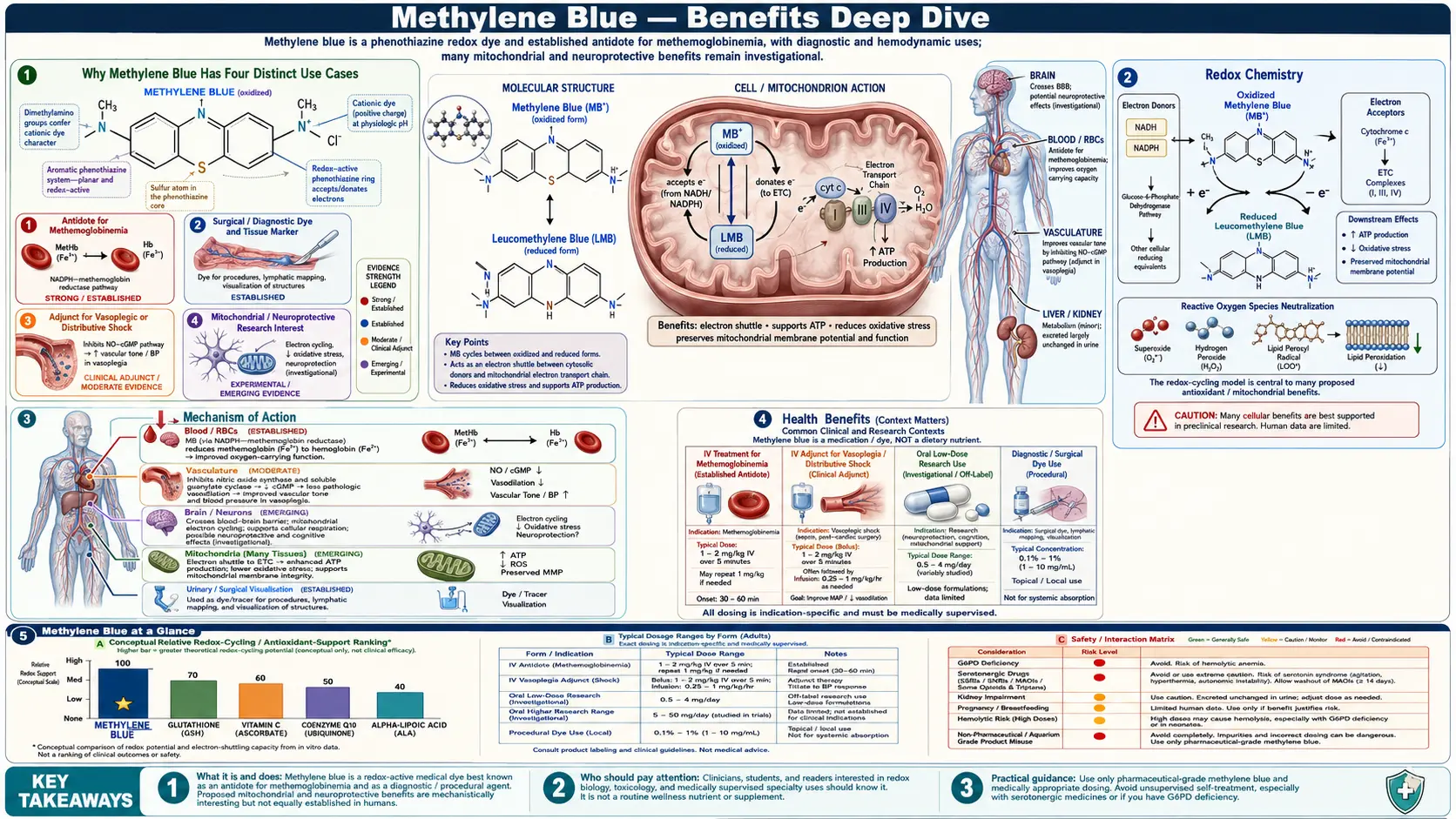
Methylene blue is unusual among small molecules because several distinct properties come from the same phenothiazine core: in cell and animal studies it acts as an alternative electron carrier that bypasses blocked Complexes I and III of the mitochondrial chain (unlike coenzyme Q10, which is itself a normal part of the chain); it and its stabilized reduced form LMTM inhibit tau-protein aggregation in laboratory studies; it is active against malaria parasites, and under red light it generates singlet oxygen that can kill microbes and inactivate viruses; and it is the FDA-approved treatment for acquired methemoglobinemia, reducing the ferric iron of methemoglobin back to ferrous. Each benefit page below covers one application — with the caveat that its US label carries a boxed warning for serotonin syndrome and a contraindication in G6PD deficiency.
Deep-Dive Articles
Mitochondrial Bypass & Bioenergetics
How, in cell and animal studies, methylene blue accepts electrons from NADH and passes them to cytochrome c, bypassing blocked Complexes I and III; the hormetic dose-response that reviews describe, with opposite effects at low and high doses; the contrast with CoQ10, which is a normal part of the chain; and the animal models of stroke, brain injury and Parkinson’s disease in which it has been tested.
Read the deep dive →Cognition & Brain
The tau-aggregation research of Wischik and colleagues; the phase 2 trial of methylthioninium chloride and the phase 3 trials of LMTM in Alzheimer’s disease — one negative, one reanalysed with non-randomized cohorts, and LUCIDITY with no difference on its co-primary endpoints at 52 weeks; rat studies of methylene blue alone and laboratory work combining it with near-infrared light; and Bryan Ardis’s nicotine-receptor hypothesis, reported as he states it. The human evidence in healthy adults comes from small single-dose studies.
Read the deep dive →Antiviral & Antimicrobial
Guttmann and Ehrlich’s 1891 report, the first of a synthetic antimalarial, decades before chloroquine; a 2018 systematic review of methylene blue in malaria; photodynamic inactivation of viruses and bacteria; the limited evidence on COVID-19; the photodynamic-therapy literature on skin, dental and superficial infections; and Bryan Ardis’s snake-venom hypothesis, reported as he states it alongside what the published research shows.
Read the deep dive →Methemoglobinemia — the FDA-Approved Use
The mechanism: methylene blue is converted to leuco-methylene blue, which reduces the ferric iron in methemoglobin back to ferrous so hemoglobin can carry oxygen again. The intravenous dosing on the US label, drug and chemical causes of acquired methemoglobinemia such as nitrites and dapsone (where the label notes the condition may not resolve or may rebound), the congenital CYB5R deficiency picture, and the label’s two main warnings — the G6PD contraindication and the serotonin-syndrome boxed warning.
Read the deep dive →Table of Contents
- Deep-Dive Articles
- Why Methylene Blue Has Four Distinct Use Cases
- Research Papers: Mitochondrial Bypass
- Research Papers: Cognition & Brain
- Research Papers: Antiviral & Antimicrobial
- Research Papers: Methemoglobinemia
- Research Papers: Safety (MAO-A, Serotonin Syndrome, G6PD)
- External Authoritative Resources
- Connections
- Featured Videos
Why Methylene Blue Has Four Distinct Use Cases
Most drugs have one primary mechanism of action that produces a narrow range of clinical effects. Methylene blue is unusual because four chemically distinct properties of the phenothiazine core map to four different therapeutic categories:
- Redox-active electron carrier — the leuco (reduced) form donates electrons; the oxidized form accepts them. In cell and animal studies, this is the property that lets methylene blue act as an alternative electron carrier in the mitochondrial chain, bypassing blocked Complex I and Complex III (Wen 2011). The same redox cycling is what lets it reduce methemoglobin (Fe³+) back to functional hemoglobin (Fe²+) — the FDA-approved indication.
- Tau-aggregation inhibitor — methylthioninium and its stabilized reduced form LMTM (TRx0237) inhibit aggregation of the tau protein in test-tube studies and in transgenic mice (Gauthier 2016). In the phase 3 trials in Alzheimer’s disease, no randomized comparison on the co-primary clinical outcomes showed a benefit: TRx-237-015 was negative (Gauthier 2016), TRx-237-005 replaced its randomized analysis with non-randomized cohort comparisons before unblinding (Wilcock 2018), and the LUCIDITY phase 3 trial could not show a difference on its co-primary endpoints at 52 weeks (Wischik 2026).
- Photodynamic-active dye — methylene blue absorbs red light and generates singlet oxygen when illuminated. This is the basis of photodynamic antimicrobial and oncology applications (Tardivo 2005). Separately, its antimalarial action was reported by Guttmann and Ehrlich in 1891 (Vennerstrom 1995), and a 2018 systematic review found it consistently effective against malaria in endemic areas (Lu 2018).
- Monoamine-oxidase A inhibitor — in assays on the purified human enzyme, methylene blue is a potent, reversible inhibitor of MAO-A (Ramsay 2007). This has been proposed as one mechanism for the antidepressant effect reported in a small bipolar-disorder trial (Alda 2017), and it is the mechanism behind the label’s boxed warning on serotonin syndrome with SSRIs, SNRIs, MAOIs and opioids; the label’s interaction section also lists bupropion, buspirone, clomipramine, mirtazapine, linezolid and dextromethorphan.
These four properties put methylene blue in four nearly unrelated settings: hospital treatment of methemoglobinemia, research on Alzheimer’s disease and brain bioenergetics, photodynamic therapy in dentistry and dermatology, and off-label use for longevity and post-viral symptoms. Both main risks are on the FDA label: the boxed warning for serotonin syndrome and the contraindication in G6PD deficiency, where treatment may cause severe hemolysis.
Research Papers: Mitochondrial Bypass
- Wen Y, Li W, Poteet EC, et al. (2011). Alternative mitochondrial electron transfer as a novel strategy for neuroprotection. Journal of Biological Chemistry 286(18):16504–15 (cell and animal study) — PubMed PMID: 21454572
- Atamna H, Nguyen A, Schultz C, et al. (2008). Methylene blue delays cellular senescence and enhances key mitochondrial biochemical pathways. FASEB Journal 22(3):703–12 (cell study) — PubMed PMID: 17928358
- Poteet E, Winters A, Yan LJ, et al. (2012). Neuroprotective actions of methylene blue and its derivatives. PLoS ONE 7(10):e48279 (cell study) — PubMed PMID: 23118969
- Tucker D, Lu Y, Zhang Q (2018). From mitochondrial function to neuroprotection — an emerging role for methylene blue. Molecular Neurobiology 55(6):5137–53 (review) — PubMed PMID: 28840449
- Bruchey AK, Gonzalez-Lima F (2008). Behavioral, physiological and biochemical hormetic responses to the autoxidizable dye methylene blue. American Journal of Pharmacology and Toxicology 3(1):72–79 (review) — PubMed PMID: 20463863
- U-shaped hormetic dose response of methylene blue — PubMed: MB hormesis dose response
- Methylene blue in traumatic brain injury (animal models) — PubMed: MB traumatic brain injury
- MB in stroke and cerebral ischemia — PubMed: MB stroke
- NADH oxidation and shuttle across inner membrane — PubMed: MB NADH shuttle
- Comparison MB vs CoQ10 in mitochondrial dysfunction — PubMed: MB vs CoQ10
Research Papers: Cognition & Brain
- Rodriguez P, Zhou W, Barrett DW, et al. (2016). Multimodal randomized functional MR imaging of the effects of methylene blue in the human brain. Radiology 281(2):516–526 (26 healthy adults, single dose) — PubMed PMID: 27351678
- Wischik CM, Staff RT, Wischik DJ, et al. (2015). Tau aggregation inhibitor therapy: an exploratory phase 2 study in mild or moderate Alzheimer’s disease. Journal of Alzheimer’s Disease 44(2):705–20 (methylthioninium chloride) — PubMed PMID: 25550228
- Gauthier S, Feldman HH, Schneider LS, et al. (2016). Efficacy and safety of tau-aggregation inhibitor therapy in patients with mild or moderate Alzheimer’s disease: a randomised, controlled, double-blind, parallel-arm, phase 3 trial. Lancet 388(10062):2873–2884 (TRx-237-015) — PubMed PMID: 27863809
- Wilcock GK, Gauthier S, Frisoni GB, et al. (2018). Potential of low dose leuco-methylthioninium bis(hydromethanesulphonate) (LMTM) monotherapy for treatment of mild Alzheimer’s disease: cohort analysis as modified primary outcome in a phase III clinical trial. Journal of Alzheimer’s Disease 61(1):435–457 (TRx-237-005) — PubMed PMID: 29154277
- Wischik CM, Stefanacci R, Bentham P, et al. (2026). Clinical, imaging and blood biomarker outcomes in a phase 3 clinical trial of tau aggregation inhibitor hydromethylthionine mesylate in mild cognitive impairment and mild to moderate dementia due to Alzheimer’s disease. Journal of Prevention of Alzheimer’s Disease 13(3):100480 (LUCIDITY, TRx-237-039) — PubMed PMID: 41570392
- Auchter A, Williams J, Barksdale B, et al. (2014). Therapeutic benefits of methylene blue on cognitive impairment during chronic cerebral hypoperfusion. Journal of Alzheimer’s Disease 42 Suppl 4:S525–35 (rat study; methylene blue alone, no light therapy) — PubMed PMID: 25079810
- Gonzalez-Lima F, Auchter A (2015). Protection against neurodegeneration with low-dose methylene blue and near-infrared light. Frontiers in Cellular Neuroscience 9:179 — PubMed PMID: 26029050
- Riha PD, Bruchey AK, Echevarria DJ, Gonzalez-Lima F (2005). Memory facilitation by methylene blue: dose-dependent effect on behavior and brain oxygen consumption. European Journal of Pharmacology 511(2–3):151–8 (rat study) — PubMed PMID: 15792783
- Callaway NL, Riha PD, Bruchey AK, Munshi Z, Gonzalez-Lima F (2004). Methylene blue improves brain oxidative metabolism and memory retention in rats. Pharmacology Biochemistry and Behavior 77(1):175–81 (rat study) — PubMed PMID: 14724055
- Alda M, McKinnon M, Blagdon R, et al. (2017). Methylene blue treatment for residual symptoms of bipolar disorder: randomised crossover study. British Journal of Psychiatry 210(1):54–60 — PubMed PMID: 27284082
- MB in frontotemporal dementia — PubMed: MB frontotemporal dementia
- MB and Parkinson's disease neuroprotection — PubMed: MB Parkinson's
Research Papers: Antiviral & Antimicrobial
- Ehrlich P — methylene blue antimalarial (historical) — PubMed: Ehrlich antimalarial
- Wainwright M, Crossley KB (2002). Methylene Blue — a therapeutic dye for all seasons? Journal of Chemotherapy 14(5):431–43 (review) — PubMed PMID: 12462423
- Vennerstrom JL, Makler MT, Angerhofer CK, et al. (1995). Antimalarial dyes revisited: xanthenes, azines, oxazines, and thiazines. Antimicrobial Agents and Chemotherapy 39(12):2671–7 — PubMed PMID: 8593000
- Lu G, Nagbanshi M, Goldau N, et al. (2018). Efficacy and safety of methylene blue in the treatment of malaria: a systematic review. BMC Medicine 16(1):59 — PubMed PMID: 29690878
- Tardivo JP, Del Giglio A, de Oliveira CS, et al. (2005). Methylene blue in photodynamic therapy: from basic mechanisms to clinical applications. Photodiagnosis and Photodynamic Therapy 2(3):175–91 (review) — PubMed PMID: 25048768
- MB photodynamic inactivation of viruses (HIV, HCV, blood-product decontamination) — PubMed: MB photodynamic virus inactivation
- MB COVID-19 hypothesis discussions — PubMed: MB and SARS-CoV-2
- MB antiparasitic activity (Plasmodium, Trypanosoma) — PubMed: MB antiparasitic
- Photodynamic therapy for periodontal disease — PubMed: MB periodontal PDT
- MB antibacterial activity (MRSA, biofilms) — PubMed: MB MRSA biofilm
- MB for fungal infections (Candida, dermatophytes) — PubMed: MB antifungal
Research Papers: Methemoglobinemia
- Wendel WB (1939). The control of methemoglobinemia with methylene blue. Journal of Clinical Investigation 18(2):179–85 — PubMed PMID: 16694652
- U.S. Food and Drug Administration, Drugs@FDA. Methylene blue injection, 5 mg/mL, for intravenous use: prescribing information (NDA 204630), revised November 2023 — accessdata.fda.gov
- Methylene blue in sodium nitrite poisoning — PubMed: MB sodium nitrite poisoning
- MB for dapsone-induced methemoglobinemia — PubMed: MB dapsone toxicity
- Congenital methemoglobinemia and CYB5R3 deficiency — PubMed: congenital methemoglobinemia CYB5R3
- MB intravenous dosing for methemoglobinemia (the label gives 1 mg/kg) — PubMed: MB IV dosing
- Local anesthetic-induced methemoglobinemia (benzocaine, prilocaine) — PubMed: anesthetic-induced methemoglobinemia
- Aniline dye and nitrate-water methemoglobinemia — PubMed: nitrate-water methemoglobinemia
- Methylene blue paradox: antidote at low dose, cause at high dose — PubMed: MB paradox high dose
Research Papers: Safety (MAO-A, Serotonin Syndrome, G6PD)
- Ramsay RR, Dunford C, Gillman PK (2007). Methylene blue and serotonin toxicity: inhibition of monoamine oxidase A (MAO A) confirms a theoretical prediction. British Journal of Pharmacology 152(6):946–51 — PubMed PMID: 17721552
- Gillman PK (2006). Methylene blue implicated in potentially fatal serotonin toxicity. Anaesthesia 61(10):1013–4 (letter) — PubMed PMID: 16978328
- U.S. Food and Drug Administration (2011). FDA Drug Safety Communication: Serious CNS reactions possible when methylene blue is given to patients taking certain psychiatric medications. July 26, 2011 (archived copy) — web.archive.org
- Beutler E (1994). G6PD deficiency. Blood 84(11):3613–36 (review) — PubMed PMID: 7949118
- MB-induced hemolysis in G6PD deficiency — PubMed: MB G6PD hemolysis
- MB and tramadol / fentanyl / dextromethorphan interactions — PubMed: MB opioid interactions
- MB in pregnancy — teratogenicity warning — PubMed: MB pregnancy
- Bistas E, Sanghavi DK — StatPearls comprehensive monograph — StatPearls: Methylene Blue
External Authoritative Resources
- StatPearls (NCBI Bookshelf) — Methylene Blue — a clinical monograph covering pharmacology, dosing, contraindications and monitoring
- FDA Drug Safety Communication — serotonin syndrome with methylene blue
- PubMed — all research on methylene blue (more than 31,000 records as of October 2026)
- ClinicalTrials.gov — active and recent methylene blue trials
Connections
- Methylene Blue (Main Page)
- MB for Mitochondrial Bypass
- MB for Cognition & Brain
- MB Antiviral
- MB for Methemoglobinemia
- Mitochondrial Mechanism & Bioenergetics
- Dosing Guide
- Drug Interactions & Serotonin Syndrome
- Methemoglobinemia & G6PD Deficiency
- Cognitive Enhancement & ADHD
- Methylene Blue & Long COVID
- Photodynamic Therapy
- Pharmaceutical vs Industrial Grade
- History — Ehrlich & Phenothiazines
- All Antioxidants
- CoQ10
- Glutathione
- NAD+ and NMN
- Bryan Ardis (Context)
- Alzheimer's Disease
- Depression
- Malaria
- History