NAD+ & NMN — Benefits Deep Dive
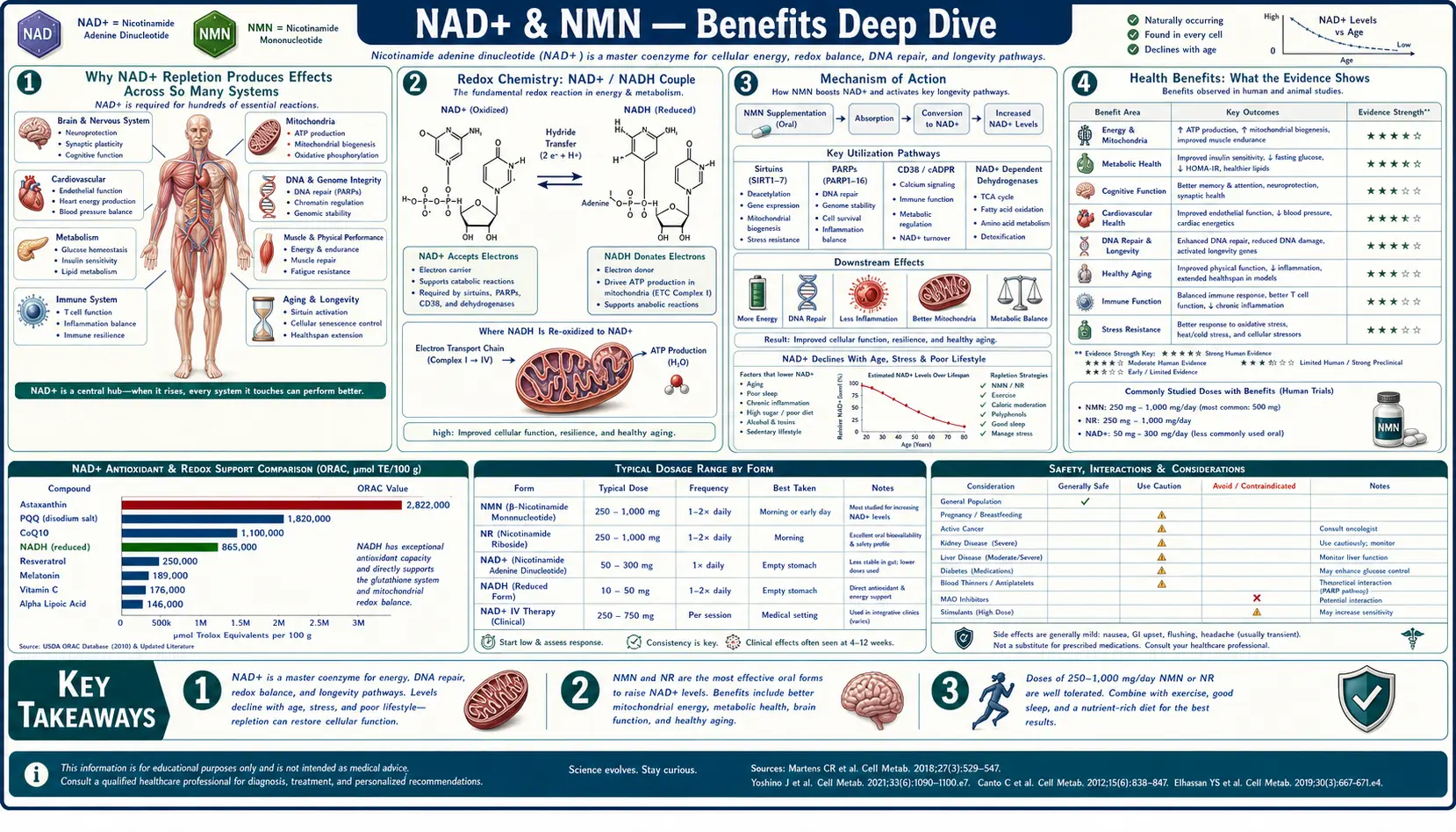
NAD+ sits at the intersection of four distinct therapeutic territories that almost no other molecule occupies simultaneously: (1) it is the master substrate for the sirtuin family of longevity-regulating enzymes, (2) it is the electron carrier without which mitochondrial ATP production collapses, (3) it is the cofactor that PARP enzymes burn through to repair DNA damage, and (4) it is the molecule whose tissue concentrations decline 50% from young adulthood to middle age. Each benefit page below explores one of these territories in clinical-trial depth, including the David Sinclair sirtuin program, the brain-NAD+ trials, the bioenergetics literature, and the structural and regulatory differences between the four available B3 precursors (niacin, niacinamide, NR, NMN).
Deep-Dive Articles
Longevity & Sirtuins
The David Sinclair lab program at Harvard Medical School, the sirtuin family (SIRT1–SIRT7) as NAD+-dependent deacetylases, telomere maintenance via SIRT6, the SIRT3 mitochondrial protection axis, autophagy regulation, FOXO transcription factor activation, the "NAD+ decline = aging" hypothesis, caloric restriction mimicry, and the Brenner vs Sinclair NMN-vs-NR scientific debate.
Cognition & Brain Health
NAD+ in the central nervous system, brain SIRT1 activation, NMN crossing the blood-brain barrier, age-related cognitive decline trials, Parkinson's pilot data, neuroinflammation reduction, the modest attention/processing-speed signals in older-adult trials, and an honest accounting of why the small published NR/NMN cognitive RCTs have shown mixed evidence so far.
Energy & Mitochondria
NAD+ as universal electron carrier (Complex I substrate), the NAD+/NADH ratio as bioenergetic indicator, mitochondrial unfolded protein response (UPRmt) activation, AMPK + sirtuin cross-talk, ATP-production support, the chronic-fatigue and long-COVID protocols, and the IV NAD+ infusion clinic landscape.
NAD Precursors Compared
Niacin (NA) vs niacinamide (NAM) vs nicotinamide riboside (NR/Niagen) vs nicotinamide mononucleotide (NMN): bioavailability differences, the NMN FDA reclassification controversy of 2022 and the September 2025 reversal, why NR is the more clinically proven precursor, Sinclair's NMN advocacy, cost comparisons, niacin's vasodilator flush, and the Brenner methylation-cofactor depletion critique.
Table of Contents
- Deep-Dive Articles
- Why NAD+ Repletion Produces Effects Across So Many Systems
- Research Papers: Longevity & Sirtuins
- Research Papers: Cognition & Brain
- Research Papers: Energy & Mitochondria
- Research Papers: NAD Precursors & Pharmacokinetics
- Research Papers: Cross-Cutting (Safety, Regulation, Mechanism)
- External Authoritative Resources
- Connections
- Featured Videos
Why NAD+ Repletion Produces Effects Across So Many Systems
Most supplements have a narrow window of clinical effect because they act on one or two enzymes or one or two tissues. NAD+ is unusual because it is consumed as a substrate by at least three large enzyme families (sirtuins, PARPs, CD38), it is required as an electron carrier in every mitochondrion in the body, and its concentration falls substantially with age in every tissue measured. Repleting NAD+ therefore touches a remarkably wide range of biology.
- Sirtuin substrate for the longevity-regulating enzyme family — SIRT1, SIRT3, and SIRT6 are the best-characterized; each requires NAD+ in stoichiometric amounts to remove acetyl groups from target proteins. Restoring NAD+ to youthful levels reactivates sirtuin activity, with downstream effects on autophagy, DNA repair, mitochondrial biogenesis, and inflammation. Explored in Longevity & Sirtuins.
- Mitochondrial electron carrier — NADH donates electrons to Complex I of the electron transport chain. When NAD+ falls, less NADH is regenerated, electron flow slows, ATP production drops, and reactive oxygen species leak from the chain. This drives the fatigue, exercise-capacity, and bioenergetic applications.
- PARP cofactor for DNA repair — PARP1 and PARP2 use NAD+ to flag DNA single-strand and double-strand breaks for repair. Under DNA damage stress, PARPs can consume cellular NAD+ within minutes. Aging tissues with accumulated DNA damage have chronically elevated PARP activity, draining NAD+ that would otherwise feed sirtuins.
- CD38 substrate — the consumer that rises with inflammaging — CD38 is a NADase whose expression rises markedly with age on inflammatory immune cells. CD38 is now understood as a primary driver of age-related NAD+ decline, which means anti-inflammatory interventions support NAD+ as much as precursor supplementation does.
- Brain bioavailability via dedicated transporters — NMN can cross the blood-brain barrier via the Slc12a8 transporter and other mechanisms, supporting the cognitive and neuroprotective applications.
The choice between the four B3 precursors (niacin, niacinamide, NR, NMN) is therefore not arbitrary: each has different absorption kinetics, tissue distribution, methylation cost, and price-per-mg-NAD+-raised. The precursors comparison page walks through the Brenner critique, the Sinclair advocacy, and the 2025 FDA reversal that re-permitted NMN as a US dietary supplement.
Research Papers: Longevity & Sirtuins
- Imai & Guarente — NAD+ and sirtuins in aging and disease (Trends Cell Biol 2014) — PubMed: Imai & Guarente sirtuins review
- Bonkowski & Sinclair — Slowing ageing by design: NAD+ and STACs (Nat Rev Mol Cell Biol 2016) — PubMed: Bonkowski-Sinclair STAC review
- Mills et al. — Long-term NMN mitigates age-associated physiological decline in mice (Cell Metab 2016) — PubMed: Mills NMN aged mice
- Yoshino, Baur, Imai — NAD+ intermediates NMN and NR (Cell Metab 2018) — PubMed: Yoshino-Baur-Imai NAD intermediates
- Covarrubias et al. — NAD+ metabolism in cellular ageing (Nat Rev Mol Cell Biol 2021) — PubMed: Covarrubias NAD metabolism review
- SIRT6 overexpression extends lifespan in mice — PubMed: SIRT6 lifespan extension
- SIRT3 and mitochondrial protection — PubMed: SIRT3 mitochondrial protection
- Camacho-Pereira — CD38 dictates age-related NAD decline and mitochondrial dysfunction (Cell Metab 2016) — PubMed: Camacho-Pereira CD38
- FOXO transcription factor activation by sirtuins — PubMed: SIRT1-FOXO axis
- Caloric restriction mimicry via sirtuin activation — PubMed: caloric restriction mimicry
- Information Theory of Aging — Sinclair epigenetic noise (Cell 2023) — PubMed: Sinclair Information Theory of Aging
- Telomere maintenance and SIRT6 — PubMed: SIRT6 telomere maintenance
Research Papers: Cognition & Brain
- Tarantini et al. — NMN rescues cerebromicrovascular endothelial function in aged mice (Redox Biol 2019) — PubMed: Tarantini NMN cerebrovascular
- NMN supplementation 12-week trial in older adults (Igarashi 2022) — PubMed: Igarashi NMN older men trial
- Nicotinamide riboside in mild cognitive impairment — PubMed: NR MCI trial
- NMN and Alzheimer's mouse model (amyloid-beta reduction) — PubMed: NMN Alzheimer's mouse
- NMN neurovascular coupling and spatial memory — PubMed: NMN neurovascular coupling
- Slc12a8 NMN transporter in intestine and brain — PubMed: Slc12a8 NMN transporter
- NAD+ and Parkinson's disease pilot (NR-SAFE / NADPARK) — PubMed: NADPARK Parkinson pilot
- NAD+ and neuroinflammation — PubMed: NAD+ neuroinflammation
- NMN and traumatic brain injury — PubMed: NMN TBI
- NAD+ and the gut-brain axis — PubMed: NAD+ gut-brain axis
Research Papers: Energy & Mitochondria
- NAD+/NADH ratio and Complex I electron transport — PubMed: NAD+/NADH and Complex I
- Mitochondrial unfolded protein response (UPRmt) and NAD+ — PubMed: UPRmt and NAD+
- SIRT1-PGC1alpha and mitochondrial biogenesis — PubMed: SIRT1-PGC1α biogenesis
- AMPK and sirtuin cross-talk — PubMed: AMPK-SIRT1 cross-talk
- NMN supplementation and exercise capacity in amateur runners (Liao 2021) — PubMed: Liao NMN runners trial
- NAD+ and chronic fatigue syndrome — PubMed: NAD+ chronic fatigue syndrome
- IV NAD+ infusion pilot in elderly adults — PubMed: IV NAD+ pilot
- NAD+ in long-COVID and post-viral fatigue — PubMed: NAD+ long-COVID fatigue
- NMN insulin sensitivity in prediabetic women (Yoshino Science 2021) — PubMed: Yoshino NMN prediabetic women
- Cardiac NAD+ and heart failure — PubMed: cardiac NAD+ and heart failure
Research Papers: NAD Precursors & Pharmacokinetics
- Martens et al. — Chronic NR is safe and elevates NAD+ in middle-aged adults (Nat Commun 2018) — PubMed: Martens NR safety
- Pencina et al. — MIB-626 pharmaceutical NMN doubles NAD+ in obese adults — PubMed: Pencina MIB-626 NMN
- Yi et al. — NMN safety and efficacy in healthy middle-aged adults (GeroScience 2023) — PubMed: Yi NMN trial
- Brenner critique — methylation cofactor depletion and the NR vs NMN debate — PubMed: Brenner methylation critique
- Niacin (NA) vs niacinamide (NAM) vs NR vs NMN pharmacokinetics — PubMed: B3 precursor PK comparison
- Niacin vasodilator flush and GPR109A — PubMed: niacin flush mechanism
- Gut microbiota deamidation of NMN and NR — PubMed: gut deamidation of NMN/NR
- NMN FDA reclassification 2022 and 2025 reversal — PubMed: NMN FDA regulatory status
- Sublingual vs oral NMN bioavailability — PubMed: sublingual vs oral NMN
- Walker & Bhargava — Clinical evidence for NAD+ precursors to slow aging (2025) — PubMed: Walker-Bhargava 2025 review
Research Papers: Cross-Cutting (Safety, Regulation, Mechanism)
- NAD+ decline 50% from young adulthood to middle age — PubMed: NAD+ age-related decline
- NAMPT (rate-limiting salvage enzyme) and circadian regulation — PubMed: NAMPT and circadian biology
- NAD+ and CLOCK-BMAL1 feedback loop (Nakahata, Ramsey Science 2009) — PubMed: NAD+-circadian feedback
- NAD+ and female reproductive aging (Bertoldo, Miao) — PubMed: NAD+ and female fertility
- NAD+ and skin aging — PubMed: NAD+ and skin aging
- NMN safety profile across human trials — PubMed: NMN safety meta-analysis
- PARP1 NAD+ consumption under DNA damage stress — PubMed: PARP1 NAD+ consumption
- De novo NAD+ synthesis from tryptophan via kynurenine — PubMed: tryptophan-kynurenine NAD+ synthesis
- Theoretical cancer concern with NAD+ supplementation — PubMed: NAD+ and cancer risk
- Verdin — NAD+ in aging, metabolism, and neurodegeneration (Science 2015) — PubMed: Verdin NAD+ review
External Authoritative Resources
- National Institute on Aging — Dietary Supplements — the NIA's public-facing guidance on aging supplements
- Linus Pauling Institute — Niacin (Vitamin B3) — the most authoritative scientific summary of B3 biology, regularly updated
- NCCIH — Herbs and Supplements at a Glance
- PubMed — All research on NMN
- PubMed — All research on nicotinamide riboside
Connections
- NAD+ & NMN (Main Page)
- NAD+ for Longevity & Sirtuins
- NAD+ for Cognition
- NAD+ for Energy & Mitochondria
- NAD Precursors Compared
- All Antioxidants
- CoQ10
- Glutathione
- NAC
- Alpha Lipoic Acid
- Methylene Blue
- Vitamin B3 (Niacin)
- Longevity Protocols
- Fasting
- Rapamycin
- Quercetin
- Fisetin
- Creatine
- Oxidative Stress
- Alzheimer's Disease
- Cardiovascular Disease
- Insulin Resistance