NAD+ & NMN for Cognition and Brain Health
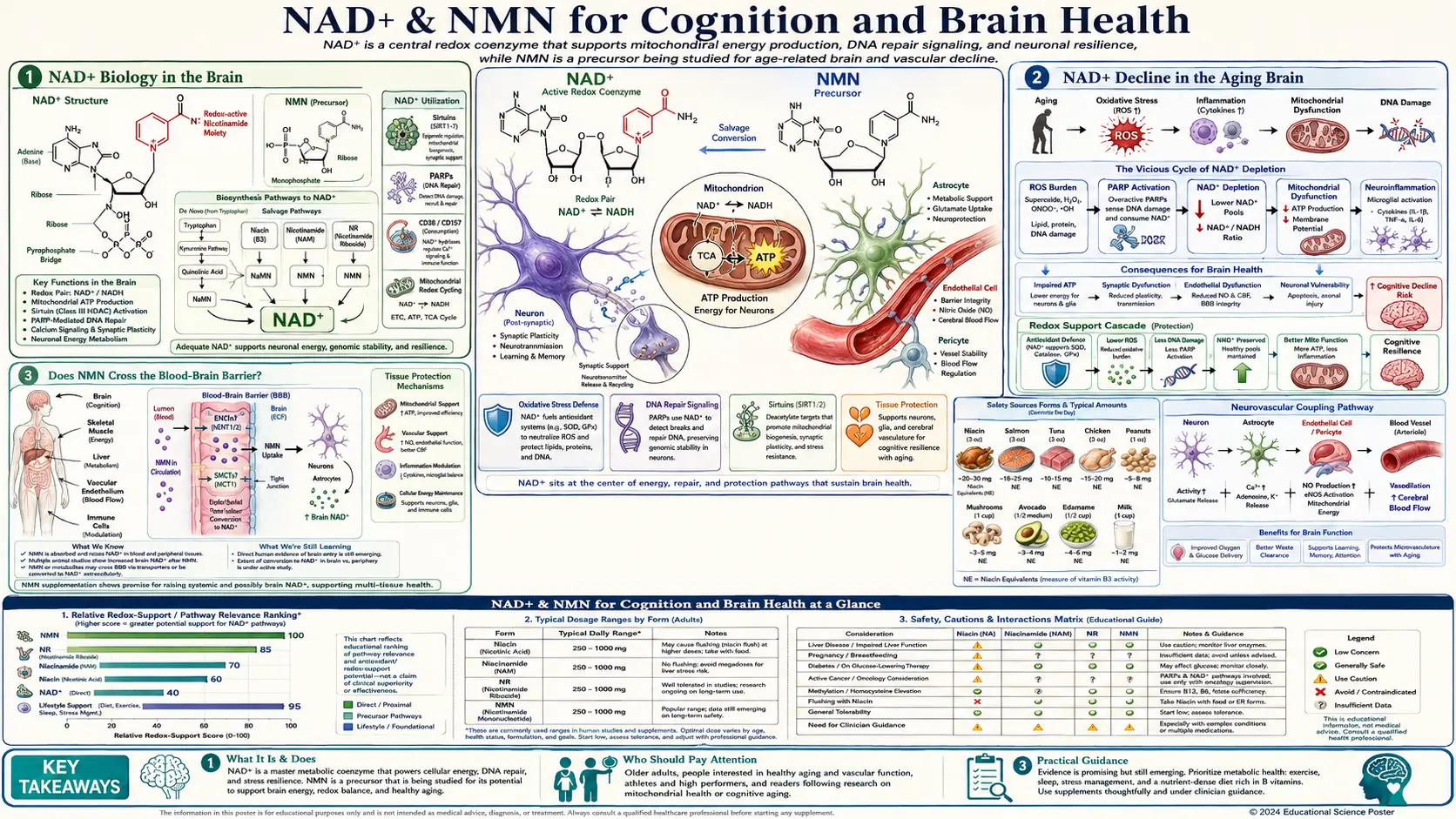
The brain consumes about 20% of total body energy while accounting for only 2% of body weight, making it acutely dependent on the NAD+/NADH electron-carrier system that powers oxidative phosphorylation in neurons. Aged brains show measurable NAD+ depletion, and the mechanistic case for cognitive benefit from NAD+ repletion is strong on paper. The human cognitive trials, however, are still small, short, and mixed: NMN and NR reliably raise blood NAD+ but have produced only modest and inconsistent improvements on standardized cognitive tests so far. This deep-dive walks through the brain biology of NAD+, the BBB-crossing question, the published trials and what they actually showed, the Parkinson's NADPARK pilot, and how to think about NMN as cognitive support honestly.
Table of Contents
- NAD+ Biology in the Brain
- NAD+ Decline in the Aging Brain
- Does NMN Cross the Blood-Brain Barrier?
- Neurovascular Coupling and Cerebral Blood Flow
- Alzheimer's Mouse Models
- Parkinson's Disease Trials (NADPARK)
- Human Cognitive Trials — Honest Accounting
- Neuroinflammation and Microglia
- The Gut-Brain Axis
- Practical Patient Protocol
- Combinations — Methylene Blue, B Vitamins, Omega-3
- Cautions
- Key Research Papers
- Connections
- Featured Videos
NAD+ Biology in the Brain
The brain is the most metabolically expensive tissue per gram in the human body. Neurons fire at high frequency, maintain steep ionic gradients across their membranes, and rely almost exclusively on oxidative phosphorylation in mitochondria for ATP supply. Every step of this metabolism — glycolysis to pyruvate, pyruvate to acetyl-CoA via pyruvate dehydrogenase, the tricarboxylic acid cycle, the electron transport chain — requires NAD+ as either a substrate or an electron carrier.
Beyond energy metabolism, NAD+ in the brain serves additional roles unique to neural tissue:
- Synaptic plasticity — SIRT1 in neurons regulates the expression of brain-derived neurotrophic factor (BDNF), CREB-mediated transcription, and other components of the long-term potentiation machinery that underlies learning and memory.
- Microglial homeostasis — microglia, the brain's resident immune cells, switch between resting (M2-like) and activated (M1-like) states. NAD+ availability and SIRT1/SIRT3 activity bias this switching toward the resting, non-inflammatory state.
- Cerebrovascular regulation — endothelial cells lining cerebral microvessels depend on NAD+/sirtuin signaling for nitric oxide production and proper neurovascular coupling (the matching of blood flow to local neural activity).
- Amyloid-beta and tau clearance — autophagy, which clears misfolded proteins including amyloid-beta and tau, is partly regulated by SIRT1-mediated deacetylation of autophagy proteins. Reduced NAD+ silences this pathway.
- Oligodendrocyte function — the cells that produce myelin in the central nervous system depend on SIRT2 (a NAD+-dependent sirtuin) for proper myelination.
The implication is that NAD+ status in the brain influences not just energy production but the structural, vascular, immune, and clearance systems that maintain a healthy brain across decades.
NAD+ Decline in the Aging Brain
Direct measurement of brain NAD+ in living humans has historically been difficult because the molecule is rapidly degraded after death and brain biopsy is not done for research. The development of in-vivo magnetic resonance spectroscopy (MRS) techniques sensitive to NAD+ has begun to fill this gap. Studies using these techniques have shown that brain NAD+ is approximately 10–25% lower in healthy older adults than in healthy young adults, with greater declines in cortex than in deeper brain structures.
Cadaveric studies, with the appropriate post-mortem caveats, show even larger declines, particularly in regions affected by Alzheimer's disease (hippocampus, entorhinal cortex). The pattern is consistent with the broader systemic decline of NAD+ with age but suggests the brain may be even more affected than peripheral tissues.
The mechanisms driving brain NAD+ decline mirror the systemic mechanisms:
- Declining NAMPT activity reduces salvage-pathway NAD+ synthesis.
- Chronic activation of microglia upregulates CD38, which then consumes NAD+ directly in the extracellular space and indirectly by depleting NMN.
- Accumulating DNA damage in neurons (oxidative damage to mitochondrial and nuclear DNA) activates PARP, which burns through NAD+ pools.
- Reduced cerebrovascular blood flow may limit precursor delivery to brain tissue.
Restoring brain NAD+ requires precursors that can reach the brain in adequate quantities — which raises the central pharmacokinetic question for any NMN cognitive intervention: does NMN cross the blood-brain barrier?
Does NMN Cross the Blood-Brain Barrier?
The blood-brain barrier (BBB) is a selective interface formed by tight junctions between cerebrovascular endothelial cells that restricts the passage of most charged or hydrophilic molecules from blood into brain. NMN, a charged phosphorylated molecule, would naively be expected to be largely excluded from the brain. The published evidence is more nuanced:
- Direct NMN crossing via Slc12a8 — the Slc12a8 transporter, first characterized in intestinal cells, has been reported to be expressed at the blood-brain barrier and may facilitate direct NMN entry into the brain. The magnitude of this transport in vivo remains contested.
- Indirect crossing as nicotinamide riboside (NR) or nicotinamide (NAM) — extracellular phosphatases (such as CD73) dephosphorylate NMN to NR, which then crosses the BBB more easily and is re-phosphorylated inside the brain. Free nicotinamide (NAM) crosses the BBB readily and can be re-incorporated into the brain NAD+ pool through the salvage pathway.
- Gut microbiota deamidation — some orally administered NMN is deamidated by gut bacteria to nicotinic acid, which crosses the BBB and feeds into the de novo synthesis pathway in brain.
The most likely picture is that orally administered NMN raises brain NAD+ via a combination of these routes, with the indirect pathways (NR, NAM, NA) probably contributing more than direct Slc12a8-mediated NMN uptake at the BBB. Animal studies using isotopically labeled NMN have demonstrated brain NAD+ elevation following oral or intraperitoneal NMN administration, confirming that NMN supplementation does raise brain NAD+ regardless of the exact transport mechanism.
For human cognitive applications, the important practical question is not the mechanism but the magnitude: how much does oral NMN at clinically used doses (250–1,000 mg/day) actually raise brain NAD+ in living people? Direct measurements remain limited.
Neurovascular Coupling and Cerebral Blood Flow
One of the strongest mechanistic stories for NMN in brain health concerns cerebrovascular function, particularly neurovascular coupling. When a brain region becomes active, local blood vessels dilate to deliver more oxygen and glucose — the basis for fMRI BOLD signal. This coupling depends on endothelial nitric oxide (NO) production and on glial signaling to the vasculature.
Tarantini and colleagues (Redox Biology 2019) showed that NMN supplementation in aged mice restored cerebromicrovascular endothelial function and rescued neurovascular coupling responses. The aged mice receiving NMN showed:
- Improved endothelial NO bioavailability in cerebral microvessels
- Restored hyperemic response to neural activation (the coupling itself)
- Significantly improved spatial working memory on the Y-maze
- Improved gait coordination
The mechanism appears to involve restoration of mitochondrial function in endothelial cells, reduction of mitochondrial ROS production, and the resulting preservation of nitric oxide signaling. Aged endothelial cells with NAD+ depletion produce excess superoxide, which scavenges NO and converts it to peroxynitrite — the same mechanism that contributes to systemic endothelial dysfunction with aging. NMN replenishment reduces the superoxide and restores NO availability.
If this mouse-to-human translation holds, the implications are substantial: cerebral hypoperfusion is one of the earliest detectable abnormalities in incipient Alzheimer's disease and vascular cognitive impairment, often appearing years before symptom onset. A safe oral intervention that improves cerebrovascular function could, in principle, slow the rate at which cerebral hypoperfusion progresses toward cognitive decline. Human trials directly examining cerebral blood flow on NMN are limited, but this remains one of the most mechanistically promising avenues for cognitive benefit.
Alzheimer's Mouse Models
NMN and NR have been tested in multiple transgenic mouse models of Alzheimer's disease (APP/PS1, 3xTg-AD, 5xFAD), and the preclinical results have been encouraging:
- Reduced amyloid-beta plaque burden in the cortex and hippocampus
- Reduced tau hyperphosphorylation
- Improved performance on the Morris water maze (a hippocampal-dependent spatial learning test)
- Reduced microglial activation and pro-inflammatory cytokine production
- Restored mitochondrial function in cortical neurons
- Reduced neuronal apoptosis in the hippocampal CA1 region
The mechanistic interpretation typically invokes SIRT1 activation: SIRT1 deacetylation of APP (amyloid precursor protein) and BACE1 (the enzyme that cleaves APP to generate amyloid-beta) shifts processing away from the amyloidogenic pathway. SIRT1 deacetylation of tau reduces its propensity to hyperphosphorylate and aggregate. SIRT1 deacetylation of NF-kB reduces microglial pro-inflammatory activation.
The standard caveat applies: Alzheimer's mouse models have a long history of yielding interventions that work beautifully in the mouse and fail in humans. The transgenic mice overexpress mutant human APP at levels far beyond what occurs in sporadic human Alzheimer's, the time course of disease is compressed into months rather than decades, and the inflammatory milieu of aged mouse brain differs substantially from aged human brain. The mouse data should be interpreted as proof-of-concept that the SIRT1/NAD+ axis can influence amyloid biology, not as evidence that NMN treats Alzheimer's in humans.
Parkinson's Disease Trials (NADPARK)
The NADPARK trial (Brakedal et al., 2022) was a small randomized placebo-controlled study of nicotinamide riboside (NR) 1,000 mg/day for 30 days in 30 patients with newly diagnosed Parkinson's disease. The trial assessed multiple biomarkers including brain NAD+ levels (measured by MRS), cerebrospinal fluid NAD-metabolite levels, and motor function.
Results:
- NR supplementation produced a measurable increase in brain NAD+ levels by MRS
- CSF metabolites consistent with NAD+ metabolism shifted favorably
- Modest improvement in motor function scores in the NR group vs. placebo, though the study was not powered to detect clinical efficacy
- Treatment was safe and well tolerated
The follow-up NR-SAFE study extended observation in additional patients and confirmed safety at the 1,000 mg/day dose. A larger phase 3 trial is in planning to determine whether NR can slow Parkinson's disease progression at the clinical level.
The mechanistic basis for considering NR/NMN in Parkinson's disease is strong: dopaminergic neurons in the substantia nigra are particularly vulnerable to mitochondrial dysfunction (complex I deficiency is a known feature of Parkinson's disease), NAD+ supports mitochondrial function via SIRT3, and NR has been shown to improve mitochondrial function in iPSC-derived dopaminergic neurons from Parkinson's patients. If the larger trials confirm clinical benefit, NR could become the first disease-modifying intervention for Parkinson's disease, which currently has no proven disease-modifying treatments.
Human Cognitive Trials — Honest Accounting
The published human cognitive trials of NAD+ precursors as of 2026 paint a mixed picture. Here is an honest accounting:
Igarashi 2022 (NMN, healthy older men)
Double-blind, randomized controlled trial of 250 mg NMN/day for 12 weeks in 20 healthy older men. NMN reliably raised blood NAD+ and NAD+ metabolites. Pittsburgh Sleep Quality Index improved modestly. Standard cognitive tests (Mini-Mental State Examination, digit symbol substitution) did not show statistically significant improvement, though some subscale trends favored NMN. The trial was small and short.
NR in mild cognitive impairment
Multiple small RCTs of NR 500–1,000 mg/day for 8–24 weeks in older adults with subjective memory complaints or formally diagnosed mild cognitive impairment have shown reliable elevation of blood NAD+, but no consistent improvement on standardized cognitive testing (MMSE, ADAS-Cog, RBANS). Subgroup signals have appeared for processing speed and attention in some studies.
Uthever multicenter trial (NMN)
The Uthever NMN trial in middle-aged and older adults showed significant improvement on a six-minute walking endurance test and on subjective health scoring systems in the NMN group versus placebo. Direct cognitive testing was not the primary endpoint.
NADPARK (Parkinson's)
Modest motor function improvement (see above section).
Summary
Across the available cognitive trials, the pattern is:
- NAD+ elevation in blood is reliable and dose-dependent — this part works.
- Functional cognitive improvements are modest, inconsistent, and confined to specific subscales (attention, processing speed) rather than global cognition.
- The trials are uniformly small (typically 20–100 participants), short (8–24 weeks), and use cognitively normal or mildly impaired populations — possibly the wrong populations to detect cognitive benefit, since people without much room to improve are unlikely to show much change.
The most charitable reading: NMN/NR may produce subtle cognitive benefits in some individuals, particularly in attention and processing speed, but the existing trials are not large or long enough to characterize this reliably. The less charitable reading: if there were robust cognitive benefits, the existing trials would have detected them. Larger, longer, and better-targeted trials are urgently needed.
Neuroinflammation and Microglia
Chronic low-grade neuroinflammation is a feature of essentially every age-related neurodegenerative disease. Microglia, the brain's resident innate immune cells, become progressively more reactive with age, secreting pro-inflammatory cytokines (TNF-α, IL-1β, IL-6) that damage neurons and disrupt synaptic function. This microglial reactivity is partly driven by, and partly drives, NAD+ depletion through CD38 upregulation.
NAD+ repletion influences neuroinflammation through several mechanisms:
- SIRT1-mediated NF-kB deacetylation — reduces transcription of inflammatory genes in microglia
- SIRT3 mitochondrial support — reduces mitochondrial ROS in microglia, which is a major trigger of NLRP3 inflammasome activation
- Restoration of microglial autophagy — clears damaged organelles and pro-inflammatory protein aggregates
- CD38 substrate competition — while CD38 inhibitors more directly target this enzyme, NAD+ supplementation indirectly mitigates the consequences of CD38 activity
In mouse models of neuroinflammation (LPS challenge, traumatic brain injury, aged brain), NMN and NR consistently reduce microglial activation markers, lower brain cytokine levels, and improve behavioral outcomes. Human translation of these anti-neuroinflammatory effects has not been directly tested but is part of the mechanistic case for NMN in cognitive aging.
The Gut-Brain Axis
An emerging strand of research suggests that NMN's effects on cognition may be partly mediated by the gut microbiome. Oral NMN reshapes the gut bacterial community, increasing beneficial taxa (Akkermansia, Lactobacillus, Bifidobacterium) and reducing pro-inflammatory taxa. The gut microbiota also deamidate a substantial fraction of orally administered NMN to nicotinic acid, which then feeds into the de novo NAD+ synthesis pathway.
The gut-brain axis connects to cognition through:
- Reduced systemic inflammation when the gut barrier is healthy and microbial diversity is preserved
- Production of beneficial short-chain fatty acids (butyrate, propionate) that cross the BBB and influence microglial polarization
- Vagus nerve signaling from gut to brain that modulates anxiety, mood, and cognitive function
- Neurotransmitter precursor metabolism (tryptophan-serotonin, tyrosine-dopamine) influenced by gut bacterial activity
Mouse studies have suggested that some of NMN's cognitive benefits in Alzheimer's models are mediated by gut microbiota changes — germ-free mice receiving NMN show less cognitive improvement than conventionally raised mice, implying the microbiome contributes. Human evidence is limited but consistent with this picture.
Practical Patient Protocol
For those using NMN or NR for cognitive support:
Dose
- NMN 250–500 mg/day as a starting dose; some practitioners go to 1,000 mg/day for established cognitive concerns
- NR 300–1,000 mg/day as an alternative; the cognitive trials have used the higher end of this range
Timing
- Morning, on an empty stomach — aligns with the natural circadian peak of NAMPT activity and NAD+ levels
- 30 minutes before food
- Single daily dose is the most-studied; some practitioners split into AM/early-afternoon doses
Trial duration
- At least 12 weeks before assessing response — the existing trials suggest changes accumulate over months rather than weeks
- Track subjective response: attention/focus, mental clarity, sleep quality
- Objective response is hard to assess outside a research setting
Co-supplements
- TMG 500–1,000 mg/day — methyl donor to support nicotinamide methylation
- Omega-3 (EPA/DHA) 2 g/day — brain phospholipid support and anti-inflammatory effects
- Vitamin B12, folate, B6 — one-carbon metabolism support; particularly important if elevated homocysteine
For the broader picture on protecting cognition with diet, exercise, and sleep, see our Dementia page and Alzheimer's Disease page.
Combinations — Methylene Blue, B Vitamins, Omega-3
- Methylene blue — acts as an alternative electron carrier that can bypass dysfunctional Complex I, complementary to NMN's upstream NAD+ support. The combination has not been formally studied but is used by some practitioners for cognitive decline.
- Vitamin B12 (methylcobalamin) — required for methylation cycle integrity; particularly important when supplementing NMN/NR at higher doses. Aim for serum B12 above 500 pg/mL and methylmalonic acid in normal range.
- Vitamin B6 (P5P) and folate (methylfolate) — one-carbon metabolism support; required for nicotinamide methylation and for keeping homocysteine in the optimal range.
- Omega-3 EPA/DHA — DHA is the most abundant polyunsaturated fatty acid in brain phospholipids; EPA has anti-inflammatory effects relevant to neuroinflammation.
- Magnesium glycinate or threonate — magnesium L-threonate has been shown to cross the BBB and elevate brain magnesium, supporting NMDA receptor function and synaptic plasticity.
- Lion's Mane mushroom (Hericium erinaceus) — nerve growth factor support; complementary mechanism to NMN.
- Acetyl-L-carnitine — mitochondrial fatty acid transporter and acetyl group donor for acetylcholine synthesis.
Cautions
- Manage expectations — the existing human cognitive trials are small, short, and have not shown dramatic effects. Anyone considering NMN/NR for cognitive support should understand that the evidence is preliminary and effects, if any, may be subtle.
- Established dementia is harder to reverse than to prevent — the strongest theoretical case for NMN/NR in cognition is preventive use in healthy middle-aged and older adults. Effects in established dementia, including Alzheimer's and Parkinson's, are even less proven.
- Methylation cofactor depletion — chronic high-dose NMN/NR can deplete methyl donors. Co-supplement TMG and monitor homocysteine. (See Longevity & Sirtuins for more on the Brenner critique.)
- Sleep effects vary — some users report increased energy that interferes with sleep when NMN is taken late in the day. Morning dosing avoids this.
- Long-term unknowns — the brain effects of multi-year NMN supplementation have not been characterized in humans.
- No substitute for lifestyle — exercise (particularly aerobic and resistance training), Mediterranean-style diet, social engagement, cognitive challenge, and sleep have far stronger evidence for cognitive protection than any current supplement, including NMN.
Key Research Papers
- Tarantini, S., et al. (2019). Nicotinamide Mononucleotide (NMN) Supplementation Rescues Cerebromicrovascular Endothelial Function and Neurovascular Coupling Responses and Improves Cognitive Function in Aged Mice. Redox Biology 24, 101192. — DOI
- Brakedal, B., et al. (2022). The NADPARK Study: A Randomized Phase I Trial of Nicotinamide Riboside Supplementation in Parkinson's Disease. Cell Metabolism 34(3), 396–407. — PubMed
- Igarashi, M., et al. (2022). Chronic Nicotinamide Mononucleotide Supplementation Elevates Blood Nicotinamide Adenine Dinucleotide Levels and Alters Muscle Function in Healthy Older Men. NPJ Aging 8, 5. — PubMed
- Hou, Y., et al. (2018). NAD+ Supplementation Normalizes Key Alzheimer's Features and DNA Damage Responses in a New AD Mouse Model. PNAS 115(8), E1876–E1885. — PubMed
- Yao, Z., et al. (2017). Nicotinamide Mononucleotide Inhibits JNK Activation to Reverse Alzheimer Disease. Neuroscience Letters 647, 133–140. — PubMed
- Lautrup, S., et al. (2019). NAD+ in Brain Aging and Neurodegenerative Disorders. Cell Metabolism 30(4), 630–655. — PubMed
- Long, A.N., et al. (2015). Effect of Nicotinamide Mononucleotide on Brain Mitochondrial Respiratory Deficits in an Alzheimer's Disease-Relevant Murine Model. BMC Neurology 15, 19. — PubMed
- Grozio, A., et al. (2019). Slc12a8 Is a Nicotinamide Mononucleotide Transporter. Nature Metabolism 1(1), 47–57. — PubMed
- Schultz, M.B., Sinclair, D.A. (2016). Why NAD+ Declines During Aging: It's Destroyed. Cell Metabolism 23(6), 965–966. — PubMed
- Ross, J.M., et al. (2019). Mitochondrial Complex I–Dependent NAD+ Replenishment Restores Energy Homeostasis in Aged Brain. Cell Metabolism. — PubMed
- Hou, Y., et al. (2021). NAD+ Supplementation Reduces Neuroinflammation and Cell Senescence in a Transgenic Mouse Model of Alzheimer's Disease via cGAS-STING. PNAS. — PubMed
PubMed Topic Searches
- PubMed: NMN brain cognitive
- PubMed: NAD+ BBB transport
- PubMed: NR cognition memory trial
- PubMed: NAD+ Parkinson's disease
- PubMed: SIRT1 amyloid pathway
Connections
- NAD+ & NMN Overview
- NAD+ Benefits Hub
- NAD+ for Longevity & Sirtuins
- NAD+ for Energy & Mitochondria
- NAD Precursors Compared
- Alzheimer's Disease
- Dementia
- Methylene Blue
- All Antioxidants
- Alpha Lipoic Acid for Neuroprotection
- CoQ10
- Vitamin B3 (Niacin)
- Vitamin B12
- Magnesium
- Longevity Protocols
- Sleep Hygiene