N-acetyl-cysteine (NAC) — Benefits Deep Dive
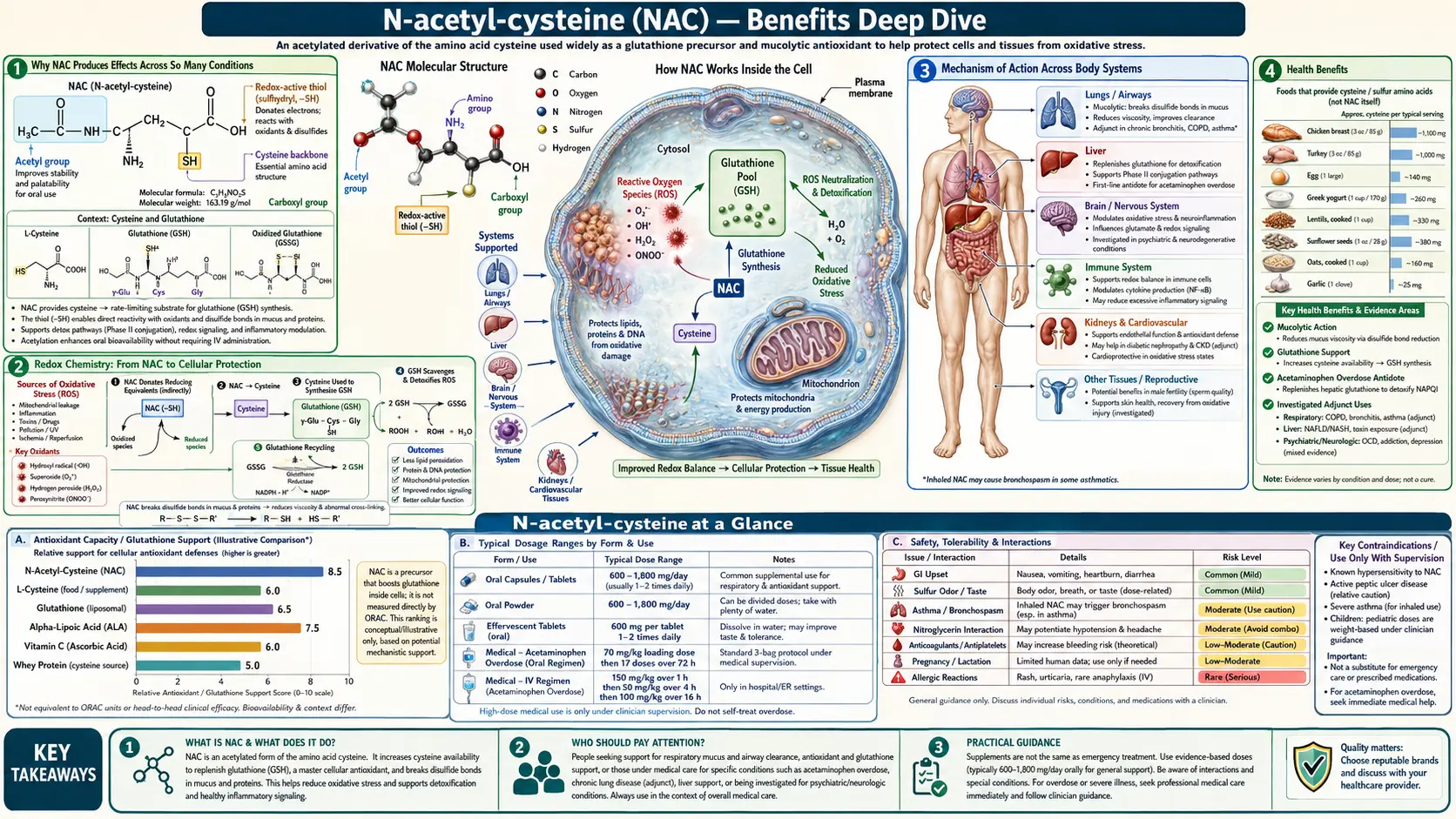
N-acetylcysteine produces clinically meaningful effects across a remarkably wide range of conditions because four distinct biochemical mechanisms operate at once: glutathione precursor activity (delivering cysteine through the rate-limiting step of GSH synthesis), direct thiol antioxidant action (scavenging hydroxyl radicals and hypochlorous acid), disulfide-bond cleavage (breaking mucus glycoproteins, plasma protein-homocysteine disulfides, and cystine crystals), and glutamate homeostasis via the cystine-glutamate antiporter in the brain. Each benefit page below explores one specific therapeutic application in clinical-trial depth.
Deep-Dive Articles
Acetaminophen (Paracetamol) Antidote
The original and most rigorously validated NAC indication. NAPQI generation by CYP2E1, glutathione depletion as the proximate cause of hepatocyte death, and how NAC restores intrahepatic cysteine within hours. The Prescott IV protocol (150 mg/kg over 1 hour → 50 mg/kg over 4 hours → 100 mg/kg over 16 hours), the Smilkstein 72-hour oral protocol (140 mg/kg loading + 70 mg/kg q4h × 17 doses), the Rumack-Matthew nomogram, and why NAC delivers essentially 100% transplant-free survival when given inside the 8-hour window.
COPD & Lung Health
The PANTHEON trial (Zheng 2014, 600 mg twice daily for one year, 22% reduction in exacerbations in moderate-to-severe COPD), the BRONCUS trial, the Cochrane mucolytic meta-analysis, and the IFIGENIA-vs-PANTHER-IPF reversal in idiopathic pulmonary fibrosis. Disulfide-bond cleavage as the mucolytic mechanism, bronchial-epithelial glutathione restoration, the nebulized-NAC bronchospasm caution in asthmatics, and where chronic bronchitis, cystic fibrosis, and bronchiectasis fit.
Mental Health: OCD, Trichotillomania & Beyond
The psychiatric NAC story. Grant 2009 launched the field with a placebo-controlled trichotillomania trial (1,200–2,400 mg/day). Afshar 2012 OCD augmentation (600 mg TID), Berk 2008 and 2014 bipolar depression trials (2 g/day as an adjunct), schizophrenia negative-symptom data, autism irritability (Hardan 2012), excoriation, nail biting, and addiction. The glutamate-homeostasis hypothesis through the cystine-glutamate antiporter (system xc−) and mGluR2/3 signaling in prefrontal cortex.
Glutathione Precursor — the Master Mechanism
Why oral free cysteine fails (gut degradation and rapid blood oxidation back to cystine) and how the acetyl group on NAC protects the thiol all the way to hepatocyte uptake. Glutamate-cysteine ligase (GCL) as the rate-limiting enzyme in glutathione synthesis. The 1-to-4-week kinetics of intracellular GSH restoration. Pairing NAC with glycine for the full GlyNAC effect (Sekhar). Why intact NAC bioavailability is only 4–10% — and why that does not matter for the clinical effect.
Interactive Visualization Free Radicals & Your Antioxidant Network Follow one superoxide radical down the whole relay — SOD, catalase, glutathione, vitamin E, vitamin C, NADPH — then release free iron and watch a membrane tear itself apart. Launch →
Table of Contents
- Deep-Dive Articles
- Why NAC Produces Effects Across So Many Conditions
- Research Papers: Acetaminophen Antidote
- Research Papers: COPD & Lung Health
- Research Papers: Mental Health & OCD
- Research Papers: Glutathione Precursor
- Research Papers: Cross-Cutting (Forms, Safety, Mechanism)
- External Authoritative Resources
- Connections
- Featured Videos
Why NAC Produces Effects Across So Many Conditions
Most small molecules used clinically have one or two primary mechanisms of action that produce a narrow range of effects. NAC is unusual because four distinct mechanisms operate simultaneously, and each mechanism maps to a different category of clinical benefit:
- Glutathione precursor / cysteine delivery — deacetylation releases L-cysteine, the rate-limiting substrate for glutamate-cysteine ligase (GCL), the rate-limiting enzyme of glutathione synthesis. This mechanism drives the acetaminophen-antidote effect, the broad antioxidant and detoxification effects, and the longevity-medicine GlyNAC story.
- Direct thiol-radical scavenger — the free -SH group reduces hydroxyl radicals, hypochlorous acid, and peroxynitrite independently of the glutathione system. This contributes to the kidney-protective, liver-protective, and cardiovascular effects covered on the Kidney Health and Cardiovascular Health pages.
- Disulfide-bond cleavage — the reduced thiol breaks S–S bonds in mucus glycoproteins (the mucolytic effect in COPD and cystic fibrosis), plasma protein-homocysteine disulfides (homocysteine lowering), and cystine crystal precursors (cystinuria prevention).
- Glutamate homeostasis through system xc− — in the brain, cystine exchanges for glutamate via the cystine-glutamate antiporter, which normalizes extrasynaptic glutamate tone, signals through mGluR2/3 receptors, and underpins the psychiatric benefits in OCD, trichotillomania, bipolar depression, and schizophrenia.
Two secondary mechanisms reinforce all four primary mechanisms. NAC restores S-nitrosothiol pools, donating NO to organic-nitrate molecules and reversing nitrate tolerance — the original cardiovascular use (Packer 1987, Horowitz 1988). And glutathione restoration tightly couples to suppression of NF-κB transcription, so cytokine output falls automatically as cellular redox state improves — explaining the anti-inflammatory thread that runs through every NAC indication.
Research Papers: Acetaminophen Antidote
- Prescott LF et al. (1979). Intravenous N-acetylcysteine: the treatment of choice for paracetamol poisoning — the original IV protocol — PubMed: Prescott 1979 IV protocol
- Smilkstein MJ et al. (1988). Efficacy of oral N-acetylcysteine in the treatment of acetaminophen overdose — the 72-hour oral protocol — PubMed: Smilkstein 72-hour oral
- Rumack-Matthew nomogram (Rumack & Matthew 1975) — PubMed: Rumack-Matthew nomogram
- NAPQI hepatotoxicity mechanism (Mitchell-Jollow series) — PubMed: NAPQI CYP2E1 glutathione
- Lee 2009 NAC in non-acetaminophen acute liver failure (Gastroenterology) — PubMed: Lee 2009 ALF
- NAC vs methionine for paracetamol overdose — PubMed: NAC vs methionine
- Kerr 2005 chronic alcohol risk-stratification for paracetamol — PubMed: paracetamol-alcohol risk
- Hodgman & Garrard 2012 review of paracetamol toxicity — PubMed: Hodgman 2012 review
- Anaphylactoid reactions to IV NAC — PubMed: IV NAC anaphylactoid
- SNAP shortened 12-hour NAC regimen — PubMed: SNAP 12-hour regimen
Research Papers: COPD & Lung Health
- PANTHEON trial (Zheng 2014, Lancet Respiratory Medicine) — PubMed: PANTHEON 2014
- BRONCUS trial (Decramer 2005) — PubMed: BRONCUS 2005
- Cochrane mucolytics meta-analysis (Poole 2019) — PubMed: Cochrane mucolytic meta-analysis
- HIACE trial (Tse 2013) high-dose NAC stable COPD — PubMed: HIACE high-dose NAC
- IFIGENIA trial in IPF (Demedts 2005, NEJM) — PubMed: IFIGENIA 2005
- PANTHER-IPF (Raghu 2014) — the reversal — PubMed: PANTHER-IPF 2014
- Disulfide-bond cleavage mucolytic mechanism — PubMed: NAC mucin disulfide
- Bronchial-epithelial glutathione (Cantin 1989) — PubMed: Cantin GSH lung lining
- De Flora 1997 influenza prophylaxis trial — PubMed: De Flora 1997 influenza
- Nebulized NAC bronchospasm in asthma — PubMed: nebulized NAC bronchospasm
Research Papers: Mental Health & OCD
- Grant 2009 trichotillomania trial — the field-defining study — PubMed: Grant 2009 trichotillomania
- Afshar 2012 OCD augmentation — PubMed: Afshar 2012 OCD
- Berk 2008 bipolar depression (Biological Psychiatry) — PubMed: Berk 2008 bipolar
- Berk 2014 bipolar depression replication — PubMed: Berk 2014 bipolar
- Berk 2008 schizophrenia adjunct trial — PubMed: Berk 2008 schizophrenia
- Hardan 2012 Stanford autism irritability trial — PubMed: Hardan 2012 autism
- Gray 2012 adolescent cannabis cessation — PubMed: Gray 2012 cannabis
- LaRowe cocaine craving trials — PubMed: LaRowe cocaine
- Cystine-glutamate antiporter (system xc−) in addiction — PubMed: system xc- addiction
- Back 2016 PTSD-substance-use trial — PubMed: Back 2016 PTSD
- Deepmala 2015 NAC psychiatric review — PubMed: Deepmala 2015 review
Research Papers: Glutathione Precursor
- Sekhar GlyNAC trial in older adults (2021, Clinical and Translational Medicine) — PubMed: Sekhar GlyNAC aging
- Sekhar GlyNAC and HIV (2014) — PubMed: Sekhar HIV GlyNAC
- Glutamate-cysteine ligase (GCL) rate-limiting kinetics — PubMed: GCL rate-limiting
- Cysteine bioavailability and gut/blood degradation — PubMed: cysteine bioavailability problem
- NAC pharmacokinetics 4-10% bioavailability — PubMed: NAC pharmacokinetics
- Herzenberg HIV glutathione 1997 — PubMed: Herzenberg HIV 1997
- Oral NAC raises whole-blood glutathione — PubMed: oral NAC raises GSH
- Liposomal vs oral glutathione comparison — PubMed: liposomal vs oral GSH
- Whey protein cysteine bioavailability — PubMed: whey protein cysteine
- Selenium and glutathione peroxidase activity — PubMed: Se GPX cofactor
Research Papers: Cross-Cutting (Forms, Safety, Mechanism)
- NAC effervescent tablet vs capsule tolerance — PubMed: NAC effervescent vs capsule
- N-Acetylcysteine ethyl ester (NACET) and NACA — the next-generation cell-penetrating analogs — PubMed: NACET NACA
- NAC and nitric oxide donation / S-nitrosothiol formation — PubMed: NAC S-nitrosothiol
- NF-κB suppression by glutathione restoration — PubMed: NAC NF-kB
- FDA NAC dietary-supplement enforcement discretion 2022 — PubMed: FDA NAC supplement status
- NAC drug interactions (nitroglycerin, carbamazepine, activated charcoal) — PubMed: NAC drug interactions
- NAC + nitroglycerin hypotension (Horowitz 1988) — PubMed: Horowitz 1988 NAC-NTG
- NAC safety profile across chronic high-dose use — PubMed: NAC long-term safety
- NAC and pregnancy safety (Category B) — PubMed: NAC pregnancy safety
- Cystinuria stone prevention with NAC (thiol-disulfide exchange) — PubMed: NAC cystinuria
External Authoritative Resources
- PubMed — All research on N-acetylcysteine (over 25,000 papers as of 2026)
- MedlinePlus — Acetylcysteine
- NCCIH — Herbs and Supplements at a Glance
- NIH TOXNET / Toxicology Data Network — primary source for the acetaminophen-NAC dosing guidance
- American Liver Foundation — patient resources on acetaminophen safety
Connections
- Free Radicals & Your Antioxidant Network — interactive animation
- N-Acetylcysteine (Main Page)
- NAC as Acetaminophen Antidote
- NAC for COPD & Lung Health
- NAC for Mental Health & OCD
- NAC as Glutathione Precursor
- NAC & Glutathione (Overview)
- NAC & Liver Health
- NAC & Kidney Health
- NAC & Respiratory Health
- NAC & Mental Health (Overview)
- NAC & Cardiovascular Health
- NAC, Fertility & PCOS
- All Antioxidants
- Glutathione
- Alpha Lipoic Acid
- CoQ10
- Cysteine
- Glycine
- Liver Cleansing
- Detox Protocols
- Oxidative Stress
- COPD
- OCD
- Bipolar Disorder
- Liver Disease