Melatonin: History and Discovery
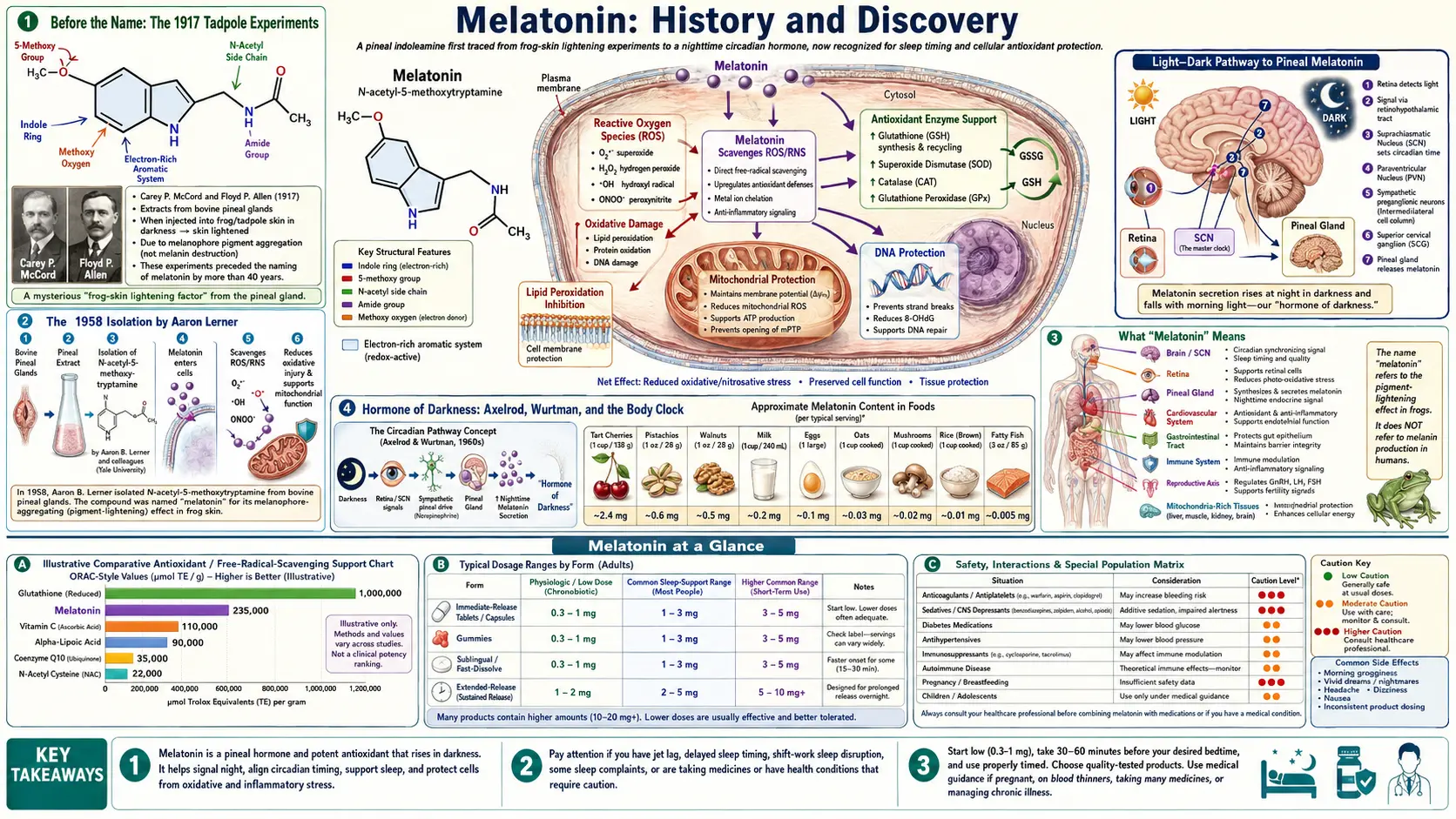
Melatonin is one of those molecules whose story turned out to be far bigger than the question that first led scientists to it. It was not discovered by anyone hunting for a sleep hormone. It was found in 1958 by a Yale dermatologist who was trying to understand skin colour, and who followed up a curious 1917 report that mashed-up cow pineal glands could make tadpoles turn pale. The molecule he isolated, named, and chemically identified that year went on to be recognised first as the chemical signal of darkness and the timer of sleep, then — decades later — as a powerful and evolutionarily ancient antioxidant. This article traces that documented path: the early pigment experiments, the 1958 isolation and the meaning of the name, the work of the 1960s that tied melatonin to light and the body clock, the 1993 turn that revealed its role against free radicals, its surprising discovery in plants and foods, and its modern life as both a prescription drug and a drugstore supplement. Where dates and names are firmly recorded we give them; where a date is debated or an attribution is shared, we say so.
Table of Contents
- Before the Name: The 1917 Tadpole Experiments
- The 1958 Isolation by Aaron Lerner
- What “Melatonin” Means
- Hormone of Darkness: Axelrod, Wurtman, and the Body Clock
- From Laboratory to Bedside: The Sleep Era
- 1993: Melatonin the Antioxidant
- An Ancient Molecule: Melatonin in Plants and Food
- Drug, Supplement, and Open Questions
- Research Papers and References
- Connections
- Featured Videos
Before the Name: The 1917 Tadpole Experiments
The thread that eventually led to melatonin begins not with sleep but with colour. In 1917, two American researchers, Carey Pratt McCord and Floyd Pierpont Allen, published a paper in the Journal of Experimental Zoology titled “Evidences associating pineal gland function with alterations in pigmentation.” They had taken the pineal glands of cattle, made an extract, and added it to water containing tadpoles. Within roughly half an hour to an hour, the tadpoles went pale: the dark pigment cells in their skin (melanophores) contracted, drawing the pigment inward and lightening the animal.
This was a real, repeatable observation, and it pointed to something genuinely new — that the pineal gland, a tiny structure deep in the brain whose function was then almost entirely mysterious, was making a substance that acted on pigment cells. What McCord and Allen could not do was say what that substance was. The chemistry of the day was not up to isolating a trace hormone from glandular tissue. So the finding sat in the literature as an intriguing loose end for four decades, occasionally cited, but not chased to its conclusion.
It is worth being precise about what this early work did and did not establish. McCord and Allen discovered an effect — pineal extract lightens amphibian skin — not the molecule responsible for it. They did not isolate, name, or chemically identify melatonin, and they had no notion of sleep, circadian rhythm, or antioxidant activity. Their lasting contribution was the experimental clue that, much later, told a chemist exactly where to look and what to look for.
The 1958 Isolation by Aaron Lerner
The person who finally captured the molecule was Aaron B. Lerner, a dermatologist at the Yale University School of Medicine. Lerner’s interest was not the pineal gland for its own sake; he was studying skin pigmentation and the depigmenting disorder vitiligo, and he was searching for substances that controlled skin colour. The old McCord and Allen report — pineal extract lightens skin — was exactly the kind of lead he needed, because a skin-lightening factor was precisely what he was trying to find.
The work was painstaking. Lerner and his colleagues processed an enormous quantity of bovine (cattle) pineal glands — accounts describe on the order of a hundred thousand glands — to extract a tiny amount of the active compound. In 1958 they published their result in the Journal of the American Chemical Society, in a short paper titled “Isolation of melatonin, the pineal gland factor that lightens melanocytes.” The authors were Aaron B. Lerner, James D. Case, Yoshiyata Takahashi, Teh H. Lee, and Wataru Mori. Having isolated the substance and given it a name, the group went on to establish its chemical structure the following year — an indoleamine they identified as N-acetyl-5-methoxytryptamine — in a short companion paper (Lerner, Case, and Heinzelman, “Structure of melatonin,” Journal of the American Chemical Society, 1959).
This 1958 paper is the firmly documented birth of melatonin as a known molecule. It is a clean example of a real scientific milestone with named people and a fixed date: a specific compound, isolated from a specific tissue and given a name, with its full chemical structure pinned down in the immediate follow-up work of 1959. Everything that follows in melatonin’s story builds on this point.
What “Melatonin” Means
The name melatonin was coined by Lerner’s group, and it is a small window into how the molecule was first understood. The first part comes from the Greek melas, meaning “black” or “dark” — the same root that gives us melanin and melanocyte. It refers directly to the effect that defined the molecule at the time: its action on the dark pigment of skin cells, lightening them by causing the pigment to clump together.
The second part of the name reflects the molecule’s chemical kinship. Melatonin is made in the body from serotonin, and the “-tonin” ending echoes that relationship; serotonin in turn comes from the amino acid tryptophan. So the name encodes both what the compound did in the experiments that revealed it (acting on dark pigment) and what it chemically is (a close relative of serotonin). It is a fittingly layered name for a molecule whose roles would keep multiplying.
There is a genuine irony worth flagging. The skin-lightening effect that gave melatonin its name — dramatic in frogs and fish, whose pigment cells respond strongly — turned out to be a relatively minor part of its biology in humans, where pigment cells do not behave the same way. The molecule was, in effect, named for the first thing it was caught doing, not for the circadian-timing and antioxidant roles that would later define its importance. The name stuck even as the understanding of the molecule moved on.
Hormone of Darkness: Axelrod, Wurtman, and the Body Clock
Once the molecule was in hand, attention turned from what it is to what it is for. The central figures of this next chapter, through the 1960s, were the pharmacologist Julius Axelrod (a Nobel laureate, working at the U.S. National Institutes of Health) and his collaborator Richard J. Wurtman. Axelrod helped work out how the body makes melatonin, identifying the enzyme — hydroxyindole-O-methyltransferase (HIOMT) — that carries out the final chemical step in its synthesis.
More importantly for the molecule’s eventual fame, Axelrod and Wurtman showed that melatonin production is governed by light. The pineal gland makes melatonin chiefly at night and largely shuts down production in light, so the hormone behaves as a faithful internal signal of darkness. In the mid-1960s they advanced what became known as the “melatonin hypothesis”: that the pineal converts information about environmental light and dark into a chemical message that influences the body’s rhythms and, in mammals they studied, reproductive cycles. Research in the 1970s, including work by Lynch and colleagues, went on to document that melatonin in humans follows a daily (circadian) rhythm, rising at night.
This is the period in which melatonin acquired the identity most people still associate with it: the “hormone of darkness,” a chemical clock-hand linking the light outside to the timing of sleep and other rhythms inside. It is a substantial, well-documented body of work; the takeaway for a general reader is that the circadian and sleep role of melatonin was not assumed from the start but was established experimentally over roughly two decades after the molecule itself was found.
From Laboratory to Bedside: The Sleep Era
Understanding that melatonin signals night naturally raised a practical question: could giving it deliberately help people whose internal clocks were out of step with the world — shift workers, long-haul travellers, blind people with no light cue, and older adults whose own production had faded? From the 1980s onward, researchers tested melatonin for jet lag, delayed sleep timing, and insomnia, and a picture emerged of a molecule that gently re-times the sleep–wake cycle more than it sedates.
A notable landmark in this transition belongs to Richard Wurtman, who by then was at the Massachusetts Institute of Technology and whose laboratory studied melatonin’s effects on human sleep. In the mid-1990s Wurtman obtained a patent covering the use of low, physiological doses of melatonin as a sleep aid — a marker of the moment the molecule moved decisively from a research curiosity toward a consumer product. His work also helped make the case that small doses, close to what the body itself releases, were the appropriate target rather than the much larger amounts that later filled supplement shelves.
The regulatory paths then split by country, and that split persists. In the United States, melatonin became an over-the-counter dietary supplement, sold freely and in widely varying doses. In much of Europe and elsewhere it was treated as a medicine: a prolonged-release 2 mg formulation was authorised for short-term insomnia in older adults. The fuller clinical detail — what the evidence supports, sensible dosing, and cautions — lives on the main Melatonin page and in the discussion of insomnia; this history simply marks the point at which melatonin entered everyday life.
1993: Melatonin the Antioxidant
For its first thirty-five years as a known molecule, melatonin was understood almost entirely as a hormone — a signal. The discovery that reframed it came in 1993, from the laboratory of Russel J. Reiter at the University of Texas Health Science Center in San Antonio, working with colleagues including Dun-Xian Tan and Burkhard Poeggeler. They reported that melatonin is a potent scavenger of the hydroxyl radical — the most aggressively damaging of the free radicals produced in the body, and one for which cells have no dedicated protective enzyme.
Two 1993 papers anchor this turn. One, by Tan, Chen, Poeggeler, Manchester, and Reiter, was bluntly titled “Melatonin: a potent, endogenous hydroxyl radical scavenger” (published in the journal Endocrine Journal). The other, by Poeggeler, Reiter, Tan, Chen, and Manchester in the Journal of Pineal Research, set out the broader hypothesis linking melatonin’s radical-scavenging to oxidative damage and aging. Together they opened an entirely new research field, and Reiter became the central and most prolific figure in melatonin–antioxidant science for decades afterward.
The significance was conceptual as well as chemical. A signalling hormone that switches on at night is one kind of thing; a small molecule that directly neutralises destructive radicals — and whose own breakdown products keep scavenging in a relay — is another. This is the work that underlies melatonin’s description today as a mitochondrial and cellular antioxidant, and the reason it sits in the Antioxidants category at all. The detailed chemistry of that scavenging cascade is covered on the main Melatonin page; what matters historically is that 1993 marks the year melatonin stopped being “only” a hormone.
An Ancient Molecule: Melatonin in Plants and Food
If melatonin were merely a vertebrate sleep hormone, it would have no business being in a tomato. Yet in 1995 several research groups, working independently and largely unaware of one another, reported that melatonin is present in plants — including ordinary edible ones. Among them, a team led by R. Dubbels with Russel Reiter and colleagues identified melatonin in edible plants using radioimmunoassay and high-performance liquid chromatography–mass spectrometry, while a group around Hattori, also with Reiter, quantified it across a wide range of edible plants. (An earlier report had hinted at melatonin in plant tissue, but 1995 is when its presence in higher plants and foods was solidly established by multiple groups.)
This was more than a botanical footnote. Melatonin has since been found across the living world — in bacteria, fungi, algae, plants, invertebrates, and all vertebrates — which tells us it is evolutionarily very old, far older than the pineal gland or sleep. In organisms that have no nervous system and no day–night sleep behaviour, the only role melatonin can plausibly play is chemical protection against oxidative stress. This is a major reason researchers argue that melatonin’s original job was as an antioxidant, with the role of timing sleep added much later in some animals — a reading that fits neatly with the 1993 antioxidant discovery.
The plant connection also explains the dietary and cultural angle. Because plants make melatonin (“phytomelatonin”), certain foods carry measurable amounts. Tart (sour) cherries are the best-known example and the reason tart-cherry juice is marketed as a natural sleep aid; pistachios, certain grapes, tomatoes, and some grains and seeds also contain it, and small studies have found that eating melatonin-rich foods can nudge circulating levels upward. The amounts are modest compared with a supplement tablet, but the principle — that a “sleep hormone” is also a normal constituent of the plate — flows directly from the 1995 discovery. See Tart Cherry and Tryptophan for the dietary picture.
Drug, Supplement, and Open Questions
In the span of a single lifetime, melatonin travelled from an unknown factor in cow brains to one of the most widely taken substances in the world. Its modern story has two faces. As a medicine, a prolonged-release form is licensed in many countries for short-term insomnia in older adults, and melatonin is used clinically for circadian-rhythm problems such as non-24-hour sleep–wake disorder in blind people. As a supplement, particularly in the United States, it is sold over the counter in doses often many times higher than the body’s own nightly output, and independent testing has repeatedly found that the actual content of consumer products can differ sharply from the label.
Research, meanwhile, has kept expanding beyond sleep, following the antioxidant thread opened in 1993 into mitochondrial protection, neuroprotection, cardiovascular and immune effects, and adjunctive use in oncology research. Much of this work is promising but still developing, and it is the subject of the main Melatonin article rather than this history. The honest historical summary is that melatonin’s reputation has been revised upward more than once — from a frog-skin curiosity, to the hormone of darkness, to an ancient and versatile antioxidant — and that each revision came from a specific, datable piece of work rather than from folklore.
Two cautions belong at the close of any history like this. First, the long reach of melatonin research is a reason to study it carefully, not a licence to treat it as harmless or universally beneficial; it is a hormone, doses matter, and high “antioxidant-dose” use is a clinical decision, not a casual one. Second, the most reliable parts of melatonin’s story are precisely the ones with names and dates attached — 1917, 1958, the 1960s clock work, 1993, 1995 — while the broadest health claims remain under active investigation. Knowing which is which is the whole point of tracing the history. For practical guidance on forms, dosing, and safety, see the main Melatonin page and the broader topics of oxidative stress and longevity protocols.
Research Papers and References
The list below gathers the primary historical papers in melatonin’s discovery alongside key reviews and curated PubMed topic searches. Author names, titles, and journals are given as plain text; only a stable DOI, PMID, or archive link is hyperlinked, and each opens in a new tab. One foundational paper (Tan et al., 1993, in the now-defunct Endocrine Journal) has no surviving DOI or PMID and is therefore listed without a link; its companion hypothesis paper from the same year and group is linked in its place.
- McCord CP, Allen FP. Evidences associating pineal gland function with alterations in pigmentation. Journal of Experimental Zoology. 1917;23(1):207-224. — doi:10.1002/jez.1400230108
- Lerner AB, Case JD, Takahashi Y, Lee TH, Mori W. Isolation of melatonin, the pineal gland factor that lightens melanocytes. Journal of the American Chemical Society. 1958;80(10):2587. — doi:10.1021/ja01543a060
- Lerner AB, Case JD, Heinzelman RV. Structure of melatonin. Journal of the American Chemical Society. 1959;81(22):6084-6085. — doi:10.1021/ja01531a060
- Tan DX, Chen LD, Poeggeler B, Manchester LC, Reiter RJ. Melatonin: a potent, endogenous hydroxyl radical scavenger. Endocrine Journal. 1993;1:57-60. (Foundational antioxidant report; no DOI/PMID assigned — see the linked companion paper below.)
- Poeggeler B, Reiter RJ, Tan DX, Chen LD, Manchester LC. Melatonin, hydroxyl radical-mediated oxidative damage, and aging: a hypothesis. Journal of Pineal Research. 1993;14(4):151-168. — PMID: 8102180
- Dubbels R, Reiter RJ, Klenke E, Goebel A, Schnakenberg E, Ehlers C, Schiwara HW, Schloot W. Melatonin in edible plants identified by radioimmunoassay and by high performance liquid chromatography-mass spectrometry. Journal of Pineal Research. 1995;18(1):28-31. — doi:10.1111/j.1600-079X.1995.tb00136.x
- Reiter RJ, Mayo JC, Tan DX, Sainz RM, Alatorre-Jimenez M, Qin L. Melatonin as an antioxidant: under promises but over delivers. Journal of Pineal Research. 2016;61(3):253-278. — doi:10.1111/jpi.12360
- Tan DX, Manchester LC, Esteban-Zubero E, Zhou Z, Reiter RJ. Melatonin as a potent and inducible endogenous antioxidant: synthesis and metabolism. Molecules. 2015;20(10):18886-18906. — doi:10.3390/molecules201018886
- Melatonin — discovery and history — PubMed: melatonin discovery and history
- Phytomelatonin — melatonin in plants and food — PubMed: phytomelatonin in plants and food
External Authoritative Resources
- NIH Office of Dietary Supplements — Melatonin
- NCCIH — Melatonin: What You Need To Know
- PubMed — melatonin history
Connections
- Melatonin
- All Antioxidants
- Glutathione
- CoQ10
- Methylene Blue
- Tryptophan (Melatonin Precursor)
- Tart Cherry