EGCG for Metabolism and Weight
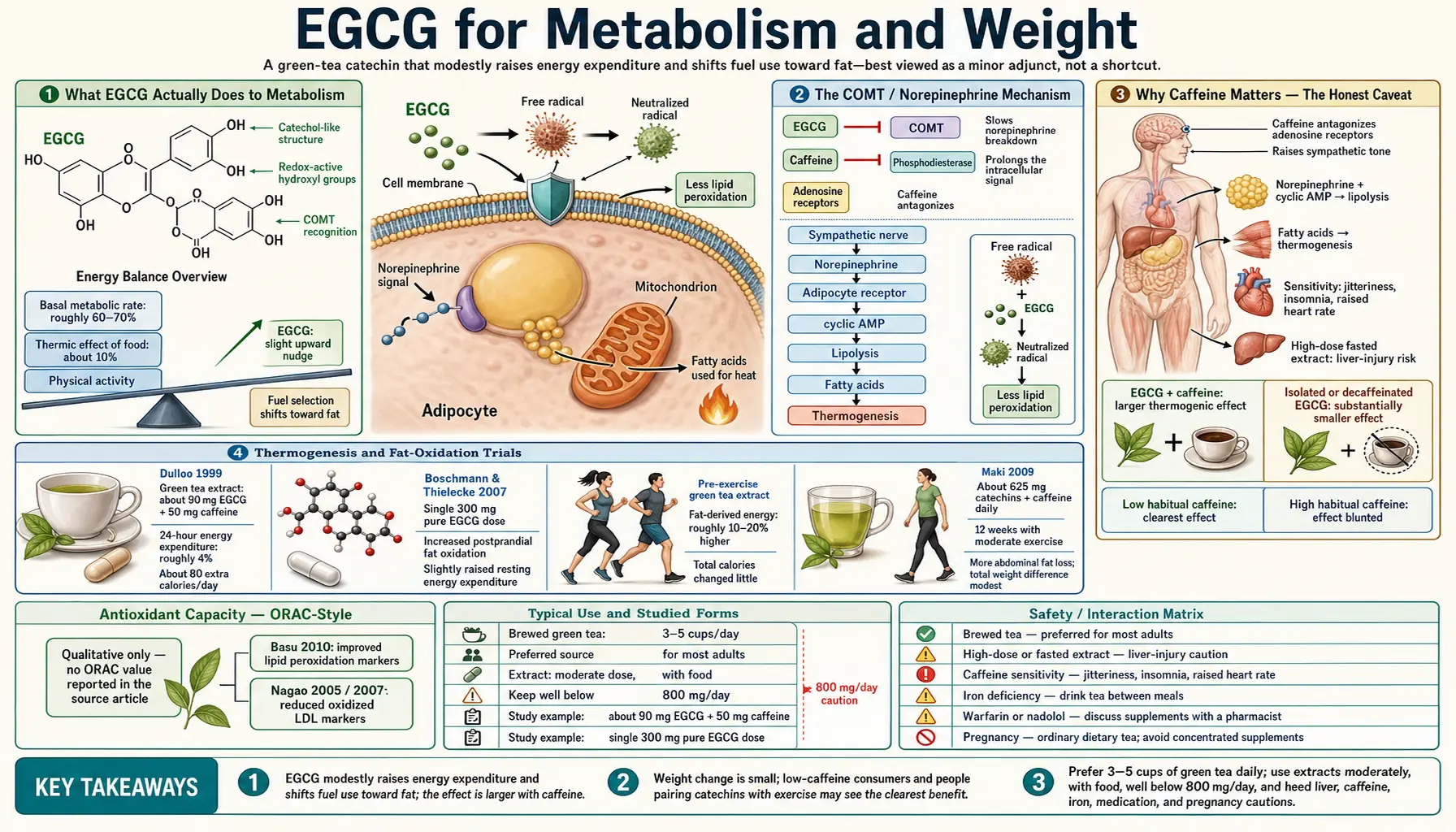
EGCG is the ingredient behind nearly every "green tea fat burner" on the shelf, and it does have a real, measurable effect on metabolism: it modestly raises energy expenditure and shifts the body toward burning fat. But the honest numbers are humbling. In controlled trials the daily calorie boost is on the order of a short walk, the fat-oxidation effect depends heavily on the caffeine that comes with it, and the largest weight-loss analyses — including a Cochrane review — find changes measured in a pound or two, not a dress size. This page walks through the genuine biochemistry, what the trials actually showed, why individual results vary so much, and how to think about EGCG as a minor metabolic helper rather than a weight-loss shortcut.
Table of Contents
- What EGCG Actually Does to Metabolism
- The COMT / Norepinephrine Mechanism
- Why Caffeine Matters — The Honest Caveat
- Thermogenesis and Fat-Oxidation Trials
- Weight-Loss Trials and Meta-Analyses
- Abdominal Fat and the Exercise Synergy
- Metabolic Syndrome, Insulin, and Blood Sugar
- Why Individual Results Vary So Much
- Realistic Expectations and How to Use It
- Cautions and Dose
- Key Research Papers
- Connections
- Featured Videos
What EGCG Actually Does to Metabolism
Body weight is governed by energy balance: calories in versus calories out. EGCG cannot change the "calories in" side much on its own (it is not an appetite suppressant of any strength), so any effect on weight has to come from the "calories out" side — total energy expenditure — or from a shift in which fuel the body burns.
Total daily energy expenditure has three parts: basal metabolic rate (roughly 60–70% of the total, the energy your body spends at rest), the thermic effect of food (about 10%), and physical activity. EGCG appears to nudge the first component upward slightly and to shift fuel selection toward fat oxidation. In the landmark 1999 study by Dulloo and colleagues, a green tea extract providing about 90 mg of EGCG plus 50 mg of caffeine raised 24-hour energy expenditure by roughly 4% compared with placebo — about 80 extra calories per day — and increased the proportion of energy derived from fat. Crucially, a caffeine-only arm did not reproduce the full effect, which is the origin of the idea that EGCG contributes something caffeine alone does not.
An extra 80 calories a day is real, but it is small. It is roughly the energy of half a banana, or a ten-minute walk. Sustained perfectly for a month it might, in theory, correspond to a fraction of a pound of fat — and in the messy reality of human appetite and behavior, effects that small are easily swamped by day-to-day variation in what people eat and do. That gap between a genuine metabolic signal and a meaningful bathroom-scale change is the central story of EGCG and weight.
The COMT / Norepinephrine Mechanism
The most-cited mechanism for EGCG's metabolic effect involves an enzyme called catechol-O-methyltransferase (COMT). When the sympathetic ("fight or flight") nervous system fires, nerve endings release norepinephrine, a signal that tells fat cells to break down stored triglycerides (lipolysis) and tells tissues to burn the released fatty acids for heat (thermogenesis). COMT is one of the enzymes that degrades norepinephrine, ending the signal.
EGCG inhibits COMT. By slowing the breakdown of norepinephrine, EGCG lets the fat-mobilizing signal linger a little longer than it otherwise would, modestly increasing lipolysis and thermogenesis. This is a genuinely elegant mechanism, and it is chemically plausible because EGCG's catechol-like structure is exactly the kind of molecule COMT recognizes.
Caffeine works on a complementary lever: it blocks phosphodiesterase (the enzyme that breaks down the intracellular "go" signal cyclic AMP) and antagonizes adenosine receptors, both of which also raise sympathetic tone and prolong the fat-burning cascade downstream of norepinephrine. Because EGCG acts at one point in the pathway (slowing norepinephrine removal) and caffeine acts at another (amplifying the downstream signal), the two are thought to be synergistic — each makes the other's effect larger. That synergy is the pharmacological reason green tea's whole-leaf combination of catechins plus caffeine tends to outperform isolated EGCG in thermogenesis studies.
Why Caffeine Matters — The Honest Caveat
Here is where honesty is essential. Much of the "EGCG burns fat" reputation actually reflects the combination of EGCG and caffeine found in green tea, not EGCG alone. Several careful trials of decaffeinated catechins or EGCG isolated from caffeine show substantially smaller thermogenic effects than the whole green-tea combination. When Westerterp-Plantenga's group analyzed the trials, they found that the weight-management effect of green tea catechins was blunted in people with high habitual caffeine intake and was clearest in low-caffeine consumers — a strong hint that a good part of the benefit runs through caffeine.
This matters practically in two ways:
- A "caffeine-free green tea extract" supplement may deliver far less of the metabolic effect than the marketing implies, because it has removed part of the active combination.
- If you already drink several cups of coffee a day, your body has partly adapted to caffeine, and adding EGCG-plus-caffeine may do little on top of what you already get.
None of this means EGCG contributes nothing. The Dulloo study specifically included a caffeine-only comparison and still found an extra effect attributable to the catechin fraction. But the effect of the combination is consistently larger than the effect of EGCG alone, and any claim that isolated EGCG is a stand-alone "fat burner" overstates the evidence.
Thermogenesis and Fat-Oxidation Trials
The short-term metabolic-chamber studies are the strongest part of the EGCG-metabolism story because they measure energy expenditure directly rather than relying on the scale:
- Dulloo 1999 — green tea extract raised 24-hour energy expenditure by about 4% and increased fat oxidation, beyond what the caffeine content alone explained.
- Boschmann & Thielecke 2007 — in obese men, a single 300 mg dose of pure EGCG increased postprandial fat oxidation and slightly raised resting energy expenditure over the following hours, evidence that EGCG has some effect even isolated from caffeine.
- Fat-oxidation during exercise — several small crossover studies report that green tea extract taken before moderate exercise increases the share of energy coming from fat by roughly 10–20% during the session, though total calories burned change little.
The pattern across these trials is consistent: EGCG (especially with caffeine) produces a small, reproducible increase in energy expenditure and a modest shift toward fat as fuel. The effect is real and measurable in a lab. Whether it accumulates into meaningful weight change over weeks is a separate question — and that is where the longer trials come in.
Weight-Loss Trials and Meta-Analyses
When you pool the longer randomized weight-loss trials, the effect shrinks to the edge of significance:
- Hursel 2009 meta-analysis (International Journal of Obesity) pooled 11 studies and found green tea catechins with caffeine produced a small but statistically significant reduction in body weight and a help with weight maintenance — on the order of about 1.3 kg — with the effect clearly modified by habitual caffeine intake and by ethnicity (larger in Asian populations).
- Jurgens 2012 Cochrane review pooled 14 trials and concluded that green tea preparations produced weight loss that was small, not statistically significant in the higher-quality studies, and not likely to be clinically important. The Cochrane authors were deliberately cautious, and their verdict is the single most sobering data point on this page.
- Basu 2010 found that green tea beverage or extract for eight weeks in people with metabolic syndrome reduced body weight and BMI modestly and improved lipid peroxidation markers, but again the magnitude was small.
How do we reconcile a real thermogenic effect with an unimpressive weight change? Three things blunt it over time: the body partially compensates for a small rise in expenditure by nudging appetite up or spontaneous activity down; the caffeine component loses potency as tolerance develops; and a difference of one or two pounds is simply within the noise of ordinary weight fluctuation. The trials are not contradicting the chamber studies — they are showing that a small metabolic signal does not automatically translate into a large or durable change in body weight.
For the bigger picture of evidence-based weight management, see our pages on Obesity and Metabolic Syndrome.
Abdominal Fat and the Exercise Synergy
One of the more interesting signals is that EGCG may preferentially affect visceral (abdominal) fat — the metabolically active fat around the organs that drives insulin resistance and cardiovascular risk — and that it works better when paired with exercise.
In Maki and colleagues' 2009 trial (Journal of Nutrition), overweight and obese adults who consumed a catechin-rich green tea beverage (about 625 mg catechins plus caffeine daily) while following a moderate exercise program lost more abdominal fat and had a greater reduction in fasting triglycerides than the exercise-only control group over 12 weeks. Total body-weight change between groups was modest, but the shift in where fat was lost — away from the visceral depot — is potentially more relevant to health than the number on the scale.
Nagao's 2005 and 2007 studies pointed the same direction: a catechin-rich tea reduced body fat, waist circumference, and markers of oxidized LDL more than a low-catechin control. The practical read is that EGCG is best thought of as a small adjunct to exercise and diet, not a replacement for them. It seems to help the fat-loss you are already earning through activity go a little further, and to target the fat that matters most.
Metabolic Syndrome, Insulin, and Blood Sugar
Beyond weight itself, green tea catechins have been studied for the cluster of problems — high blood sugar, high triglycerides, high blood pressure, central obesity — that make up metabolic syndrome. The mechanisms are plausible: EGCG improves insulin sensitivity in cell and animal models, slows carbohydrate digestion by inhibiting the enzyme alpha-amylase, and reduces intestinal glucose uptake.
In humans the effect on blood sugar is modest and inconsistent. Some trials report small reductions in fasting glucose and hemoglobin A1c with green tea catechin supplementation; others find no significant change. A reasonable summary of the human literature is that green tea catechins may produce a small improvement in fasting glucose and insulin sensitivity in people who start with impaired glucose control, and little measurable effect in people who are already metabolically healthy. This is worth checking against your own labs rather than assuming a benefit — see Fasting Insulin and Hemoglobin A1C.
The compound is not a substitute for the interventions with strong outcome data in type 2 diabetes — weight loss, exercise, and proven medications. It sits in the category of "plausible, modest, worth-having-if-you-enjoy-the-tea-anyway," not "treatment."
Why Individual Results Vary So Much
Two people can take the same EGCG dose and respond very differently. The main reasons:
- COMT genotype — people carry different variants of the COMT gene that break down norepinephrine at different baseline speeds. EGCG's COMT-inhibiting effect is more noticeable in people whose enzyme is naturally fast.
- Habitual caffeine intake — as discussed, heavy coffee drinkers get less added benefit because part of the effect works through caffeine to which they are already adapted.
- Baseline body composition and metabolic health — effects on fat oxidation and glucose are generally larger in people who are overweight or metabolically impaired than in lean, healthy adults.
- Low and variable bioavailability — less than 5% of oral EGCG typically reaches the bloodstream intact, and absorption varies with dose, food, and gut microbiome. This is the single biggest source of unpredictability, and it is also why people are tempted to take large fasted doses — a practice that, as the safety page explains, is exactly what raises the risk of liver injury.
Realistic Expectations and How to Use It
A fair, evidence-anchored summary for someone deciding whether EGCG is worth it for weight or metabolism:
- Drinking green tea is the safest way to get EGCG, delivers the natural EGCG-plus-caffeine combination that the thermogenesis studies used, and carries essentially no hepatotoxicity risk. Three to five cups a day supplies a meaningful catechin dose.
- Expect a small adjunct effect, not weight loss on its own. The honest ceiling from the trials is roughly a pound or two over several weeks, concentrated in people who also change diet and activity.
- Pair it with exercise if the goal is visceral fat — the strongest human signals come from catechin-plus-exercise combinations.
- Do not chase the effect with mega-dose fasted supplements. The metabolic gain from pushing EGCG higher is marginal, while the liver risk climbs. If you use an extract, keep the EGCG dose moderate and take it with food.
Cautions and Dose
- Brewed green tea at ordinary intakes (up to several cups daily) is safe for most adults and is the preferred source.
- Concentrated extracts carry a real, if uncommon, risk of liver injury — especially at high EGCG doses and when taken fasted. Keep supplemental EGCG well below the 800 mg/day level flagged by EFSA and take it with food. Full detail on the Safety & Liver page.
- Caffeine sensitivity — green tea "fat burner" supplements often stack extra caffeine; watch for jitteriness, insomnia, and raised heart rate.
- Iron absorption — tea catechins reduce absorption of non-heme (plant) iron. If you are prone to iron deficiency, drink tea between meals rather than with them.
- Medications — EGCG can interact with certain drugs (for example it may reduce the effect of the blood thinner warfarin via its vitamin K content in some preparations, and can affect the beta-blocker nadolol). Discuss high-dose supplements with a pharmacist if you take prescription medication.
- Pregnancy — keep to ordinary dietary green tea; avoid concentrated EGCG supplements, which have not been established as safe in pregnancy.
Key Research Papers
- Dulloo AG et al. (1999). Efficacy of a green tea extract rich in catechin polyphenols and caffeine in increasing 24-h energy expenditure and fat oxidation in humans. Am J Clin Nutr. — PubMed
- Boschmann M, Thielecke F (2007). The effects of epigallocatechin-3-gallate on thermogenesis and fat oxidation in obese men: a pilot study. J Am Coll Nutr. — PubMed
- Hursel R, Viechtbauer W, Westerterp-Plantenga MS (2009). The effects of green tea on weight loss and weight maintenance: a meta-analysis. Int J Obes (Lond). — PubMed
- Jurgens TM et al. (2012). Green tea for weight loss and weight maintenance in overweight or obese adults. Cochrane Database Syst Rev. — PubMed
- Maki KC et al. (2009). Green tea catechin consumption enhances exercise-induced abdominal fat loss in overweight and obese adults. J Nutr. — PubMed
- Nagao T et al. (2005). Ingestion of a tea rich in catechins leads to a reduction in body fat and malondialdehyde-modified LDL in men. Am J Clin Nutr. — PubMed
- Nagao T et al. (2007). A green tea extract high in catechins reduces body fat and cardiovascular risks in humans. Obesity (Silver Spring). — PubMed
- Basu A et al. (2010). Green tea supplementation affects body weight, lipids, and lipid peroxidation in obese subjects with metabolic syndrome. J Am Coll Nutr. — PubMed
PubMed Topic Searches
- PubMed: Green tea catechins and weight loss
- PubMed: EGCG thermogenesis and fat oxidation
- PubMed: Catechin-caffeine energy expenditure
- PubMed: Green tea and abdominal fat
- PubMed: Green tea, insulin, and glucose
External Resources
Connections
- EGCG Overview
- EGCG Benefits Hub
- EGCG for Heart & Cholesterol
- EGCG Antioxidant & Cellular Health
- EGCG Safety & Liver
- Green Tea
- Obesity
- Metabolic Syndrome
- Type 2 Diabetes
- Fasting Insulin
- Hemoglobin A1C
- Quercetin
- Curcumin
- Coffee
- All Antioxidants